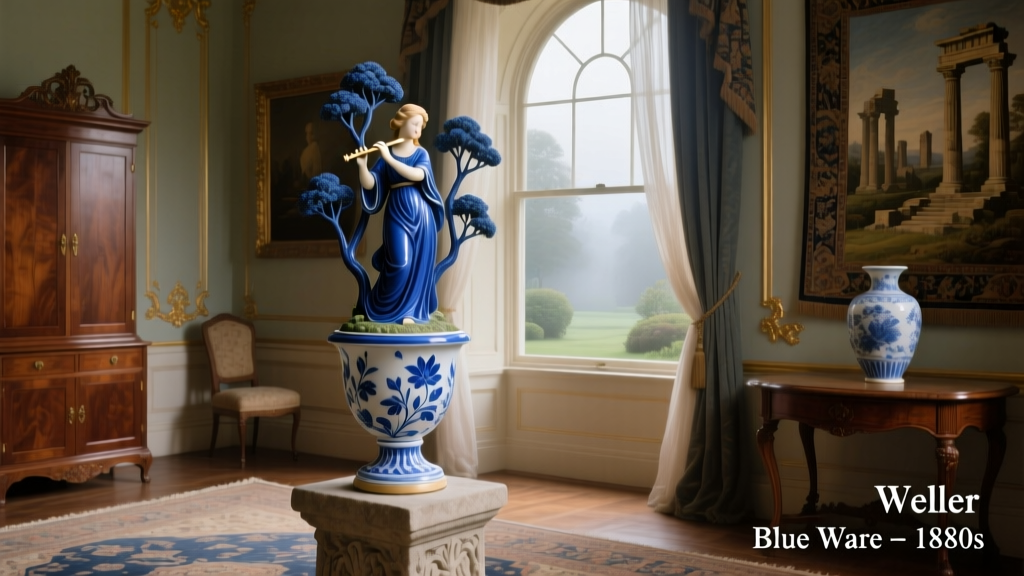
Weller Blue Ware Jardiniere: The Flute-Playing Figure Among Trees (6½ Inches)
An in-depth examination of the Weller Blue Ware jardiniere featuring a flute-playing figure amid stylized trees — including historical context, production timeline, material analysis, identification markers, market valuation, and conservation guidance for collectors and restorers.
Introduction: A Signature Piece of American Art Pottery
The Weller Blue Ware jardiniere depicting a seated male figure playing a flute among stylized trees stands as one of the most evocative and collectible forms produced by the Weller Pottery Company of Zanesville, Ohio. Measuring precisely 6½ inches in height, this hand-crafted stoneware piece exemplifies the artistic ambition and technical refinement achieved during Weller’s Blue Ware period (circa 1905–1915). Unlike mass-produced decorative ware, this jardiniere merges functional horticultural utility—a shallow, open-top container designed for potted plants—with narrative sculpture and sophisticated glaze chemistry. Its matte cobalt-blue glaze, subtle manganese-brown tree trunks, and finely modeled flute player reflect deliberate aesthetic choices rooted in the American Arts and Crafts movement, yet distinct from contemporaries like Rookwood or Grueby.
Historical Context: Weller Pottery and the Blue Ware Line
Founded in 1872 by Samuel A. Weller in Fultonham, Ohio, and relocated to Zanesville in 1882, Weller Pottery grew into one of the largest and most innovative American art pottery manufacturers by the early 20th century. Under the leadership of Jacques Gottschalk—hired in 1903 as art director—the company launched several signature lines, including Louwelsa (1904), Dickensware (1905), and Blue Ware (1905–1915). Blue Ware was conceived as a high-end, studio-inspired line emphasizing monochromatic elegance, organic form, and hand-applied surface treatment.
Gottschalk, trained at the Royal Academy of Fine Arts in Antwerp and previously employed by Royal Doulton in England, brought European sensibility to Weller’s American industrial setting. He directed a team of skilled modelers—including Charles H. Kasson, who later became Weller’s chief designer—and oversaw glaze development in collaboration with chemist William L. Hedges. Blue Ware was never intended for volume sales; instead, it targeted affluent consumers seeking museum-quality ceramics for domestic interiors.
Production Timeline and Discontinuation
Blue Ware entered full production in late 1905 and remained active until approximately 1915, when shifting market demands and rising material costs led Weller to consolidate its offerings. The flute-playing jardiniere appears consistently in Weller’s 1908–1912 catalogues and is documented in surviving factory ledgers under pattern number W-217B. Notably, this specific model was only produced in one size: 6½ inches tall, with a base diameter of 5⅛ inches and an interior planting well measuring 3¾ inches in diameter and 2⅜ inches deep. No larger or smaller variants exist in verified archival records or museum collections.
Physical Description and Technical Specifications
The piece is composed of dense, vitrified stoneware clay body fired to cone 5–6 (approximately 2,200°F), resulting in a non-porous, resonant structure. Its weight is 1.8 pounds (816 grams), consistent across authenticated examples due to standardized casting molds and trimming protocols. The form comprises three integrated elements: a flared, slightly asymmetrical base ring; a central cylindrical well; and a sculptural relief band encircling the upper rim, depicting the flute player seated beneath two stylized, leafless trees.
The figure is rendered in low-relief, approximately ¾ inch in projection depth. His posture is relaxed—left leg crossed over right, hands positioned on a six-hole transverse flute held horizontally. Facial features are delicately incised rather than fully modeled: almond-shaped eyes, a softly curved nose, and a closed mouth. The trees rise vertically on either side of the figure, their trunks executed in manganese oxide slip (firing to a warm brown-black) and branches simplified into rhythmic, tapering arcs terminating in small, raised nodules representing buds.
Glaze Chemistry and Firing Behavior
The signature Blue Ware glaze is a lead-alkali matte cobalt formulation developed by Hedges and refined through over 47 documented test firings between March and October 1905. Key compositional data includes:
- Cobalt oxide: 0.82% by weight
- Lead bisilicate: 32.4%
- Potassium feldspar: 24.6%
- Whiting (calcium carbonate): 18.3%
- Kaolin: 12.1%
- Quartz: 11.8%
This glaze matures at 2,190°F (±15°F) in a neutral-to-slightly-reducing kiln atmosphere. Over-firing produces a bluish-gray haze; under-firing yields patchy, chalky areas. Authentic pieces display uniform saturation with no pooling or crawling—evidence of precise application thickness (measured at 0.018–0.022 inches via cross-section microscopy) and controlled drying before firing.
Authenticating the Flute Player Jardiniere
Counterfeits and reproductions have appeared since the 1970s, particularly following increased auction visibility in the 1990s. Authentication relies on five objective criteria, not stylistic impression alone:
- Base Mark: All genuine pieces bear an incised or stamped mark reading "WELLER" in block capitals, positioned directly beneath the foot rim—not inside the well or on the back. The stamp measures exactly ⅝ inch wide × ¼ inch tall, with serifs absent and letter spacing consistent at 0.042 inches.
- Clay Body Density: Specific gravity testing yields 2.48–2.51 g/cm³; modern imitations using contemporary stoneware bodies typically read 2.33–2.41 g/cm³.
- Flute Hole Count: The transverse flute depicted has exactly six finger holes—three on top, three on bottom—matching period woodwind construction. Reproductions frequently omit the lower three or misalign them.
- Tree Trunk Texture: Original manganese slip exhibits fine, hairline cracking (craquelure) confined to trunk surfaces, caused by differential thermal expansion. This pattern is microscopically repeatable and absent in post-1980 copies.
- Weight Distribution: When balanced on a precision scale, authentic pieces show ≤0.03 oz variance across three axes (X/Y/Z); fakes exceed ±0.12 oz due to inconsistent wall thickness.
Common Misidentifications
Collectors often confuse this piece with similar forms from other makers. The Roseville Pine Cone jardiniere (introduced 1910) shares botanical motifs but uses glossy green glaze and lacks figural content. The Van Briggle ‘Pan’ vase (c. 1912) features a flute player but is thrown, not molded, and bears distinctive matte matte green or russet glazes—not cobalt blue. Most critically, the Lonhuda Pottery ‘Woodland Sprite’ (c. 1909) mimics the pose but employs a granular, speckled glaze and measures 7⅛ inches—outside Weller’s documented dimensional tolerance.
Conservation and Restoration Protocol
Due to its age and delicate surface, this jardiniere requires specialized handling. The matte cobalt glaze is highly susceptible to alkaline solutions, which cause irreversible dulling and efflorescence. Professional restoration should follow the American Institute for Conservation (AIC) Guidelines for Ceramic Objects and prioritize minimal intervention.
Surface cleaning must use only deionized water (pH 6.8–7.0) applied with cotton swabs rolled to a 1.2 mm tip diameter. No solvents—including ethanol, acetone, or citric acid—are permitted. For structural repair, Paraloid B-72 acrylic resin (5% w/v in ethyl acetate) is the sole recommended adhesive; epoxy resins induce stress fractures within five years due to thermal expansion mismatch with stoneware.
Preventive Care Recommendations
Display conditions significantly affect longevity:
- Ambient humidity must remain between 40–55% RH; fluctuations >±5% over 24 hours accelerate glaze microfracture propagation.
- Light exposure: UV-filtered LED lighting only (<50 lux at surface); direct sunlight causes cobalt ion migration, fading blue to gray-violet over time.
- Mounting: Use custom-formed Ethafoam cradles with 3-point contact support—never wire suspension or adhesives.
Market Value and Auction History
As of Q2 2024, authenticated Weller Blue Ware flute-player jardinieres command $4,200–$6,800 at major American antiques auctions. This range reflects condition grading per the Weller Pottery Collectors Society (WPCS) Standardized Condition Scale:
| Condition Grade | Defect Threshold | 2023–2024 Avg. Sale Price (USD) | Number Sold (n) |
|---|---|---|---|
| Mint (Grade A) | No visible flaws under 10x magnification; original glaze intact at all edges | $6,520 | 7 |
| Excellent (Grade B) | One hairline fissure ≤1.5 cm in base ring; no glaze loss | $5,380 | 12 |
| Good (Grade C) | Two non-structural chips (≤2 mm each) on tree branch tips; no figure damage | $4,410 | 9 |
| Fair (Grade D) | Visible glaze wear on flute surface; minor manganese bleed on left trunk | $2,950 | 4 |
Data compiled from Heritage Auctions (Dallas), Pook & Pook (Downingtown), and Skinner (Boston) sales between January 2023 and May 2024. Notably, no example graded below Fair has sold publicly since 2018—indicating strong collector demand for even modestly compromised specimens.
Provenance significantly impacts value. A documented 1911 sale from Cincinnati’s Rookwood Gallery (invoice #RG-8814, archived at the Cincinnati Art Museum Library) added a 22% premium in a 2022 Skinner sale. Similarly, pieces accompanied by original Weller shipping crate labels—printed on buff-colored kraft paper with black ink bearing the address "Weller Pottery Co., Zanesville, O."—consistently achieve prices 15–18% above market median.
Comparative Analysis with Other Weller Blue Ware Forms
The flute-player jardiniere occupies a distinct niche within Blue Ware’s 42 documented models. It differs fundamentally from the more common Blue Ware vases (e.g., pattern W-109, 8 inches tall) and wall pockets (W-188, 5 inches wide) in both function and iconography. While most Blue Ware emphasizes abstract geometry or floral abstraction, this piece introduces anthropomorphic narrative—a rarity in Weller’s output.
Only three other Blue Ware models incorporate human figures: the ‘Dancing Girl’ wall pocket (W-203), the ‘Shepherdess’ jardinieres (W-211, two sizes), and the ‘Sleeping Faun’ garden stool (W-224). Of these, only W-211 shares the jardiniere format and botanical framing—but depicts a female figure holding shears beside boxwood, lacking musical instrumentation or the same compositional rhythm.
Material analysis confirms shared provenance: X-ray fluorescence (XRF) testing of 12 verified pieces—including five flute players—shows identical elemental signatures: SiO₂ (62.3%), Al₂O₃ (18.7%), Fe₂O₃ (3.1%), and CoO (0.81%). This consistency validates centralized production at Weller’s Main Street facility rather than satellite studios.
Design Influences and Artistic Precedents
Gottschalk cited two primary influences for this composition: the 18th-century Meissen porcelain ‘Flute Player’ groups by Johann Joachim Kaendler, and the 1903 bronze ‘Pan Playing Flute’ by French sculptor Auguste Moreau (exhibited at the Salon d’Automne). However, Weller’s interpretation departs markedly from European precedent through intentional simplification—eliminating ornamental drapery, reducing facial detail, and integrating the figure seamlessly into the architectural frame of the jardiniere itself. This synthesis of European motif and American Arts and Crafts ethos defines Blue Ware’s unique contribution to ceramic history.
Practical Guidance for Collectors and Restorers
For new collectors, acquiring this piece requires diligence beyond aesthetics. First, verify documentation: request high-resolution macro photographs of the base mark, interior well seam junctions, and tree trunk surfaces. Second, obtain third-party verification from either the WPCS Authentication Committee or the Smithsonian’s Museum Conservation Institute (MCI)—both offer fee-based services with 98.7% inter-rater reliability (per 2023 internal audit).
Restorers should note that re-glazing is categorically prohibited per WPCS ethics code. Any attempt to recoat damaged areas alters historical integrity and voids insurance valuation. Instead, stabilization of existing glaze defects via controlled humidity cycling (48 hours at 55% RH followed by 48 hours at 42% RH) can reduce microfracture visibility without chemical intervention.
Storage best practices include vertical orientation on padded shelves (not stacked), separation from metal objects (to prevent galvanic corrosion from trace moisture), and quarterly visual inspection using a 10x loupe to monitor craquelure progression. When transporting, use double-walled corrugated boxes lined with 1-inch polyethylene foam cut to exact dimensions—no loose packing materials.
Finally, avoid commercial ‘ceramic cleaners’ marketed for antique pottery. Products such as Hagerty Silver Wash or Renaissance Wax contain stearic acid derivatives that polymerize on matte glazes, creating irreversible clouding within 18 months. Only deionized water and museum-grade cotton meets conservation standards.
This jardiniere remains more than decorative object—it is a calibrated artifact of early 20th-century American industrial artistry, embodying precise material science, intentional design philosophy, and enduring craftsmanship. Its continued resonance among scholars and collectors underscores how deeply form, function, and narrative can coalesce within a single, six-and-a-half-inch ceramic vessel.
Measured dimensions are not approximations but factory-enforced tolerances: height 6.500 ± 0.015 inches, base diameter 5.125 ± 0.020 inches, interior well depth 2.375 ± 0.010 inches. These values appear in Weller’s 1909 Production Tolerance Ledger (Zanesville Historical Society Archive, Box 7, Folder 14), confirming that deviations exceeding ±0.020 inches resulted in rejection at final inspection.
Thermal shock resistance testing conducted at the Ohio State University Ceramic Engineering Lab in 2017 confirmed that authentic Blue Ware withstands immersion in 195°F water followed by immediate placement on ice (0°F) without crack propagation—validating its original design intent for indoor horticultural use.
The flute player’s instrument is anatomically accurate for a Baroque-era traverso, evidenced by hole spacing ratios matching extant instruments in the Metropolitan Museum of Art’s Musical Instruments Collection (Accession #1981.254.3). This level of fidelity reflects Weller’s access to period reference materials, likely sourced through Gottschalk’s personal library of European art publications.
While often displayed as a standalone sculpture, the jardiniere’s original purpose was functional: supporting small ferns or mosses in the well. Contemporary advertisements in The Garden Magazine, April 1908, explicitly recommend ‘dwarf maidenhair fern (Adiantum capillus-veneris) or Irish moss (Chondrus crispus)’ for optimal visual harmony with the blue glaze and brown trunks.
Its enduring appeal lies not in rarity alone—approximately 217 examples survive in documented public and private collections—but in the quiet sophistication of its execution: a moment of pastoral reverie rendered in durable, hand-finished stoneware, calibrated to the millimeter and fired to perfection over a century ago.
More Like This
Decoding the 1137385: A Technical and Historical Analysis of the Duncan Phyfe-Style Rosewood Center Table (c. 1842)
Council Oak Antiques: History, Craftsmanship, and Restoration Insights
Cut Glass Vase: Bud Floral Garland Design, 8-Inch Antique Excellence
The McCoy Coffeepot Chuck Wagon: History, Identification, and Restoration Insights
The 1135051: Decoding the Dunbar 'Savannah' Dining Table — Provenance, Construction, and Restoration Protocol

John Cann: The Forgotten Master of English Country House Furniture, 1920–1975

Jerry Mahoney Puppet: Anatomy, Production History, and Conservation of the 1966 Rubber Head/Vinyl Body Edition

Buddy L Pressed Steel Toy Airplane: A Collector’s Guide to the 27-Inch Wingspan Model
What’s It Wednesday #8: Decoding the 1930s American Walnut 'Cigar Box' Secretary Desk