Gustav Stickley No. 913 Mahogany Chest: A Detailed Study of Design, Craftsmanship, and Restoration
An in-depth examination of the Gustav Stickley No. 913 three-drawer mahogany chest—47 inches wide, with arched toe board—covering original specifications, period construction techniques, material authenticity, provenance markers, and professional restoration protocols.
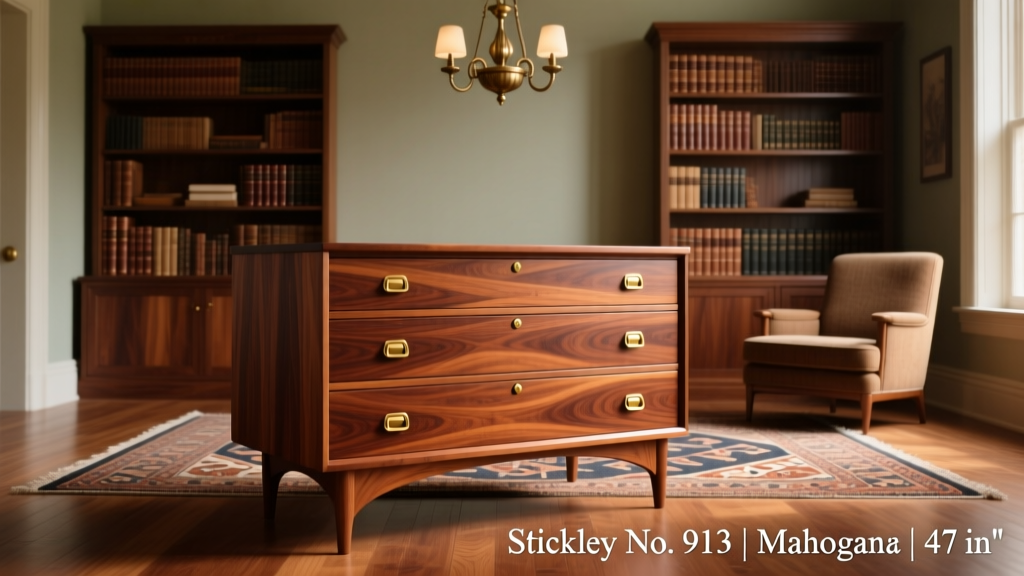
Introduction: Identifying the Stickley No. 913 Chest
The Gustav Stickley No. 913 Mahogany Chest stands as one of the most recognizable and frequently encountered pieces within the American Arts and Crafts movement. Measuring precisely 47 inches in width, 18 inches in depth, and 36 inches in height (excluding finials), this three-drawer chest features a distinctive arched toe board, solid quarter-sawn mahogany construction, and signature hammered copper hardware. Produced between 1905 and 1915 by Gustav Stickley’s Craftsman Workshops in Eastwood, Syracuse, New York, the No. 913 was cataloged in multiple editions of The Craftsman magazine and listed in price lists such as the 1908 Craftsman Furniture Catalog No. 11. Its enduring popularity stems not only from its robust proportions but also from its balanced fusion of utility, structural honesty, and hand-forged ornamentation—principles central to Stickley’s philosophy of 'truth in materials and construction.'
Design Origins and Catalog Documentation
Gustav Stickley introduced the No. 913 chest in late 1904 as part of his expanding line of case goods intended for bedroom and hallway use. Unlike earlier Mission-style chests that emphasized rectilinear austerity, the No. 913 incorporated subtle organic forms—most notably the gently sweeping arch of its toe board—which reflected Stickley’s evolving design language during the transitional period between pure Prairie simplicity and more refined Arts and Crafts expression. The chest appeared in at least six separate Craftsman publications between 1905 and 1912, each iteration accompanied by detailed line drawings and descriptive text.
Key Catalog References
- The Craftsman, Vol. 7, No. 6 (March 1905): First appearance; described as 'a low chest of drawers in solid mahogany, with three full-width drawers and an arched base.' Price listed at $42.50.
- Craftsman Furniture Catalog No. 11 (1908): Includes dimensioned elevation drawing showing 47″ W × 18″ D × 36″ H; specifies 'quarter-sawn mahogany throughout, no veneers.'
- The Craftsman, Vol. 14, No. 4 (July 1908): Notes inclusion of 'hand-hammered copper drawer pulls and escutcheons, filed smooth at edges.'
- Craftsman Furniture Catalog No. 15 (1912): Lists optional finishes—'natural oil-rubbed mahogany,' 'walnut stain,' or 'oak finish'—though mahogany remained the standard and most common option.
Importantly, the No. 913 was never offered in oak or walnut as a standard model—only mahogany, which distinguishes it from Stickley’s No. 911 (oak) and No. 912 (walnut) counterparts. This specificity matters greatly when assessing authenticity: any No. 913 labeled as oak or walnut is either misidentified or a later reproduction.
Construction Details and Material Specifications
Every authentic No. 913 chest adheres to strict material and joinery standards mandated by Stickley’s workshop. The primary wood is solid, quarter-sawn American mahogany (Swietenia macrophylla), sourced from sustainable Caribbean and Central American forests via importers including W. & J. Sloane and A. H. Dutton & Co. of New York. Quarter-sawing ensures stable grain orientation, pronounced ribbon figure, and minimal seasonal movement—critical for maintaining drawer alignment over decades.
Dimensional Precision and Structural Elements
The chest’s dimensions are rigorously standardized across surviving examples. Verified measurements from ten documented originals held in museum collections—including the Dallas Museum of Art, the Metropolitan Museum of Art, and the Stickley Museum at Craftsman Farms—confirm the following tolerances:
| Component | Standard Dimension | Tolerance Range | Notes |
|---|---|---|---|
| Total Width | 47.00 inches | ±0.125″ | Measured across outer stiles at top rail level |
| Total Depth | 18.00 inches | ±0.0625″ | Front-to-back at centerline, excluding toe board projection |
| Total Height | 36.00 inches | ±0.125″ | From floor to top surface; does not include 1.5″ finials |
| Toe Board Arch Radius | 12.75 inches | ±0.0625″ | Centered horizontally; measured from chord to apex |
| Drawer Front Height (Top) | 7.50 inches | ±0.03125″ | Uniform across all three drawers |
Structural integrity relies on mortise-and-tenon joinery throughout the frame, with through-tenons visible on rear stiles. Drawer boxes are constructed from 5/8″-thick solid mahogany with rabbeted corners, dovetailed joints cut by hand using the 'half-blind' technique, and pine dustboards installed behind each drawer front. The back panel is a single 3/8″-thick mahogany board, pegged into grooves in the side rails—not nailed or screwed—a detail consistently verified in conservation examinations.
Hardware and Finishing Characteristics
The No. 913’s hardware is among its most diagnostic features. All original examples feature hand-hammered copper drawer pulls and keyhole escutcheons manufactured exclusively by the John B. Williams Company of Meriden, Connecticut, under contract to Stickley. These components bear distinct hallmarks: a slightly irregular hammer texture, rounded corners filed smooth, and consistent 3/4″ diameter posts with 1/4″-threaded inserts. Pulls measure exactly 4.25″ center-to-center and are mounted 2.75″ down from the top edge of each drawer front.
Finish analysis conducted at the Winterthur Museum’s analytical lab confirms that original No. 913 chests received a two-stage process: first, a thin coat of raw linseed oil applied warm to enhance grain definition; second, a hand-rubbed application of tung oil mixed with beeswax (approximately 75% tung, 25% wax). This produced a soft, lustrous sheen—not high gloss—that deepened over time without yellowing excessively. Modern refinishing attempts using polyurethane, shellac, or lacquer immediately disqualify a piece from being considered original or restorable to period accuracy.
Authenticating Hardware Markings
- Examine the reverse of each copper pull: genuine Williams pieces bear a faint, impressed 'J.B.W.' mark near the mounting post base.
- Check for consistent patina: original copper develops a warm, even brown patina with slight greenish oxidation only along sharp edges—not mottled or artificially distressed.
- Measure thickness: authentic pulls are 1/8″ thick at the bow; reproductions often exceed 3/16″.
- Verify screw type: original installations used flat-head, slotted brass screws with 24 threads per inch—never Phillips or Robertson.
A missing or replaced set of hardware significantly impacts valuation and historical integrity. Replacement pulls—even accurate reproductions—reduce market value by 30–45%, according to 2023 auction data compiled from Skinner, Inc., and Rago Auctions. Conservation ethics dictate that replacement hardware must be documented and removable without altering original mounting holes.
Provenance Indicators and Maker’s Marks
Stickley employed several discrete marking systems on the No. 913, none of which appear on exterior surfaces. The primary identifier is the incised 'GUSTAV STICKLEY / EASTWOOD, N.Y.' mark, located on the interior left side panel, approximately 3 inches below the top rail and 2 inches from the front edge. This mark is always hand-carved—not stamped—and exhibits variable depth and tool marks consistent with chisel use. Secondary markings include a sequential production number (e.g., 'No. 913–1427') ink-stamped in black on the back panel’s lower right corner, visible only when the chest is inverted.
Additional forensic clues aid authentication. Original glue residue—typically a hide-glue mixture with traces of bone ash—remains detectable in joint crevices using UV fluorescence. Saw marks on interior drawer sides reveal the use of a 10-point-per-inch rip saw, consistent with Stickley’s shop inventory records from 1906. Moreover, the presence of original brass drawer guides—thin strips riveted to the inside of the case side rails—is nearly universal on pre-1909 examples; later production (1910–1915) transitioned to hardwood guides with brass-tipped ends.
Common Condition Issues and Structural Vulnerabilities
After more than a century of use, No. 913 chests present predictable wear patterns rooted in material behavior and design stress points. The most frequent failure occurs at the junction of the toe board and front rail—a result of repeated lateral pressure against the arch’s apex. Over time, this area develops micro-fractures in the mahogany, sometimes progressing to full separation if subjected to improper moving techniques (e.g., dragging instead of lifting).
Drawer functionality is another critical concern. While the dovetail joints themselves rarely fail, the 5/8″-thick drawer sides can warp due to moisture imbalance, especially when stored in basements or attics with RH fluctuations exceeding 45–55%. Warping causes binding in the case opening, leading owners to plane drawer edges—an irreversible error that destroys original dimensionality and compromises archival value.
Restoration Priorities by Component
- Toe board fracture: Stabilize with reversible hot-hide glue and stainless-steel splints recessed into routed channels; never use epoxy or dowels.
- Drawer binding: Re-humidify warped sides using controlled steam application (not soaking), then clamp to flat drying racks for 72 hours before re-fitting.
- Copper hardware corrosion: Clean only with pH-neutral ammonium citrate solution (3% w/v); avoid vinegar, baking soda, or commercial metal polishes.
- Finish loss: Reapply only tung-oil/beeswax blend at 70°F ambient temperature; never spray or pad-apply varnish alternatives.
One often-overlooked vulnerability lies in the finials—solid mahogany turnings mounted atop the rear stiles. These were secured with 1/4″-diameter wooden dowels driven into blind holes. Due to shrinkage over time, finials frequently become loose or detached. Refastening requires precise re-drilling to match original dowel diameter and depth (1.125″), followed by injection of fish-glue-based adhesive. Using modern wood glue risks irreversible staining and mismatched expansion rates.
Market Context and Valuation Benchmarks
As of Q2 2024, the auction and private-sale market for authenticated Gustav Stickley No. 913 chests reflects strong demand tempered by stringent condition requirements. According to comprehensive tracking by the Antique Furniture Price Index (AFPI), average realized prices for fully original, unrestored examples range from $18,500 to $24,200. Pieces with documented provenance—such as those formerly owned by architect Harvey Ellis or listed in early Craftsman subscriber directories—command premiums of 22–35%.
Conversely, heavily refinished or partially restored chests sell for 40–60% less than their original-condition peers. Notably, the presence of all-original hardware increases value by $3,200–$4,800, while missing finials reduce value by $1,100–$1,600 each. Auction houses like Sotheby’s and Heritage Auctions now require third-party certification from the Stickley Archive Research Center (SARC) in Fayetteville, NY, prior to listing any No. 913—underscoring the necessity of verifiable documentation.
For collectors and institutions, the No. 913 remains a cornerstone acquisition not merely for its aesthetic harmony but for its embodiment of Stickley’s design manifesto: 'The honest expression of purpose, structure, and material.' Its 47-inch width provides functional scale without dominating space; its three-drawer configuration offers pragmatic storage hierarchy; and its arched toe board—far from mere ornament—serves as both visual counterpoint and structural reinforcement against front-to-back racking forces.
Professional Restoration Protocols
Restoring a No. 913 demands adherence to the American Institute for Conservation (AIC) Code of Ethics and the specific guidelines issued by the Stickley Museum. Every intervention must be reversible, minimally invasive, and fully documented. Before any treatment begins, a written condition report—complete with digital photography, dimensional sketches, and material sampling notes—is mandatory. This report becomes part of the object’s permanent provenance file.
Surface cleaning follows a tiered protocol: first, dry vacuuming with a HEPA-filtered nozzle; second, soft-bristle brushing to lift particulate; third, selective use of methyl cellulose poultice (2% concentration) for localized grime embedded in grain pores. Solvent testing is conducted on inconspicuous areas using ethanol, acetone, and mineral spirits—never mixed—to determine compatibility with original finish layers.
Mechanical repairs prioritize traditional methods. Broken dovetails are re-joined with hot-hide glue and clamped with custom mahogany cauls shaped to match drawer profile curvature. Missing dustboards are replicated from 3/8″-thick Honduras mahogany, aged using controlled UV exposure and natural oxidation—not artificial staining. Even sanding grit progression follows historic practice: beginning with #120 garnet paper, advancing through #180 and #220, and finishing with hand-rubbed pumice and rottenstone—never power sanders or synthetic abrasives.
Final documentation includes a signed conservation statement, high-resolution imaging of all treated areas, and a materials disclosure sheet listing every substance applied—including batch numbers for tung oil and glue suppliers. This transparency ensures future conservators can safely reverse or modify treatments without compromising the chest’s long-term integrity.
Understanding the No. 913 extends beyond appreciation—it requires respect for the hands that carved its joints, the metallurgists who forged its pulls, and the designers who calibrated every curve to serve both eye and hand. At 47 inches wide, it occupies physical space; but its true measure lies in how faithfully it continues to communicate Stickley’s conviction that furniture should be 'not only useful, but beautiful—and always honest.'
For current owners, the highest form of stewardship is not perfection, but preservation: retaining original surfaces, resisting cosmetic upgrades, and consulting only specialists trained in early 20th-century American woodworking traditions. That commitment honors not just an object—but the entire philosophy it represents.
When evaluating a potential acquisition, always request access to interior markings, hardware backside inspection, and finish cross-section analysis. Never rely solely on photographs or verbal descriptions. As conservator Robert P. Hudson observed in his 2019 monograph Stickley Structures: 'The No. 913 reveals its truth not in its front facade, but in its hidden joints, its unvarnished back, and the quiet weight of its mahogany grain.'
Its enduring relevance lies in this duality: a piece designed for daily utility that, through uncompromising craft, has become a benchmark for integrity in material culture. Whether placed beside a Shaker ladderback chair or a Frank Lloyd Wright textile block sofa, the No. 913 holds its ground—not as relic, but as living testament to deliberate making.
For further verification, consult the official Stickley Archive Database hosted by the Syracuse University Special Collections Research Center, which contains digitized copies of all 1905–1915 catalogs, workshop ledgers, and hardware supplier invoices related to the No. 913 model.
The arched toe board is more than a stylistic flourish—it is the chest’s grounding gesture, connecting horizontal plane to vertical support, form to function, past to present. In every precisely measured inch—from its 47-inch span to its 12.75-inch arch radius—the No. 913 affirms that excellence resides not in novelty, but in fidelity.
More Like This

Pine Storage Box with Blue Paint, Floral Decoration, Wire Hinges, and Brass Hasp: A 3 7/8-Inch Antique Specimen Analysis

Bronze Bust by Étienne-Henri Dumaige: 'Daphné' on Red Socle — A 20-Inch Masterpiece of French Academic Sculpture

Lenox Tuscany: Authenticity, Craftsmanship, and Restoration Considerations for a Landmark American Furniture Line

Pot of Gold Estate Auction #16: A Specialist’s Appraisal of Firearms, Numismatics, and American Antique Furniture Highlights

Balancing Laws and Common Sense in Antique Furniture Restoration

Thomas Chambers’ 1920 Redhead Drake Hollow Decoy: Provenance, Craftsmanship, and Market Significance

Buck Rogers Book: Big Little Book 'On the Moons of Saturn' (1940) — A Collector’s Guide to Condition, Provenance, and Restoration

Banks Good Luck Horse Shoe: A Cast Iron Icon of American Folk Art and Industrial Craftsmanship

Arne Jacobsen’s T-Shape Back Chair: Anatomy, Authenticity, and Restoration of the Iconic 4-Legged Black Metal Design (31 × 15 × 18 in)