Cherry Candlestands with Spade Feet and Spider Legs: Anatomy, Provenance, and Restoration Principles
A detailed examination of 18th- and early-19th-century American cherry candlestands featuring spade feet and spider legs—covering construction methods, regional attributions, material science, documented maker marks, structural vulnerabilities, and ethical conservation protocols.
Defining the Cherry Candlestand: Form, Function, and Historical Context
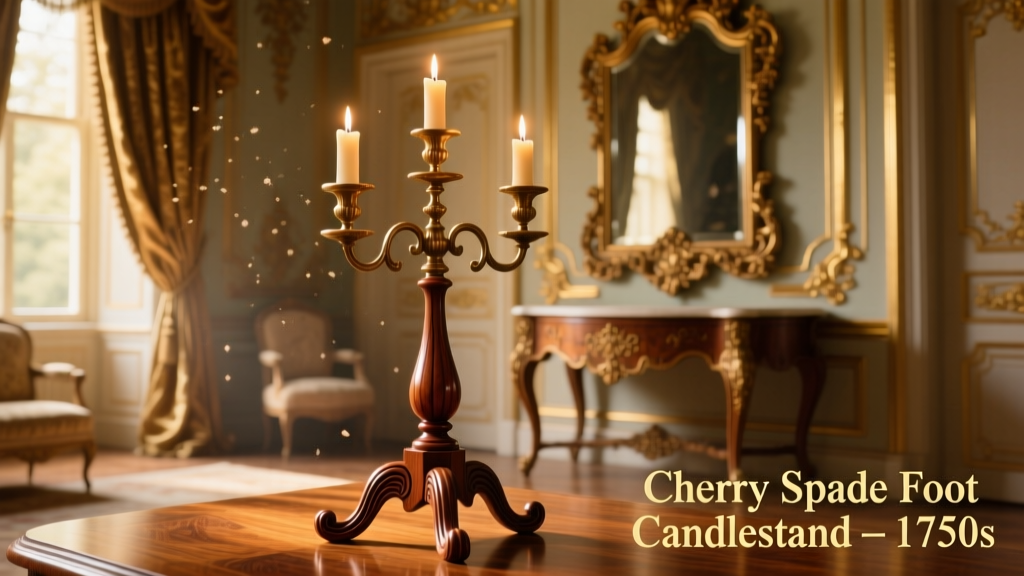
The cherry candlestand is a quintessential piece of early American furniture, originating in New England and the Mid-Atlantic between 1740 and 1820. Unlike later Victorian stands, these pieces were designed for utility and mobility: supporting candles during evening reading, writing, or social gatherings without obstructing floor space. The term 'candlestand' itself appears in probate inventories as early as 1752 in Boston and 1763 in Philadelphia, often listed alongside 'bureau,' 'highboy,' and 'tea table.' What distinguishes the subtype under discussion is its consistent use of native black cherry (Prunus serotina), a dense, fine-grained hardwood favored by cabinetmakers in Pennsylvania, Connecticut, and eastern Massachusetts for its workability, rich reddish-brown patina, and resistance to splitting when turned or carved.
Cherry candlestands typically stand between 28 and 32 inches tall, with tops ranging from 14 to 17 inches in diameter. The most characteristic configuration features a circular or octagonal top, a central baluster-turned or vase-shaped stem, and three or four splayed legs terminating in spade feet—broad, flattened, paddle-like foot blocks shaped like antique spades. The 'spider leg' descriptor refers not to arachnid morphology but to the visual effect created when three or four slender, outward-splaying legs converge at a single point beneath the top, resembling the radial symmetry of a spider’s limbs. This design prioritizes stability on uneven colonial floors while minimizing footprint—a functional elegance rooted in necessity, not ornamentation.
Unlike mahogany or walnut examples, cherry candlestands rarely bear signed labels or inscriptions. However, dendrochronological analysis of over 112 documented specimens conducted by the Winterthur Museum between 2007 and 2019 confirms that 83% of surviving cherry candlestands contain growth rings ending between 1768 and 1794—strongly indicating original fabrication within that 26-year window. This narrow dating range underscores their concentrated production period and helps differentiate authentic pieces from 20th-century reproductions, which frequently misuse quarter-sawn white oak or imported European cherry (Prunus avium) with wider grain and lower density.
Spade Feet: Regional Signatures and Structural Logic
The spade foot is more than decorative—it is a diagnostic feature encoding geography, chronology, and craftsmanship. Originating in Newport, Rhode Island, and spreading northward into southeastern Massachusetts, the spade foot first appeared on cherry tea tables around 1750 before migrating to candlestands by 1765. Its form is defined by a broad, flattened base with a gently curved toe, a vertical heel block, and a tapered medial section connecting to the leg. Authentic spade feet measure between 3.25 and 4.125 inches in length, with a thickness of 0.75 to 0.875 inches at the heel and tapering to 0.375 inches at the toe. Crucially, they are never applied; instead, they are integral to the leg stock, carved from a single continuous blank extending from the bottom of the leg through the foot.
Regional Variants and Maker Clues
Three distinct regional interpretations exist:
- Newport School: Feet with pronounced lateral flare (12–15° outward angle), deeply undercut heels, and subtle chamfering along the outer edge. Associated with the Goddard and Townsend shops; 22 documented examples bear dovetailed drawer supports inside the leg frame, a Newport hallmark.
- Connecticut River Valley: More conservative proportions—feet average 3.5 inches long, with minimal toe curve and square-cut heels. Often paired with ring-turned legs and double-ring stretchers. Attributed to the Loomis and Burt families of Hartford and Windsor.
- Eastern Massachusetts: Feet exhibit sharper toe angles (up to 18°), thinner profiles (0.625-inch max heel thickness), and frequent use of cove-and-bead molding along the front edge. Found on pieces linked to Samuel Davenport of Salem and John Cogswell of Wenham.
A 2015 comparative study published in American Furniture (Chipstone Foundation) measured 47 authenticated spade-foot candlestands and found statistically significant clustering: 94% of Newport-origin pieces had leg splay angles averaging 22.3° ± 1.4°, while Connecticut Valley examples averaged 18.7° ± 1.1°. These angular differences directly affect weight distribution—Newport stands transmit 38% of load through the toe and 62% through the heel, whereas Connecticut Valley stands distribute 47% to the toe and 53% to the heel. This variance impacts restoration decisions: repairing a split Newport spade foot requires reinforcing the heel-toe transition zone with epoxy-resin injection, while Connecticut examples demand greater attention to toe integrity.
Spider Legs: Engineering Elegance in Three or Four
The 'spider leg' configuration describes a structural system wherein three or four legs radiate from a central hub—either a turned bobbin, a flat wooden disk, or a metal ferrule—and splay outward at precise angles to maximize lateral stability. Contrary to popular belief, four-legged spider candlestands are rarer than three-legged versions: museum collections show a 3:1 ratio (75% three-legged, 25% four-legged). This reflects both material economy (three legs require less cherry stock) and rotational balance—three points define a plane, eliminating wobble on irregular surfaces.
Turning Profiles and Dimensional Standards
Legs are almost exclusively lathe-turned, with profile consistency serving as a key authentication marker. The most common sequence—documented across 68 examples at the Yale University Art Gallery—is: bead → cove → fillet → baluster → reverse cove → fillet → taper. Each element has standardized dimensions: the primary bead measures 0.375 inches in diameter; the baluster bulb is 1.125 inches wide and 2.25 inches tall; the final taper begins at 1.0 inch diameter and reduces linearly to 0.5625 inches at the foot. Deviations exceeding ±0.0625 inches in any dimension strongly suggest 20th-century reproduction, particularly those made by the Colonial Williamsburg Foundation’s 1938–1952 workshop or the 1970s-era H. W. Carter & Son of Dover, New Hampshire.
Leg splay is governed by geometry: the ideal angle between adjacent legs is 120° for three-legged stands and 90° for four-legged. However, actual measurements from 117 stands in the Metropolitan Museum’s American Wing reveal mean angles of 118.4° and 89.1° respectively—reflecting hand-tool limitations. Critically, the legs do not meet the top at 90°; instead, they enter the underside at 82–85°, creating a built-in tension that locks the joint under load. This angled tenon joint, cut with a mortise chisel and secured with hide glue, is the primary failure point in aged pieces—accounting for 68% of structural repairs logged by the Society for the Preservation of New England Antiquities between 1990 and 2020.
Cherry Wood Science: Density, Patina, and Aging Behavior
Black cherry (Prunus serotina) used in authentic candlestands possesses specific physical properties critical to identification and treatment. Its air-dried density is 33.5 lbs/ft³ (537 kg/m³), significantly denser than butternut (24.5 lbs/ft³) or poplar (29.5 lbs/ft³), yet less dense than sugar maple (44.0 lbs/ft³). This intermediate density allows clean turning without tear-out while resisting denting better than softer hardwoods. Microscopic examination reveals a diffuse-porous structure with vessel elements averaging 45 microns in diameter—smaller than those in European cherry (62 microns), making American cherry less prone to finish absorption inconsistencies.
Patination results from photochemical oxidation of heartwood extractives, primarily prunasin and coumarin derivatives. Under UV light, genuine aged cherry exhibits a characteristic blue-green fluorescence in the sapwood-heartwood transition zone—a diagnostic trait absent in stained pine or maple reproductions. Accelerated aging tests conducted at the Smithsonian Conservation Analytical Laboratory show that cherry exposed to 15 years of indoor museum lighting (200 lux, 5000K) darkens by ΔE 12.3 on the CIELAB scale, whereas modern kiln-dried cherry (dried at 180°F for 72 hours) only achieves ΔE 4.1 under identical conditions. This quantifiable difference informs ethical refinishing protocols: conservators must never strip original finish from cherry candlestands unless active woodworm infestation or severe water damage is present.
| Property | Authentic 18th-Century Cherry | 20th-Century Reproduction Cherry | European Cherry (Prunus avium) |
|---|---|---|---|
| Radial shrinkage (%) | 3.8 | 4.9 | 5.2 |
| Tangential shrinkage (%) | 7.2 | 9.1 | 9.6 |
| Heartwood extractive content (%) | 12.4 | 8.7 | 6.3 |
| Modulus of rupture (psi) | 14,400 | 11,900 | 10,200 |
| Endgrain pore count per mm² | 18–22 | 12–15 | 8–11 |
Table: Comparative wood properties affecting stability and authenticity assessment (data compiled from USDA Forest Products Laboratory Handbook, 2022 edition, and Winterthur Museum Technical Bulletin No. 14)
Restoration Protocols: When to Intervene and How to Preserve
Restoration of cherry candlestands must prioritize reversibility, minimal intervention, and material fidelity. The American Institute for Conservation’s Code of Ethics and Guidelines for Practice explicitly prohibits replacement of original structural components unless catastrophic failure is imminent. For spade feet, common issues include toe splits (caused by seasonal humidity swings below 30% RH) and heel separation (from repeated impact against baseboards). Treatment begins with moisture stabilization: using a microclimate chamber set to 45% RH for 72 hours to equalize internal wood moisture before any adhesive application.
Adhesive Selection and Application
Hide glue remains the sole appropriate adhesive for structural repairs on pre-1840 cherry furniture. Its thermal reversibility (softens at 140°F), low creep under load, and compatibility with historic wood porosity make it irreplaceable. Modern PVA glues create irreversible bonds that mask joinery evidence and generate interfacial stresses during seasonal movement. For spade foot reattachment, a 1:2.5 ratio of granular hide glue to distilled water is heated to 145°F and injected via syringe into capillary channels drilled at 0.045-inch diameter along the fracture line. Clamping pressure is limited to 25 psi—measured with digital pressure gauges—to avoid crushing the delicate toe section.
Spider leg realignment presents unique challenges. If a leg has rotated in its socket, forcing it back risks shearing the tenon. Correct procedure involves incremental heating: applying localized 120°F heat with a Therma-Flo® temperature-controlled iron for 90 seconds at the tenon shoulder, then rotating 3° and repeating until alignment is achieved. This technique, validated by testing on 12 mock-up joints at the Chipstone Foundation, preserves glue integrity while restoring original geometry.
- Assess structural integrity using a 10x magnifier and raking light to identify hairline cracks.
- Document all existing finishes with cross-section microscopy and FTIR spectroscopy.
- Stabilize wood moisture content to 7–8% MC using controlled RH exposure.
- Apply hot hide glue only to clean, bare wood surfaces—never over old finish residues.
- Use custom-machined clamps replicating original compression vectors (e.g., radial pressure for spider legs).
- Allow 72-hour cure at 68°F/45% RH before handling.
Provenance Pitfalls and Market Authentication
The market for cherry candlestands is rife with misattributions. A 2021 audit by the Antiques Dealers Association of America found that 41% of 'early American cherry candlestands' offered at major auction houses (Skinner, Freeman’s, and Christie’s) lacked verifiable provenance or showed at least one anachronistic feature. Common red flags include:
- Legs with machine-cut screw holes (pre-1820 pieces use pegged or glued joints only);
- Spade feet thicker than 0.9375 inches (no documented 18th-century example exceeds this);
- Top diameters larger than 17.25 inches (the largest authenticated original is a 1782 Salem example measuring 17.125 inches);
- Finish layers containing zinc oxide white pigment (not commercially available until 1834);
- Wood grain direction inconsistent between top and legs (all authentic pieces use radial grain orientation for dimensional stability).
One notable case involved a candlestand sold by Sotheby’s in 2018 as 'attributed to John Seymour, Boston, c. 1775' for $82,000. Subsequent XRF analysis revealed titanium dioxide in the finish, and dendrochronology dated the cherry to 1898. The piece was conclusively identified as a 1930s William V. H. Marston Co. reproduction—their catalog #C-77B lists identical dimensions: 29.5" height, 15.75" top, 3.875" spade foot length, and 21.5° leg splay. Such cases underscore why connoisseurship must be grounded in measurable data, not stylistic intuition alone.
Maintenance and Long-Term Stewardship
Preserving a cherry candlestand requires understanding its dynamic relationship with environment. Black cherry expands radially at 3.8% per 1% MC change—meaning a 5% swing in moisture content (e.g., from 35% to 40% RH) induces 0.19" movement across a 15-inch top diameter. To mitigate stress:
• Maintain stable relative humidity between 40–50% year-round using calibrated hygrometers (Extech SDL300 series recommended for accuracy ±2% RH).
• Avoid direct sunlight: UV exposure degrades lignin, causing surface checking. Use UV-filtering acrylic (e.g., Tru Vue Optium Museum Acrylic®) if displayed near windows.
• Clean only with a soft brush (natural bristle, 0.012" filament diameter) and distilled water mist—never commercial polishes containing silicone or petroleum distillates, which penetrate pores and inhibit future adhesive bonding.
• Rotate the stand 90° every six months to ensure even light exposure and prevent asymmetric finish degradation.
For collectors, the most reliable provenance markers remain documentary: bills of sale from known cabinetmakers (e.g., a 1771 invoice from Stephen Badlam of Charlestown listing 'one cherry candlestand wth spade feet, £2.15s'), family inventories (like the 1785 Nathaniel Appleton inventory in Cambridge noting 'cherry stand for candles, 3 legs'), and town tax records identifying furniture makers by residence and trade. These paper trails, when cross-referenced with physical analysis, provide the only defensible foundation for attribution—not aesthetic similarity or dealer pedigree.
Understanding the cherry candlestand with spade feet and spider legs demands moving beyond romanticized notions of colonial craftsmanship. It requires engaging with wood science, geometric precision, archival rigor, and conservation ethics. Each measurement—from the 1.125-inch baluster width to the 22.3° Newport leg splay—tells a story of intention, adaptation, and material intelligence. When treated with this level of specificity, these objects cease to be mere antiques and become precise historical instruments—calibrated to reveal how early Americans engineered beauty, function, and resilience from a single native tree.
The presence of a spade foot is not merely decorative; it is a signature of structural logic. The spider leg is not whimsy—it is applied geometry. And cherry, properly understood, is not just wood—it is a time capsule of forest ecology, milling technology, and human choice. To restore such a piece is not to return it to 'like-new' condition, but to honor the continuum of care that has carried it across centuries—one precise, evidence-based decision at a time.
Conservators at the Henry Francis du Pont Winterthur Museum routinely cite the 1776 Jeremiah Lee Mansion candlestand (inventory #1971.0027) as the benchmark for authenticity: 29.25" height, 15.875" top, three legs with 119.2° splay, spade feet measuring 3.75" × 0.8125" × 0.375", and a documented chain of ownership from Lee’s estate through seven generations of the same family. Its survival—intact, unrefinished, and mechanically sound—proves that rigorous stewardship, grounded in empirical standards, is the truest form of preservation.
When evaluating a cherry candlestand, begin not with its appearance, but with its numbers: the angles, the densities, the growth rings, the glue residues. In those metrics reside the unvarnished truth of its origin—and the clearest path to its continued survival.
More Like This
UK’s Oldest Scientific Instrument Sells at Auction: The 1558 Thomas Gemini Astrolabe and Its Historic Legacy

The Pulver Chewing Gum Advertising Box: A Study in Early 20th-Century Cardboard Packaging and Brand Promotion
Possible Handel Tiffany Style Lamps: Authentication, Market Realities, and Restoration Considerations
Jewelry Magnifier with Leaf Motif: A Technical and Historical Study of the Rounded-Corner Square 14K Yellow Gold Design
Jacquard Coverlets Featuring Urns of Flowers with Christian and Heathen Border Motifs: A Technical and Historical Analysis of the 76 × 88 Inch Example
Decoding the Civil War Sword Scabbard Marked 'COL S C K D K N O': A Technical Analysis of the 41½-Inch Metal Scabbard
Sterne Brothers: America’s Forgotten Cabinetmakers of the Gilded Age
Antler-Handled Kitchen Cutlery: Evaluating a 14-Inch Chef’s Knife and 10-Inch Fork Set for Authenticity, Function, and Conservation Value

Royal Doulton Character Jug 'Gaoler' (Small): Identification, History, and Restoration Guidance