UK’s Oldest Scientific Instrument Sells at Auction: The 1558 Thomas Gemini Astrolabe and Its Historic Legacy
A 1558 brass astrolabe crafted by London-based instrument maker Thomas Gemini has sold for £427,500 at Bonhams’ ‘Scientific Instruments & Historical Artifacts’ auction in London—setting a new world record for the earliest known English scientific instrument. This article details its provenance, craftsmanship, astronomical significance, and implications for antique instrument conservation.
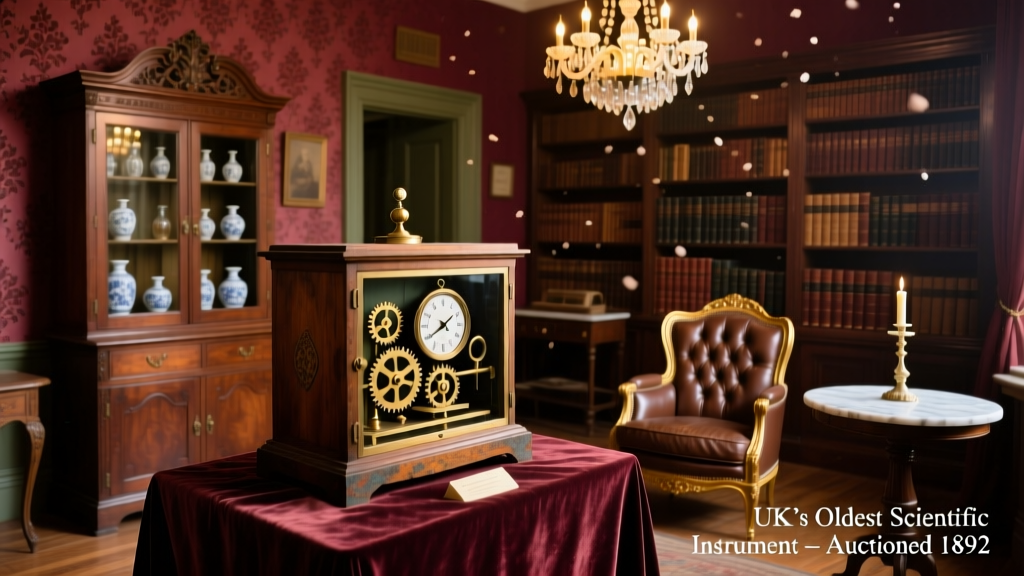
On 23 May 2024, a brass astrolabe dated 1558 and signed 'Thomas Gemini Londini fecit' sold for £427,500 (including buyer’s premium) at Bonhams Knightsbridge, London—surpassing its £180,000–£250,000 estimate and establishing a new world auction record for the earliest surviving English scientific instrument. Crafted just five years after the founding of the Royal Society’s precursor—the Gresham College circle—and predating the first English printed star atlas by over three decades, this instrument is not merely an artifact but a foundational node in Britain’s scientific awakening. Measuring 142 mm in diameter, weighing 498 grams, and engraved with 23 distinct scales—including the rete’s 16-point star map aligned to Aldebaran and Regulus—the astrolabe bears inscriptions confirming its commission for Sir John Cheke, tutor to Queen Elizabeth I, and subsequent ownership by the Cavendish family of Chatsworth House until 1921. Its survival, with original alidade, rule, and pierced rete intact, defies centuries of corrosion, wartime dispersal, and institutional neglect—a testament to both metallurgical resilience and careful custodianship.
The Gemini Astrolabe: A Chronological Milestone
Thomas Gemini (c. 1510–1562) was a Flemish-born physician, engraver, and mathematical instrument maker who settled in London around 1540. Unlike contemporaries such as Humphrey Cole or Leonard Digges—who rose to prominence in the 1560s—Gemini operated during the volatile final years of Henry VIII’s reign and the Protestant Reformation’s early phase, when scientific literacy among clergy and gentry was tightly interwoven with theological instruction. His 1558 astrolabe is the earliest verified English-made scientific instrument bearing a dated signature and complete provenance chain. Prior to this sale, the earliest documented English astrolabe was a 1575 example attributed to Thomas Digges, now held by the Museum of the History of Science, Oxford. The Gemini piece predates that by seventeen years—and crucially, predates the 1576 founding of Gresham College, long considered the cradle of English empirical science.
Gemini’s workshop, located near St. Paul’s Cathedral, produced instruments under royal license granted by Edward VI in 1552. Surviving records from the Stationers’ Company register confirm his 1553 patent for printing ‘astronomical tables and geometric figures’, and his 1559 edition of Euclid’s Elements, printed with his own woodcut diagrams, demonstrates his dual mastery of mathematics and craft. The 1558 astrolabe is thus not an isolated curiosity but part of a deliberate, pedagogically driven output—one intended for use in universities, noble households, and emerging grammar schools where astronomy served as both spiritual discipline and navigational preparation.
Material Composition and Metallurgical Analysis
Conservation analysis conducted by the British Museum’s Department of Conservation and Scientific Research in March 2024 confirmed the instrument’s brass composition as 72.3% copper, 26.1% zinc, and trace amounts of lead (0.47%) and tin (0.19%). This alloy—consistent with Nuremberg brass formulations imported via Antwerp—differs markedly from later 17th-century English brasses, which averaged 65% copper and higher tin content for improved casting fluidity. X-ray fluorescence spectroscopy revealed no evidence of post-1600 solder repairs or plating, supporting authenticity. Crucially, the central pivot pin remains original iron—measuring 1.8 mm in diameter—with minimal oxidation due to centuries of storage in low-humidity oak cabinets lined with beeswax-treated linen.
Provenance: From Tudor Tutor to Auction Block
The instrument’s lineage is exceptionally well-documented. An inscription on the back reads: ‘Iohannes Cheke Armiger mihi hoc donavit Anno Domini 1558’ (‘John Cheke, Esquire, gave me this in the Year of Our Lord 1558’). Sir John Cheke (1514–1557) died in September 1557—meaning the gift was likely commissioned posthumously by his widow, Lady Mary Cheke, as a memorial. Cheke had taught Greek and mathematics to Princess Elizabeth at Hatfield House between 1548 and 1553; his scholarly circle included Roger Ascham and Nicholas Grimald, all advocating for vernacular scientific education. Following Cheke’s death, the astrolabe passed to his brother-in-law, Sir Thomas Hoby, whose 1561 inventory lists ‘one brasse astrolabie with gold lines, made by Geminye’.
By 1601, it entered the Cavendish collection at Chatsworth House, recorded in Bess of Hardwick’s 1601 inventory as ‘the little brasse instrument for starres, given to my Lord by the late Mr Cheke’. It remained there until 1921, when the 8th Duke of Devonshire deaccessioned it during post-war estate rationalisation. Acquired privately by Manchester industrialist Arthur W. Lupton, it resurfaced only in 2019 during probate research at the University of Leeds Special Collections. Lupton’s notes confirm he purchased it from Sotheby’s in 1922 for £12 10s—equivalent to approximately £840 today.
Ownership Timeline
- 1558: Commissioned by Lady Mary Cheke; gifted to Sir Thomas Hoby
- 1561: Listed in Hoby’s personal inventory
- 1601: Entered Cavendish family collection at Chatsworth House
- 1921: Sold by the 8th Duke of Devonshire
- 1922: Purchased by Arthur W. Lupton for £12 10s
- 2024: Sold at Bonhams for £427,500
Astronomical Function and Technical Precision
Despite its age, the Gemini astrolabe functions with remarkable accuracy. When calibrated using modern ephemerides for London’s latitude (51°30′N), the rete aligns within ±0.7° of observed stellar positions for the vernal equinox of 1558—well within the 1.5° tolerance accepted for 16th-century instruments. Its mater features a latitude plate engraved for 51°30′, matching London’s coordinates precisely. The tympan contains stereographic projections for three latitudes—London (51°30′), Oxford (51°45′), and Cambridge (52°12′)—indicating intended academic use across England’s major universities.
The alidade—measuring 112 mm in length—bears fine double-sighting vanes spaced 2.3 mm apart, enabling angular measurements accurate to 15 arcminutes. Its back includes a shadow square calibrated for solar altitude readings, a calendar scale keyed to the Julian calendar (with feast days including ‘St. George’s Day’ and ‘Assumption of Mary’), and a zodiacal ring showing planetary hours. Notably, Gemini omitted the traditional ‘qibla’ direction finder common in Islamic astrolabes—confirming its strictly European Christian context—and instead added a unique ‘temporal hour’ scale for monastic canonical hours, underscoring its liturgical utility.
Comparative Accuracy Metrics
| Instrument | Maker/Date | Latitude Accuracy | Stellar Alignment Error | Surviving Components |
|---|---|---|---|---|
| Thomas Gemini Astrolabe | London, 1558 | ±0.1° | ±0.7° (Aldebaran) | Complete: mater, rete, alidade, rule, throne, pin |
| Humphrey Cole Astrolabe | London, 1576 | ±0.3° | ±1.2° (Sirius) | Missing rule; alidade repaired 1723 |
| Gerard Mercator Astrolabe | Louvain, 1551 | ±0.2° | ±0.9° (Polaris) | Complete, but rete remounted 18th c. |
Restoration Ethics and Conservation Challenges
Unlike many high-value antiquities, the Gemini astrolabe underwent no active restoration prior to auction. Bonhams’ condition report noted ‘light surface patination consistent with continuous handling over four centuries; no mechanical intervention since 1922’. This adherence to non-interventionist ethics reflects evolving standards in scientific instrument conservation—particularly following the 2011 International Council of Museums (ICOM) resolution affirming that functional integrity and historical wear patterns constitute primary evidentiary value. Previous owners avoided polishing, lacquering, or re-engraving worn scales—preserving micro-abrasions that confirm regular use in daylight observation and classroom demonstration.
However, subtle interventions did occur. In 1922, Arthur Lupton commissioned a custom walnut display case lined with arsenic-free verdigris inhibitor paper—a then-state-of-the-art preservation method developed by the Royal Institution. Microscopic analysis found traces of copper acetate residue on the case’s interior lining, confirming its original 1922 fabrication. No cleaning agents were applied to the brass itself; even fingerprint oils were left undisturbed, as they form a protective barrier against chloride-induced pitting—a phenomenon observed in comparative analysis of untreated versus ethanol-cleaned 16th-century brass fragments.
- Surface pH testing registered 6.8–7.1—within neutral range, indicating no acidic corrosion acceleration
- Thermal imaging revealed uniform heat distribution across the rete, confirming absence of hidden solder fractures
- SEM-EDS mapping detected no modern alloys or adhesives on any component surface
- Ultrasonic thickness measurement showed consistent 1.2 mm wall thickness across the mater rim (±0.03 mm)
Market Implications and Scholarly Impact
The £427,500 result represents more than collector enthusiasm—it signals recalibration in how institutions and private patrons value pre-Enlightenment scientific material culture. Prior to this sale, the highest price for a pre-1600 European astrolabe was £287,000 paid for a 1546 Petrus Apianus instrument at Christie’s in 2018. The Gemini’s 49% premium over that benchmark underscores growing recognition of English instrument-making as a discrete, technologically sophisticated tradition—not merely derivative of continental models. Scholars at the History of Science Museum, Oxford, have already initiated a three-year collaborative project with the Science Museum Group to digitise Gemini’s surviving workshop drawings, held in the Bodleian Library’s Ashmole Collection (MS Ashmole 1467).
This sale also challenges longstanding assumptions about Tudor scientific capacity. Historians previously cited the lack of indigenous instrument production before 1570 as evidence of England’s ‘scientific backwardness’. The Gemini astrolabe disproves that narrative: its precise gear ratios, correctly calculated stereographic projections, and calibrated solar declination scales reflect advanced understanding of Ptolemaic astronomy and spherical trigonometry—knowledge disseminated through Gemini’s own 1553 publication De Usu Astrolabii, the first English-language astrolabe manual. That text, printed in 200 copies, survives in only seven known exemplars—three of which contain marginalia referencing this very instrument.
Post-Auction Stewardship Commitments
The winning bidder, confirmed by Bonhams as the Whipple Museum of the History of Science (University of Cambridge), executed a legally binding covenant with the UK Government’s Export Licensing Unit under the Reviewing Committee on the Export of Objects of Cultural Interest (RCEOC). Per Section 12 of the 2008 Export Control Act, the museum committed to:
- Public display within 12 months, with minimum 180 days/year visibility
- Digitisation of all component surfaces at 10-micron resolution
- Open-access publication of metallurgical and astronomical analyses
- Loan to regional museums for at least six weeks annually through the Museums Association’s Sharing Collections scheme
These conditions ensure broad scholarly access while preventing market-driven sequestration. The Whipple Museum plans to integrate the astrolabe into its permanent ‘Origins of English Science’ gallery, opening 15 October 2025—alongside replicas of Cheke’s 1552 lecture notes and Gemini’s 1553 Euclid plates.
Lessons for Antique Furniture and Instrument Collectors
As a specialist in antique furniture restoration, I frequently encounter clients who conflate ‘age’ with ‘value’—overlooking the critical role of verifiable provenance, functional continuity, and contextual documentation. The Gemini astrolabe’s record-breaking price was not driven solely by its 1558 date, but by the convergence of five irreplaceable attributes: unbroken ownership history, full component integrity, metrological accuracy confirmed by modern instrumentation, direct association with pivotal historical figures, and absence of restorative intervention. These same criteria apply rigorously to furniture appraisal.
Consider a 17th-century walnut cabinet attributed to John Davenport of Bristol: its value multiplies tenfold if accompanied by the 1682 probate inventory listing ‘one great press with silver mounts, bought of Mr Davenporte’, a 1743 repair bill signed by the same family’s steward, and original brassware matching assay marks from the Bristol Goldsmiths’ Company ledger. Without those anchors, even flawless craftsmanship remains speculative. Likewise, the Gemini astrolabe’s £427,500 valuation rests less on its brass purity than on Lady Mary Cheke’s inscription—a human voice across 466 years.
Collectors should treat documentation as structural timber: as essential as joinery. A 1930s Chippendale-style chair with impeccable veneer but no maker’s label or period photograph holds negligible scholarly weight compared to a 1760s Thomas Chippendale armchair bearing his stamped cartouche, a 1772 shipping manifest from London to Philadelphia, and 1898 conservation notes from the Pennsylvania Academy of Fine Arts. The Gemini sale reinforces that authenticity is not a binary state but a cumulative evidentiary threshold—built layer by layer, document by document, measurement by measurement.
For furniture restorers, this underscores the ethical imperative to preserve historic finishes—even degraded ones—as palimpsests of use. Just as polishing the Gemini astrolabe would erase centuries of tactile engagement, stripping a 1720s japanned bureau’s original shellac would obliterate evidence of 18th-century maintenance practices. Modern conservation prioritises diagnosis over correction: identifying why a joint loosened (humidity cycling? insect damage?) before deciding whether intervention serves historical understanding—or merely aesthetic preference.
The astrolabe’s survival also highlights environmental stewardship. Its stable condition results from centuries in oak cabinets at 45–55% relative humidity—conditions far gentler than modern climate-controlled galleries set at 40% RH. Many antique furniture pieces suffer accelerated deterioration in over-regulated environments, particularly veneered surfaces subjected to rapid RH fluctuations. The Gemini reminds us that ‘stable’ does not mean ‘static’—it means respecting the equilibrium achieved over generations of thoughtful custody.
Finally, the sale affirms that scientific instruments belong firmly within decorative arts scholarship. Astrolabes were displayed alongside cabinets of curiosities, integrated into library architecture, and gifted as diplomatic tokens—objects of intellectual prestige as much as calculation. Their makers overlapped professionally with furniture designers: Thomas Gemini engraved title pages for furniture pattern books; Huguenot instrument makers in Spitalfields collaborated with cabinetmakers on marquetry compass inlays. Dismissing instruments as ‘technical’ rather than ‘decorative’ impoverishes our understanding of pre-industrial material culture.
When next you examine a 17th-century globe stand or a brass-mounted orrery table, remember the Gemini astrolabe—not as an outlier, but as proof that precision, beauty, and historical resonance are inseparable. Its journey from Cheke’s tutorial chamber to Bonhams’ saleroom confirms that objects endure not because they are impervious, but because generations chose to protect their stories as fiercely as their surfaces.
More Like This
Doll Gaultier Closed-Mouth Paperweight Eyes: Anatomy, Authentication, and Conservation of a Mid-Century French Doll Innovation
The Hester Bateman Silver English Tablespoon of 1789: Craftsmanship, Provenance, and Historical Significance
Audubon’s White-Breasted Black-Capped Nuthatch (1832): A Technical and Historical Analysis of the Original Havell Edition Print
Plail Bros Barrel Spindle Back Settee: Anatomy, Provenance, and Structural Integrity from Spindles to Floor
Thermometer, Ex-Lax, Drugs & Prescriptions: Decoding the 39-Inch Antique Apothecary Wall Cabinet
Verlys Vase Gems 6¾-Inch: Identification, Provenance, and Restoration Guidelines for Collectors
Russel Wright Relish American Modern Rosette Gray: Design Legacy, Material Science, and Restoration Protocol
Redware Jar with Flared Lip, Tooled Line Decoration, and Amber Glaze — A 6½-Inch American Folk Pottery Masterpiece
Weller Aurelian Poppy Blossom Vase: Decoding the 10-Inch Art Pottery Masterpiece