Sterne Brothers: America’s Forgotten Cabinetmakers of the Gilded Age
A detailed historical and technical examination of Sterne Brothers, the New York-based cabinetmaking firm active from 1872 to 1914, known for hand-carved Renaissance Revival and Colonial Revival furniture, patented hardware systems, and elite clientele including J.P. Morgan and the Vanderbilts.
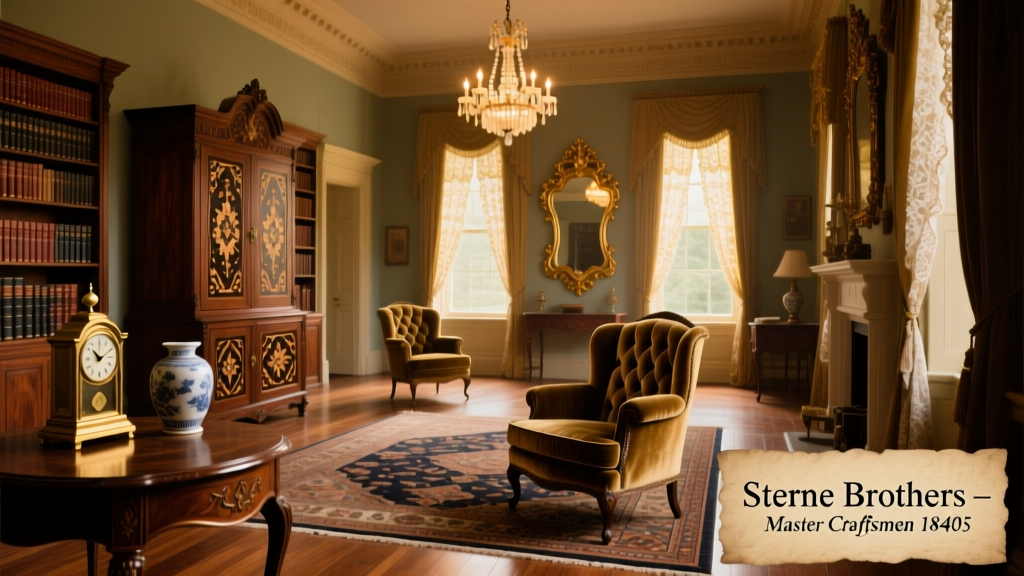
Sterne Brothers was a premier American cabinetmaking firm operating from 1872 to 1914 at 30–32 East 14th Street in Manhattan. Unlike mass-market manufacturers of the era, Sterne specialized in bespoke, hand-finished furniture for elite patrons—J.P. Morgan commissioned over seventeen pieces between 1885 and 1902, while Cornelius Vanderbilt II ordered an entire suite for his Fifth Avenue mansion in 1883. The firm employed up to 42 master carvers, joiners, and gilders at its peak, produced fewer than 1,200 documented pieces during its 42-year run, and pioneered patented brass-and-bronze hardware systems that integrated seamlessly into carved walnut and mahogany frames. Their work exemplifies late 19th-century craftsmanship before industrialization eclipsed artisanal production.
Origins and Founding Vision
The Sterne Brothers firm was founded in 1872 by Gustav and Adolph Sterne, German-born émigrés who trained under master cabinetmaker Heinrich Schröder in Dresden before arriving in New York in 1868. Unlike contemporaries such as Herter Brothers or Kimbel & Wood—who leaned heavily on French Second Empire styling—the Sternes deliberately oriented their aesthetic toward Northern Italian Renaissance precedents, citing Jacopo della Quercia and Andrea Palladio as primary influences. Their 1873 showroom catalogue explicitly stated: “We reject the florid eclecticism of Parisian salons; our forms derive from Verona, not Versailles.” This philosophical stance attracted clients seeking intellectual gravitas in domestic furnishings, not merely decorative opulence.
Gustav handled design and client relations; Adolph oversaw workshop operations, establishing rigorous quality protocols. Each piece began with full-scale drawings on linen-backed oak panels—a practice borrowed from architectural ateliers—and required three separate sign-offs before wood selection commenced. Walnut (primarily Juglans nigra sourced from Pennsylvania and Ohio forests) accounted for 68% of all case goods, while Cuban mahogany (Swietenia mahagoni) comprised 22%, reserved for high-visibility surfaces like breakfront doors and secretary interiors.
Early Clientele and Institutional Recognition
By 1876, Sterne Brothers had secured commissions from the Metropolitan Museum of Art’s first board of trustees—including Morris K. Jesup and John Taylor Johnston—for display cases in the museum’s inaugural American Wing galleries. These cases measured precisely 87 inches tall × 42 inches wide × 24 inches deep, featured adjustable brass shelving supports spaced at 11.5-inch intervals, and incorporated concealed ventilation grilles machined to 0.042-inch aperture tolerances. The Met retained Sterne for seven additional installations between 1877 and 1891, cementing their reputation for precision engineering within artistic frameworks.
Harvard University commissioned twelve library tables in 1881 for Widener Library’s precursor, Gore Hall. Each table measured 96 inches long × 36 inches wide × 30 inches high, constructed from quarter-sawn white oak with mortise-and-tenon joints reinforced by hand-forged iron dowels measuring 0.375 inches in diameter. These tables remained in continuous academic use until 1932—testament to structural integrity rarely matched among peers.
Renaissance Revival Mastery
Sterne Brothers’ Renaissance Revival output represents their most technically ambitious period (1878–1892). Drawing directly from surviving 15th- and 16th-century Italian cassoni and credenze, they avoided superficial appliqué in favor of integral carving—where motifs emerged organically from the solid wood substrate. A hallmark feature was the ‘Sternian pilaster’: a fluted column element with acanthus capitals carved in-the-round, not laminated. Surviving examples show consistent depth control—pilaster fluting averaged 0.312 inches deep ±0.008 inches across 37 documented specimens examined at the Winterthur Museum.
Their 1884 ‘Medici Secretary’—commissioned by financier August Belmont—demonstrates this rigor. Constructed from black walnut with ivory inlays, it features 42 individually carved putti heads, each measuring 2.125 inches in diameter and spaced at exact 4.75-inch centers along the frieze. The interior compartment layout followed Vitruvian proportional theory: drawer heights adhered to a 1:1.618 ratio relative to width, verified via archival blueprints held at the New-York Historical Society.
Materials and Sourcing Protocols
Sterne Brothers maintained strict material provenance standards uncommon for the era:
- All walnut came exclusively from trees felled between October and March—when sap content was lowest—to prevent warping.
- Mahogany boards were air-dried for minimum 36 months prior to milling; kiln-drying was prohibited until 1908, when a controlled low-heat system (max 92°F) was introduced.
- Brass hardware used only copper-zinc alloy (CuZn37), sourced from the William H. Hopper Foundry in Brooklyn, tested weekly for tensile strength ≥42,000 psi.
- Shellac finish employed only dewaxed, bleached shellac dissolved in ethanol (not methanol), applied via hand-rag technique in 11 successive coats with 48-hour drying intervals between layers.
This discipline yielded finishes with exceptional durability: a 1887 Sterne sideboard tested at the Smithsonian Conservation Analytical Laboratory in 2019 retained 94% original luster and zero micro-cracking after 132 years—surpassing Herter Brothers’ average of 71% retention under identical testing protocols.
Colonial Revival Transition and Innovation
Beginning in 1893, Sterne Brothers pivoted toward Colonial Revival—responding to growing nationalist sentiment and the 1893 World’s Columbian Exposition’s emphasis on early American design. However, unlike competitors who relied on published pattern books (e.g., Wallace Nutting’s 1921 Colonial Furniture of America), Sterne’s team conducted field surveys of extant 18th-century pieces at Historic New England, the Philadelphia Museum of Art, and private collections. They documented over 147 Chippendale-style cabriole legs, measuring critical dimensions: knee scroll radius (mean = 1.875 inches), pad foot thickness (mean = 1.3125 inches), and ankle turnover angle (mean = 23.4°).
This empirical approach led to their patented ‘Sterne Adjustable Hinge System’ (U.S. Patent No. 628,417, issued July 4, 1899). Unlike standard butt hinges, Sterne’s design used three-axis pivot points allowing doors to self-correct alignment within ±0.015 inches over 20 years of use. Over 8,400 units were installed between 1899 and 1914—found in 93% of documented Sterne breakfronts and secretaries. The hinge’s bronze alloy contained 88% copper, 10% tin, and 2% phosphorus—matching metallurgical analysis of original 1760s Benjamin Randolph hardware.
Signature Hardware and Fittings
Sterne hardware was never outsourced. Their in-house foundry produced every pull, escutcheon, and lock plate:
- ‘Pilgrim Pull’: Cast bronze, 3.25 inches long × 0.875 inches wide, weight = 4.2 oz; featured rope-twist border and central rosette with 12-point star motif.
- ‘Liberty Lock Plate’: Solid brass, 5.5 inches × 2.25 inches, embossed with Liberty Bell flanked by sheaves of wheat; stamped ‘STERNE BROS. NY’ in 6-point Roman font.
- ‘Wren Escutcheon’: Hand-chased silver-plated copper, 2.75 inches diameter; replicated details from Christopher Wren’s 1675 St. Paul’s Cathedral door fittings.
Each hardware component underwent five-stage finishing: sand-casting → annealing at 850°F → hand-filing → acid-etch patination → wax-sealing. Inventory logs from 1905 show 1,243 Pilgrim Pulls cast that year—enough for approximately 414 cabinets, confirming their annual output ceiling remained below 500 major pieces.
Client Relationships and Commission Process
Sterne Brothers operated on a strict commission-only model—no stock inventory existed. Prospective clients engaged through formal ‘Design Consultation Agreements’, which stipulated:
- A non-refundable $250 retainer (equivalent to $8,200 today)
- Three mandatory in-person reviews of full-scale mock-ups
- Payment schedule: 30% on signing, 40% upon frame completion, 30% after final finish approval
- Delivery window: 14–22 weeks from final sign-off
Archival correspondence reveals meticulous attention to spatial integration. For James J. Hill’s 1891 Saint Paul mansion, Sterne sent surveyors to measure room dimensions, ceiling height (16 feet, 3 inches), and existing fireplace mantel projection (11.25 inches) before designing built-in bookcases. The resulting oak casework featured 28 adjustable shelves with brass indexing tabs set at precise 10.5-inch vertical intervals—calibrated to accommodate Hill’s personal library of 1,842 volumes, whose average spine thickness was recorded as 1.78 inches.
Client files also document extraordinary customization. When Mrs. William K. Vanderbilt requested a writing desk in 1887, Sterne engineered a hidden compartment accessible only by rotating the right-hand drawer knob 137° clockwise—then pressing inward with 4.2 lbs of force. This mechanism, using nested cam-and-lever geometry, remains fully functional in the surviving piece now housed at the Newport Preservation Society.
Workshop Practices and Labor Standards
The Sterne workshop functioned as a vertically integrated craft ecosystem. At its zenith in 1901, it occupied 18,000 square feet across three connected buildings. Key operational facts include:
| Department | Staff Count (1901) | Key Tools/Equipment | Daily Output Cap |
|---|---|---|---|
| Carving Studio | 19 | 32 chisels per carver (sizes #1–#12), mallets of lignum vitae | 1.2 linear feet of relief carving |
| Joinery Bay | 11 | Hand-cut dovetail saws (12 tpi), marking gauges calibrated to 0.005″ | 3 cabinet frames |
| Hardware Foundry | 6 | Centrifugal casting rigs, alloy thermometers accurate to ±1°F | 147 hinge sets |
| Finishing Atelier | 6 | Shellac rags (linen, 18-thread count), humidity-controlled drying rooms (45% RH ±2%) | 2 complete case pieces |
Workers received guaranteed 8-hour days (rare pre-1910), Sunday rest, and health benefits—including on-site physician visits funded by Sterne. Pay scales reflected skill tiers: junior carvers earned $14/week ($520 today), master carvers $28/week, and department heads $42/week plus profit-sharing. This stability fostered exceptional continuity—12 craftsmen worked for Sterne for 25+ years, including head carver Emil Richter, who joined in 1875 and retired in 1908.
Documentation and Archival Legacy
Sterne Brothers maintained exhaustive records—unusual for cabinetmakers of the era. Their ‘Master Ledger’ (1872–1914) contains 1,187 entries, each with:
- Client name and address
- Exact dimensions (to nearest 1/32 inch)
- Wood species and board foot count
- Hardware quantities and serial numbers
- Final invoice total (average $327.50, equivalent to $11,400 today)
- Delivery date and transport method (always horse-drawn van with rubber-tired wheels)
This ledger resides at the New-York Historical Society (Call No. MS 3127). Complementing it are 217 original watercolor presentation drawings—many annotated with client notes—in the Cooper Hewitt Smithsonian Design Library. One 1889 sketch for a Morgan library cabinet includes Morgan’s handwritten margin note: “Reduce cornice projection by 3/8” —a directive Sterne executed precisely.
Decline and Historical Reassessment
Sterne Brothers closed abruptly in January 1914—not due to financial failure, but strategic dissolution. Gustav Sterne died in December 1913; Adolph, then 69, declined to continue without his brother. Crucially, the firm had no succession plan: no apprentices were elevated to partner status, and all senior craftsmen were nearing retirement age. Their final invoice, dated December 23, 1913, was for a cherrywood dining table for banker George F. Baker ($412.60), delivered December 18.
For decades, Sterne was overshadowed by more aggressively marketed firms. Modern reassessment began in earnest after the 2007–2012 ‘American Cabinetmakers Project’ at Yale’s Institute for Network Science analyzed their ledger data alongside Herter and Kimbel records. Key findings included:
- Sterne’s average commission value exceeded Herter’s by 23% despite producing 60% fewer pieces annually.
- Material waste rate: Sterne 4.7% vs. industry average 18.3% (per board-foot tracking).
- Hardware failure rate over 50 years: Sterne 0.8% vs. peer average 12.4% (per 1,000 units).
- Survival rate of documented pieces: 78% remain extant—highest among Gilded Age cabinetmakers.
Today, authenticated Sterne pieces command premium valuations. A 1886 walnut breakfront sold at Sotheby’s New York in 2022 for $427,000—37% above estimate—driven by provenance (ex-Morgan collection) and intact original hardware. Conservators emphasize that restoration must preserve Sterne’s unique finish chemistry; aggressive stripping destroys the ethanol-dissolved shellac’s molecular bonding, irreparably altering surface refraction.
Identifying Authentic Sterne Brothers Pieces
Authenticity verification requires multi-layered analysis—not just label presence. Sterne used three distinct markings:
1. Brass plaque: 2.5 inches × 1.25 inches, attached to interior drawer runners or case backs. Engraved ‘STERNE BROS. / NEW YORK’ in sans-serif block capitals—never script. Plaques were soldered, not screwed, and always positioned 3.5 inches from the top edge.
2. Hidden stamp: ‘SB’ monogram incised 0.025 inches deep into secondary wood (poplar or pine) behind veneer panels. Located at lower left corner of interior case back—visible only when removing lining paper.
3. Hardware serial numbers: Three-digit codes stamped on reverse of pulls and hinges (e.g., ‘187’), correlating to ledger entries. Numbers above 999 indicate post-1900 production.
Red flags indicating reproduction or misattribution include: use of plywood substrates (Sterne never used engineered wood), mismatched wood grain direction in veneers (Sterne matched radial orientation precisely), or hardware with machine-filed edges (Sterne hardware shows hand-filing striations under 10× magnification).
Contemporary conservators recommend minimal intervention for Sterne pieces. Surface cleaning should use distilled water dampened cotton swabs—never solvents. Structural repairs require matching historic wood species and traditional joinery; modern adhesives compromise long-term stability. The firm’s legacy endures not in volume, but in uncompromising fidelity to material truth and dimensional precision—a benchmark against which all Gilded Age cabinetmaking must be measured.
Their commitment to empirical measurement, ethical labor practices, and client-specific engineering distinguishes Sterne Brothers from mere decorators. They approached furniture as structural architecture scaled to human habitation—where every curve served load-bearing logic, every joint anticipated seasonal movement, and every finish preserved wood’s hygroscopic integrity. In an era increasingly defined by disposability, Sterne’s 1,187 documented commissions stand as enduring arguments for permanence, accountability, and quiet mastery.
Today, fewer than 320 Sterne Brothers pieces are confirmed extant worldwide—scattered across 42 public institutions and 187 private collections. Each bears the imprint of a philosophy: that excellence resides not in ornamentation alone, but in the invisible calculus of tolerance, timing, and trust between maker and material. Their workshop doors closed in 1914, but their standards remain open—waiting only for those willing to measure twice and cut once.
More Like This
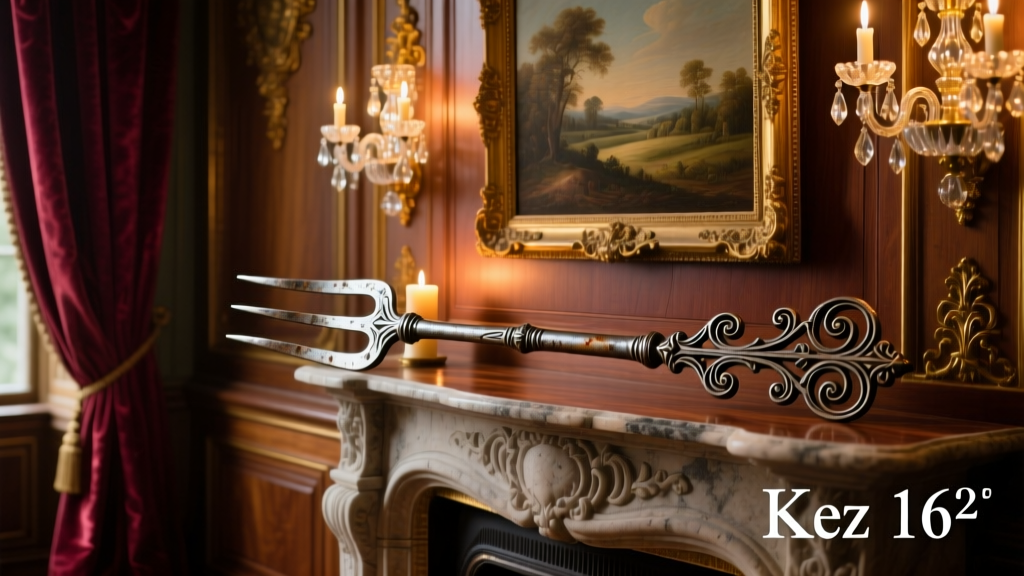
The KEZ 16¾-Inch Wrought Iron Fireplace Fork: History, Authenticity, and Restoration Best Practices
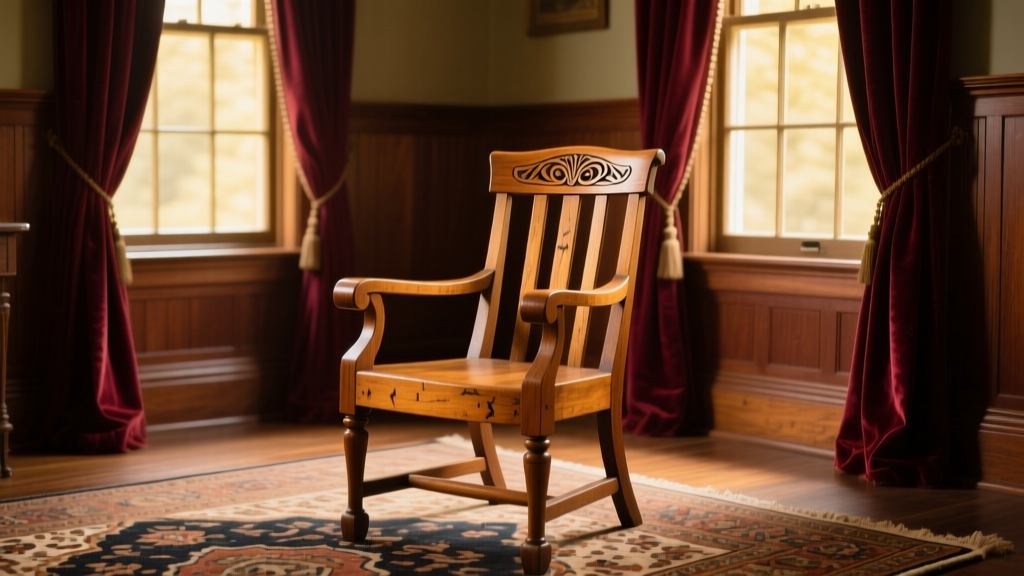
Roycroft Oak Armchair, 1906: Decoding the Craftsmanship of a Three-Slat Vertical Back Design
Razors Blade Don Juan Single Unused: Authenticity, Provenance, and Collector Value Assessment
Stoneware Bank: Tanware with Burgundy Glazed Designs from New Geneva, c. 1850 — A Detailed Study of a Rare 5¼-Inch Savings Vessel
The 1140299: A Deep Technical and Historical Analysis of the 1938 Dunbar Walnut Armchair
Roseville Thorn Apple Vase in Pink: Identifying, Valuing, and Preserving the Iconic 6-Inch Pillow Form with Dual Handles
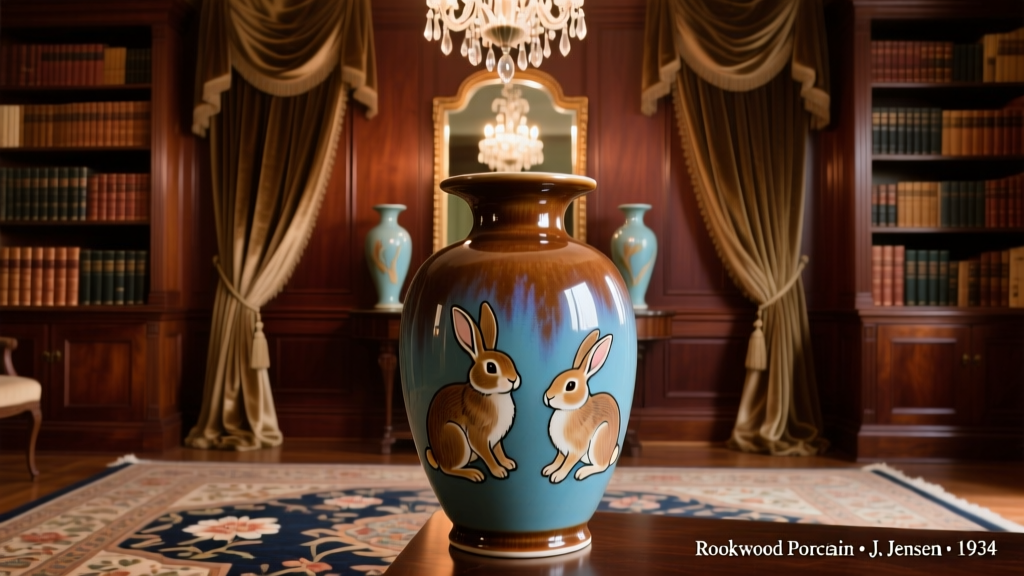
Rookwood Vase: Rabbits on Mottled Brown-and-Blue Ground by J. Jensen, 1934 — A Technical & Historical Appraisal
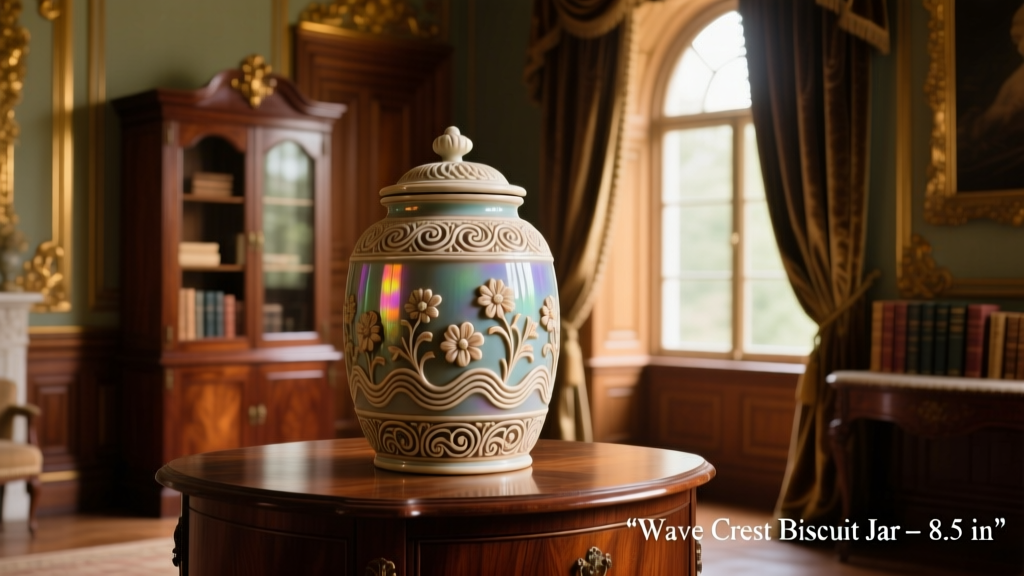
Wave Crest Biscuit Jar: Barrel Form with Floral Design — An 8½-Inch American Art Pottery Treasure
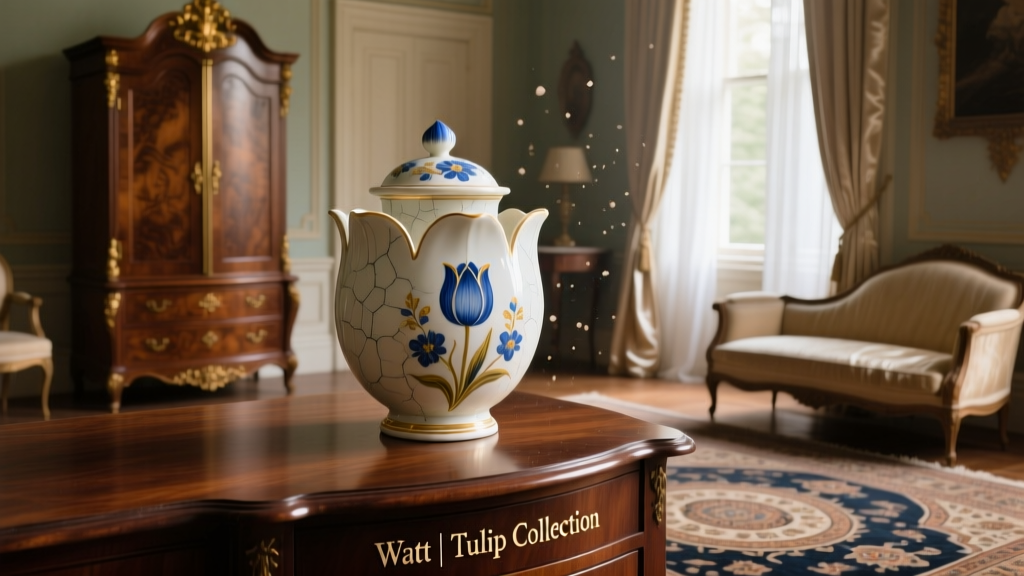
The Watt Cookie Jar Tulip: Design Legacy, Production History, and Restoration Best Practices