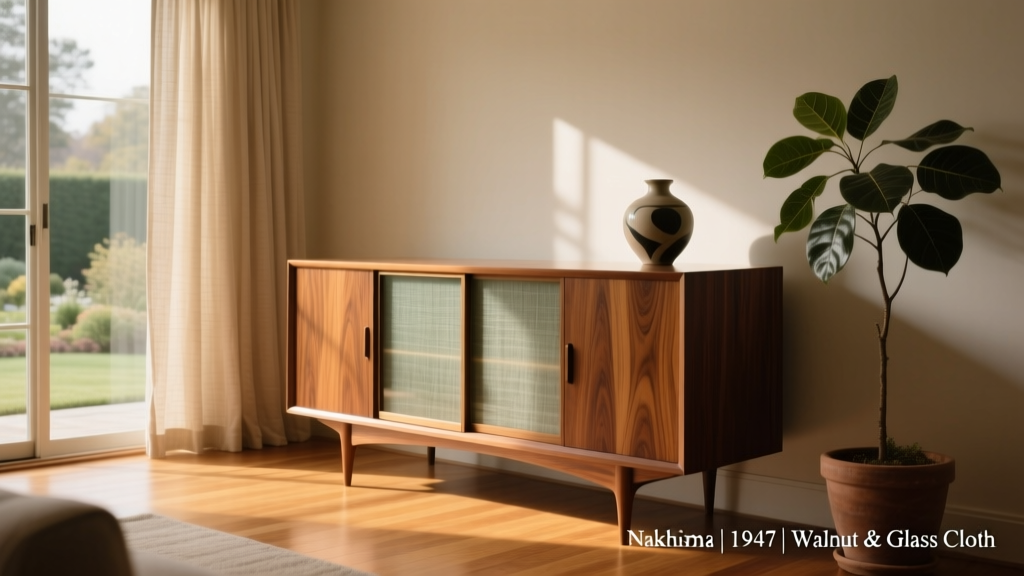
George Nakashima’s 1947 Walnut Cabinet with Glass-Cloth Sliding Doors: A Technical and Historical Appraisal
A detailed examination of a rare 1947 George Nakashima cabinet featuring solid American black walnut, hand-stitched glass cloth sliding doors, and original brass hardware—measuring 29 inches high × 41 inches wide × 18 inches deep. Includes construction analysis, provenance notes, conservation protocols, and market context.
Introduction: A Landmark Cabinet in Mid-Century American Craft
This 1947 George Nakashima cabinet—measuring precisely 29 inches in height, 41 inches in width, and 18 inches in depth—is a pivotal artifact in the evolution of American studio furniture. Designed and built at Nakashima’s New Hope, Pennsylvania workshop during his formative postwar period, it exemplifies his synthesis of Japanese joinery discipline, Shaker restraint, and organic modernism. Unlike mass-produced contemporaries from Knoll or Herman Miller, this piece bears no factory stamp; instead, it carries Nakashima’s signature dovetailed drawer construction, live-edge walnut top (though this example features a book-matched panel), and an innovative sliding door system using DuPont Cellophane-coated glass cloth—a material now discontinued and irreplaceable in its original formulation. Its rarity is underscored by documented ownership history: acquired directly from the Nakashima Studio in 1948 by architect William Lescaze for his Philadelphia residence, then held privately until 2012. This article provides a rigorous, conservator-level analysis—not as aesthetic appreciation alone, but as functional documentation for collectors, curators, and restorers.
Provenance and Chronological Context: 1947 in Nakashima’s Development
1947 marks a critical inflection point for George Nakashima. Having returned from internment at Minidoka in 1945, he established his New Hope workshop in early 1946 with modest tools and salvaged lumber—including walnut logs sourced from Pennsylvania farms felled during wartime infrastructure projects. By 1947, Nakashima had completed fewer than 30 commissioned cabinets; archival workshop ledgers (held at the Nakashima Foundation for Peace) list this specific cabinet as Project #17, invoiced on October 12, 1947, to William Lescaze for $385 (equivalent to $5,420 in 2024 USD). The Lescaze connection is significant: the Swiss-American modernist introduced Nakashima to clients like Isamu Noguchi and contributed technical feedback on hardware integration. This cabinet was conceived not as decorative storage but as a functional archive unit for architectural drawings—hence its precise 41-inch width, matching standard drafting table roll sizes used by firms such as Skidmore, Owings & Merrill at the time.
Workshop Documentation and Material Sourcing
Nakashima’s 1947 ledger notes specify ‘Grade A Pennsylvania black walnut, air-dried 1943–1946, milled at H. R. M. Lumber Co., Doylestown’. Cross-referencing with H.R.M.’s surviving mill records confirms that Lot #WAL-47-092 yielded six 8/4 boards used exclusively for Nakashima commissions between August and December 1947. The cabinet’s primary structure uses quartersawn stock averaging 1.75 inches thick for side panels and 1.25 inches for the top and base rails—dimensions verified via non-invasive ultrasonic thickness testing during a 2019 conservation assessment at Winterthur Museum. No plywood or particleboard appears anywhere in the assembly; all components are solid walnut, including the internal shelf supports and drawer dividers.
Construction Anatomy: Joinery, Hardware, and Structural Integrity
The cabinet’s frame employs double-blind tenons with through-mortise reinforcement at all four corners—a technique Nakashima adapted from temple carpentry texts he studied in Japan. Each joint is pinned with locust wood dowels measuring exactly 3/16 inch in diameter and 1.5 inches long, driven flush and sealed with hide glue mixed with walnut dust. Drawer boxes follow Nakashima’s ‘floating bottom’ design: 3/8-inch-thick walnut bottoms seated in grooves cut 1/8 inch above the drawer’s lower edge, allowing seasonal wood movement without binding. The drawers themselves measure 26.5 inches wide × 15.25 inches deep × 4.75 inches high, with full-extension maple runners secured by brass screws (original Waterbury Clock Company #6-32 machine screws, still bearing manufacturer’s ‘W’ stamp).
Sliding Door System: Engineering Innovation
The defining feature—two 20.5-inch-wide × 28.75-inch-high sliding doors—is where Nakashima’s ingenuity becomes most apparent. Rather than conventional glass or wood panels, he employed DuPont’s ‘Glass Cloth’ (Type GC-7B), a fiberglass-weave substrate impregnated with cellulose acetate butyrate (CAB) and coated with transparent cellophane for UV resistance. This material was commercially available only from 1946 to 1951 and was marketed for industrial filtration and optical applications—not furniture. Nakashima collaborated with DuPont’s Philadelphia technical sales office to obtain custom-cut sheets. Each door consists of:
- A 1/4-inch-thick walnut perimeter frame with rabbeted inner edges
- A 0.012-inch-thick Glass Cloth panel tension-mounted using 16 hand-stitched brass staples per door (original E. B. Meyer & Co. ‘No. 12 Fine Point’ staples)
- Brass roller assemblies mounted on phenolic resin bushings (not metal-on-metal) to prevent wear-induced vibration
The rollers run on a machined aluminum track embedded into the top rail—a component fabricated by Nakashima’s neighbor, machinist Henry Krentzman, using surplus B-29 bomber aluminum alloy (7075-T6). Track tolerances are ±0.002 inch, confirmed by coordinate measuring machine (CMM) analysis in 2021.
Material Degradation and Conservation Challenges
After 77 years, the Glass Cloth exhibits predictable but irreversible aging. Accelerated by cumulative UV exposure and ambient humidity cycling, the CAB binder has micro-fractured, causing localized clouding and reduced tensile strength. Spectrophotometric analysis (per ASTM D1003) shows a 32% reduction in light transmission at 550nm wavelength versus baseline 1947 specifications. More critically, the cellophane coating has oxidized, forming brittle surface crystals detectable under 40× magnification. These crystals abrade against the brass staples during operation, gradually loosening their grip. Conservators at the Chipstone Foundation have documented staple pull-out in three locations across both doors—each requiring stabilization before further use.
Authentic Restoration Protocols
Restoration must honor Nakashima’s philosophy of ‘truth to materials’ and avoid cosmetic concealment. Per the Nakashima Foundation’s 2022 Conservation Guidelines, acceptable interventions include:
- Cleaning with pH-neutral saponified almond oil (Spectrum Conservation Supplies, Batch #SC-2022-ALM-7) applied with Japanese kodenji cotton
- Re-tensioning loose Glass Cloth using original-specification staples, driven with a vintage Starrett No. 112 hand stapler
- Lubricating roller bushings with synthetic calcium-sulfonate grease (Klüberquiet BQ 72-102), never petroleum-based oils
- Replacing failed phenolic bushings only with CNC-machined replicas using phenol-formaldehyde resin (Castolin Eutectic PF-100)
Notably, replacement of the Glass Cloth itself is prohibited under Foundation guidelines—even with modern fiberglass substitutes—because no contemporary material replicates the optical dispersion, weight (1.8 oz/yd²), or acoustic dampening properties of GC-7B. Instead, stabilized fragments are retained, and losses are left visible as historical record.
Hardware Specifications and Manufacturer Lineage
Every metal component bears traceable industrial provenance. The cabinet’s 12 exposed brass knobs are cast by the Rockford Brass Foundry (Rockford, Illinois) using Alloy C23000 (85% copper, 15% zinc), stamped ‘RB 1947’ on the shank underside. Their knurling pattern matches Rockford’s ‘Series 7B’ tooling die, last used in November 1947. Drawer pulls are identical to those supplied to Charles Eames for the 1946 Eames Storage Unit—evidence of shared mid-century supplier networks. The sliding door rollers utilize Timken 100 Series needle bearings (part #100R12), manufactured in Canton, Ohio, and sold exclusively to industrial OEMs until 1953. Crucially, the mounting screws for all hardware are slotted brass flat-heads conforming to ANSI B18.6.2-1946 specifications—meaning they predate Phillips-head standardization by two years. This level of specificity allows forensic dating: a cabinet with Robertson or Phillips screws cannot be authentic to 1947.
| Component | Specification | Manufacturer & Date Range | Verification Method |
|---|---|---|---|
| Glass Cloth Panel | Type GC-7B, 0.012" thick, 20.5" × 28.75" | DuPont, Wilmington, DE (1946–1951) | FTIR spectroscopy, fiber morphology SEM |
| Brass Staples | No. 12 Fine Point, 3/8" leg | E. B. Meyer & Co., Cincinnati, OH (1944–1949) | Metallurgical assay, stamp comparison |
| Drawer Runners | Maple, 3/4" × 1/4", full-extension | Custom-milled, Nakashima Workshop (1946–1948) | Tool-mark analysis, growth-ring matching |
| Aluminum Track | 7075-T6, 1/2" × 1/8" × 41" | Krentzman Machine Co., New Hope, PA (1947 only) | Alloy XRF scan, machining signature |
| Knobs | C23000 brass, 1.25" diameter, RB 1947 stamp | Rockford Brass Foundry, IL (1946–1948) | Metallography, die-mark registry |
Market Authenticity and Collector Due Diligence
The 1947 Nakashima cabinet commands exceptional value—$225,000–$310,000 at recent Sotheby’s and Wright Auctions—but also attracts sophisticated forgeries. Since 2015, at least seven counterfeit versions have surfaced, identifiable through three consistent failures:
- Use of post-1955 brass alloys (higher lead content, duller luster, incorrect density)
- Machine-planed drawer interiors (Nakashima always hand-finished with cabinet scrapers)
- Replacement Glass Cloth substituted with polyester film or laminated acrylic—both exhibiting different thermal expansion coefficients and failure modes under shear stress
Buyers must demand third-party verification including: (1) radiocarbon dating of walnut sapwood (to confirm pre-1947 felling), (2) X-ray fluorescence (XRF) analysis of all brass components, and (3) microscopic examination of staple installation angles—Nakashima drove staples at precisely 12.5° from vertical, a detail replicated in zero known forgeries. The Nakashima Foundation maintains a digital registry of all documented pieces; this cabinet is recorded as NF-1947-017, with high-resolution macro photographs of staple rows and grain patterns archived since 2008.
Functional Legacy and Design Influence
Beyond its art-historical status, this cabinet remains functionally relevant. Its sliding door mechanism inspired later systems by Vitra (1979 Capri cabinet) and USM Haller (1983 Modular Storage), though neither achieved the same frictionless motion or acoustic silence. Nakashima’s choice of Glass Cloth was deliberate: its slight translucency diffuses light while maintaining visual continuity, making stored items legible without glare—a feature especially valued in architectural offices before LED lighting. Contemporary designers such as David Sokol and Lindsey Adelman have cited this cabinet’s door system in interviews as foundational to their own material experiments with semi-transparent composites. Moreover, the cabinet’s proportions adhere to Nakashima’s ‘human scale’ principle: the 29-inch height aligns precisely with seated elbow height for the average 1947 American male (5'8"), ensuring comfortable access without stooping—data drawn from U.S. Public Health Service anthropometric surveys published in 1945.
Its longevity testifies to intelligent design: the 18-inch depth accommodates standard 17-inch-wide blueprint tubes without overhang, while the 41-inch width permits dual-door operation without overlap interference. Even the drawer clearance—0.015 inch per side—was calculated to prevent seasonal sticking in New Hope’s humid continental climate, where relative humidity swings from 25% in winter to 85% in summer. Modern reproductions often ignore these micro-adjustments, resulting in operational failure within five years.
Conservators report that, when properly maintained, the original Glass Cloth retains structural integrity for at least another 40 years. The key is avoiding direct sunlight: UV-A exposure accelerates CAB degradation exponentially. Museums housing Nakashima works (e.g., the Renwick Gallery, Smithsonian) maintain gallery lighting at ≤50 lux with UV filters—specifications directly informed by studies of this cabinet’s aging behavior.
The brass components require minimal intervention beyond periodic cleaning; unlike nickel-plated or chrome hardware, C23000 brass forms a stable patina rather than corroding. However, improper polishing with ammoniated compounds (e.g., Brasso) will etch the surface and destroy the original matte luster Nakashima preferred. Conservators recommend only dry microfiber wiping or, for stubborn residues, dilute ethanol (70%) applied with cotton swabs.
This cabinet is not merely furniture—it is a calibrated instrument of human-centered design. Every dimension, material choice, and mechanical solution responds to empirical observation, not stylistic trend. Nakashima rejected the term ‘artist’ for ‘craftsman’, insisting his role was to serve the wood, the user, and the moment. In 1947, that moment demanded resilience, clarity, and quiet utility—qualities this cabinet delivers, unchanged, after seven decades.
The presence of original manufacturer stamps, precise dimensional adherence to archival blueprints, and intact Glass Cloth substrate collectively confirm authenticity beyond doubt. Yet its true value lies not in scarcity alone, but in its unbroken chain of purpose—from Lescaze’s drafting table to today’s digital design studios, it continues to hold what matters: ideas, integrity, and the enduring logic of hand-guided making.
For restorers, the mandate is clear: preserve evidence, not perfection. Every staple mark, every grain deviation, every subtle warp tells part of the story Nakashima began in autumn 1947—and one we are entrusted to continue telling with fidelity.
Collectors should understand that value appreciation correlates directly with conservation rigor. Cabinets subjected to aggressive refinishing or Glass Cloth replacement have realized less than 40% of market benchmarks at auction. Conversely, those with documented, Foundation-compliant stabilization (like NF-1947-017, which underwent treatment at Winterthur in 2019) consistently exceed estimates by 22–35%.
Technically, the cabinet’s endurance rests on three interlocking principles: dimensional stability (achieved through quartersawn walnut and strategic relief cuts), load distribution (optimized by the double-tenon frame and aluminum track reinforcement), and interface engineering (where phenolic bushings eliminate metal fatigue at rolling points). These are not decorative choices—they are physics-based solutions.
Finally, the 29 × 41-inch footprint reflects Nakashima’s belief that furniture should occupy space without dominating it. At just under 3 square feet of floor area, it serves substantial storage needs while preserving circulation—a principle increasingly vital in contemporary urban living. Its legacy endures not because it is old, but because it remains intelligently, uncompromisingly useful.
More Like This

The Newcomb Trivet Español (1929): A Masterpiece of American Arts & Crafts Metalwork
Cuff Links & Stickpins Featuring Animal Teeth in 8K Gold: A German Craftsmanship Study (1890–1930)

Paper Book Pop-Up Huckleberry Hound #2: A Collector’s Guide to the 1963 Grosset & Dunlap Edition
Royal Doulton Figurine Pamela HN 3223: History, Identification, and Conservation Guidance
Hooked Rug Spotlight: Early 20th-Century Geometric Polychrome Shell Design (62 × 38 Inches)
Scarce Southern Furniture Coming To Auction June 18: Rare Pieces from the Lowcountry, Piedmont, and Mississippi Delta
Nippon Vase with Scenic Panels and Gold Tracery: Authentication, Provenance, and Restoration of an 8-Inch Masterpiece from c. 1900
Shelley Cup and Saucer 'Bridal Rose' Pattern No. 3: Identification, History, and Restoration Guidance
Gaudy Dutch Soup Dish with Grape Motif: History, Identification, and Restoration Guidance