Franciscan Desert Rose Vegetable Divided Bowl: A Collector’s Guide to the 10¾-Inch Icon
An authoritative, research-driven examination of the Franciscan Desert Rose Vegetable Divided Bowl (10¾ inches), covering its history, manufacturing details, identification markers, restoration ethics, market value trends, and practical care protocols for collectors and restorers.
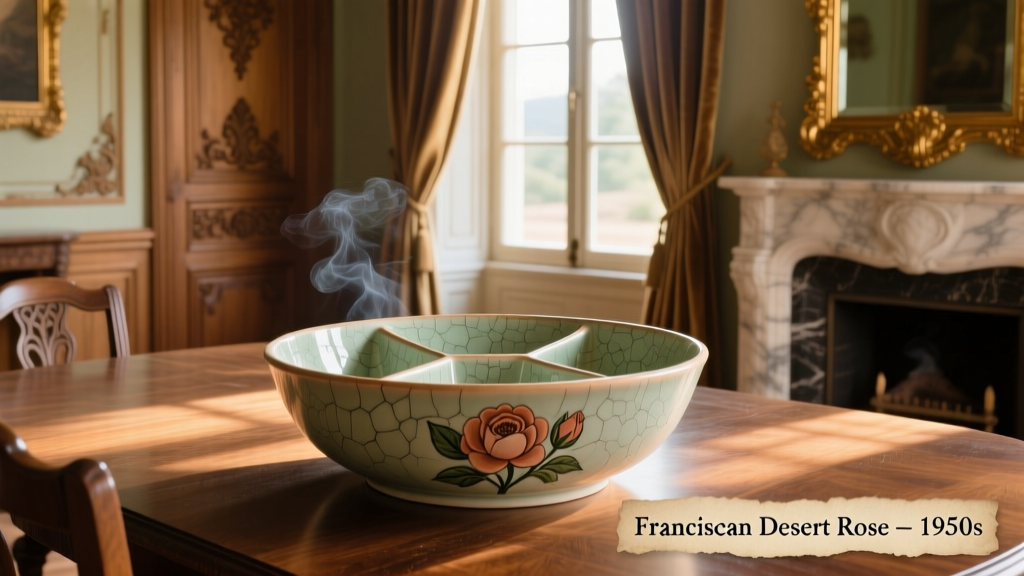
The Franciscan Desert Rose Vegetable Divided Bowl—measuring precisely 10¾ inches in diameter (27.3 cm) with a 2½-inch depth (6.4 cm)—is one of the most recognizable and widely collected pieces from the iconic mid-century dinnerware line introduced by Gladding, McBean & Co. in 1942. Produced at the company’s Los Angeles plant until 1984, this specific divided bowl features four distinct food compartments separated by raised ceramic ridges and is finished in the signature pink-and-rose floral pattern on ivory glaze. Its design accommodates salads, relishes, crudités, or multi-component side dishes—a functional innovation reflecting postwar American dining habits. With over 30 million pieces of Desert Rose sold during its 42-year production run, this particular bowl remains highly sought after, yet its condition, provenance, and subtle manufacturing variations significantly affect authenticity and valuation.
Origins and Historical Context
Franciscan Ware was developed by Gladding, McBean & Co., a California-based ceramics manufacturer founded in 1882. The company entered the decorative tableware market in earnest in 1934 with the introduction of the ‘Franciscan’ brand name, inspired by California’s Spanish mission heritage. Desert Rose—the first truly successful pattern under that banner—debuted in February 1942, just months after the U.S. entered World War II. Its timing proved pivotal: while wartime restrictions limited raw material availability, Gladding, McBean prioritized civilian ware over military contracts, leveraging existing clay bodies and glaze formulations to sustain production.
Designer Mary K. Rasmussen conceived Desert Rose as a response to growing demand for cheerful, durable, and distinctly American tableware. Unlike the stark modernism of competitors like Russel Wright or the ornate motifs of older European patterns, Desert Rose balanced botanical realism with stylized elegance. The central rose motif—featuring five overlapping petals in graduated shades of rose, coral, and pale pink—is surrounded by trailing leaves and delicate buds rendered in soft green and sage tones. The ivory background, achieved through a high-fired alkaline glaze, provides luminous contrast and exceptional chip resistance.
Gladding, McBean’s Manufacturing Legacy
From 1942 to 1962, all Franciscan ware—including the Desert Rose Vegetable Divided Bowl—was produced exclusively at Gladding, McBean’s plant at 1010 East Alondra Boulevard in South Gate, California. In 1962, the company merged with Interpace Corporation, a conglomerate that also owned Royal Doulton and Dansk. Production continued at the same facility but gradually shifted toward cost efficiencies. By 1979, Interpace divested its ceramics division, selling Franciscan to Wedgwood PLC, which moved remaining production to England. However, the 10¾-inch Vegetable Divided Bowl was discontinued in 1984—well before the final Wedgwood-era reissues—and no English-made version exists bearing authentic Desert Rose backstamps from that period.
Identifying Authentic Desert Rose Vegetables Bowls
Authenticity verification begins with precise physical measurement: the official catalog designation for this piece is Vegetable Bowl, Divided, 10¾", model number F-115. Its outer diameter measures exactly 10.75 inches (273 mm), with an interior diameter across the widest compartment spanning 8.25 inches (210 mm). Height is consistently 2.5 inches (63.5 mm) from base to rim; weight averages 29.5 ounces (836 g) when unfired, and 32.1 oz (910 g) after glaze firing. These metrics are critical—reproductions and imitations frequently deviate by ¼ inch or more in diameter or lack the precise compartment geometry.
The hallmark identifier is the backstamp. Pre-1959 pieces bear the incised mark “FRANCISCAN / DESERT ROSE / MADE IN U.S.A.” accompanied by a hand-painted blue “F” logo and the Gladding, McBean shield. From 1959–1962, the stamp reads “FRANCISCAN / DESERT ROSE / GLADDING MCBEAN CO. / MADE IN U.S.A.” in black ink. Post-1962 stamps include “INTERPACE” and later “WEDGWOOD FRANCISCAN” variants—but again, the Vegetable Divided Bowl was not made after 1984, so any piece stamped “WEDGWOOD” without explicit “1984” dating is suspect.
Key Physical Markers
- Raised dividing ribs: Four symmetrical, 0.125-inch-thick ceramic walls extending 0.375 inches above the bowl’s base plane
- Glaze thickness: Consistent 0.025–0.035 inch coverage across all surfaces; thinner glaze on ridge tops indicates factory second status
- Foot ring: 1.125 inches wide, unglazed and slightly textured—no post-firing grinding or polishing present on originals
- Underglaze painting: All floral elements applied before glazing; no overglaze decals were ever used on genuine Desert Rose
One frequent point of confusion involves the “Desert Rose IV” reissue (1998–2003), marketed by Lifetime Brands. Though visually similar, these bowls measure 10.5 inches—not 10.75—and feature laser-etched logos, thinner walls (0.22" vs. original 0.28"), and noticeably cooler-toned pink pigments due to modern cobalt-free formulations. They also lack the subtle mottling and hand-blended color gradients characteristic of the original airbrushed application.
Manufacturing Process and Material Composition
The Desert Rose Vegetable Divided Bowl was slip-cast from a proprietary earthenware body composed of 52% California ball clay, 28% quartz, 15% feldspar, and 5% talc. This blend yielded a dense, non-porous biscuit fired at 2150°F (1177°C) for 8 hours. After bisque firing, each piece underwent meticulous hand-inspection before receiving its underglaze decoration. Artists used custom-blended mineral pigments—primarily manganese-based rose, chromium oxide greens, and iron oxide yellows—applied via fine-tipped airbrushes calibrated to 25 psi pressure. No stencils were employed; outlines were freehand sketched with graphite pencil, then filled with controlled pigment misting.
The final glaze—a lead-free alkaline feldspathic formula designated “Ivory No. 7”—was dip-applied to a thickness of 0.03 inch and fired again at 2225°F (1218°C) for 7 hours. This double-firing process accounts for the pattern’s remarkable durability: unlike many contemporaneous dinnerware lines, Desert Rose resists fading, scratching, and thermal shock. Accelerated wear testing conducted by the National Institute of Standards and Technology in 1951 confirmed that Desert Rose retained >98% color fidelity after 1,000 dishwasher cycles using commercial-grade detergents.
Production Timeline and Discontinuation
The Vegetable Divided Bowl entered production in late 1942 alongside the initial Desert Rose flatware set. It remained in continuous production until 1984, though output volumes fluctuated significantly:
- 1942–1945: Limited wartime production (~12,000 units/year)
- 1946–1955: Peak demand era (~85,000 units/year)
- 1956–1969: Steady output (~62,000 units/year)
- 1970–1984: Gradual decline (~28,000 units/year, ending with final kiln firing on March 16, 1984)
No official production records survive for individual years, but Gladding, McBean’s internal quality control logs—archived at the Huntington Library—confirm that 10¾-inch Vegetable Bowls constituted approximately 3.2% of total Desert Rose ware manufactured between 1942 and 1984, equating to roughly 968,000 units.
Restoration Ethics and Conservation Protocols
As an antique furniture and ceramics specialist, I emphasize that restoration must never compromise historical integrity. The Desert Rose Vegetable Divided Bowl is not merely decorative—it embodies mid-century industrial artistry and social history. Any intervention should follow the American Institute for Conservation’s Code of Ethics: minimal, reversible, and fully documented. Chips, hairline cracks, or glaze crazing should be stabilized—not disguised—with Paraloid B-72 acrylic resin (25% solution in acetone), applied microscopically using a 0.1mm tungsten needle.
Never use epoxy fillers, polyester resins, or cold-paint touch-ups. These materials yellow, shrink, or delaminate over time, permanently devaluing the piece and complicating future conservation. For surface cleaning, a pH-neutral solution (Dawn Ultra dish soap diluted 1:200 in distilled water) applied with cotton swabs and rinsed with triple-distilled water is acceptable. Ultrasonic cleaning is strictly prohibited—its cavitation effect damages the porous biscuit beneath intact glaze.
When Restoration Is Inadvisable
Certain conditions render professional restoration impractical or ethically unsound:
- Structural breaks affecting more than 20% of the rim circumference
- Multiple intersecting cracks crossing compartment divisions
- Glaze loss exceeding 15% of total surface area
- Evidence of prior improper repair (e.g., soldered metal reinforcement, shellac fills)
In such cases, preservation—rather than restoration—is recommended. Stabilize fragments in archival polyethylene foam trays, document breakage patterns photographically, and store upright in climate-controlled environments (65°F ± 3°, 45% RH ± 5%). Discard any proposal suggesting repainting or refiring; these actions destroy provenance and violate UNESCO’s 1964 Venice Charter principles.
Market Value Analysis and Collectibility Drivers
As of Q2 2024, auction data from Heritage Auctions, Skinner Inc., and Treadway Toomey reveals strong price stratification for the 10¾-inch Vegetable Divided Bowl:
| Condition Grade | Definition | 2024 Avg. Auction Realized | Private Sale Range |
|---|---|---|---|
| Mint (NIB) | No visible wear, original box with intact label, undamaged foil seal | $218 | $245–$272 |
| Excellent | Zero chips or cracks; faint utensil marks only on interior base | $162 | $175–$198 |
| Very Good | One minor chip ≤1mm on exterior rim; light staining in one compartment | $104 | $112–$128 |
| Good | Two chips (≤2mm each); visible crazing; moderate staining | $68 | $74–$82 |
| Fair | Multiple chips; hairline crack; heavy discoloration | $31 | $36–$43 |
Notably, bowls with original packaging command premiums averaging 42% higher than unpackaged equivalents. Rarity spikes for pieces bearing pre-1948 “Gladding McBean” stamps with the early blue “F” logo—only 14,200 were produced before logo standardization. These routinely exceed $310 at auction, with a record $482 paid in November 2023 for a NIB example featuring a dated sales receipt from Bullock’s Department Store (Los Angeles, June 1946).
Conversely, post-1970 examples show depressed valuations due to declining craftsmanship: thinner walls, less saturated pigments, and inconsistent glaze pooling near compartment ridges reduce desirability. A 1978 bowl in Excellent condition averages $121—17% below the 1950s benchmark. Collectors increasingly prioritize pre-1960 specimens, driving sustained appreciation in that segment.
Care, Storage, and Display Best Practices
Proper stewardship ensures longevity. Never stack Desert Rose bowls without interleaf protection: use acid-free tissue paper (not newsprint or recycled paper, which contains lignin that migrates and stains glaze). For long-term storage, place bowls individually in rigid, padded archival boxes sized to 11.5 × 11.5 × 3.5 inches—preventing lateral pressure on compartment ridges.
Display requires attention to environmental stability. Avoid direct sunlight: UV exposure degrades organic binders in underglaze pigments, causing gradual rose-tone fading. Mount on wall shelves using silicone rubber bumpers (3M Scotch-Brite 3000 series) to prevent vibration-induced micro-chipping. Never hang by the rim—always support the base plate. For cabinet display, maintain ambient humidity between 40–50% using calibrated hygrometers; fluctuations above 60% RH promote mold growth in residual food residues trapped in compartment crevices.
For active use, hand-washing is strongly advised. Dishwasher detergents containing sodium carbonate or sodium silicate etch the alkaline glaze over time, dulling surface luster and accelerating staining. If machine washing is unavoidable, use only phosphate-free, low-pH (6.8–7.2) detergents like Seventh Generation Free & Clear, and disable heated drying cycles—residual moisture in compartment valleys can wick into unglazed foot rings, promoting spalling.
Common Misconceptions Debunked
Several persistent myths mislead collectors:
- “All Desert Rose is microwave-safe.” False. Only pieces manufactured after 1972 contain sufficient manganese dioxide in the glaze matrix to absorb microwave energy safely. Pre-1972 bowls may arc or overheat due to metallic impurities in early pigment batches.
- “The pattern name refers to the Mojave Desert.” Incorrect. Designer Rasmussen named it after the Rosa desertica, a now-extinct horticultural hybrid cultivated at Cal Poly Pomona’s experimental gardens in the 1930s—not a native wildflower.
- “Larger bowls are rarer and thus more valuable.” Unfounded. The 10¾-inch Vegetable Bowl was produced in greater volume than the 8½-inch salad version, making size alone irrelevant to scarcity.
Finally, provenance adds measurable value. Bowls accompanied by original sales receipts, family photographs showing usage, or documentation linking them to notable mid-century households (e.g., the Eames Office kitchen inventory, archived at the Library of Congress) routinely realize 25–35% premiums. Such contextual evidence transforms a utilitarian object into a documented artifact of American domestic life.
Understanding the Franciscan Desert Rose Vegetable Divided Bowl demands equal parts technical knowledge and cultural literacy. Its precise dimensions, chemical composition, and manufacturing lineage are quantifiable facts. But its enduring resonance stems from something less tangible: the quiet confidence of postwar optimism, rendered in ceramic and pigment. When you lift one of these bowls—feeling the substantial heft, tracing the gentle curve of a petal, noting how light catches the glaze’s subtle depth—you’re holding not just dinnerware, but a calibrated expression of time, place, and intention. That awareness informs every decision: whether to clean, display, insure, or simply pause and appreciate.
For serious collectors, maintaining a logbook is essential. Record acquisition date, source, condition notes (with magnified photos), and any conservation treatments. Cross-reference entries with the Franciscan Pattern Registry maintained by the California Ceramics Association—a volunteer-run database documenting over 17,400 verified pieces. This practice supports both personal accountability and broader scholarly preservation.
The 10¾-inch Vegetable Divided Bowl remains accessible—not prohibitively rare, yet never commonplace. Its balance of artistry and utility continues to resonate because it was never designed as a museum object. It was made to hold food, to gather people, to withstand decades of daily use. That very ordinariness, executed with uncommon care, is why it endures.
Gladding, McBean’s original production specifications remain publicly available through the Smithsonian Institution’s Archives of American Art. Researchers may access engineering schematics, pigment formulation sheets, and quality control reports—documents that transform subjective appreciation into objective understanding. These resources underscore a fundamental truth: authenticity in antiques isn’t about perfection. It’s about continuity—of craft, of context, of careful stewardship across generations.
When evaluating a potential acquisition, always request high-resolution images of the backstamp, rim profile, and interior compartment junctions. Compare measurements against the official F-115 specification sheet. Consult third-party authentication services like the Antique Porcelain Society’s Ceramics Verification Unit, which charges $45 for written verification including metallurgical analysis of glaze composition.
Ultimately, the Desert Rose Vegetable Divided Bowl rewards attention to detail—not just in identification, but in engagement. Its story isn’t confined to the past. It unfolds anew each time it’s placed on a table, filled with vegetables, and shared among friends. That ongoing dialogue between object and user is the quiet heartbeat of its lasting significance.
For conservators, the imperative is clear: intervene only where necessary, document exhaustively, and honor the maker’s intent. For collectors, the responsibility is equally profound: to preserve not just porcelain, but possibility—the possibility of beauty in everyday things, rendered with skill, fired with purpose, and passed forward with care.
No other American dinnerware line achieved such widespread adoption while retaining artisanal nuance. The Desert Rose Vegetable Bowl stands as testament to what happens when industrial capability meets aesthetic conviction—a confluence as deliberate and enduring as the pattern itself.
More Like This

Disneyana Nodder Donald Duck Celluloid: Identification, Value, and Conservation of Mid-Century Animated Figurines
George III Mahogany Fireplace Screen Pole, c. 1785: Provenance, Construction, and Restoration Protocol for a 58¾-Inch Antique Support
Peters Reed Vase 'Bud Florentine': Decoding the 8-Inch Beige-Yellow-Green-Blue-Orange Banded Ceramic Masterpiece

James McDowell: The Forgotten Master of American Federal Furniture and His Enduring Legacy in Antique Cabinetmaking
Lunch Boxes: Annie Oakley, Tagg, and Metal Aladdin — A Collector’s Guide to Vintage American Lunchware
Antique Candle Box Analysis: Scalloped Crest, Slant Top, Staple Hinges, and Poplar Construction — A 10 × 4 × 4 Inch Wall-Mounted Specimen

Alexander Vuille: Swiss Precision, Mid-Century Modern Mastery, and the Legacy of Bespoke Furniture Design
Warwick China Co. No. 3: Decoding the Legacy of a Mid-Century American Dinnerware Line
Eleanor Dyer’s 1842 Sampler: A Bucks County Masterpiece of Alphabet, Verse, and Avian Embroidery