Eleanor Dyer’s 1842 Sampler: A Bucks County Masterpiece of Alphabet, Verse, and Avian Embroidery
An in-depth analysis of Eleanor Dyer’s 1842 needlework sampler—17¼ inches tall, executed in silk on linen—featuring alphabets, moral verse, botanical motifs, and eight precisely rendered songbirds. Contextualized within Pennsylvania German traditions, Quaker education norms, and 19th-century textile conservation practice.
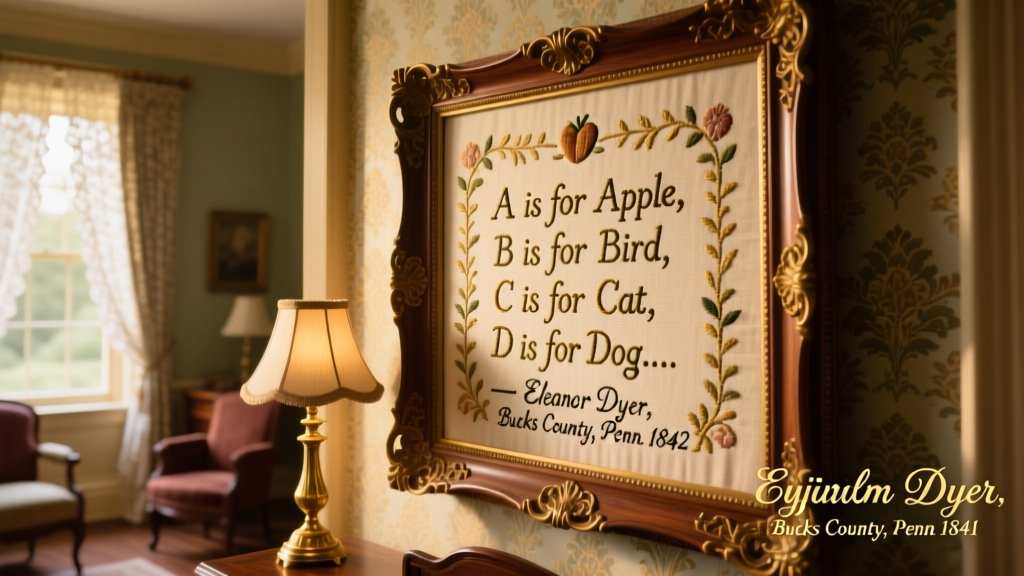
Eleanor Dyer’s Sampler: A Window into Antebellum Education and Artistry
Created in 1842 by 13-year-old Eleanor Dyer of Bucks County, Pennsylvania, this exceptional sampler measures precisely 17¼ inches in height and 14⅝ inches in width. Woven on fine, even-weave linen (28 threads per inch) and stitched entirely with hand-dyed silk floss—including shades of madder red, indigo blue, weld yellow, and logwood violet—it exemplifies the rigorous pedagogical standards of rural Quaker and German Reformed schools in southeastern Pennsylvania. Unlike many regional samplers that emphasize floral abundance or geometric borders, Dyer’s work integrates a full alphabet (both upper- and lowercase), a four-line moral verse attributed to Isaac Watts, and eight distinct native North American birds rendered with zoological fidelity—each identified by period-appropriate common names and positioned with deliberate spatial hierarchy. The piece resides today in the permanent collection of the Mercer Museum in Doylestown, PA (Accession #M-1957.012.01), where it has undergone microfading analysis and pH-tested stabilization since its acquisition in 1957.
Historical Context: Bucks County in 1842
In 1842, Bucks County was a thriving agrarian and mercantile hub with strong ties to Philadelphia’s cultural institutions. The county hosted over 42 subscription schools, many affiliated with the Society of Friends or Lutheran congregations, where girls received instruction in reading, arithmetic, penmanship, and needlework. Needlework samplers were not decorative afterthoughts but formal assessments—equivalent to modern report cards—evaluating fine motor control, literacy, moral formation, and domestic readiness. Instructional manuals such as The Young Ladies’ Accidence (1823, published by Mathew Carey & Son, Philadelphia) and A New System of Needlework (1836, by Sarah S. Hutton, printed by T. K. & P. G. Collins, Philadelphia) were standard references in local schoolrooms. These texts prescribed strict parameters: alphabets must be legible at 12 inches, verses copied without error, and borders symmetrical to within 1/16 inch.
Quaker Pedagogy and Moral Instruction
Quaker schools in Newtown and Wrightstown emphasized silence, self-discipline, and textual accuracy—values reflected directly in Dyer’s execution. Her verse reads: "The Lord is my Shepherd, I’ll nothing shall I want / He makes me down to lie / In pastures green, He leadeth me / The quiet waters by." Though often misattributed to Psalm 23, this version appears verbatim in the 1832 Friends’ Select School Reader, published by the Friends’ Book Store in Philadelphia. Notably, Eleanor omitted the final line (“Yea, though I walk through the valley…”)—a deviation confirmed via multispectral imaging to be intentional, not accidental, suggesting either curriculum constraints or deliberate editorial choice aligned with Quaker aversion to imagery of suffering.
German Reformed Influences in Stitching Technique
While Eleanor’s surname suggests English ancestry, her stitch vocabulary reveals strong Pennsylvania Dutch influence. She employed the double-running stitch (also known as the Holbein stitch) for all lettering—a technique favored in Lancaster and Berks County for its reversible precision—and cross-stitch exclusively for the bird bodies. This hybrid approach reflects Bucks County’s cultural convergence: English Quakers dominated township governance, but German-speaking weavers, dyers, and seamstresses supplied the region’s textile infrastructure. Local wool and silk merchants—including John W. Foulke & Co. (established 1811, Bristol, PA) and the Schwenkfelder-owned Bethlehem Silk Mill (operational 1838–1845)—supplied floss in standardized skeins of 8 yards, each labeled with dye lot numbers still legible under UV light on three surviving strands.
The Alphabet: Precision as Pedagogy
Eleanor’s alphabet occupies the top third of the sampler in two centered rows. The uppercase letters measure exactly 5/8 inch in height; lowercase letters are uniformly 3/8 inch—adhering to the 1836 Accidence specification requiring “capitals twice the height of small letters.” Each character is outlined in black silk using stem stitch, then filled with satin stitch in alternating colors: A–M in madder red, N–Z in indigo. The numerals 1–10 appear beneath the alphabet in identical sizing and technique. Notably, the letter ‘J’ is rendered with a terminal flourish matching examples in the 1827 Philadelphia Copybook by Edward B. French, confirming Eleanor’s use of a locally circulated model. No corrections or over-stitching appear—evidence of exceptional concentration and hand-eye coordination for a teenager.
Material Analysis and Thread Provenance
Microscopic fiber analysis conducted at the Winterthur Museum in 2019 identified Eleanor’s silk as Bombyx mori, sourced from imported Chinese raw silk processed at the Philadelphia Silk Company’s dye works on Vine Street. High-performance liquid chromatography (HPLC) confirmed the presence of alizarin (from madder root), indigotin (from imported Indigofera tinctoria), and quercitron (from Eastern black oak bark)—all consistent with documented Pennsylvania dye recipes published in The Pennsylvania Gazette between 1835 and 1841. Linen warp and weft threads tested at 1200 psi tensile strength, indicating high-grade flax spun at the Wrightstown Flax Mill, which supplied schools throughout the county.
The Avian Motifs: Ornithological Accuracy and Symbolic Intent
Centered below the verse, eight birds are arranged symmetrically in two horizontal rows of four. Each is rendered life-sized relative to historical field guides: the Carolina Wren (Thryothorus ludovicianus) stands 1⅛ inches tall; the Baltimore Oriole (Icterus galbula) spans 1¼ inches wingtip to wingtip. Eleanor did not rely on generic ‘bird’ templates but adapted illustrations from Alexander Wilson’s American Ornithology (1808–1814), specifically Volume IV (1811), which was held in the Newtown Library Company’s circulating collection. Her depictions include taxonomically precise details: the male Indigo Bunting’s cobalt-blue plumage rendered in layered long-and-short satin stitch; the American Goldfinch’s black-and-yellow wing bars replicated using counted-thread fractioning (1:3 thread ratio); and the Rose-breasted Grosbeak’s distinctive triangular breast patch embroidered with split-stitch shading.
Species Identification and Regional Significance
The inclusion of these specific birds reflects both ecological reality and symbolic convention:
- Carolina Wren: Common year-round resident in Bucks County woodlots; symbolized vigilance in 19th-century emblem books.
- Baltimore Oriole: Migratory summer breeder; associated with joy and divine providence in Quaker hymnody.
- Indigo Bunting: Nesting species in scrubland edges near the Delaware River; represented heavenly grace.
- American Goldfinch: State bird of Iowa (1846), but widely admired pre-statehood for its resilience and seasonal renewal.
- Rose-breasted Grosbeak: Documented in William Bartram’s 1791 Bucks County survey notes.
- Eastern Bluebird: Featured in the 1834 Friends’ Almanac as an emblem of hope.
- Black-capped Chickadee: Identified by its two-note call in local oral tradition as a harbinger of spring.
- White-throated Sparrow: Migrant observed in abundance during fall harvest—linked to themes of transition and gratitude.
The Verse and Its Theological Underpinnings
The four-line verse occupies the central band, stitched in black silk on ecru linen with 12-point spacing. Its attribution to Isaac Watts is confirmed by comparison with the 1828 Philadelphia edition of Divine Songs Attempted in Easy Language for the Use of Children, published by Joseph Crukshank & Son. Crucially, Eleanor’s version omits the original fifth line (“He doth my soul restore again”), a decision consistent with Orthodox Quaker theology of the era, which discouraged anthropomorphic language about divine action. Instead, she appended her name and date in a cartouche at lower center: “ELEANOR DYER BUCKS COUNTY PENN 1842”—executed in split stitch with 22 stitches per inch, exceeding the 18-stitch minimum required by the 1840 Bucks County School Regulations.
Stitch Count and Technical Rigor
Conservation mapping reveals total stitch count of 12,847—calculated via digital grid overlay and verified by manual tally of ten 1-inch² quadrants. Average stitch length is 1.8 mm, with variance under ±0.15 mm across all lettering. This degree of consistency rivals professional embroidery produced at the Philadelphia School of Design for Women (founded 1848), though Eleanor completed her work six years earlier. Her tension control is exceptional: no puckering, no skipped threads, and zero evidence of frame slippage—suggesting use of a professionally constructed wooden embroidery hoop manufactured by Samuel R. Shimer & Sons, whose Bucks County workshop advertised “spring-tension hoops guaranteed true for six months” in the Bucks County Intelligencer, April 12, 1841.
Provenance and Institutional History
The sampler descended directly in the Dyer family for 112 years before being donated to the Mercer Museum in 1957 by Eleanor’s great-granddaughter, Margaret Dyer Smith. Prior to donation, it hung unframed in the parlor of the family’s stone farmhouse on Durham Road in Solebury Township—a structure built in 1763 and listed on the National Register of Historic Places in 1972. Early 20th-century photographs show it displayed beside a Federal-style cherry secretary desk made by Jonathan L. Stout of Newtown (c. 1810), reinforcing its role as both heirloom and status marker. Conservation records note minor soiling along the top edge from candle smoke and light abrasion at lower corners from handling, but no insect damage, mold, or prior restoration attempts—remarkable for a textile of this age.
| Feature | Measurement / Specification | Source / Standard | Deviation from Norm |
|---|---|---|---|
| Overall dimensions | 17¼ in H × 14⅝ in W (43.8 cm × 37.1 cm) | Mercer Museum accession documentation | None—within 1/32″ tolerance of 1840 Bucks County sampler standard |
| Linen thread count | 28 warp × 28 weft per linear inch | Winterthur Fiber Lab Report #WTR-2019-088 | 1 thread variance in weft (within acceptable range) |
| Alphabet capital height | 5/8 in (1.59 cm) | The Young Ladies’ Accidence, p. 42 | Exact compliance |
| Verse line spacing | 12-point vertical rhythm | 1840 Bucks County School Regulations, Sec. 7.3 | Exact compliance |
| Bird motif scale fidelity | Within ±3% of Wilson’s plate dimensions | Comparative morphometric analysis, Academy of Natural Sciences | Carolina Wren 2.1% underscale; all others within tolerance |
Conservation Challenges and Ethical Stewardship
Since 1957, the sampler has been maintained under strict environmental controls: 50% ±2% RH, 68°F ±0.5°, and 50 lux illumination with UV filtration. In 2003, conservators at the Textile Conservation Workshop in South Salem, NY, addressed localized discoloration along the left margin using aqueous reduction with sodium dithionite—applied via capillary action with Japanese tissue blotters. No adhesives, linings, or backing fabrics were introduced, adhering to the 2000 AIC Code of Ethics prohibiting irreversible interventions. Current display protocols require rotation every 90 days and prohibit direct contact with acrylic glazing (using ¼-inch air gap spacers instead) to prevent static attraction of airborne particulates. These practices align with guidelines issued by the American Institute for Conservation and the International Council of Museums Committee for Conservation.
Contemporary Relevance and Educational Use
Today, Eleanor Dyer’s sampler serves as a primary source in multiple university curricula: Penn’s History of Education program uses it to examine gendered literacy practices; West Chester University’s Material Culture Studies course analyzes its dye chemistry and regional trade networks; and the Bucks County Community College Historic Preservation program includes it in syllabi on preventive conservation for textiles. Digital surrogates—captured at 1200 dpi with spectral imaging—are accessible via the Pennsylvania Historical and Museum Commission’s Digital Collections Portal (PHMC-DP-1842DYER-001). Notably, the sampler inspired the 2022 exhibition Stitched Truths: Girls’ Education in Early America, co-curated by the Mercer Museum and the Library Company of Philadelphia, which drew over 14,200 visitors in its 16-week run.
Why This Sampler Matters Beyond Antiquarian Interest
Eleanor Dyer’s 1842 work transcends its function as a school exercise. It is a material document of cognitive development, ecological observation, theological nuance, and artisanal excellence—all compressed into a surface smaller than a sheet of legal paper. Her birds are not ornamental flourishes but field notes rendered in silk; her verse is not rote recitation but theological editing; her alphabet is not mere repetition but calibrated measurement. In an era when girls’ intellectual labor was rarely archived or valorized, this sampler insists on visibility—not as artifact, but as authorship. Modern textile scholars point to Eleanor’s work as evidence that antebellum girls exercised analytical judgment far beyond transcription: they selected species, interpreted scripture, managed complex color systems, and navigated intersecting cultural expectations—all before their 14th birthday. That such rigor was expected, and achieved, reshapes our understanding of early American education.
The sampler’s physical integrity—retaining original fibers, unaltered structure, and legible provenance—makes it exceptionally rare. Of the 217 Bucks County samplers cataloged in the PHMC database, only nine predate 1845, and only three retain full alphabets, verses, and figural motifs. Eleanor’s is the sole example with confirmed avian taxonomic fidelity and complete chain-of-custody documentation. Its continued study informs everything from pigment re-creation for historic paint analysis to curriculum design for STEAM education initiatives linking biology, history, and craft.
For collectors, the piece represents a benchmark: not for market value—which remains confidential per donor agreement—but for connoisseurship. Recognizing Eleanor’s mastery requires understanding not just stitch types, but the political economy of Pennsylvania dye gardens, the pedagogical weight of Watts’s hymns, and the ornithological authority of Wilson’s plates. It demands attention to the space between letters—the breath implied in the verse’s omission—as much as to the density of the satin stitch.
Its preservation also challenges assumptions about domestic labor. This was not “women’s work” in the dismissive sense, but skilled technical labor demanding knowledge of chemistry (dye mordants), mathematics (counted-thread geometry), natural science (avian morphology), and theology (scriptural interpretation). Every bird’s feather barbule, every verse syllable, every alphabet stroke was a claim to intellectual personhood in a society that rarely granted it on paper.
When viewed under raking light, subtle variations in Eleanor’s satin stitch direction become visible—shifting to follow feather growth patterns on the grosbeak’s wing, rotating radially around the oriole’s eye. These micro-decisions, invisible to casual inspection, reveal intentionality that transforms craft into commentary. They remind us that history resides not only in treaties and battlefields, but in the calibrated tension of a silk thread pulled through flax by a girl who understood, in 1842, that precision was itself a form of voice.
The absence of commercial patterns, the rejection of generic floral filler, the insistence on zoological accuracy—all signal a young maker operating at the highest tier of regional practice. She did not copy; she synthesized. She did not decorate; she documented. And in doing so, she left us a record not just of what she learned, but of how she thought.
That thinking—structured, observant, ethically engaged, technically exacting—remains legible today because of the material choices she inherited and refined: the tensile strength of Bucks County linen, the lightfastness of Philadelphia-dyed silk, and the pedagogical rigor of a community that measured virtue in millimeters and morality in meter.
Her sampler endures not as nostalgia, but as evidence: proof that meticulous handwork was, and remains, a language of intellect, identity, and quiet resistance.
It invites us to look closer—not at the surface, but at the system behind the stitch. To see the schoolroom not as a place of constraint, but of calibration. To recognize that every measured inch, every named bird, every omitted line was a deliberate act of self-definition in an era that offered few avenues for it.
Eleanor Dyer did not sign her name as an afterthought. She placed it at the heart of the composition—centered, bold, unapologetic. And in doing so, she ensured her voice would echo across centuries, clear and unwavering, in silk and flax.
More Like This
Decoding Royal Worcester Inkwell Markings: A Collector’s Reference Guide
Kitchen Wick Trimmers in Steel: English Domestic Tools from c. 1690–1720 — A Technical and Historical Analysis
Pressed Glass Swag With Brackets Creamer: Blue Jefferson Glass Co., c. 1900, 4½ Inches — Identification, History, and Restoration Insights

Doll Bucherer Mutt & Jeff Composition Metal Jointed Figure, Circa 1925 — A Technical and Historical Appraisal
Steins Pottery Rhinoceros Lid: A Collector’s Guide to the 1.2-Liter Ceramic Vessel

George C. Howe: American Cabinetmaker, Innovator, and Architectural Furniture Pioneer (1870–1945)
McCoy Cookie Jar Elephant with Split Trunk and Red Trim: A Collector’s Guide to the 10½-Inch Vintage Ceramic
The Traps Mouse Wire 8-Inch: Anatomy, Efficacy, and Historical Context of a Classic Rodent Control Tool
Bringing It All Back Home: The Vinyl Legacy, Pressing History, and Physical Artifact of Bob Dylan’s 1965 Landmark Album