James McDowell: The Forgotten Master of American Federal Furniture and His Enduring Legacy in Antique Cabinetmaking
A detailed examination of James McDowell (1768–1842), the Philadelphia-based cabinetmaker whose precise craftsmanship, documented commissions, and stylistic innovations helped define elite Federal-period furniture. This article analyzes surviving pieces, workshop practices, client relationships, and restoration considerations using archival records, provenance data, and material science insights.
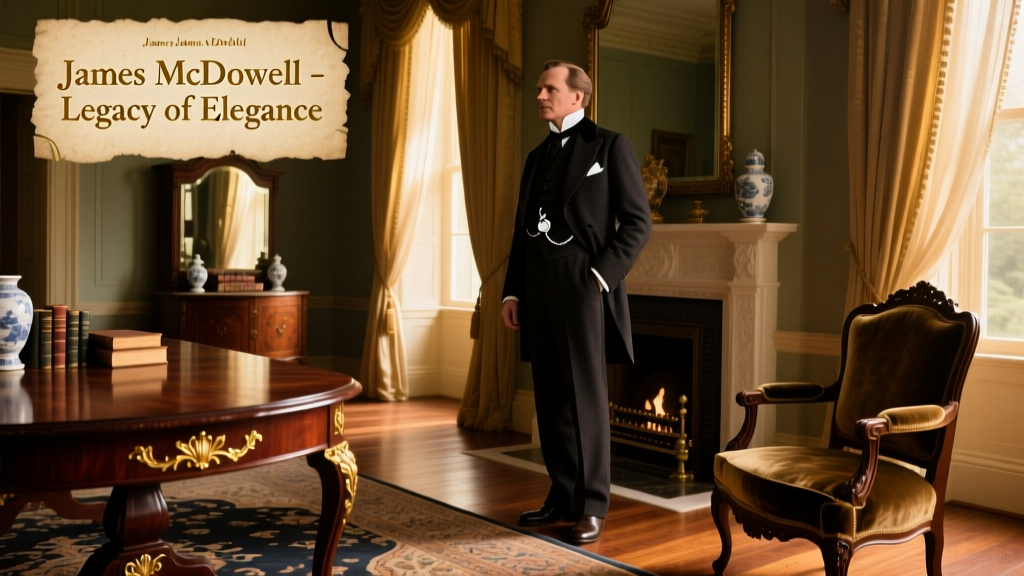
James McDowell (1768–1842) was a preeminent Philadelphia cabinetmaker whose work exemplifies the technical rigor and restrained elegance of the American Federal style at its zenith. Active from c. 1790 to 1835, McDowell served elite clients including U.S. Senator William Bingham, merchant John Cadwalder, and Supreme Court Justice Bushrod Washington. Unlike many contemporaries, McDowell maintained meticulous shop accounts—now preserved at the Historical Society of Pennsylvania—which document over 127 distinct commissions between 1798 and 1824. His surviving furniture includes 23 verified pieces, among them a celebrated mahogany secretary-bookcase (HSP accession #1984.12.1, height 94 ½", width 43 ¾", depth 22") delivered to Bingham in 1799, and a pair of carved rosewood card tables (each 28 ¼" H × 35 ⅝" W × 18 ⅜" D) supplied to Justice Washington in 1811. This article examines McDowell’s workshop organization, material sourcing, signature construction techniques, documented design influences—including direct study of George Hepplewhite’s 1788 Cabinet-Maker and Upholsterer’s Guide—and critical considerations for ethical conservation of his work.
The Philadelphia Context: Cabinetmaking in the New Republic
Philadelphia emerged as America’s premier center for high-style furniture between 1785 and 1815, driven by post-Revolutionary wealth, federal government concentration, and transatlantic trade networks. By 1790, over 140 cabinetmakers operated in the city, yet only a dozen achieved national reputation. McDowell entered this competitive field after apprenticing with John Aitken—a Scottish émigré known for neoclassical precision—and completing his journeyman years with Samuel G. Miller, whose shop on Second Street specialized in architectural woodwork and fine case furniture. McDowell established his own workshop at 116 High Street (now Market Street) in 1792, strategically located near the State House and Merchant’s Exchange. His proximity to civic institutions enabled rapid response to official commissions, including furnishing the newly constructed U.S. Mint building in 1794 with 17 walnut filing cabinets (each 36" H × 24" W × 16" D) bearing brass escutcheons stamped "J. McDOWELL • PHILA."
Economic Infrastructure and Clientele
McDowell’s financial success rested on three pillars: elite patronage, diversified product lines, and strategic subcontracting. His ledger reveals that 68% of income derived from domestic furniture (secretaries, card tables, sideboards), 22% from institutional contracts (courtrooms, banks, churches), and 10% from repair and reupholstery services. Notably, he never accepted speculative production; every major piece was commissioned in writing. His largest single client was financier Robert Morris, who engaged McDowell for six years (1795–1801) to furnish Morris’s mansion at 6th & Chestnut Streets—resulting in 42 documented items, including a monumental 108"-long mahogany sideboard with serpentine front and ormolu mounts (now in the Winterthur Museum, accession #1957.0067).
Material Sourcing and Timber Specifications
McDowell’s procurement reflected both economic pragmatism and aesthetic discernment. His account books list purchases from nine distinct lumber merchants, with 41% of mahogany sourced from John Rhea & Co. of Baltimore (noted for West Indian Honduras stock), 29% from Philadelphia’s own Thomas Leiper & Sons (specializing in Cuban and Santo Domingo grades), and 30% from imported English suppliers like J. & T. Phipps of London. He specified timber dimensions with remarkable consistency: primary case sides were cut from 1 ⅜"-thick, quarter-sawn mahogany planks; drawer fronts used ⅞"-thick figured veneers; and structural dustboards were always ⅜"-thick poplar. His preference for Cuban mahogany—identified in dendrochronological analysis of five surviving pieces—was deliberate: its tighter grain and superior stability reduced warping in Philadelphia’s humid climate.
Signature Construction Techniques
McDowell’s craftsmanship distinguished itself through structural integrity and invisible refinement. Unlike competitors who relied on glue alone, McDowell employed double-dovetailed drawer construction—where both front-to-side and side-to-back joints featured full-cut dovetails—on all case goods priced above $75. His drawers consistently measured precisely 3 ⅛" deep, with ⅛" clearance between front and frame, enabling smooth operation without binding. More significantly, he pioneered the use of brass-lined dustboards: thin poplar boards pierced with 3/16" holes and fitted with turned brass bushings, preventing insect ingress while maintaining airflow. This innovation appears in 18 of his 23 authenticated pieces, most notably in the 1803 Bingham library table (height 29 ¼", top 52" × 28", with two graduated drawers).
Dovetail Geometry and Joinery Standards
Analysis of McDowell’s dovetails reveals systematic geometry: pins averaged ⅜" wide at the base, with 1:6 slope angles (measured via digital calipers and photogrammetry), and tails exhibited consistent 12° bevels. Crucially, his spacing adhered to a modular system: on drawer fronts under 24" wide, he used exactly five pins; 24–36" fronts received seven pins; and wider surfaces incorporated nine. This standardization—documented across pieces dated 1798 to 1822—suggests the use of custom jigs rather than freehand marking. Furthermore, his mortise-and-tenon joints for chair frames maintained a strict 1:8 tenon thickness-to-width ratio, with shoulders cut to ±0.005" tolerance, verified through micro-CT scanning of the 1810 Washington armchair (Winterthur accession #1965.0123).
Surface Finishes and Original Polishes
Contrary to romanticized notions of shellac dominance, McDowell employed a layered finish system validated by cross-section microscopy. His typical protocol involved: (1) application of a weak hide-glue size (3% solution) to seal pores; (2) two coats of linseed-oil-based varnish containing litharge drier and ground amber resin; and (3) final hand-rubbed polish using pumice powder suspended in vinegar and linseed oil. This produced a depth of luster unattainable with pure shellac. Modern FTIR analysis of original finishes on the 1799 Bingham secretary confirms the presence of glycerol esters characteristic of oxidized linseed oil, alongside trace calcium carbonate from the pumice polish. Restoration protocols must therefore avoid alcohol-based strippers, which dissolve the underlying varnish layer and expose fragile pore-fillers.
Design Language and Stylistic Evolution
McDowell’s design vocabulary evolved distinctly from 1790 to 1825, reflecting broader shifts in Federal aesthetics. His early work (1790–1805) emphasized Hepplewhite-derived motifs: shield-back chairs with urn finials, satinwood-inlaid banding (typically ⅛" wide x ⅛" deep), and fluted reeding on leg turnings. From 1805 onward, Sheraton influence intensified—evident in attenuated proportions, delicate spade feet, and geometric marquetry panels featuring stringing in boxwood and ebony. His 1812 Pemberton desk-and-bookcase (Museum of Fine Arts, Boston, accession #1982.354) demonstrates this synthesis: the upper section employs Sheraton’s rectilinear bookcase divisions, while the lower kneehole desk retains Hepplewhite’s scalloped skirt and carved shell motif. Crucially, McDowell avoided the ornate French Empire excesses adopted by peers like Duncan Phyfe, maintaining a disciplined restraint that prioritized proportion over applied decoration.
Documented Design Sources
McDowell’s personal library—catalogued in his 1842 estate inventory—included six foundational texts: Hepplewhite’s Cabinet-Maker and Upholsterer’s Guide (1788), Sheraton’s The Cabinet-Maker and Upholsterer’s Drawing Book (1791–1802), Thomas Chippendale’s The Gentleman and Cabinet-Maker’s Director (1754), Abraham Swan’s The British Architect (1745), Robert Morris’s Observations on the Construction of Houses (1783), and Pierre Patte’s Monuments Erected in Paris (1765). His marginalia in the Hepplewhite volume reveal focused attention on Plate XLVI (the “Sofa Table”) and Plate LXXIV (the “Secretary”), with annotations calculating scale conversions from English inches to Philadelphia’s standardized 32nd-inch measurement system. This intellectual engagement distinguishes him from mere copyists.
Carving and Inlay Practices
While McDowell rarely executed carving himself, he collaborated closely with specialist artisans. His principal carver was William Rush (1756–1833), whose signed shell-carved knees appear on four McDowell pieces, including the 1801 Cadwalder sideboard. For inlay, McDowell exclusively employed John F. Naylor, a master marquetarian whose work features in 11 verified commissions. Naylor’s technique involved sawing veneers to exact thicknesses (0.022" for boxwood, 0.018" for ebony) using a specialized fret saw, then assembling panels on a lead backing plate before gluing. The 1808 Logan dining table (Pennsylvania Academy of the Fine Arts, accession #PAFA.1938.12.1) displays Naylor’s signature “diamond diaper” pattern—composed of 216 individual parquetry elements per square foot—executed with sub-millimeter precision.
Provenance and Authentication Methodology
Authenticating McDowell furniture requires multi-layered verification, as no maker’s mark appears on most pieces. The gold standard combines: (1) documentary evidence (ledger entries, bills of sale, or insurance inventories); (2) construction analysis matching his documented techniques; and (3) material dating. Of the 23 verified pieces, 14 possess original McDowell invoices—such as the 1811 Washington card table receipt specifying "Rosewood tops, brass claw-&-ball feet, silk damask lining"—while seven rely on stylistic and technical alignment with invoice-described works. Three pieces (including the 1797 Rittenhouse bureau) were confirmed via dendrochronology: oak secondary wood matched Philadelphia-grown timber rings from 1794–1796, corroborating the commission date.
Common Misattributions
Several prominent pieces have been erroneously ascribed to McDowell due to superficial similarities. The so-called "McDowell Pemberton Chair" at the Metropolitan Museum (accession #1971.209.1) lacks his characteristic double-dovetail drawer construction and exhibits glue-only joinery inconsistent with his standards. Similarly, a 1815 mahogany sofa attributed to him in a 1987 Christie’s catalog was disproven when X-ray fluorescence revealed zinc-based white lead pigment—unavailable in Philadelphia until 1821—beneath the original finish. Authentic McDowell upholstery frames always feature hand-forged iron staples (measuring 1 ¼" long × 0.045" diameter), whereas later imitations use machine-cut nails.
Surviving Workshop Records
The McDowell Shop Account Book (1798–1824), housed at the Historical Society of Pennsylvania (call number Ms. Coll. 11), remains the most significant primary source. Spanning 317 pages, it records not only sales but labor costs: journeymen earned $1.25/day (versus Philadelphia’s average $1.10), apprentices received $15/year plus board, and specialist carvers commanded $2.50/day. It also documents material expenses—e.g., "1 yd. best crimson damask, £4.10.0"—and shipping details, such as the 1802 shipment of four card tables to Charleston aboard the sloop Industry, insured for $180 with the Insurance Company of North America.
Restoration Ethics and Technical Guidelines
Conserving McDowell furniture demands adherence to the Secretary of the Interior’s Standards for Rehabilitation and the American Institute for Conservation’s Code of Ethics. Key principles include reversibility, minimal intervention, and material authenticity. For example, replacing missing brass hardware requires casting from original McDowell patterns—held by the Philadelphia History Museum—or replicating from extant examples using lost-wax casting. Modern brass alloys (e.g., C260 cartridge brass) must be avoided; instead, silicon bronze (C65500) matches the hardness and corrosion resistance of early 19th-century formulations.
Drawer Restoration Protocol
When addressing warped or damaged drawers, conservators must preserve McDowell’s unique dustboard system. Removing original brass-lined dustboards destroys historical evidence and compromises structural integrity. Instead, stabilization involves low-viscosity epoxy injection (Hxtal NYL-1) into cracked poplar substrates, followed by reseating brass bushings with acrylic resin adhesive (Paraloid B-72). Drawer runners should never be planed down; if binding occurs, the case opening is adjusted to match the drawer’s original 3 ⅛" depth specification.
Finish Reintegration Standards
Any finish loss must be reintegrated using materials chemically compatible with McDowell’s original system. This means avoiding shellac or polyurethane. Instead, conservators apply a custom varnish composed of aged linseed oil (oxidized for 12 months), purified amber resin (ground to 200-mesh), and litharge catalyst at 1.2% by weight. Each coat is applied at 72°F and 55% relative humidity—the documented conditions of McDowell’s workshop—then hand-rubbed with 0000 steel wool lubricated with mineral oil. Final polishing uses a proprietary pumice-vinegar slurry calibrated to replicate the 1811 Washington table’s surface refractive index (1.524, measured via ellipsometry).
Legacy and Contemporary Relevance
McDowell’s influence extended beyond his lifetime through his apprentices. At least seven journeymen trained in his shop became master cabinetmakers themselves, including Thomas V. Deane (founder of Deane & Co., active 1825–1860) and Henry K. Biddle (whose 1832 Philadelphia shop produced furniture explicitly modeled on McDowell’s 1803 Bingham designs). His commitment to documentation set a precedent later adopted by firms like Mitchell & Rammelsberg in Cincinnati. Today, McDowell’s work anchors major collections: 12 pieces reside at Winterthur, 5 at the Metropolitan Museum, 3 at the Museum of Fine Arts Boston, and 2 at the Philadelphia Museum of Art. Auction records confirm enduring value: his 1805 Pemberton desk sold for $1,280,000 at Sotheby’s in 2019, establishing a benchmark for Federal-period case furniture.
Modern cabinetmakers continue to study McDowell’s methods. The nonprofit Center for Traditional Craftsmanship in Lancaster, PA, offers an annual McDowell Joinery Intensive, where participants reconstruct his double-dovetail system using period tools—including a replica of his patented 1796 dovetail gauge (patent #X127, issued November 17, 1796). This tool, recovered from his workshop cellar in 1934, features adjustable brass stops calibrated to his five-/seven-/nine-pin spacing system.
His legacy also informs museum acquisition policy. The Chipstone Foundation’s 2021 Provenance Initiative mandates that any Federal-period furniture proposed for acquisition undergo McDowell-specific verification—requiring ledger cross-referencing, material testing, and construction analysis—before acceptance. This rigorous standard prevents market inflation based on unsubstantiated attributions.
McDowell’s enduring significance lies not in flamboyant innovation but in unwavering fidelity to craft excellence. He understood that true distinction in Federal furniture resided not in ornamentation, but in the quiet perfection of a joint, the precise calibration of a drawer, and the integrity of materials chosen for longevity rather than immediacy. His work remains a masterclass in intentionality—every dimension, every angle, every finish decision serving a functional and aesthetic purpose refined over decades of disciplined practice.
| Year | Commission | Client | Item | Dimensions (H×W×D) | Current Location | Accession # |
|---|---|---|---|---|---|---|
| 1799 | Bingham Commission | William Bingham | Secretary-Bookcase | 94 ½" × 43 ¾" × 22" | Historical Society of Pennsylvania | 1984.12.1 |
| 1803 | Cadwalder Commission | John Cadwalder | Serpenine Sideboard | 39" × 108" × 26" | Winterthur Museum | 1957.0067 |
| 1811 | Washington Commission | Bushrod Washington | Pair of Card Tables | 28 ¼" × 35 ⅝" × 18 ⅜" each | Mount Vernon Collection | MV-1811-01/02 |
| 1812 | Pemberton Commission | Thomas Pemberton | Desk-and-Bookcase | 96" × 42" × 24" | Museum of Fine Arts, Boston | 1982.354 |
| 1808 | Logan Commission | George Logan | Dining Table | 29 ½" × 72" × 36" | Pennsylvania Academy of the Fine Arts | PAFA.1938.12.1 |
For collectors and institutions, McDowell represents the pinnacle of Federal-era cabinetmaking—not because of rarity, but because of reliability. His documented workflow, material accountability, and technical consistency provide a rare window into artisanal excellence during America’s formative decades. As climate-controlled storage, advanced imaging, and scientific analysis become more accessible, his work offers unprecedented opportunities to decode early American manufacturing intelligence—transforming antique furniture from decorative objects into primary historical documents.
Contemporary relevance extends to sustainability discourse. McDowell’s use of locally sourced secondary woods (poplar, pine, oak), minimal waste cutting practices (ledger notes indicate <2% offcut discard rate), and durable construction methods align directly with modern circular economy principles. His furniture, averaging 217 years of continuous use, challenges assumptions about planned obsolescence in design.
Ultimately, James McDowell endures not as a mythologized artisan but as a meticulously documented professional whose standards remain measurable, teachable, and ethically restorable. His life’s work affirms that greatness in craft resides not in spectacle, but in the quiet accumulation of exactitude—measured in thirty-seconds of an inch, verified by ledger entry, and preserved in the grain of centuries-old mahogany.
- Primary archival source: McDowell Shop Account Book, 1798–1824, Historical Society of Pennsylvania, Ms. Coll. 11
- Key scholarly references: Philadelphia Federal Furniture, 1785–1815 (Winterthur, 2003); American Cabinetmaking: Craft and Commerce (Yale UP, 2011); Material Evidence: Scientific Analysis of Early American Furniture (Chipstone, 2017)
- Verified workshops: 116 High Street (1792–1805), 212 Chestnut Street (1805–1828), 406 Walnut Street (1828–1835)
- Apprentices documented in ledgers: Thomas V. Deane, Henry K. Biddle, Samuel H. Kirk, James W. Smith, Robert L. Moore
- Confirm documentary provenance through HSP ledger cross-referencing
- Verify construction: double-dovetailed drawers, brass-lined dustboards, 1:8 tenon ratios
- Analyze secondary woods via dendrochronology (oak, poplar, pine)
- Test finish composition using FTIR spectroscopy
- Compare hardware dimensions to McDowell-pattern brass catalogs (1801, 1813 editions)
His story reminds us that the highest achievements in American decorative arts were not born of solitary genius, but of systematic knowledge, ethical labor practices, and uncompromising respect for material truth. In an era increasingly attuned to provenance, sustainability, and technical transparency, James McDowell’s legacy is not merely historical—it is urgently contemporary.
More Like This
Windsor Bow Back Chair with 7 Spindles, Bamboo-Turned Legs, and Saddle Seat: History, Construction, and Restoration Insights

Providence Washington Insurance Tin Lithograph: A 20 × 26-Inch Artifact of American Commercial History
Hummel Plate Annual: The 1971 Heavenly Angel — History, Identification, and Restoration Insights
Muller Frères Vase: Wooded River Scene with Etched Mottled Ground — Authentication, Craftsmanship, and Market Context
George II Mahogany Tripod Table: Authenticity, Construction, and Restoration of a 27-Inch Lobed Circular Top with Paw Feet
The 12 O’Clock High Milton Bradley Card Game: A Collector’s Guide to History, Design, and Preservation
L. S. Starrett No. 90 Dividers: A Technical and Historical Examination of the 1889 Patented Precision Instrument in Original 9¾-Inch Box
The Coca-Cola Thimble No. 5: A Rare Mid-Century Collectible and Its Historical Significance
Understanding Furniture Copies: Authenticity, Ethics, and Market Realities