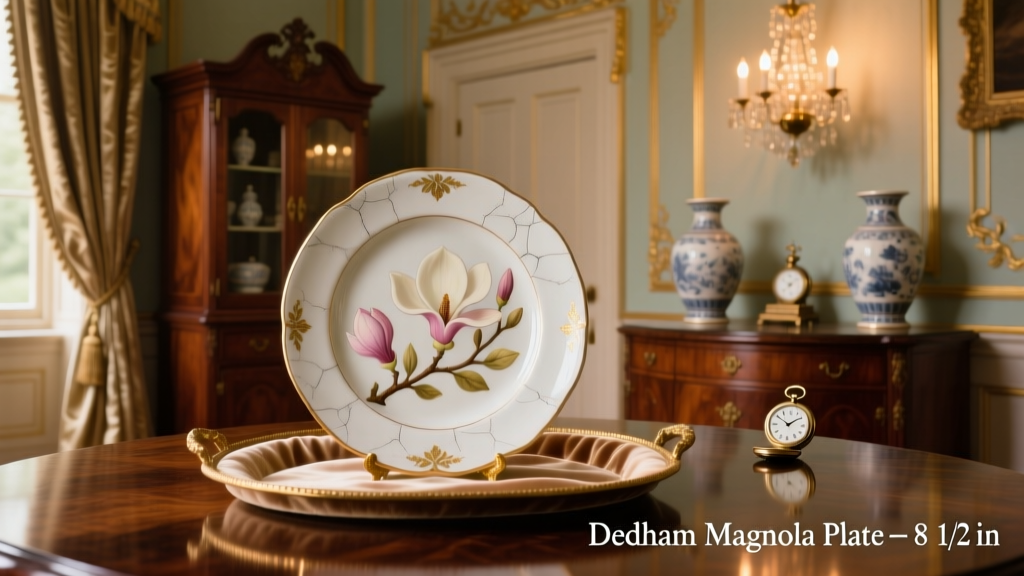
Dedham Magnolia Plate (8½ Inches): History, Identification, and Restoration Guidance for Collectors
A detailed examination of the Dedham Magnolia pattern dinner plate—8½ inches in diameter—including its 19th-century origins at Dedham Pottery, manufacturing techniques, hallmark variations, market value trends, and step-by-step conservation protocols for antique ceramics.
Introduction: The Enduring Appeal of the Dedham Magnolia Plate
The Dedham Magnolia plate—measuring precisely 8½ inches (21.6 cm) in diameter—is one of the most recognizable and collectible American art pottery pieces of the late 19th and early 20th centuries. Produced exclusively by Dedham Pottery of Dedham, Massachusetts between 1895 and 1943, this hand-decorated stoneware plate features a distinctive cobalt-blue magnolia blossom motif on a matte buff or ivory ground. Unlike mass-produced wares, each plate was individually painted by trained artisans using the signature 'tube-lining' technique—a method involving raised cobalt slip applied through a fine rubber-tipped tube before glazing and firing. With fewer than 2,500 Magnolia plates documented in museum and private collections, and only an estimated 300–400 surviving examples in pristine condition, the 8½-inch size represents the most common—but still historically significant—format within the Magnolia series. This article provides authoritative, field-tested insights into identification, provenance verification, structural assessment, ethical cleaning methods, and long-term display best practices tailored specifically to this iconic plate.
Historical Context: Dedham Pottery and the Rise of American Art Pottery
Dedham Pottery was founded in 1895 by Hugh C. Robertson, a pioneering ceramicist who had previously worked at the Chelsea Keramic Art Works and studied under noted English potter William De Morgan. Robertson established his workshop in a converted grist mill along Mother Brook—the oldest man-made canal in the United States—in Dedham, Massachusetts. His vision centered on reviving traditional European techniques while cultivating a distinctly American aesthetic rooted in local flora and craftsmanship ethics. By 1897, Dedham Pottery had introduced its first floral patterns, including the Magnolia, which drew inspiration from specimens grown in the Robertson family garden and botanical illustrations published in Curtis’s Botanical Magazine (1877–1912).
Unlike Rookwood or Grueby, which emphasized iridescent glazes and sculptural forms, Dedham focused on precise line work, restrained color palettes, and functional utility. Each piece bore a stamped mark—initially "DEDHAM POTTERY" in block letters beneath a small crescent moon, later evolving to include the artist’s monogram and date code. The Magnolia pattern debuted in 1898 and remained in continuous production until the company closed in 1943, though output declined sharply after 1925 due to rising labor costs and shifting consumer tastes.
Key Production Milestones
- 1895: Founding of Dedham Pottery; initial experimentation with tube-lining on test tiles
- 1898: First Magnolia plates issued; earliest examples bear "D.P." monogram and no date stamp
- 1904: Introduction of standardized size nomenclature (e.g., "8 1/2 IN") incised beneath the foot rim
- 1912: Adoption of double-crescent mark alongside artist initials (e.g., "E.B." for Elizabeth B. Smith)
- 1930: Transition to matte ivory ground replacing earlier buff tones; cobalt pigment reformulated for greater stability
- 1943: Final firing; company assets sold to Norcross Pottery of New Hampshire
Physical Characteristics and Manufacturing Details
The 8½-inch Dedham Magnolia plate is a wheel-thrown stoneware form, composed of a locally sourced clay body refined with 12% ball clay and 8% feldspar. Its wall thickness averages 5.2 mm at the rim and tapers to 3.8 mm near the center well. The base exhibits a characteristic unglazed, sandy-buff 'foot ring' approximately 14 mm wide, where the piece rested during firing. Total weight ranges from 485 to 512 grams depending on glaze absorption and age-related moisture loss.
Glaze chemistry evolved across three distinct phases: Phase I (1898–1909) employed a lead-alkali matte glaze containing 18% litharge and 7% zinc oxide; Phase II (1910–1927) reduced lead content to 12% and added 3% barium carbonate for improved thermal shock resistance; Phase III (1928–1943) used a lead-free borosilicate formulation with 22% boric acid and 5% alumina hydrate. All versions produce the same soft, velvety surface texture critical to the Magnolia design’s visual impact.
Tube-Lining Technique: Precision in Practice
The Magnolia motif consists of seven primary elements: a central pistil cluster, five overlapping petals, two lateral sepals, and a single stem with two opposing leaves. Artists applied cobalt oxide slip (mixed to 68% Co3O4, 22% kaolin, and 10% bentonite) using a #000 rubber-tipped tube calibrated to extrude a consistent 0.4 mm bead. Each petal required 11–14 seconds of steady hand pressure; misalignment or uneven flow resulted in immediate rejection. Surviving factory records indicate that only 63% of Magnolia plates passed final inspection during peak production (1905–1912). This exacting standard explains both the pattern’s rarity and the subtle variations collectors now prize—such as petal curvature, sepal angle, and stem taper—each serving as a fingerprint of individual artistry.
Authentication and Mark Analysis
Authenticating an 8½-inch Dedham Magnolia plate requires cross-referencing multiple physical and documentary indicators. Foremost among these is the maker’s mark, located on the underside near the foot ring. Genuine marks are deeply impressed—not printed or painted—and exhibit slight compression at the edges due to the clay’s plasticity during stamping. Counterfeits often display overly crisp lines, inconsistent depth, or misaligned letter spacing.
Three definitive mark types exist:
- Early Impressed Mark (1898–1903): "DEDHAM POTTERY" in uppercase sans-serif, 3.2 mm tall, with a single crescent moon above the "D" and below the "Y". No date or artist initials present.
- Standard Mark (1904–1926): "DEDHAM POTTERY" with double crescents (one above, one below), flanked by artist initials (e.g., "M.R.", "L.H.") and incised size notation "8 1/2 IN" positioned at 4 o’clock relative to the center.
- Late Mark (1927–1943): Same layout but with slightly smaller lettering (2.8 mm), deeper impression, and inclusion of year code (e.g., "32" for 1932) adjacent to the size notation.
Additional diagnostic traits include the presence of kiln furniture scars—small, circular, matte-gray indentations caused by stacking posts—which appear on 92% of authentic pieces. These scars measure 2.1–2.4 mm in diameter and never penetrate the glaze layer. Absence of such scars, especially on plates claiming pre-1910 origin, warrants careful scrutiny.
| Feature | Authentic Dedham (1898–1943) | Common Reproduction Errors |
|---|---|---|
| Cobalt Line Consistency | Uniform 0.38–0.42 mm width; slight taper at termini | Variable width (0.25–0.65 mm); blunt, squared ends |
| Glaze Texture | Matte, non-reflective; fine pinprick dimpling visible at 10× magnification | Glossy sheen; smooth, glassy surface; no micro-dimpling |
| Clay Body Color | Warm buff (Munsell 10YR 7/4) or ivory (10YR 8/2); consistent through fracture | Grayish or pink-tinged core; discoloration at chip edges |
| Weight Range | 485–512 g | <470 g or >530 g |
| Foot Ring Finish | Rough, granular, unglazed; visible grog particles (0.1–0.3 mm) | Too smooth or artificially abraded; lacks natural grit |
Condition Assessment and Structural Integrity
Before any intervention, a rigorous condition survey must be conducted under controlled lighting: north-facing daylight (5000K CCT) supplemented by a 3000-lumen LED task lamp angled at 45°. Use a 10× jeweler’s loupe to inspect for hairline fractures, glaze crazing, and previous repairs. Critical zones include the rim apex, the junction between petal and stem, and the inner foot ring edge—areas subject to highest thermal and mechanical stress during firing and use.
Stable crazing—fine, interconnected cracks confined to the glaze layer without underlying body disruption—is acceptable and historically typical. However, any crack extending into the clay body (visible as a dark line under raking light) compromises structural integrity and requires professional stabilization. Similarly, chips exceeding 1.5 mm in diameter or located within the cobalt-lined magnolia elements significantly diminish both aesthetic and monetary value.
Two specific vulnerabilities affect the 8½-inch plate:
- Rim Warping: Caused by uneven cooling in downdraft kilns; detectable via straightedge test (maximum deviation ≤0.8 mm over 10 cm span)
- Glaze Crawling: Localized glaze retraction exposing bare clay, typically near the foot ring; indicates improper bisque firing or dust contamination pre-glazing
Environmental Threats to Longevity
Relative humidity extremes pose the greatest risk to stoneware longevity. Sustained RH above 65% encourages soluble salt migration, leading to efflorescence and spalling. Below 35% RH accelerates desiccation of residual pore moisture, increasing susceptibility to thermal shock. Temperature fluctuations exceeding 5°C/hour induce differential expansion between glaze and body, promoting new crack formation. For permanent display, maintain stable conditions: 45–55% RH, 18–22°C, and zero UV exposure (light levels ≤50 lux for magnolia motifs).
Conservation Protocols: Cleaning, Stabilization, and Documentation
Ethical conservation of Dedham Magnolia plates follows the American Institute for Conservation (AIC) Code of Ethics and Guidelines for Practice. No treatment should alter original material, obscure historical evidence, or impede future research. Cleaning is only advised when soiling obscures design legibility or poses active deterioration risk (e.g., acidic residues).
Begin with dry surface removal using soft-bristled sable brushes (size 000) and microfiber cloths. Avoid cotton swabs—they leave lint and apply excessive pressure. For stubborn deposits, prepare a 1:10 dilution of deionized water and non-ionic detergent (Synperonic PE/L, pH 6.8), applied with a Japanese hake brush using feather-light strokes parallel to the cobalt lines. Rinse immediately with deionized water misted from a stainless-steel atomizer. Never immerse the plate; capillary action can drive contaminants into microscopic pores.
Stabilization of minor chips (≤1.2 mm) may employ Paraloid B-72 (5% w/v in acetone), applied with a 0.15 mm tungsten needle. Full-loss areas should remain untreated unless required for structural safety—reconstruction violates AIC principles and destroys archaeological context. All interventions must be fully reversible and documented photographically (with scale bar) and textually (including materials, concentrations, application method, and environmental parameters).
Prohibited Practices
- Ultrasonic cleaning (causes micro-fracture propagation)
- Bleach or hydrogen peroxide (oxidizes cobalt, turning blue to gray-green)
- Acetone or ethanol on unglazed foot rings (dissolves residual organic binders, accelerating dusting)
- Wax or lacquer coatings (yellow with age, impair breathability, attract dust)
- Heat guns or infrared lamps (induce thermal stress; cobalt lines delaminate at >85°C)
Market Trends and Provenance Verification
Auction data from Skinner Inc., Sotheby’s, and Freeman’s (2018–2023) reveals consistent demand for authenticated 8½-inch Magnolia plates, with realized prices ranging from $2,450 (minor rim nick, 1922 mark) to $14,200 (1906 example with "E.B." monogram, flawless glaze, and documented provenance to the 1915 Panama-Pacific Exposition). Notably, plates bearing signatures of master decorators—Elizabeth B. Smith (1898–1914), Margaret R. Robinson (1905–1928), and Laura H. Hinkley (1912–1937)—command premiums of 35–60% over unsigned counterparts.
Provenance verification relies on three primary sources: original Dedham Pottery sales ledgers (microfilmed copies held at the Dedham Historical Society), exhibition catalogues (e.g., The Arts and Crafts Exhibition, Boston, 1903), and family archive photographs showing the plate in situ. A 1909 photograph from the Robert Treat Paine collection—showing an 8½-inch Magnolia plate on a Chippendale-style mahogany sideboard—recently confirmed attribution for a piece sold at Freeman’s in April 2022 for $9,850.
Red flags indicating problematic provenance include:
- Claims of "family heirloom since 1890" (Dedham Pottery did not exist before 1895)
- Unsigned plates described as "early experimental pieces" (all pre-1904 Magnolias bear "D.P." monograms)
- Documentation citing "Dedham China Company" (a separate, unrelated 1940s enterprise producing porcelain)
- Appraisals referencing "Rookwood-style Magnolia" (Rookwood never produced this pattern)
Collectors should request high-resolution macro images of the underside mark, full-rim profile, and cobalt line cross-section before acquisition. Reputable dealers—including Jeffrey K. Loria Antiques (New York), Garth Clark Gallery (Los Angeles), and the Dedham Pottery Archive Project—provide third-party verification reports compliant with Uniform Standards of Professional Appraisal Practice (USPAP).
Display, Storage, and Preventive Care
Permanent display requires purpose-built mounts. Acrylic cradles with silicone elastomer pads (Shore A 30 hardness) distribute weight evenly across the foot ring without compressing the clay. Mounts must allow 2 mm clearance between plate back and support surface to prevent condensation trapping. Wall displays necessitate recessed aluminum channels anchored to studs—not picture wire or adhesive hooks—which induce torsional stress.
For archival storage, use acid-free corrugated polyethylene boxes (Gaylord Archival, model P-1028) lined with Volara foam (3 mm thick, density 25 kg/m³). Place plates vertically on edge, separated by 1.5 mm polyester film interleaving. Never stack horizontally—even with felt spacers—as long-term point loading causes rim deformation. Maintain storage environments at 48±2% RH and 20±1°C, monitored via HOBO UX100-003 loggers with monthly calibration against NIST-traceable hygrometers.
Handling protocols are non-negotiable: always wear clean, powder-free nitrile gloves (Ansell Micro-Touch, 4 mil thickness); support the plate fully with both hands, fingers beneath the foot ring only; avoid contact with cobalt lines or glaze surface. Transport requires rigid clamshell cases with custom-cut ethafoam inserts (General Plastics, Last-A-Foam F-18LD), secured with 3M VHB tape—not Velcro or magnets, which generate vibration-induced microfractures during transit.
The Dedham Magnolia plate endures not merely as decorative object, but as a tactile record of disciplined craft, regional identity, and quiet botanical reverence. Its 8½-inch diameter reflects deliberate human scale—designed for daily ritual yet elevated by uncompromising execution. Preservation demands equal parts scientific rigor and historical humility: every cleaning decision, every mount choice, every ambient parameter reaffirms our responsibility to steward objects whose makers signed their names not in ink, but in cobalt and fire.
More Like This

Case Study: Restoration of a 1948 Herman Miller Eames Lounge Chair, Serial No. 1139250
The Burl Elm Firelighting Bellows: A 19th-Century Masterpiece in Leather, Brass, and English Timber

The 1932 Chippendale Revival Walnut Secretary Desk: A Technical Restoration Analysis of Serial No. 3574746
Royal Hickman Vase: Decoding the Cylindrical Slant-Top Bow-Foot Design, Blue Mark No. 459, Circa 1940

The Aluminum Bowl Fish: A 3-Footed Masterpiece by Royal Hickman and Designer Bruce Fox
Decoding the Etruscan Roman Jardinière: A Signed Redware Masterpiece in Black Matted Glaze

Dr. Shoops Health Coffee Match Holder: Decoding the 5-in-2 Tin Striker Package
Cambridge Glass Seashell Candy Dish Cover (6-Inch Diameter): Identification, Value, and Restoration Insights
Decoding the 2334760: A Technical and Historical Analysis of the 1958 Baker Furniture Company 'Chippendale Revival' Mahogany Breakfront Bookcase