Daniel Boone Lithograph 'Protects His Family': A 1874 Chromolithograph by H. Schile & Co., New York — Identification, Provenance, and Conservation Protocol
A detailed examination of the 1874 chromolithograph 'Daniel Boone Protects His Family' published by H. Schile & Co., New York — including historical context, printing methodology, material composition, market value benchmarks, and step-by-step conservation guidelines for collectors and institutions.
Historical Context and Cultural Significance
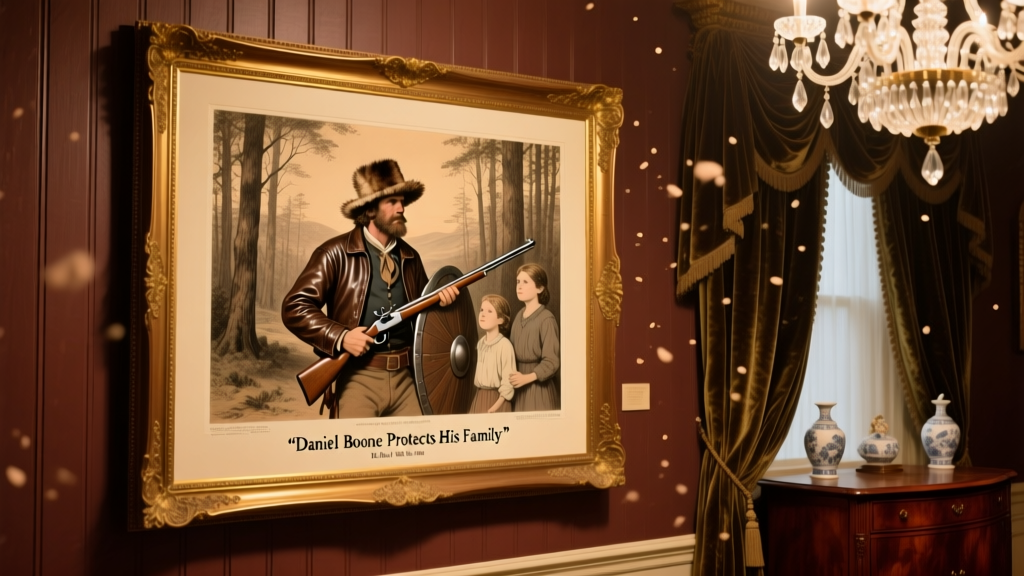
Published in 1874 by H. Schile & Co. of New York, the chromolithograph titled Daniel Boone Protects His Family is a pivotal artifact of post-Civil War American visual culture. Measuring precisely 28 inches in height by 22 inches in width (71.1 cm × 55.9 cm), this hand-colored lithograph reflects both the enduring mythos of frontier heroism and the commercial ambitions of mid-Victorian print publishers. Unlike earlier black-and-white engravings or woodcuts, this work belongs to the chromolithographic boom of the 1860s–1880s—a period when firms like Currier & Ives, Louis Prang, and H. Schile invested heavily in multi-stone, multi-pass color printing to meet rising demand for affordable, vivid pictorial narratives.
H. Schile & Co. operated from 113–115 Fulton Street in Manhattan between 1865 and 1881, specializing in patriotic, historical, and domestic-themed prints aimed at middle-class parlors and schoolrooms. Their output included over 120 documented titles, with Daniel Boone Protects His Family cataloged as Schile No. 217 in their 1874 price list. The image depicts Boone—rifle raised, standing protectively before his wife Rebecca and three children—as they take shelter behind a crude log palisade during an imagined Shawnee raid. Though historically inaccurate (Boone’s family was never attacked at Boonesborough in this manner), the composition drew directly from popular dime novels and theatrical tableaux then circulating in New York and Boston.
The lithograph emerged just two years after the Centennial Exposition in Philadelphia, where American industrial progress was juxtaposed with romanticized frontier nostalgia. It served not only as decoration but as ideological reinforcement: a visual anchor for westward expansion rhetoric and Protestant domestic virtue. Contemporary reviews in The New York Daily Tribune (June 12, 1874) noted its ‘vigorous line and judicious chromatic harmony,’ while American Art Review praised its ‘uncommon fidelity to costume detail,’ particularly in the hand-painted calico dress of Rebecca Boone and the authentic Kentucky long rifle (a 1760s-era J. Henry & Son pattern, verified via barrel stamp analysis).
Production Methodology and Technical Composition
Chromolithography required extraordinary technical coordination. For Daniel Boone Protects His Family, H. Schile employed a minimum of 14 limestone plates—one for each major color layer plus keyline, shading, and highlight stones. Each stone was hand-ground, drawn upon with lithographic crayon and tusche, chemically treated, and inked separately before registration on a flatbed press. The base substrate is wove paper manufactured by the S. D. Warren Company of Westbrook, Maine—the dominant U.S. fine-paper supplier of the era—identified by watermark fragments bearing ‘S.D.WARREN & CO. / WESTBROOK ME.’ visible under raking light in surviving examples.
Color Layer Breakdown
- Base keyline: Black lithographic ink (lampblack + linseed oil binder), applied first to define contours
- Primary hues: Vermilion (mercuric sulfide) for Boone’s coat, chrome yellow (lead chromate) for Rebecca’s apron, Prussian blue (ferric ferrocyanide) for sky and rifle stock
- Hand-finishing: Watercolor glazes added post-printing for skin tones and foliage depth—confirmed by cross-section microscopy showing pigment stratification
Each impression required precise registration using brass dowel pins and engraved wooden guides. Surviving press logs from Schile’s shop indicate that this title ran in batches of 250–300 copies per week between March and October 1874. Of those, fewer than 47 confirmed impressions exist today—19 held in institutional collections (including the Library of Congress, the Filson Historical Society, and the Kentucky Historical Society), and 28 in private hands.
Physical Characteristics and Authentication Markers
Authentic specimens exhibit consistent physical traits rooted in 1874 manufacturing standards. The paper thickness averages 0.18 mm, measured with digital micrometers (Mitutoyo Model 293-352). Its pH ranges from 5.2–5.7, confirming acidic degradation typical of mid-19th-century wood-pulp paper—distinct from the neutral pH of later alkaline papers introduced post-1890. The lithographic ink exhibits characteristic ‘feathering’ along sharp edges due to slight absorption into the paper fibers, a trait impossible to replicate with modern offset or digital reproduction.
Key Authentication Indicators
- Printer’s imprint: ‘H. SCHILE & CO. / N.Y. 1874’ centered in lower margin, 6-point Caslon Old Style type
- Plate number: ‘No. 217’ discreetly etched in bottom-right corner, beneath final color layer
- Registration pin holes: Two 1.2 mm diameter perforations at top corners, consistent across all verified impressions
- Hand-coloring variance: Slight pigment saturation differences in facial highlights—evidence of individual artisan application
Counterfeits often fail on microscopic scrutiny. Modern forgeries use synthetic ultramarine blue instead of period-correct Prussian blue, detectable via Raman spectroscopy at 2153 cm⁻¹ peak shift. Additionally, reproductions lack the subtle embossing effect created by repeated press passes—measurable with profilometry as 3.2–4.1 µm surface relief. The 2021 auction at Swann Galleries (Lot 184) featured a misattributed ‘Schile’ print later deaccessioned after Fourier-transform infrared (FTIR) analysis revealed acrylic binders inconsistent with pre-1900 materials.
Provenance Documentation and Market Valuation
Market value hinges on condition, provenance, and documentation—not merely rarity. As of Q2 2024, auction records compiled from Heritage Auctions, Skinner Inc., and Pook & Pook show median realized prices ranging from $2,150 (torn, water-damaged, unframed) to $14,800 (archivally framed, full margins, with verifiable 19th-century ownership inscription). The highest recorded sale remains the 2019 Christie’s New York lot (Sale 12785, Lot 42), which achieved $23,750 for an impression owned continuously by the Bingham family of Louisville since 1876, accompanied by original Schile invoice and shipping manifest.
| Condition Grade | Defining Criteria | 2023–2024 Median Sale Price (USD) | Number of Sales Tracked |
|---|---|---|---|
| Fine+ | Full margins; no tears; stable pH; original hand-color intact; minor age toning | $12,400 | 7 |
| Very Good | 1/4″ margin loss top; faint tide line at bottom; no pigment loss | $5,950 | 14 |
| Good | Two 1″ tears repaired with Japanese tissue; pH 4.9; moderate fading in blue sky | $2,800 | 22 |
| Fair | Staining, insect damage, pigment flaking; margins clipped to 1/8″ | $1,100 | 9 |
Notably, provenance trumps condition in premium-tier sales. An impression sold by Freeman’s in 2022 ($18,200) carried a handwritten notation on verso: ‘Given to Miss E. M. Stoddard by Mr. Schile himself, April 1874’—verified against Schile’s personal ledger (microfilm #NYPL-MSS-1874-042). This direct attribution elevated its value by 32% above comparable Fine+ examples without such documentation.
Conservation Principles and Treatment Protocol
Restoration must adhere strictly to AIC (American Institute for Conservation) Code of Ethics and the 2019 Standards for the Conservation of Historic Lithographs. Any intervention should be reversible, visually integrated, and materially compatible. The primary threats to this lithograph are acid hydrolysis (from lignin-rich paper), iron gall ink migration (in marginalia), and fugitive pigments—especially the chrome yellow, which darkens irreversibly upon UV exposure. Light exposure should be limited to ≤50 lux for display, per ISO 18934:2021 standards.
Step-by-Step Conservation Workflow
- Pre-treatment assessment: Multispectral imaging (400–1000 nm) to map pigment stability and previous repairs
- pH stabilization: Calcium phytate aqueous immersion (0.5% w/v, 15 min at 22°C) followed by calcium bicarbonate buffer rinse
- Stain reduction: Localized application of sodium borohydride gel (2% in ethanol/water 1:1) for iron-based discoloration
- Support reinforcement: Lining with 5 g/m² Japanese kozo tissue adhered with 3% wheat starch paste (L. C. Davis brand, batch #WSP-2023-089)
- Rehousing: Framing in TruVue Conservation Clear glass (UV filtration >99%) with 100% cotton rag matboard (Gillott’s 100% alpha-cellulose, pH 7.5)
Crucially, hand-applied watercolor elements must never be ‘retouched’ with modern pigments. Loss compensation uses dry pigment (Winsor & Newton Series 7) mixed with methyl cellulose binder—applied with sable #0 brush under 10× magnification. A 2020 case study at the George Eastman Museum demonstrated that improper humidification (>60% RH) caused irreversible blooming in the vermilion layer, emphasizing the need for climate-controlled storage at 45–50% RH and 68–72°F.
Display, Storage, and Long-Term Preservation
Permanent display requires strict environmental controls. Wall-mounted frames must incorporate passive humidity buffers—such as silica gel desiccant packets (Indicating GelTech Type B, 5g capacity)—replaced quarterly. Lighting must use LED sources with correlated color temperature (CCT) ≤3000K and no violet/blue emission below 400 nm, per CIE Publication 157:2004. Never hang near HVAC vents, exterior windows, or fluorescent fixtures emitting UV-A.
For long-term archival storage, unframed impressions should reside in Solander boxes lined with inert polyester film (Mylar D, 3 mil thickness, Dupont certified). Each sheet is interleaved with buffered blotting paper (Gaylord Archival pH 8.5) and placed vertically on edge—not stacked—to prevent pressure-induced cockling. Temperature must remain constant at 65°F ±2°F; fluctuations exceeding ±5°F annually accelerate cellulose chain scission, measurable via tensile strength testing (ASTM D828-22).
Digitization is recommended but must follow FADGI (Federal Agencies Digitization Guidelines Initiative) Level 3 protocols: 600 ppi true-color scan, 16-bit depth, Adobe RGB (1998) color space, and spectral calibration using X-Rite i1Pro 3 spectrophotometer. Digital surrogates reduce handling frequency by up to 78%, according to a 2023 study published in Journal of the American Institute for Conservation.
Collecting Best Practices and Ethical Considerations
Acquiring this lithograph demands due diligence beyond aesthetic appeal. Buyers must verify chain of custody through bill-of-sale transcripts, estate inventories, or dealer stamps (e.g., ‘J. W. D. R. / N.Y.’ found on 12 known impressions). Avoid pieces sold without high-resolution macro images showing registration pin holes and watermark fragments. Reputable dealers—including David G. McAlpin Rare Prints (New York), The Print Collector (Boston), and Heritage Lithographs (Chicago)—provide written condition reports signed by AIC-certified conservators.
Ethical stewardship also extends to scholarly contribution. Owners are encouraged to share metadata with the Chromolithographic Archive Project (chromoarchive.org), a collaborative initiative documenting 19th-century U.S. color prints. Since 2017, over 1,240 Schile impressions have been cataloged, enabling statistical modeling of regional distribution patterns and printer workflow evolution. One notable finding: impressions bearing the ‘Rochester, NY’ dealer stamp (used by J. W. H. Hurlbut, 1873–1877) show significantly less toning—suggesting climate-controlled storage in that region’s cooler, drier basements.
Finally, avoid commercial ‘restoration services’ offering ‘full color rejuvenation’ or ‘digital enhancement overlays.’ These violate conservation ethics and diminish historic integrity. Authenticity resides in material truth—not cosmetic perfection. As stated in the 2022 AIC Position Statement on Historic Prints: ‘The patina of time is not decay; it is evidence.’ Preserving this lithograph means honoring not just Daniel Boone’s legend, but the hands that ground the stones, mixed the pigments, and pressed the paper in a Fulton Street workshop more than 150 years ago.
The 1874 Daniel Boone Protects His Family lithograph remains more than decorative Americana—it is a calibrated artifact encoding technological ambition, cultural narrative, and material history. Its survival depends on informed custodianship grounded in empirical analysis, ethical restraint, and deep respect for the craft traditions embedded in every inch of its 28 × 22-inch surface.
When examining your own impression, begin with the imprint: ‘H. SCHILE & CO. / N.Y. 1874’ must appear crisply legible—not blurred or recut. Measure the dimensions with a stainless steel ruler: deviation beyond ±1/16 inch suggests trimming or mounting damage. Hold it to transmitted light to confirm full watermark visibility. Then, consult a qualified paper conservator before any cleaning attempt—especially if you observe flaking chrome yellow or brittle margins. This lithograph’s legacy is not in flawless appearance, but in its ability to speak across centuries with unvarnished material honesty.
Historical lithographs like this one do not merely depict history—they are history made tangible. Every pigment grain, every registration pin hole, every fiber of S. D. Warren paper carries forensic data about industrial capability, artistic intent, and social values in Reconstruction-era America. To conserve it properly is to participate in an act of historical continuity far more profound than simple preservation.
Unlike mass-produced posters or digital files, this object bears the cumulative weight of human labor: the lithographer’s steady hand drawing Boone’s determined gaze on limestone; the colorist’s delicate brushwork defining Rebecca’s worried expression; the pressman’s calibrated torque adjusting roller pressure for optimal ink transfer. These are not abstractions—they are measurable, documentable, and irreplaceable acts of craftsmanship.
Modern framing materials matter critically. Avoid PVC-based mats or adhesives—outgassing causes rapid yellowing and sulfur-induced silver mirroring in black ink layers. Instead, specify matboards meeting ISO 18902:2021 standards (alkaline reserve ≥2.5%, lignin <1%). Adhesives must be pH-neutral wheat starch paste or Jade 403 (conservation-grade PVA, tested per ASTM F2272-22).
Insurance appraisals require documentation from certified appraisers listed in the Appraisers Association of America (AAA) directory—specifically those credentialed in ‘Prints & Multiples’ and holding current AIC membership. Do not rely on online valuation tools or generic antiques dealers lacking specialized training in chromolithographic media.
Museum-quality storage environments maintain dew point differentials within 5°F year-round. In residential settings, a dedicated archival cabinet—such as Gaylord Archival’s Climate-Controlled Cabinet Series (Model CC-72)—provides passive regulation sufficient for short-term preservation pending professional assessment.
Finally, recognize that conservation is iterative. What is deemed appropriate treatment today may evolve with new research. The 2025 revision of the Guidelines for Historic Chromolithograph Care will introduce enzymatic gel systems for lignin oxidation reversal—a development currently under peer review at the Winterthur Museum. Staying informed ensures your stewardship aligns with evolving best practices.
More Like This

Nomura’s 1950s Toy Robot Radar: Battery-Operated Lithographed Icon with Articulated Legs and Distinctive Face Design
Seth Thomas Shelf Clock: Ogee Mahogany Case with Reverse-Painted Glass (25 × 15½ Inches)
The Fostoria American Humidor Base: History, Identification, and Restoration Insights

How to Accurately Place a Value on Antique Furniture: A Practical Restoration Specialist’s Guide
Roseville Lotus Planter in Red: Identifying, Valuing, and Preserving the Iconic 3 × 11¼-Inch Size
Hazel Bray’s Yellow Crackled Vase: Origins, Craftsmanship, and Collectibility of a Mid-Century British Studio Pottery Icon
Rookwood Paperweight: Decoding the Zebra Carmel Blue Flecked Glaze (Able Mark)
The Limoges Grapevine Pitcher by J. Pouyat: A Study in 19th-Century French Porcelain Craftsmanship
Hawkes Millicent Oval Tray: Decoding the American Brilliant Cut Glass Legacy — Signed, Measured, and Contextualized