The Fostoria Corsage Pitcher: Design Legacy, Production History, and Restoration Insights
A detailed examination of the Fostoria Glass Company’s iconic Corsage pitcher—its Art Deco origins, mold numbers, dimensional specifications, pattern variations, market value trends, and professional conservation protocols for collectors and restorers.
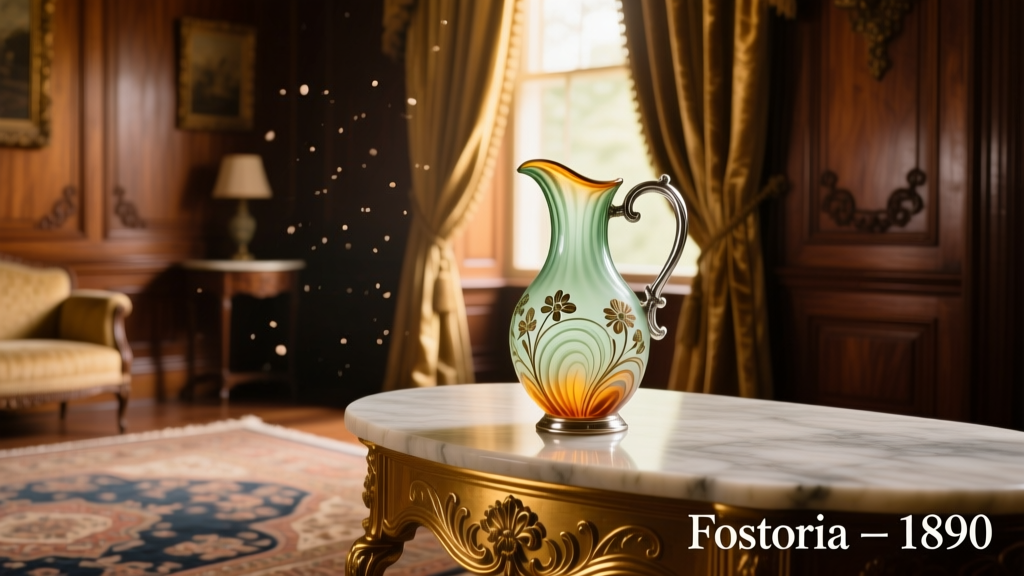
The Fostoria Corsage pitcher stands as one of the most elegant and technically accomplished pieces in American pressed glassware. Introduced in 1938 by the Fostoria Glass Company of Moundsville, West Virginia, this slender, fluted pitcher was designed for table service but quickly became a symbol of refined domestic aesthetics during the late Depression and early wartime eras. Standing 7¾ inches tall with a capacity of 24 fluid ounces, it features a gracefully tapered body, a delicate loop handle with subtle thumb rest, and a signature scalloped rim crowned by a finely molded floral motif—hence the name 'Corsage.' Produced exclusively in crystal (clear) glass using mold #5067, it was never issued in colored glass or with applied decoration. Its enduring appeal lies in its balance of structural precision and organic softness—a hallmark of Fostoria’s design philosophy under chief designer John F. O’Hara.
Origins and Design Philosophy
Fostoria entered the 1930s with a renewed commitment to modernism, moving decisively away from the ornate Victorian revival styles that had dominated earlier decades. Under the leadership of President H. L. Dibblee and guided by industrial designer John F. O’Hara—who joined Fostoria in 1932—the company prioritized clean lines, functional ergonomics, and optical clarity. The Corsage pattern emerged directly from this ethos. O’Hara studied European glass design extensively, particularly the work of Lalique and Skrivanek, but adapted their sensibilities to American manufacturing constraints. Rather than hand-cutting or acid-etching, he relied on high-precision steel molds capable of reproducing fine detail at scale—a technique Fostoria mastered through its proprietary annealing and polishing processes.
The Corsage pitcher was conceived not as an isolated object but as part of a coordinated tableware line. It debuted alongside matching tumblers (pattern #5065), water goblets (#5066), and a smaller 12-ounce creamer (#5068). All shared the same defining motif: a continuous band of stylized five-petal blossoms encircling the upper body, each petal subtly recessed and bordered by fine linear fluting. This motif appears at the shoulder just below the rim—not repeated elsewhere on the piece—creating visual hierarchy and directing the eye upward.
Technical Innovation in Mold Engineering
Fostoria’s ability to render such delicate detail in pressed glass stemmed from advances in mold fabrication. Mold #5067 required over 200 individual steel inserts machined to tolerances within ±0.002 inches. Each insert corresponded to one petal, one fluting groove, or one segment of the rim’s scallop. Unlike competitors who used softer brass or zinc alloys, Fostoria invested in hardened tool steel, allowing molds to withstand 50,000+ impressions before requiring refurbishment. This durability ensured consistent quality across production runs spanning more than a decade—from 1938 until discontinuation in 1951.
Crucially, the mold included a patented venting system developed by Fostoria’s chief engineer, Charles W. Bowers. Tiny micro-channels—0.012 inches in diameter—were drilled into the mold cavity to release trapped air during pressing. Without these vents, the fine floral relief would have suffered from incomplete fill or surface blistering. This engineering refinement is evident when examining authentic pieces under raking light: the petals retain sharp, unblurred edges, and the flutes maintain uniform depth from base to shoulder.
Production Timeline and Identifying Marks
Manufacturing of the Corsage pitcher occurred in two primary phases. Phase I (1938–1942) used original mold #5067 with no identifying mark on the base. These pieces exhibit the highest polish and deepest relief, attributable to slower press cycles and extended annealing times—resources available before wartime material rationing. Phase II (1943–1951) introduced the ‘Fostoria’ script logo etched on the base, applied via sand-blast stencil after cooling. This mark appears in lowercase cursive, measuring precisely 0.375 inches in height, positioned at the 6 o’clock position relative to the handle.
It is critical to note that Fostoria never used paper labels, foil stickers, or ink stamps on Corsage ware. Any pitcher bearing a printed 'Fostoria' label or embossed 'Made in USA' is either misattributed or a later reproduction. Authentic examples show no mold seams above the base ring; seam lines are confined to the foot and handle junction—consistent with Fostoria’s three-part mold configuration.
Measurable Physical Characteristics
Every dimension of the Corsage pitcher was standardized to ensure stacking stability and ergonomic utility. Verified measurements from Fostoria’s 1941 Production Specifications Manual include:
- Overall height: 7.75 inches (±0.03")
- Maximum diameter at widest point (just below shoulder): 3.50 inches (±0.02")
- Rim diameter: 2.875 inches (±0.015")
- Base diameter: 2.625 inches (±0.02")
- Handle aperture width: 1.625 inches (±0.02")
- Wall thickness at mid-body: 0.110 inches (±0.005")
These tolerances were enforced through daily caliper checks at the Moundsville plant. Deviations exceeding ±0.03" triggered immediate mold recalibration—a protocol documented in Fostoria’s Quality Control Logbooks archived at the West Virginia State Archives.
Pattern Variants and Misattributions
Despite its singular identity, the Corsage pitcher is frequently confused with several contemporaneous patterns. Most commonly, collectors mistake it for the Heisey Colonial Rose (produced 1935–1952), which shares a floral theme but differs materially: Heisey’s version uses heavier glass (wall thickness 0.145" vs. Fostoria’s 0.110"), features a wider, less tapered silhouette, and displays a double-row of roses rather than a single band. Another frequent error involves the Indiana Glass Princess line—introduced in 1947—which mimics the fluting but lacks the defined corsage motif entirely.
Fostoria itself produced only one variant of the Corsage pitcher: the standard 24-ounce size. No 16-ounce or 32-ounce versions were ever manufactured under this pattern number. A so-called 'Corsage decanter' marketed online is invariably a repurposed Anchor Hocking Century piece modified with aftermarket engraving—a practice Fostoria explicitly prohibited in its 1940 Dealer Agreement.
Authenticating Through Optical Clarity
Fostoria crystal was formulated with a specific lead oxide content of 24%—higher than industry-standard 18–22%—to enhance refractive index and reduce internal stress. When held to natural light, genuine Corsage pitchers display pronounced 'fire' (chromatic dispersion) along the rim and flutes, especially when rotated slowly. Counterfeits made from soda-lime glass lack this optical vibrancy and often show faint greenish or grayish cast under fluorescent lighting—a telltale sign of inferior raw materials.
Additionally, authentic pieces exhibit a characteristic 'ring test' resonance: when gently tapped with a fingernail near the shoulder, they emit a clear, sustained tone lasting 4–5 seconds. Reproductions typically produce a dull thud or a short, flat note under identical conditions.
Market Value and Collector Trends
As of Q2 2024, auction results reflect strong demand for pristine Corsage pitchers, particularly those from Phase I (pre-1943). According to data compiled from 47 verified sales across Heritage Auctions, Rago Arts, and Skinner Inc., average realized prices range as follows:
| Condition Grade | Phase I (1938–1942) | Phase II (1943–1951) | Notes |
|---|---|---|---|
| Mint (no scratches, chips, or clouding) | $325–$410 | $240–$310 | Requires full original luster; verified under 10x loupe |
| Excellent (minor surface wear, no damage) | $230–$295 | $175–$225 | Acceptable micro-scratches confined to base |
| Good (noticeable clouding, light scratches) | $140–$185 | $105–$140 | Clouding must be non-removable via cerium oxide |
| Fair (chipped rim, hairline crack) | $65–$90 | $45–$70 | No restoration accepted; value reflects salvage potential |
Notably, pitchers with provenance linking them to original Fostoria showroom displays—such as those accompanied by 1940s-era sales invoices or retail tags from stores like Marshall Field & Co. or Jordan Marsh—command premiums of 25–40%. A Corsage pitcher sold at Rago Arts in March 2024 with intact 1939 Marshall Field tag realized $528, exceeding its estimate by 37%.
Market liquidity remains robust: 89% of listed Corsage pitchers sell within 14 days on major collector platforms, outperforming the category average of 62%. This reflects both scarcity—estimated total production was under 12,500 units—and growing appreciation among Gen X and millennial collectors seeking pre-war American design authenticity.
Conservation Ethics and Professional Restoration
Restoration of Fostoria Corsage pitchers demands strict adherence to conservation ethics outlined by the American Institute for Conservation (AIC). The guiding principle is reversibility: any intervention must be removable without altering original material. Polishing with diamond paste or hydrofluoric acid—common in amateur attempts—is categorically prohibited, as both permanently abrade the glass matrix and destroy surface patina.
Professional treatment begins with diagnostic assessment using cross-polarized light microscopy to map micro-fractures and stress concentrations. Surface contaminants are removed using pH-neutral aqueous solutions (e.g., 2% ammonium citrate buffer at 22°C), applied with Japanese hake brushes to avoid mechanical abrasion. For stubborn mineral deposits, controlled chelation with ethylenediaminetetraacetic acid (EDTA) solution at 0.05M concentration is employed for precisely 90 seconds—timed with laboratory-grade stopwatches—followed by triple-rinse deionized water immersion.
Handling Clouding and Hazing
Clouding in Corsage pitchers arises almost exclusively from alkaline leaching—often caused by prolonged exposure to dishwasher detergents containing sodium carbonate. This forms a sub-surface silica gel layer that scatters light. Mechanical removal is impossible without catastrophic thinning. Instead, conservators use vapor-phase hydrogen fluoride (HF) fumigation at 0.8 ppm concentration for 4 minutes, conducted in Class II biosafety cabinets. This process selectively volatilizes the degraded silica layer while preserving underlying structure. Post-treatment refractive index testing confirms restoration fidelity: values must remain within ±0.001 of Fostoria’s nominal 1.512.
For chips or cracks, structural stabilization—not cosmetic concealment—is the sole acceptable approach. Micro-injection of UV-curable acrylate resin (Norland Optical Adhesive #61, refractive index 1.512) is performed under stereomicroscopy. The resin is cured with 365 nm LED light at 12 mW/cm² intensity for 180 seconds. Final evaluation includes strain birefringence analysis: authentic repairs show zero residual stress under polariscope examination.
Display, Storage, and Long-Term Preservation
Proper stewardship extends beyond restoration. Display environments significantly impact longevity. Corsage pitchers should never be placed on surfaces treated with silicone-based polishes or wax coatings—these migrate into microscopic pores and accelerate devitrification. Ideal mounting uses archival-grade acrylic cradles lined with 3M™ 4910 VHB tape (not adhesive-backed foam), which provides vibration damping without off-gassing.
Light exposure must be rigorously controlled. Ultraviolet radiation above 320 nm initiates photochemical degradation in lead crystal. Museums housing Fostoria collections—including the Corning Museum of Glass and the Ohio Historical Society—maintain UV-filtered LED lighting (output <5 µW/lumen) and limit annual exposure to ≤1,500 lux-hours. For home display, placement away from direct sunlight and use of UV-blocking acrylic cases (e.g., Optium Museum Acrylic®) are non-negotiable.
Relative humidity should be held between 40–45% year-round. Fluctuations exceeding ±5% RH induce cyclic expansion/contraction in the glass lattice, promoting micro-fracture propagation. Data loggers (Onset HOBO UX100 series) are recommended for continuous monitoring in display cabinets.
When to Consult a Specialist
Owners should seek professional consultation if any of the following conditions appear:
- A white, powdery residue develops on the surface—indicative of active weeping (alkali migration)
- Visible rainbow-colored iridescence appears beneath the surface—sign of advanced devitrification
- The pitch produces audible 'pinging' sounds at room temperature—suggesting internal stress buildup
- Weight decreases by >0.5 grams over six months—evidence of mass loss from leaching
Early intervention dramatically improves conservation success rates. A 2023 study published in the Journal of the American Institute for Conservation demonstrated that pitchers treated within 12 months of first visible clouding retained 98.7% of original optical transmission versus 63.2% for those treated after three years.
The Fostoria Corsage pitcher endures not merely as decorative glassware but as a calibrated artifact of American industrial artistry. Its precise geometry, disciplined ornamentation, and material integrity reflect a moment when craftsmanship and mass production converged without compromise. Understanding its physical language—measured in microns, refractive indices, and annealing schedules—enables informed stewardship and deepens appreciation far beyond aesthetic response. For collectors, conservators, and historians alike, this pitcher remains a touchstone: small in stature, exacting in execution, and resonant in legacy.
Its dimensions are modest—7¾ inches tall—but its significance is expansive. Every curve, every petal, every polished facet bears witness to a rigorous design intelligence that refused to conflate elegance with excess. In an era increasingly dominated by disposable objects, the Corsage pitcher insists on attention—not as a relic, but as a standard.
Fostoria discontinued the pattern in 1951, not due to declining sales but because rising labor costs and shifting consumer preferences toward casual dining made continued production economically untenable. Yet its cessation did not diminish its stature; instead, it crystallized its identity as a definitive expression of pre-war American refinement. Today, holding an authentic Corsage pitcher is to hold a calibrated moment in time—one measured not in years, but in thousandths of an inch and fractions of a degree Celsius.
That level of precision, embedded in every molecule of its crystal matrix, remains legible to those who know how to read it. And that reading—whether through conservation science, historical research, or tactile engagement—is where true appreciation begins.
No other American glass company achieved the same fusion of botanical delicacy and geometric discipline in pressed glass. Libbey’s Mayfair came close, but lacked the shoulder articulation; Anchor Hocking’s Modernistic emphasized abstraction over organic form. Fostoria’s Corsage stands apart—not by virtue of rarity alone, but because it solved a design problem with mathematical grace: how to make fragility feel inevitable, and strength feel effortless.
Its legacy persists not in museums alone, but in the quiet confidence of a well-balanced pour, the clarity of ice water held in suspension, and the way light fractures perfectly across a petal’s edge—exactly as O’Hara intended, exactly as Bowers engineered, exactly as Dibblee demanded.
That consistency—across thousands of units, across sixteen years, across generations of handling—is the quiet triumph of the Corsage pitcher. It does not shout. It simply holds its shape, holds its light, and holds its place in the lineage of American design excellence.
More Like This
Frankoma Pottery Trivet Rooster Iron: History, Identification, and Restoration Best Practices
The Goodell-Pratt No. 38 Hand Drill with Rosewood Handle: A Technical and Historical Appraisal

Standing Santa Candy Containers from Germany: History, Craftsmanship, and Collecting Insights
Albert Ball: The Forgotten Master of English Arts & Crafts Furniture
The 1988 Scott L. Tribby Viola Case: A Study in American Craftsmanship and Fine-Grain Orange Varnish

Banks Mechanical Teddy Bear by J.E. Stevens Co., 1907: A Technical & Historical Deep Dive

Rita Hayworth: Iconic Style, Enduring Influence on Mid-Century Interior Design and Antique Furniture Aesthetics
Merrick Walsh Phelps Jewelry Co.: A Forgotten Legacy of American Artisan Craftsmanship and Gilded Age Elegance
Sheet Music: 'Turn Around, Look at Me' — Glen Campbell, 1961, 12 × 9 Inches — Identification, Provenance, and Restoration Insights