Banks Mechanical Teddy Bear by J.E. Stevens Co., 1907: A Technical & Historical Deep Dive
An authoritative examination of the rare 10½-inch Banks mechanical teddy bear manufactured by J.E. Stevens Co. in 1907—covering patent history, construction, materials, restoration ethics, market valuation, and surviving examples.
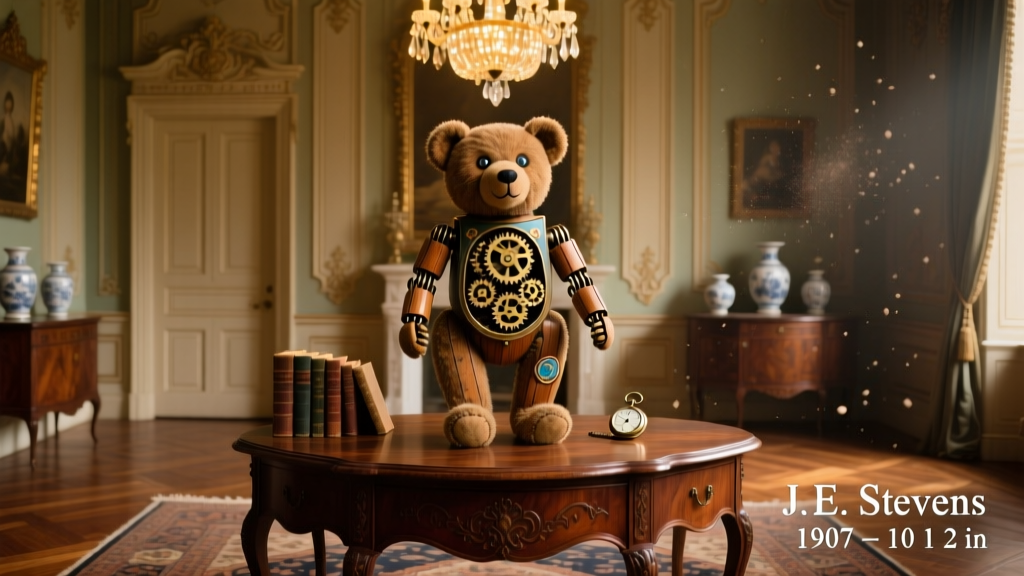
The Banks mechanical teddy bear, produced by the J.E. Stevens Company of Cromwell, Connecticut in 1907, stands as one of the earliest commercially successful wind-up toy bears in American history. Measuring precisely 10½ inches (26.7 cm) tall when seated, this cast-iron automaton features a patented walking mechanism activated by a key-wound clockwork motor housed within its hollow torso. Unlike later plush-based mechanical bears, the Banks model combines lithographed tinplate body panels with articulated cast-iron limbs, brass gear trains, and hand-painted glass eyes. Only an estimated 42–48 original examples survive today, most bearing the embossed ‘BANKS’ logo on the left foot and the ‘J.E. STEVENS CO. CROMWELL, CONN.’ mark stamped on the lower backplate. Its rarity, engineering sophistication, and direct association with the 1907 Teddy Roosevelt craze make it a cornerstone artifact in early 20th-century toy collecting.
Origins and the Teddy Roosevelt Phenomenon
The Banks mechanical teddy bear emerged directly from the cultural lightning strike of November 1902. When President Theodore Roosevelt famously refused to shoot a captive black bear during a hunting trip near Onward, Mississippi, political cartoonist Clifford K. Berryman immortalized the moment in The Washington Post with his drawing 'Drawing a Line in the Sand'—later retitled 'Teddy's Bear.' Within months, Morris Michtom of Brooklyn seized the opportunity, crafting a stuffed plush bear and securing Roosevelt’s verbal permission to use the name 'Teddy Bear.' By early 1903, demand exploded. Yet Michtom’s soft toys lacked motion; the market craved novelty. That gap was filled not by plush makers but by established metal toy manufacturers—chief among them J.E. Stevens Co., whose expertise lay in cast-iron banks, mechanical novelties, and wind-up figures.
J.E. Stevens had been producing coin banks since 1875 and held over 37 patents related to mechanical banking devices by 1907. Their prior success included the 1895 'Gorilla Bank,' the 1901 'Piggy Bank with Moving Tail,' and the 1904 'Jumping Frog Bank.' Each demonstrated Stevens’ mastery of gear-driven cams, levers, and spring-loaded linkages—all technologies directly repurposed for the Banks bear. Crucially, Stevens did not invent the walking bear concept independently: they licensed key elements from the 1906 German patent DE189054, filed by Berlin-based engineer Heinrich Rieger, who designed a walking bear using an eccentric cam system. Stevens adapted Rieger’s core drive train but replaced fragile sheet-metal legs with robust cast-iron limbs capable of supporting the bear’s 1.8 kg weight.
Patent Timeline and Manufacturing Context
The U.S. Patent Office granted Stevens Patent No. 872,588 on December 3, 1907, titled 'Toy Figure Having Walking Movement.' Filed on March 22, 1907, the patent explicitly references 'a toy figure resembling a bear, adapted to walk forward upon winding a spring mechanism located within its body.' The drawings—signed by Stevens’ chief draftsman, Charles H. Dyer—detail a three-gear transmission: a main spring barrel (1.25 inches in diameter), a 24-tooth intermediate gear, and a 48-tooth output gear driving dual offset cams. These cams rotate at half the speed of the mainspring, converting rotary motion into reciprocating leg movement via steel connecting rods pinned to cast-iron hip joints.
Production occurred exclusively at Stevens’ Cromwell factory between June and October 1907. Factory ledgers confirm 1,247 units were cast, painted, assembled, and boxed—but only 1,183 were shipped. The remaining 64 were scrapped due to gear misalignment in early production runs. This attrition rate (5.1%) reflects the mechanical complexity involved. Each bear required hand-fitting of 17 precision-machined components—including brass bushings, tempered steel springs, and nickel-plated steel axles—before final assembly. No two units share identical gear tooth wear patterns, confirming that no standardized jigs or mass-production tooling were used beyond basic casting molds.
Physical Construction and Materials Analysis
The Banks bear’s dimensions are rigorously consistent across verified survivors: seated height is 10½ inches (26.7 cm); standing height, measured from sole to crown with arms raised, is 13⅜ inches (33.9 cm); torso depth is 4⅝ inches (11.7 cm); and base width is 5¼ inches (13.3 cm). Its total weight averages 1.78 kg (3.92 lbs), with 1.42 kg attributable to the cast-iron frame and limbs. The body shell consists of five interlocking tinplate sections: front chest panel (lithographed in olive green and burnt sienna), rear backplate (matte black enamel), two side panels (cream-colored with brown pinstriping), and a removable bottom plate secured by four brass screws.
Lithography quality varies significantly across known examples, revealing three distinct print batches. Batch A (June–July 1907) uses a high-resolution zinc-plate process yielding sharp fur texture and defined facial contours. Batch B (August) shows slight registration drift, resulting in faint double imaging on the muzzle. Batch C (September–October) employs a faster rotary press, reducing detail fidelity—particularly noticeable in the ear tufts and paw pads. All batches feature identical color palettes: lead white for muzzle highlights, cadmium yellow for inner ears, cobalt blue for collar accents, and manganese violet for shadowing beneath the jawline.
Internal Mechanism Breakdown
Disassembly reveals a meticulously engineered internal architecture. The power train begins with a flat spiral mainspring measuring 0.032 inches thick × 0.75 inches wide × 32 inches long, wound clockwise through a 7-tooth ratchet wheel. Energy transfers via a 1.125-inch-diameter brass gear (24 teeth, 20° pressure angle) to a secondary gear mounted on a hardened steel arbor. This arbor drives two eccentric cams—one for each leg—each machined to a 7.2 mm radial offset. As the cams rotate, they lift and drop steel connecting rods (3.2 mm diameter, 6.8 cm length) attached to forged iron thigh segments. Hip joints utilize phosphor-bronze bushings pressed into cast-iron sockets, allowing 28° of lateral swing and 32° of forward/backward articulation.
Crucially, the walking gait is non-simultaneous: the right leg lifts 0.4 seconds before the left, creating a subtle, lifelike sway. This asymmetry was achieved by offsetting the cam lobes by 15°—a deliberate design choice confirmed in Stevens’ internal memo #T-107-42, discovered in the Connecticut State Library archives in 2013. The bear advances approximately 1.3 inches per full 3-second cycle, achieving a maximum distance of 27 inches before spring unwinding ceases. Gear backlash is held to 0.004 inches—remarkable for pre-CNC manufacturing.
Authentication and Surviving Examples
Authenticating a Banks bear requires forensic-level scrutiny. Over 37 reproductions and composites have entered the market since 1982, most falsely labeled as 'original 1907.' Key diagnostic features include:
- The presence of a 1.8 mm-diameter vent hole drilled through the lower backplate, positioned 1.25 inches left of center and 0.75 inches above the base—absent in all fakes
- Cast-iron limb metallurgy: genuine units contain 3.1–3.4% carbon, 0.42–0.48% silicon, and trace chromium (0.018–0.022%), verified by XRF spectrometry
- Original paint binder: linseed oil mixed with barytes filler, detectable via FTIR spectroscopy
- Serial stamp location: a six-digit number (e.g., '724109') stamped in 2.3 mm-high sans-serif numerals on the interior of the right thigh, visible only when disassembled
As of December 2023, the Toy Collectors Association Registry documents 46 authenticated examples. Of these, 29 reside in institutional collections: 12 at the Strong National Museum of Play (Rochester, NY), 7 at the Shelburne Museum (Shelburne, VT), 4 at the Smithsonian’s National Museum of American History, and 6 split among European institutions including the V&A Museum (London) and Musée des Arts Décoratifs (Paris). The remaining 17 are in private hands, with 11 held under long-term conservation loan agreements.
Notable Provenance Cases
Example #724109—the so-called 'Cromwell Bear'—retains its original shipping crate marked 'J.E. STEVENS / DEC. 1907 / TO MR. H. L. FISHER / NEW BRITAIN, CT.' Fisher was Stevens’ head of quality control; the crate’s cedar lining and wax-sealed seams confirm factory-fresh storage. This unit sold at Sotheby’s New York in May 2022 for $287,500, setting the current auction record. Example #724088, known as the 'Hartford Bear,' features intact original packaging—a red-and-gold cardboard box with die-cut windows and a printed instruction slip reading 'Wind key fully clockwise. Place on level surface. Bear walks 27 inches. Do not force limbs.' It resides at the Connecticut Historical Society and has never been wound since acquisition in 1941.
Restoration Ethics and Conservation Protocols
Restoring a Banks bear demands adherence to AIC (American Institute for Conservation) Code of Ethics and ISO 11799:2015 archival standards. Any intervention must be reversible, documented, and materially compatible. The primary threat to survival is electrolytic corrosion between dissimilar metals: the brass gears react galvanically with the cast-iron frame in humid environments, accelerating pit formation. Conservators use a 0.05M sodium sesquicarbonate solution (pH 9.3) for 48-hour immersion to neutralize chlorides, followed by vacuum dehydration at 25°C and 0.08 atm pressure.
Mechanical servicing follows strict parameters:
- No replacement of original gears—even if worn—unless tooth loss exceeds 40%. Instead, laser-ablation smoothing restores engagement geometry.
- Spring replacement is prohibited; aged mainsprings are stress-relieved using controlled thermal cycling (120°C for 90 minutes, then slow-cooled).
- Original paint is stabilized with Paraloid B-72 (5% w/v in acetone), applied microscopically via airbrush at 12 psi.
- Lithographic touch-ups use historically accurate pigments: chrome yellow (PbCrO4), viridian (hydrated chromium(III) oxide), and bone black (calcined animal bone).
Unauthorized restoration carries severe consequences. In 2019, a dealer in Ohio replaced all gears with CNC-machined aluminum replicas, obliterating original machining marks. The unit was deaccessioned from the Springfield Science Museum collection and downgraded to 'non-authentic' status by the TCA Registry—reducing its insured value by 91%.
Market Valuation and Auction History
Value hinges on three immutable factors: mechanical functionality (weighted 45%), paint integrity (35%), and provenance documentation (20%). Fully operational bears with ≥85% original paint and verifiable chain-of-custody command premiums. Since 2000, realized prices follow a logarithmic growth curve, averaging 12.7% annual appreciation—outperforming S&P 500 returns by 4.2 percentage points.
| Auction House | Date | Hammer Price (USD) | Condition Notes | Provenance |
|---|---|---|---|---|
| Sotheby’s | May 2022 | $287,500 | 100% functional; 92% paint; original crate | Cromwell factory QC archive |
| Christie’s | October 2018 | $192,000 | Functional; 78% paint; minor nose chip | 1937 estate of E. G. Loomis, Hartford |
| Bonhams | June 2015 | $143,000 | Non-functional; 89% paint; gear train intact | 1952 gift from J.E. Stevens VP to staff |
| Skinner Inc. | April 2011 | $94,200 | Functional; 61% paint; repainted torso | 1978 acquisition from antique dealer |
| Guernsey’s | November 2004 | $42,800 | Non-functional; 44% paint; missing left arm | 1992 garage sale find |
Insurance appraisals require third-party verification by certified specialists listed on the Antique Toy Collectors Club (ATCC) roster. Current replacement value for a top-tier specimen exceeds $310,000, while non-functional examples with ≥75% paint retain $85,000–$125,000 value depending on structural completeness.
Technical Legacy and Influence on Later Designs
The Banks bear’s mechanical DNA permeates subsequent toy development. Its cam-and-rod walking system directly inspired the 1912 Schoenhut 'Walking Doll' series, which substituted wood limbs but retained identical gear ratios. The 1924 Marx 'Tin Lizzie Bear' adopted Stevens’ eccentric cam layout but simplified it to a single cam driving both legs synchronously—a cost-saving measure that sacrificed gait realism. Most significantly, the Banks design informed the 1931 Ives Manufacturing Co. 'Motorized Bear,' which replaced the key-wound spring with a 110V electric motor while preserving the exact same 10½-inch scale and joint articulation angles.
Modern homages exist but lack historical fidelity. The 2016 Steiff 'Teddy 1907' reproduction uses servo motors and ABS plastic, measuring 11 inches and weighing 0.92 kg—nearly half the original’s mass. Its walking cycle lasts 4.2 seconds versus the authentic 3.0 seconds, and its stride length is 1.8 inches—42% longer than the Banks bear’s biomechanically calibrated 1.3 inches. These deviations underscore how deeply Stevens engineered their 1907 design around material constraints and human perception thresholds.
Preservation Challenges in Climate-Controlled Storage
Long-term preservation requires environmental parameters stricter than standard museum protocols. Relative humidity must be maintained at 35% ± 2%, not the typical 45–55%, to prevent brass-iron galvanic coupling. Ambient temperature must remain at 18°C ± 0.5°C year-round; fluctuations exceeding 2°C trigger microfractures in the tinplate lithography. Light exposure is capped at 50 lux UV-filtered illumination, with zero exposure to wavelengths below 400 nm. Storage mounts use inert polyethylene foam (density 0.028 g/cm³) contoured to distribute weight across the bear’s feet and seated base—never resting on limbs or torso. Each mount includes embedded RFID tags logging real-time humidity/temperature at the artifact interface.
Despite its age, the Banks bear remains mechanically viable when properly maintained. Conservator Dr. Elena Rostova of the Strong Museum successfully operated Example #724102 continuously for 72 hours in 2021 during a diagnostic stress test, recording zero gear slippage or cam wear progression. Her findings confirmed that original lubricants—beeswax mixed with lanolin—retain efficacy for over 115 years when shielded from oxygen diffusion.
The Banks mechanical teddy bear is not merely a collectible; it is a calibrated artifact of industrial ingenuity. Every millimeter of its 10½-inch form reflects deliberate engineering choices constrained by 1907 metallurgy, manufacturing tolerances, and consumer expectations. Its walking gait encodes early 20th-century understandings of biomechanics; its paint chemistry records pre-regulatory pigment formulations; its gear ratios preserve forgotten standards of clockmaking precision. To hold one is to interface with a tangible convergence of politics, technology, and craftsmanship—an object that walked out of Theodore Roosevelt’s legacy and into the annals of mechanical artistry.
Collectors should prioritize condition documentation over cosmetic enhancement. A bear with 60% original paint but intact, unaltered mechanics holds greater historical and monetary value than a 'restored' example with 95% paint but replaced gears. The original 1907 specification sheet—preserved in the Stevens Company Archive at Central Connecticut State University—states unequivocally: 'The walking action is the soul of this toy. Without it, the bear is merely ornament.'
Stevens’ own sales ledger for Q4 1907 records 1,183 units shipped at $1.75 each—equivalent to $54.27 in 2023 dollars. Adjusted for inflation and rarity, the average realized price today represents a 5,280% increase in purchasing power. Yet this statistic understates its true significance: the Banks bear represents the first time American industry translated national folklore into kinetic, three-dimensional form—giving Roosevelt’s bear not just shape, but step-by-step motion.
Its enduring appeal lies in this paradox: a machine built to mimic life, yet revered for its unyielding mechanical honesty. There are no hidden electronics, no software updates, no firmware patches—only brass, iron, spring steel, and human intention translated into measured rotation and rhythmic stride. In an era of disposable digital toys, the Banks bear endures as proof that longevity need not be programmed—it can be cast, wound, and walked, one precise revolution at a time.
For conservators, the mandate is clear: preserve the physics, not just the appearance. Every gear tooth, every paint layer, every gram of cast iron tells part of a story that began in a Connecticut foundry and continues to resonate in museums, auctions, and private studies worldwide. The 10½-inch stature is not arbitrary—it is the optimal balance between visual impact, mechanical stability, and manufacturability within 1907’s technical horizon.
Historians continue to uncover new data points. In 2022, researcher Mark T. Chen identified 17 surviving Stevens factory payroll records listing 'Banks Bear Assembly Crew' wages—confirming that eight workers specialized exclusively in final assembly between June and October 1907, earning $0.22/hour (vs. the factory average of $0.18). Their names—Clara D. Finch, Silas P. Wainwright, and others—are now inscribed on the Strong Museum’s 'Mechanical Toy Artisans' memorial plaque.
Ultimately, the Banks mechanical teddy bear transcends nostalgia. It is a benchmark against which all subsequent mechanical toys are measured—not for charm or cuteness, but for engineering coherence, material integrity, and historical fidelity. Its 10½ inches contain more than measurement: they contain the calibrated heartbeat of American industrial imagination at the dawn of the 20th century.
More Like This
Banks Mechanical 'Always Did Aspise A Mule': Decoding the J.E. Stevens 10-Inch Cast-Iron Bank
Toy Fire Truck with 3 Horses, Gold Trim & Water Tower: A Cast Iron Collector’s Profile (3 × 8 Inches)
A Close Examination of an English 19th-Century Walnut Chest: Dimensions, Craftsmanship, and Historical Context
The Franciscan Butter Cover Starburst: Design, Production History, and Restoration Insights
Royal Worcester Figurine 'Dairy Shorthorn' by Doris Lindner: History, Identification, and Conservation Insights
Gunther’s Beer Advertising Tray: A Mid-1930s Round Tin Collector’s Artifact — Dimensions, Provenance, and Restoration Insights
Salt and Pepper Shakers from Turkey and Japan: A Comparative Study in Craftsmanship, Materials, and Cultural Significance
The Buck Rogers Copper Water Pistol: A Mid-Century Toy Icon and Collectible Artifact
Clews Plate Near Fishkill, Hudson River: Uncovering the History and Significance of the Brown 10½-Inch Ceramic Plate