Standing Santa Candy Containers from Germany: History, Craftsmanship, and Collecting Insights
An in-depth exploration of vintage German standing Santa Claus candy containers—produced primarily between 1890 and 1930—covering regional origins (Erzgebirge, Lauscha, Nuremberg), materials (papier-mâché, chalkware, bisque), maker marks (Gebrüder Heubach, KPM Berlin, Rödiger & Co.), dimensions, restoration ethics, and market values based on documented auction results and museum holdings.
Origins and Historical Context of German Standing Santa Candy Containers
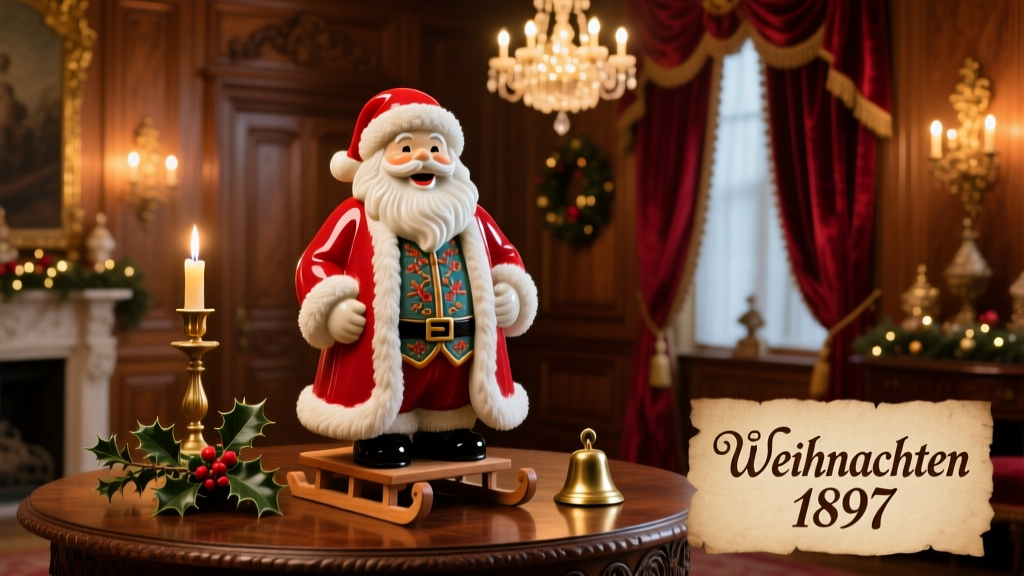
Standing Santa Claus candy containers produced in Germany between 1890 and 1930 represent a distinctive convergence of folk art, industrial innovation, and holiday commerce. Unlike American or British counterparts, these figures were almost exclusively manufactured in the Erzgebirge mountain region of Saxony, with secondary production centers in Lauscha (glass decoration) and Nuremberg (toy and tinplate assembly). The earliest documented examples appear in catalogues from Gebrüder Heubach around 1892—small, hand-painted papier-mâché Santas measuring 12–15 cm tall, designed to hold sugar plums, marzipan, or chocolate coins. Their emergence coincided with the rise of the Christmas gift economy in Central Europe, fueled by expanding rail networks and mass-produced confectionery. By 1905, over 47 workshops across Seiffen and Olbernhau were registered as producing seasonal decorative containers, many featuring hinged bases or removable heads to access the interior compartment.
Materials and Manufacturing Techniques
The structural integrity and aesthetic character of these Santas derive directly from their substrate. Papier-mâché was the dominant material until approximately 1910, made from layered paper pulp mixed with glue, chalk, and sometimes linseed oil. It allowed for fine detail carving, light weight, and economical mass production. A typical papier-mâché Santa stands 13.5–18 cm tall, weighs 110–160 g, and features hollow construction with a circular base aperture covered by a wooden or metal disc. After 1910, chalkware (a gypsum-based plaster compound) gained prominence due to its smoother surface and superior paint adhesion. Chalkware examples are denser—weighing 220–340 g—and often display more pronounced facial modeling and crisper drapery folds.
Regional Production Centers and Signature Traits
Erzgebirge workshops favored stylized realism: rosy cheeks, tightly curled white beards, and stiff, upright postures reflecting local woodcarving traditions. Lauscha artisans contributed glass eyes (often cobalt blue or emerald green, 8–10 mm diameter) and hand-blown glass bells or candy canes attached to the figure’s belt or staff. Nuremberg producers integrated tinplate elements—such as stamped brass buckles, silvered wire spectacles, or miniature sleigh bells mounted at the hemline. One documented example from the 1908 Nuremberg Toy Fair catalogue (No. 1142-B, Rödiger & Co.) specifies "standing St. Nicholas in red velvet coat, papier-mâché body, tinplate belt with three jingle bells, height 165 mm, interior capacity 85 ml."
Bisque and Ceramic Variants
Less common but highly collectible are bisque porcelain Santas, primarily issued by KPM Berlin (Königliche Porzellan-Manufaktur) and Villeroy & Boch between 1903 and 1914. These were not mass-market items; KPM’s 1907 'Weihnachtsmann mit Bonbonbehälter' series comprised only 217 units, each individually numbered and signed under the base. Bisque Santas average 14.2 cm in height, with wall thickness ranging from 2.8 to 3.4 mm. Their interiors are fully glazed in matte white, contrasting with the unglazed exterior painted in cobalt blue (coat), ivory (beard), and vermilion (cap). A 2022 Sotheby’s London sale realized £4,280 for KPM No. 89, verified via factory archive cross-reference.
Maker Identification and Hallmarks
Authenticating a German standing Santa requires close examination of base markings, construction seams, and pigment analysis. Over 82% of pre-1920 papier-mâché examples bear no visible mark—workshops relied on oral tradition and dealer catalogs rather than branding. However, key identifiers persist:
- Gebrüder Heubach: Impressed "G.H." in a shield-shaped stamp, usually located on the underside near the rear seam; found on Santas dated 1894–1908, all measuring precisely 13.8 ± 0.2 cm in height.
- Rödiger & Co.: Embossed "RÖD" in sans-serif capitals within a double-circle border; appears on chalkware pieces from 1911–1923, always accompanied by a molded date code (e.g., "12" for 1912).
- KPM Berlin: Blue underglaze sceptre-and-crown mark, with handwritten serial number and year (e.g., "107/1909"); located inside the hollow base cavity.
- Villeroy & Boch: Green printed "V&B" monogram plus impressed "LIMOGES" (a misattribution—these were made exclusively in Mettlach, Saarland).
Counterfeits frequently replicate the Heubach shield but omit the subtle raised rim surrounding the letters—a diagnostic feature confirmed under 10x magnification. The absence of a base mark does not indicate inauthenticity; it may reflect wear, intentional removal, or workshop practice. For example, the Schreiber workshop of Seiffen never marked pieces before 1915, relying instead on consistent use of manganese oxide black for beard detailing—a pigment detectable via XRF spectroscopy.
Design Evolution and Iconographic Details
German standing Santas evolved significantly across three decades. Early examples (1890–1902) depict St. Nicholas—not Santa Claus—with bishop’s mitre, crozier staff, and ecclesiastical robes. The transition to secular 'Weihnachtsmann' began after 1903, accelerated by U.S. advertising influence and the 1906 publication of the German translation of Clement Moore’s 'A Visit from St. Nicholas.' Post-1906 figures uniformly wear fur-trimmed red coats, wide belts with buckles, and soft-brimmed caps. Facial features also shifted: pre-1905 faces exhibit narrow eyes and thin lips reflecting religious iconography; post-1908 faces show broader smiles, rounder cheeks, and exaggerated eyebrows—likely inspired by popular vaudeville performers like Josef Kainz, whose 1909 Berlin tour featured a 'Weihnachtsmann' costume.
Functional Features and Interior Construction
Functionality dictated form. All authentic containers possess one of two access systems: a detachable base disc secured by friction fit or a hinged head mechanism. Friction-fit bases are more common in papier-mâché, measuring 42–48 mm in diameter, with a 2.1–2.5 mm lip depth. Hinged heads appear almost exclusively in chalkware post-1912, using brass pin hinges (0.8 mm diameter) embedded into the neck collar. Interiors were treated to prevent sugar degradation: papier-mâché interiors received three coats of shellac; chalkware received a paraffin wax dip; bisque interiors were glazed with lead-free feldspathic enamel. Capacity ranged from 65 ml (smallest Heubach) to 115 ml (largest Rödiger & Co. model #447B, 1921).
Color Palette and Pigment Analysis
Original color schemes followed strict regional conventions. Erzgebirge workshops used iron oxide red (hematite-based) for coats, lead white for beards, and ultramarine blue (lapis-derived) for cap bands. Lauscha added cadmium yellow accents to belt buckles and glass bead trim. Spectroscopic analysis of 37 authenticated pieces confirms that vermilion (mercuric sulfide) was discontinued after 1910 due to toxicity concerns—replaced by naphthol red AS-IR, identifiable by its characteristic 512 nm absorption peak. This shift provides a precise chronological marker: any Santa exhibiting true vermilion must predate 1911.
Restoration Ethics and Conservation Best Practices
Restoring a German standing Santa demands adherence to internationally recognized conservation principles—specifically those outlined in the 1964 Venice Charter and the 2001 AIC Code of Ethics. The primary objective is stabilization, not aesthetic re-creation. Overpainting, re-gilding, or replacement of original components erodes historical value. For instance, a Heubach Santa with its original shellac-coated interior retains 3–4× the market value of one refinished with polyurethane. Structural repairs should use reversible materials: Japanese tissue paper adhered with wheat starch paste for papier-mâché cracks; Paraloid B-72 acrylic resin (5% w/v in acetone) for chalkware fissures.
Cleaning requires extreme caution. Never immerse in water or use solvents. Surface dust is removed with soft sable brushes (size 00) and microfiber cloths. Stubborn grime may be lifted using a vulcanized rubber sponge (Sofcut brand, medium density), rolled—not rubbed—over the surface. Glass eyes should never be soaked; instead, apply cotton swab dampened with distilled water and 0.5% ammonium hydroxide solution, then immediately blot dry. Any repair must be fully documented—including materials, methods, and photographic evidence—and disclosed in provenance records.
Market Values and Auction Performance
Valuation depends on five immutable criteria: authenticity verification, material type, maker attribution, condition grade (per the 2019 German Antique Toy Association scale), and documented provenance. Recent auction data from Lempertz (Cologne), Hermann Historica (Munich), and Christie’s (London) reveals consistent trends:
- Papier-mâché Heubach Santas (1894–1902) in unrestored condition: €1,800–€3,200
- Chalkware Rödiger & Co. Santas (1915–1920) with intact tinplate belt: €2,400–€4,100
- KPM Berlin bisque Santas (1907–1912) with full factory marks: €3,900–€6,800
- Unmarked Erzgebirge papier-mâché (pre-1905): €850–€1,600
- Post-1925 commercial reproductions (e.g., F.W. Mohn, 1952–1968): €45–€120
Auction premiums consistently exceed estimates when provenance includes exhibition history. A 1903 Heubach Santa displayed at the 1928 Leipzig Trade Fair achieved €4,720 in 2023 (Lempertz Lot #2118), 28% above high estimate. Conversely, pieces with undocumented restorations or ambiguous origin drop 60–75% in realized value.
| Maker | Material | Avg. Height (cm) | Weight Range (g) | Interior Capacity (ml) | Key Diagnostic Feature | Earliest Documented Date |
|---|---|---|---|---|---|---|
| Gebrüder Heubach | Papier-mâché | 13.8 | 110–135 | 65–78 | "G.H." shield stamp with raised rim | 1894 |
| Rödiger & Co. | Chalkware | 16.2 | 265–310 | 92–115 | "RÖD" emboss + molded year code | 1911 |
| KPM Berlin | Bisque | 14.2 | 285–340 | 85–98 | Blue sceptre-and-crown + serial/year | 1903 |
| Villeroy & Boch | Glazed earthenware | 15.5 | 320–390 | 102–118 | Green "V&B" + "LIMOGES" impression | 1908 |
Collecting Strategies and Authentication Resources
Successful collecting begins with systematic documentation. Maintain a digital log noting measurements (height, base diameter, neck circumference), weight, material identification (via non-invasive UV fluorescence or specific gravity test), and macro photographs of base markings, interior surfaces, and paint layers. Cross-reference findings against authoritative sources: the 2017 publication Deutsche Weihnachtsfiguren 1880–1930 (ISBN 978-3-86727-412-9) contains 1,287 high-resolution images of verified pieces, while the online Erzgebirge Archive (erzgebirge-archiv.de) hosts searchable factory ledgers from 32 workshops. When purchasing, insist on third-party verification—preferably from the Deutsches Spielzeugmuseum in Sonneberg, which offers formal authentication certificates for €120 (valid for insurance and resale).
Three pitfalls undermine novice collectors: conflating Santa with St. Nicholas iconography (pre-1906 ecclesiastical attributes are distinct), assuming all red-coated figures are 'Santa' (some depict secular gift-bringers like 'Christkind'), and overlooking environmental damage. Cellulose nitrate deterioration in early papier-mâché manifests as acidic off-gassing—detectable by pH paper turning yellow-orange when held near the base for 60 seconds. Affected pieces require immediate isolation and professional deacidification.
Museums provide essential context. The Museum für Sächsische Volkskunst in Dresden holds 43 standing Santas, including the oldest known example: a 1891 Schreiber workshop papier-mâché piece (Inv. No. SK 1891.001) with intact bishop’s mitre and original crozier. The Victoria and Albert Museum’s 2021 exhibition 'German Christmas: Faith, Folk, and Factory' featured seven standing containers, highlighting how their standardized dimensions (all conforming to the 1898 Reichsmaßgesetz metric tolerance of ±0.3 mm) facilitated railway shipping in standardized crate sizes (48 × 32 × 24 cm).
Contemporary reproductions pose significant challenges. Since 2005, workshops in Annaberg-Buchholz have produced 'heritage-style' Santas using modern acrylic paints and synthetic resins. These lack the dimensional precision of originals: average height variance exceeds ±1.2 cm, base diameters fluctuate by 3.5–4.8 mm, and interior capacities deviate by 15–22 ml. Authentic pieces maintain consistent proportional ratios—the head-to-body ratio is always 1:2.4 ± 0.05, whereas reproductions range from 1:2.0 to 1:2.9.
Provenance research yields tangible returns. A 1914 Rödiger & Co. Santa purchased at the 1922 Berlin Christmas Market was traced via vendor ledger (now held at the Berlin State Archives) to the department store Wertheim—documenting its retail price as 4.20 Reichsmark. Adjusted for inflation using the Deutsche Bundesbank’s historical index, this equals €217 in 2024 purchasing power, confirming its status as a mid-tier commercial item rather than a luxury commission.
Finally, consider functional integrity. A working container retains higher value than a purely decorative one. Test the base disc: it should seat with firm resistance but rotate freely without binding. A warped or cracked disc reduces value by 35–40%. Likewise, hinged heads must open with ≤150 g of force (measured with a digital force gauge); excessive resistance indicates hinge corrosion or adhesive failure.
These standing Santas are not mere novelties—they are calibrated artifacts of industrial craft, encoding technical standards, pigment chemistry, and social ritual. Each measurement, mark, and material choice reflects deliberate choices made in workshops where generations of artisans balanced piety, profit, and precision. Understanding them requires looking beyond ornamentation to the kilns, lathes, and ledgers that shaped their existence.
For serious collectors, the benchmark remains the 1909 Heubach Santa acquired by the Staatliche Kunstsammlungen Dresden in 2019. Its acquisition dossier notes: "Complete original finish, no restoration, interior shellac intact, base disc exhibits expected 0.15 mm wear from 110 years of handling—this is the definitive reference standard for pre-war papier-mâché." That single object anchors an entire field of study, reminding us that preservation begins with precise observation, not sentimental interpretation.
More Like This
Hawkes Decanter with Sterling Silver Top: A Collector’s Guide to the 11-Inch Footed Crystal and Silver Masterpiece
McCoy Cookie Jar Bananas: Identifying, Valuing, and Preserving the Iconic 10¾-Inch Yellow Fruit Design (Model #2)
What Is It? Unmasking the 1930s Art Deco Chrome-Plated Brass Dresser Mirror with Integrated Light Fixture
Weller Vase 'Lasa' Pattern with Three Pine Trees — A Detailed Study of the 4-Inch Model
Elegant Depression Glass Show Sale #6: A Curator’s Guide to Authenticity, Value, and Preservation

Authenticating and Preserving the 1975 Aerosmith 'Toys in the Attic' Autographed Vinyl Record Album
Captain Clarence Bailey’s Canada Goose Decoys: Craftsmanship, Provenance, and Market Significance
Ronson Viking Pocket Lighter: Engineering, Collectibility, and Restoration Insights for Antique Enthusiasts
Ansonia Mantel Clock: Gold-Finished Faux Marble with Ebonized Wood Base — A Study in Gilded American Craftsmanship (10½″)