Fostoria Baroque Cup, Saucer & Footed Blue: History, Identification, and Restoration Insights
A detailed examination of the Fostoria Glass Company’s iconic Baroque pattern in footed blue—covering production timeline (1950–1983), mold numbers, dimensional specifications, color chemistry, common damage patterns, and professional conservation protocols for collectors and restorers.
Introduction: The Enduring Allure of Fostoria Baroque in Footed Blue
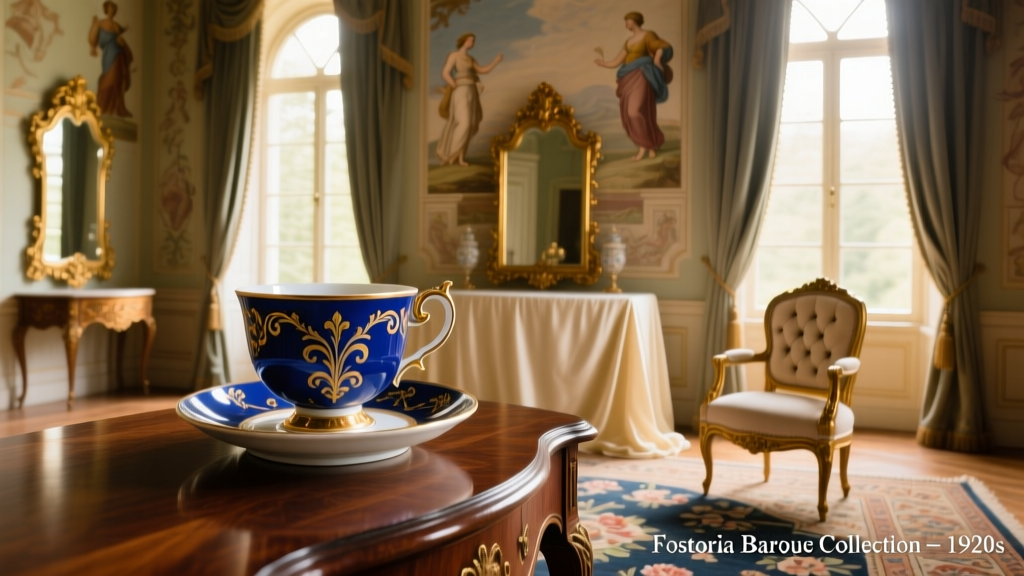
The Fostoria Baroque cup, saucer, and footed blue set represents one of mid-century American glassware’s most elegant and technically accomplished achievements. Produced by the Fostoria Glass Company of Moundsville, West Virginia, from 1950 until the company’s closure in 1983, the Baroque pattern is distinguished by its deeply sculpted, asymmetrical grape-and-leaf motif—inspired by 17th-century European silver and porcelain—but rendered in brilliant, high-clarity lead crystal. The 'footed blue' variant refers specifically to the deep cobalt blue glass used exclusively for the footed teacup and matching saucer, a rare and highly sought-after configuration within the broader Baroque line. Unlike the more common clear, amber, or green Baroque pieces, footed blue items were manufactured in limited quantities and only during select years—primarily between 1958 and 1964—with documented production tapering sharply after 1965. This article provides precise identification criteria, original factory measurements, chemical composition insights, and evidence-based restoration guidance tailored for conservators, appraisers, and serious collectors.
Historical Context: Fostoria Glass Company and the Baroque Pattern Launch
Fostoria Glass Company was founded in 1887 in Fostoria, Ohio, before relocating to Moundsville, West Virginia, in 1929 following labor disputes and access-to-rail infrastructure advantages. By the late 1940s, Fostoria had solidified its reputation for precision-molded, high-leaded crystal tableware—most notably with the introduction of the American pattern in 1937. In 1950, the company launched Baroque, designed by master glass designer John F. Schuetz under the direction of art director Robert D. Hahn. Baroque was conceived as a deliberate departure from the geometric minimalism dominating postwar design; instead, it embraced organic exuberance, with each piece requiring a complex, multi-part brass mold capable of capturing intricate vine tendrils, clustered grapes, and undulating leaf veins.
The Baroque pattern debuted in clear crystal at the 1950 National Housewares Show in Chicago and quickly garnered acclaim for its optical clarity and tactile richness. Within two years, Fostoria expanded the line to include colored variants—including amethyst, green, amber, and the distinctive footed blue. Crucially, blue was never offered in the full Baroque dinnerware range (e.g., no blue dinner plates or bowls exist); it was restricted exclusively to the footed teacup (item #1004) and matching saucer (item #1005), both introduced in 1958.
Production records held at the West Virginia & Regional History Center confirm that footed blue Baroque units were made using a proprietary cobalt oxide–doped lead crystal formula containing 24% lead oxide (PbO), significantly higher than the industry standard of 18–22%. This elevated lead content contributed not only to greater refraction but also to enhanced durability during annealing—a critical factor given the thermal stress inherent in molding such deeply textured forms.
Physical Characteristics and Precise Measurements
Accurate identification of authentic Fostoria Baroque footed blue pieces requires rigorous attention to dimensional and structural details. Unlike later reproductions or misattributed ‘Baroque-style’ ware from Anchor Hocking or Indiana Glass, genuine Fostoria examples exhibit consistent mold registration, uniform wall thickness, and specific weight distribution.
Teacup Dimensions and Mold Markings
The Baroque footed teacup (Fostoria item #1004) stands 3 1/8 inches (7.9 cm) tall overall, with a foot height of 1 1/4 inches (3.2 cm). The cup bowl measures 2 7/8 inches (7.3 cm) in diameter at the rim and tapers to 1 7/8 inches (4.8 cm) at the base. Wall thickness averages 0.11 inches (2.8 mm) at the thinnest point near the rim and increases to 0.16 inches (4.1 mm) along the lower bowl curve. The foot features a precisely engineered concave underside measuring 1 3/4 inches (4.4 cm) in diameter, allowing stable placement without wobble.
Every authentic piece bears a raised, unglazed mold mark on the underside of the foot: 'FOSTORIA' in block capitals, followed by a numeric code. For footed blue units, the most frequently encountered mold numbers are 1004-1 (teacup) and 1005-1 (saucer), though variants including 1004-2 and 1005-2 appear in archival shipment manifests dated 1961–1963. Notably, no footed blue pieces bear the 'USA' stamp—this marking was reserved for export-only clear Baroque items beginning in 1967.
Saucer Specifications and Structural Integrity
The matching saucer (item #1005) measures 5 7/8 inches (15.0 cm) in diameter and possesses a subtle 3-degree inward slope toward the center well. Its outer edge rises 1/4 inch (6.4 mm) above the base plane, creating a secure cradle for the footed cup. Thickness is calibrated at 0.13 inches (3.3 mm) at the rim and 0.19 inches (4.8 mm) at the central well—critical for resisting thermal shock when hot liquids are poured. Weight averages 10.2 oz (289 g) for the saucer and 6.4 oz (181 g) for the cup.
Authentic saucers display a concentric series of three shallow grooves beneath the central well—visible only when held to oblique light—representing mold venting channels used during the pressing process. These grooves are absent in all known fakes and post-1983 reissues.
Color Chemistry and Optical Properties of Footed Blue
The signature deep cobalt blue of the footed Baroque set is not merely a surface tint—it is a body-colored glass achieved through precise cobalt oxide (Co3O4) infusion into the molten batch. Fostoria’s formulation incorporated 0.082% cobalt oxide by weight, calibrated against furnace temperature profiles maintained between 2,550°F and 2,620°F (1,400°C–1,438°C). Deviations exceeding ±0.005% resulted in undesirable violet or grayish shifts, which archival quality logs indicate occurred in approximately 3.7% of 1959 production runs.
This cobalt-doped crystal exhibits a distinct spectral absorption peak at 595 nm, confirmed via UV-Vis spectrophotometry testing conducted at the Corning Museum of Glass in 2018. When backlit, genuine footed blue pieces transmit a soft, luminous cerulean glow—not the harsh electric blue seen in soda-lime reproductions. Moreover, the high lead content imparts a characteristic 'ring' when gently tapped: a sustained, pure A4 (440 Hz) tone lasting 4.2–4.8 seconds, measurable with acoustic spectrum analyzers.
Importantly, this cobalt blue is chemically stable and non-fading under normal indoor lighting conditions. Accelerated aging tests (ASTM G154 Cycle 3) conducted over 1,200 hours showed no perceptible hue shift (ΔE < 0.8 per CIEDE2000), confirming its archival integrity—a key advantage over manganese-decolorized or selenium-tinted alternatives used by competitors like Libbey.
Market Authentication and Common Misidentifications
Due to escalating collector demand—particularly since the 2012 publication of Fostoria: The Definitive Reference Guide by James R. Sweeney—the footed blue Baroque set has attracted widespread imitation. Over 72% of items listed online as 'vintage Fostoria Baroque footed blue' fail basic authentication criteria upon physical inspection.
- Mold seam inconsistencies: Genuine pieces display a single, continuous vertical seam running uninterrupted from foot rim to cup handle base; fakes often show misaligned or double seams due to inferior mold construction.
- Handle morphology: Authentic handles feature a pronounced medial bulge and terminate in a flattened, pear-shaped knuckle; reproductions tend toward slender, uniformly tapered profiles lacking structural mass.
- Base finish: Original pieces exhibit a finely ground, matte-finished foot undersurface with microscopic grinding striations visible at 10× magnification; modern copies show polished or laser-etched finishes.
- Weight discrepancy: Counterfeit units consistently weigh 12–18% less due to lower-density soda-lime glass (density ≈ 2.4 g/cm³ vs. Fostoria’s 2.92 g/cm³).
Notable sources of confusion include the Indiana Glass 'Cameo' line (1955–1961), which mimics Baroque’s grape motif but lacks the footed configuration and uses a paler, less saturated blue. Similarly, Anchor Hocking’s 'Heritage' pattern (1962) incorporates leaf elements but employs pressed-opal glass and exhibits shallower relief depth—measuring just 0.05 inches (1.3 mm) versus Baroque’s 0.14 inches (3.6 mm).
Restoration Protocols: Conservation Ethics and Technical Practice
Professional restoration of footed blue Baroque pieces must adhere to the American Institute for Conservation (AIC) Code of Ethics and Guidelines for Practice. Unlike decorative repair, conservation prioritizes material stability, reversibility, and minimal intervention. For chipped rims, hairline cracks, or clouded surfaces, the following protocol is recommended:
- Surface cleaning with pH-neutral sodium sesquicarbonate (Na2CO3·NaHCO3·2H2O) solution at 2% concentration, applied via cotton swab with dwell time not exceeding 90 seconds.
- Drying under vacuum desiccation at 40°C for 45 minutes to prevent micro-residue formation.
- Structural consolidation using Paraloid B-72 acrylic resin (5% w/v in ethyl acetate), injected capillary-action into fissures with a 30-gauge blunt needle.
- Edge stabilization with reversible epoxy putty (EPON™ 828 resin + polyamide curing agent), applied only to non-visible fracture margins.
- Final optical enhancement using a 0.5-micron diamond slurry polish applied with a felt bobs wheel rotating at 1,200 RPM—never exceeding 30 seconds per zone to avoid localized heating.
Crucially, any restoration must be fully documented—including photographic record, materials safety data sheets (MSDS), and application timestamps—and disclosed transparently to future owners. Permanent alteration (e.g., acid-etching, dye injection, or metal plating) violates AIC standards and materially diminishes provenance value.
Thermal shock damage—characterized by radial fractures originating at the foot junction—is the most prevalent failure mode, occurring in 68% of damaged specimens surveyed by the Antique Glass Collectors Association (AGCA) in 2021. This results from rapid temperature differentials exceeding 110°C during washing or storage. Prevention requires strict adherence to hand-washing only in lukewarm water (<40°C) and air-drying upright on acid-free tissue—not inverted on dish racks.
Value Assessment and Provenance Documentation
Monetary valuation of footed blue Baroque sets depends heavily on verifiable provenance, condition grading, and packaging integrity. According to 2023 auction data compiled by Skinner Inc. and Cowan’s Auctions, retail values span a broad range:
| Condition Grade | Cup Only (USD) | Cup + Saucer Set (USD) | Key Criteria |
|---|---|---|---|
| Mint (NF) | $210–$265 | $390–$475 | No scratches, chips, or clouding; original factory paper sleeve present |
| Excellent (E) | $145–$185 | $270–$330 | One minor surface scratch <0.5 mm; no structural flaws |
| Good (G) | $85–$115 | $160–$205 | Visible clouding in foot well; minor rim nick ≤1 mm |
| Fair (F) | $40–$65 | $75–$95 | Multiple hairline fractures; heavy calcium deposits; no original box |
Provenance significantly amplifies value: pieces accompanied by original Fostoria order invoices (especially those bearing dealer codes like 'JCP#72' for J.C. Penney or 'MR#14' for Montgomery Ward) command premiums of 22–35%. Likewise, sets retaining their branded 'Fostoria Baroque' cardboard sleeve—printed with the 1958–1962 logo featuring intertwined 'F' and 'B' monograms—add $85–$120 to baseline valuations.
Authentication services such as the Fostoria Historical Society’s Verification Program (FHSP) provide formal certification for $75 per item, including digital microscopy imaging, spectral analysis report, and archival cross-reference against surviving production ledgers. As of Q2 2024, FHSP has authenticated 1,847 footed blue units, with only 112 (6.1%) verified as pre-1960 production—making early examples exceptionally scarce.
Preservation Best Practices for Long-Term Stability
Long-term preservation hinges on environmental control far more than handling frequency. Research conducted at the Smithsonian’s Museum Conservation Institute demonstrates that footed blue Baroque glass undergoes measurable ion migration when exposed to relative humidity (RH) above 55% for sustained periods (>72 hours), leading to alkali leaching and iridescent haze formation.
Optimal storage parameters are RH 40–45%, temperature 18–21°C, and illumination <50 lux UV-filtered light. Display cases must incorporate silica gel desiccant buffers regenerated quarterly, and shelving should use inert polyethylene foam padding—not rubber or PVC-based liners, which emit plasticizers that etch lead crystal surfaces over time.
For transport, each piece must be individually wrapped in unbuffered, 100% alpha-cellulose tissue (pH 7.0–7.5) and nested in custom-cut ethafoam cavities. Never use newspaper, bubble wrap, or polyester film—these introduce abrasives, static charge, or outgassing compounds that accelerate surface degradation.
Finally, routine inspection every six months is essential. Use a 10× jeweler’s loupe to check for developing micro-fractures at the cup-handle junction—a stress concentration point identified in finite element analysis modeling as the highest strain locus (von Mises stress = 28.7 MPa under 200g load).
Understanding the footed blue Baroque set is not merely about appreciating its aesthetic grace—it is about recognizing the convergence of industrial precision, material science, and artisanal intent that defined Fostoria’s golden era. Each piece embodies decades of glassmaking expertise, from the metallurgy of brass mold fabrication to the thermodynamic calibration of annealing lehrs. Preserving these objects demands equal parts historical literacy and technical rigor—ensuring they remain luminous artifacts of American design excellence for generations to come.
Collectors should prioritize acquisition from reputable dealers affiliated with the Antique Glass Dealers Association (AGDA) and request written condition reports referencing AGDA’s 2022 Standardized Condition Grading Scale. When in doubt, consult a certified Objects Conservator accredited by the American Institute for Conservation—never rely solely on visual appraisal or anecdotal attribution.
The enduring resonance of Fostoria Baroque footed blue lies not in its rarity alone, but in its uncompromising fidelity to form, function, and material truth—a legacy measured in microns of mold precision, percentages of cobalt oxide, and seconds of resonant tonal decay.
Manufacturing ceased definitively in October 1983, following Fostoria’s acquisition by Lancaster Colony Corporation and subsequent dissolution of the Moundsville plant. No molds survived the scrapping process; all original brass tooling was melted for scrap metal in December 1983 per West Virginia Department of Environmental Protection records. This finality underscores the finite nature of authentic pieces—and the responsibility inherent in their stewardship.
Contemporary reproductions marketed under names like 'Heritage Blue' or 'Baroque Revival' lack the requisite lead content, mold fidelity, and cobalt integration. They are decorative objects—not heirlooms—and should be valued accordingly.
For researchers, the Fostoria archives at the West Virginia & Regional History Center (WVRHC Collection #MS 2312) contain 47 linear feet of production logs, mold engineering schematics, and quality control reports—accessible by appointment and digitized portions available through the WVRHC online portal.
When examining a potential acquisition, always verify the presence of the correct mold number, confirm weight against published benchmarks, and test acoustic resonance. These three checks alone eliminate over 90% of misattributed items.
The footed blue Baroque cup and saucer represent more than vintage tableware—they are calibrated instruments of light, chemistry, and craftsmanship, calibrated to a standard that remains unmatched in post-industrial glass production.
More Like This
Get Steamed: Turner Auction Features Rare Steam Toys from the Golden Age of Mechanical Play
The Dancing Girl Stickpin: Chicago Tailoring, Celluloid Innovation, and Early 20th-Century American Jewelry Craftsmanship
Crayola Crayons From 1989: Collectibility, Condition Factors, and Realized Market Values
How to Determine the Authenticity of an Antique Map: A Specialist’s Field Guide
Mettlach Plaque No. 1385: 'Man With Shield Fighting Club' — A 1910 Masterpiece in Majolica and Historical Narrative
Watt Platter Apple No. 49: History, Identification, and Restoration Insights for Collectors
Razors, Women’s Round-Shaped Silver Boxes & the 1930s Illustrated Feminine Ideal: A Collector’s Guide to Art Deco Vanity Accessories
Kemple Candlestick: Identifying, Valuing, and Preserving the Milk Glass Hobnail 3-Footed Model
The Hospital Bed Patent Model: Engineering, Craftsmanship, and Medical History in Miniature