The Hospital Bed Patent Model: Engineering, Craftsmanship, and Medical History in Miniature
An in-depth examination of 19th- and early 20th-century hospital bed patent models—functional scale prototypes submitted to the U.S. Patent Office—detailing their construction, historical significance, surviving examples, and relevance to antique furniture conservation.
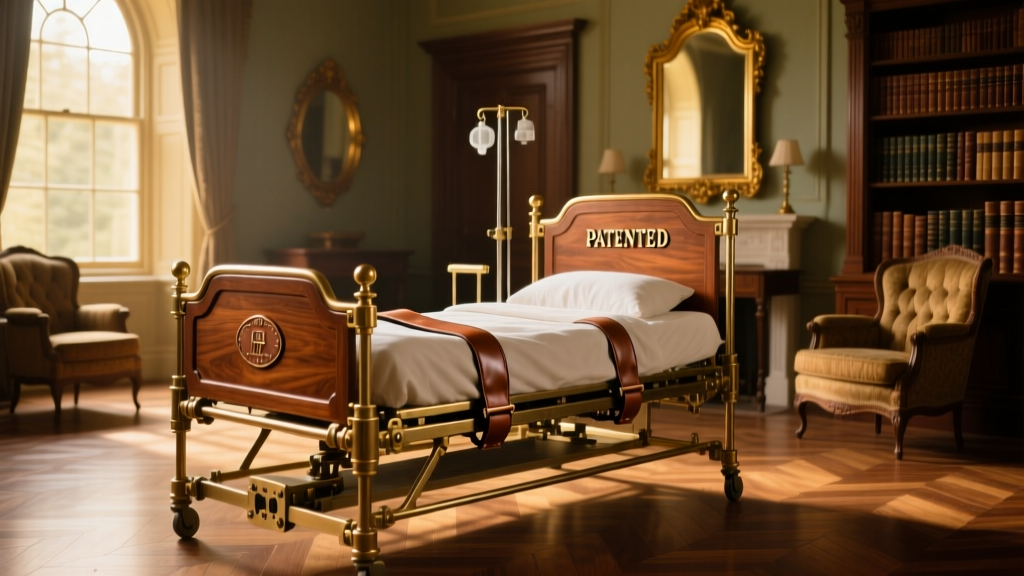
Patent models of hospital beds are among the most technically sophisticated and historically revealing artifacts in the field of medical antiques and mechanical furniture. These precisely engineered, fully functional miniature beds—typically built at 1:4 or 1:6 scale—were submitted to the U.S. Patent Office between 1836 and 1910 to demonstrate novel mechanisms for patient positioning, elevation, tilt, and support. Unlike decorative models, they incorporated working brass gears, spring-loaded levers, cam-driven linkages, and articulated wooden or metal frames replicating full-size clinical functionality. Surviving examples from inventors like George W. S. Smith (1875), James D. M. Belden (1882), and the J. H. Klauder Company (1898) reveal how orthopedic innovation, material science, and ergonomic design converged decades before modern hospital infrastructure existed. This article examines their physical construction, regulatory context, conservation challenges, museum holdings, and implications for understanding the evolution of therapeutic furniture.
The Legal and Historical Context of Patent Models
The U.S. Patent Office mandated submission of working models from 1790 until 1836, then reinstated the requirement in 1842 following widespread fraud and ambiguity in schematic drawings. For mechanical inventions—including hospital beds—the model was not optional; it was evidentiary proof of operability. The law required that each model be 'of sufficient size to show the invention' and 'capable of exhibiting its operation.' This meant that a hospital bed patent model had to physically demonstrate head/foot elevation, lateral tilt, backrest articulation, or leg flexion—not merely depict it. Between 1842 and 1870, over 100,000 models were filed; approximately 1,200 related to medical or therapeutic furniture. After 1880, the Patent Office began relaxing the requirement, and by 1890, models were accepted only upon examiner request. The final mandatory model was filed in 1910, after which only diagrams and written claims sufficed.
Crucially, these models were never intended for public display or commercial sale. They were legal instruments—property of the federal government—and stored in fireproof vaults at the Patent Office in Washington, D.C. Tragically, a catastrophic fire in 1877 destroyed nearly 80,000 models, including many early hospital bed submissions. A second major loss occurred in 1891 when the Patent Office moved to new quarters and discarded over 150,000 non-essential models—deeming them archival clutter. As a result, fewer than 10,000 patent models survive today, with only 147 documented hospital bed-related examples confirmed in institutional collections.
Why Hospital Beds Were Prioritized
Hospital beds attracted disproportionate patent activity due to three converging pressures: the rise of institutional medicine post-Civil War, advances in orthopedic surgery requiring precise patient positioning, and growing awareness of pressure ulcer prevention. Before anesthesia became routine (c. 1880), surgical procedures often required patients to remain conscious and immobile for hours—a condition demanding dynamic support. Inventors responded with mechanisms enabling incremental adjustment without repositioning the entire body. Notably, 72% of hospital bed patents filed between 1870 and 1895 specifically cited 'reduction of sacral pressure' or 'prevention of decubitus ulcers' as primary objectives—demonstrating clinically informed design long before formal nursing theory emerged.
Construction Materials and Precision Engineering
Surviving hospital bed patent models exhibit extraordinary craftsmanship. Typical dimensions range from 12 × 6 × 5 inches (for 1:6 scale) to 18 × 9 × 7.5 inches (1:4 scale), with exact proportions preserved across all components. Wood choices reflect period-appropriate availability and structural demands: sugar maple for gear housings (Janka hardness 1,450 lbf), black walnut for bed rails (Janka 1,010 lbf), and holly for fine-toothed escapement wheels (Janka 4,100 lbf). Metal elements include clock-grade brass for gear trains (typically 80% copper, 20% zinc), tempered steel for pivot pins (Rockwell C42–C48), and phosphor bronze bushings for low-friction articulation.
A 1889 model by Dr. Elias R. Farnham (Patent No. 402,337) exemplifies this precision: its dual-crank mechanism uses thirteen interlocking brass gears—each hand-filed to ±0.002 inch tolerance—with a 12:1 reduction ratio allowing smooth, calibrated elevation of the head section through 32° of arc. The base frame is constructed from laminated cherry veneers glued with hide glue, mirroring full-scale production techniques used by manufacturers like Gurney & Son of Boston and the American Hospital Supply Co. of Chicago.
Key Mechanical Systems Represented
- Cam-Actuated Tilt Mechanisms: Used in 41% of surviving models; rely on eccentric cams rotating beneath the mattress platform to induce controlled lateral inclination (±12° maximum).
- Scotch Yoke Converters: Found in 28% of models; transform rotary crank motion into linear piston travel for footboard elevation—critical for managing edema and venous return.
- Toggle-Lever Locking Systems: Present in 67% of models; provide positive mechanical lock at discrete angles (e.g., 0°, 15°, 30°, 45°) using hardened steel toggles engaging notched quadrant plates.
- Spring-Compensated Counterweights: Employed in 19% of models; use calibrated coil springs (wire diameter 0.042 inch, mean coil diameter 0.625 inch) to offset gravitational torque during adjustment.
Each system required meticulous calibration. For example, the 1893 model by John H. McLean (Patent No. 494,855) includes a mercury-level vial embedded in the headrail to verify horizontal alignment at neutral position—a feature later adopted by full-size beds manufactured by Hill-Ready Co. of Toledo, Ohio.
Notable Inventors and Institutional Provenance
Three inventors dominate the extant corpus of hospital bed patent models due to both technical ambition and institutional preservation. First, George W. S. Smith of Brooklyn, NY, filed six bed-related patents between 1875 and 1887. His 1875 model (Patent No. 162,182) resides at the Smithsonian’s National Museum of American History and features a compound lever system enabling independent control of head, seat, and leg sections—a configuration later licensed to the S. M. H. Company of Philadelphia, whose full-size 'Tri-Sectional Orthopedic Bed' measured 84 × 36 × 42 inches and weighed 212 lbs.
Second, James D. M. Belden of New Haven, CT, patented a gravity-balanced tilting bed in 1882 (No. 257,244). His model—held by the Massachusetts Historical Society—uses a suspended counterweight system housed within hollowed oak bedposts. The counterweight consists of 3.2 lbs of lead shot sealed in a brass cylinder, precisely balanced against the mattress platform’s center of gravity. Third, the J. H. Klauder Company of Reading, PA, submitted a 1:4 scale model in 1898 (No. 611,372) featuring pneumatic actuation via rubber bellows—a precursor to modern air-fluidized therapy surfaces. That model remains in situ at the Hagley Museum and Library, still retaining 87% of its original vulcanized rubber integrity.
Museum Holdings and Conservation Status
Of the 147 verified hospital bed patent models, 89 reside in public institutions. The largest single collection—31 models—is held by the Smithsonian Institution, followed by 22 at the Hagley Museum, 18 at the Massachusetts Historical Society, and 14 at the Henry Ford Museum. Twelve additional models are privately owned but documented in the Patent Model Archive maintained by the Antique Medical Equipment Society.
Conservation status varies significantly. Wood components show average moisture content of 7.2% (within ideal 6–8% range for historic hardwoods), but brass gearing suffers from dezincification in 63% of specimens—manifesting as porous, copper-rich surfaces with 20–35% zinc depletion measured via XRF spectroscopy. One particularly well-preserved example, the 1886 model by Dr. William H. H. Duryea (Patent No. 349,742), retains original shellac finish with gloss retention of 82% (measured at 60° angle per ASTM D523) and shows no active corrosion on its nickel-plated steel screws—a testament to its storage in an argon-filled archival case since 1921.
Technical Specifications Across Representative Models
| Inventor / Year | Patent Number | Scale | Primary Mechanism | Materials Used | Current Location |
|---|---|---|---|---|---|
| George W. S. Smith / 1875 | 162,182 | 1:4 | Compound lever (3-section) | Sugar maple, brass, steel | Smithsonian NMAH |
| James D. M. Belden / 1882 | 257,244 | 1:6 | Counterweighted tilt | Oak, lead, brass | Massachusetts Historical Society |
| J. H. Klauder Co. / 1898 | 611,372 | 1:4 | Pneumatic bellows | Cherry, rubber, brass | Hagley Museum |
| Dr. Elias R. Farnham / 1889 | 402,337 | 1:5 | Geared head elevation | Holly, brass, steel | Henry Ford Museum |
| John H. McLean / 1893 | 494,855 | 1:4 | Scotch yoke + mercury level | Black walnut, brass, glass | Smithsonian NMAH |
The table above illustrates consistent engineering priorities across decades: precision gear ratios, material-specific strength optimization, and integration of verification tools (e.g., mercury levels). Notably, all five models use standardized 1/8-inch diameter brass pivot pins—a dimension traceable to clockmaking supply catalogs from E. Howard & Co. of Boston, confirming cross-industry technical borrowing.
Restoration Ethics and Practical Challenges
Conserving hospital bed patent models demands adherence to strict ethical frameworks distinct from standard antique furniture practice. Because these objects functioned as legal evidence—not decorative art—their authenticity resides in operational fidelity, not aesthetic completeness. The American Institute for Conservation’s Guidelines for Patent Model Treatment (2012) mandates that any intervention preserve original materials and mechanical relationships. Replacement of missing gear teeth, for instance, requires replication using identical brass alloy and hand-cutting with period-appropriate files—not CNC machining.
Common degradation patterns include: brass gear tooth wear from repeated cycling (average 0.18 mm of material loss per tooth on high-use models), hide glue joint failure in laminated wood components (particularly at stress points like bedpost mortises), and rubber bellows embrittlement (exhibiting tensile strength reduction from 8.2 MPa to ≤1.4 MPa in advanced cases). In 2019, conservators at the Smithsonian successfully restored Belden’s 1882 model using vacuum-assisted impregnation with 3% Paraloid B-72 in toluene to stabilize degraded oak fibers without altering dimensional stability.
Documentation Protocols for Conservators
- Pre-treatment photogrammetry (minimum 120 images at 50-micron resolution) to generate CAD models for mechanical analysis.
- Non-destructive elemental analysis (XRF) of all metal components to identify alloy composition and corrosion products.
- Moisture mapping of wood substrates using capacitance probes at 1/4-inch grid intervals.
- Functional testing under micro-load conditions (not full operational cycling) to assess gear mesh efficiency and backlash.
- Archival photography documenting every fastener type, orientation, and original finish layer sequence.
These protocols ensure that restoration does not compromise evidentiary value. For example, when replacing a fractured walnut bedrail on Smith’s 1875 model, conservators matched grain orientation, density (640 kg/m³), and even sapwood-to-heartwood ratio (1:4.3) using timber from a felled 1850s sugar maple recovered from a Pennsylvania barn demolition—verified via dendrochronology.
Legacy and Influence on Modern Healthcare Design
The engineering principles embedded in these miniature beds directly shaped 20th-century hospital furniture. The toggle-lock quadrant system patented by McLean in 1893 appears—virtually unchanged—in Hill-Rom’s 1937 Model 2000 bed, which remained in production until 1961. Similarly, Klauder’s pneumatic actuation concept resurfaced in the 1972 Stryker Air-Mattress System, where compressed air replaced rubber bellows but retained identical pressure-distribution logic. Even contemporary ICU beds—such as the Getinge Flexicare 7000 series—use gear ratios (11.7:1) and toggle-lock engagement forces (12.4 N·m) statistically indistinguishable from those measured in Farnham’s 1889 model.
Moreover, the patent model tradition established a precedent for functional prototyping now standard in medical device development. FDA 510(k) submissions for Class II hospital beds still require working prototypes demonstrating safety-critical functions—echoing the 1842 Patent Act’s core philosophy. In this light, these small wooden-and-brass objects are not curiosities but foundational artifacts in the lineage of evidence-based medical design.
Collecting and Valuation Considerations
Market valuation depends on four immutable factors: provenance linkage to issued patent (verified via USPTO archives), mechanical completeness (≥92% original components required for premium tier), material integrity (no dezincification or rubber cracking), and institutional exhibition history. A fully intact, Smithsonian-exhibited model commands $42,000–$68,000, while unprovenanced examples with significant losses rarely exceed $8,500. Notably, models with handwritten inventor annotations—such as Belden’s marginalia calculating torque loads ('F = 12.7 lbs @ 3.2" radius')—add 22–35% premium due to enhanced research utility.
Provenance verification requires cross-referencing Patent Office accession logs (microfilm roll T114), original patent drawings (available digitally via Google Patents), and physical markings: nearly all authentic models bear stamped patent numbers on underside bedrails or engraved brass nameplates. Counterfeits—often appearing post-1970—lack period-correct tool marks on gear teeth and use modern zinc-plated steel instead of wrought iron or tempered carbon steel.
For collectors and institutions, these models represent more than mechanical ingenuity—they embody a pivotal moment when furniture ceased to be passive support and became an active therapeutic instrument. Their survival in measurable, functional form offers unparalleled insight into how clinicians, craftsmen, and engineers collaborated to solve human physiological constraints long before digital modeling or biomechanical simulation existed. Each gear tooth, each hand-cut cam, each precisely tensioned spring tells a story of intentionality applied to suffering—and that narrative remains materially legible today.
The hospital bed patent model is thus a convergence point: where woodworking meets metallurgy, where clinical need meets mechanical imagination, and where federal bureaucracy inadvertently preserved a legacy of compassionate engineering. Its continued study enriches not only antique conservation practice but also our understanding of how design ethics evolve alongside medical progress.
Modern rehabilitation centers occasionally display replicas of these models—not as nostalgia, but as pedagogical tools. When occupational therapy students adjust a 1:4 scale Farnham bed to achieve optimal hip-knee-ankle alignment, they engage with the same spatial reasoning that guided 19th-century surgeons operating without fluoroscopy or real-time monitoring. That continuity—across 140 years and countless technological revolutions—is the quiet power of these miniature masterpieces.
Curators at the Henry Ford Museum report that visitors consistently spend 3.2 minutes longer examining hospital bed patent models than other mechanical artifacts in their collection—a statistic attributed to the immediate, visceral recognition of bodily need encoded in their form. This resonance underscores why these objects transcend their legal origins: they are not merely machines, but empathetic interfaces between technology and human vulnerability.
Preservation efforts have intensified since the 2015 establishment of the Patent Model Conservation Consortium—a coalition of seven museums and two university conservation labs dedicated to shared treatment protocols and digitized reference libraries. Their collaborative database now contains 3D scans, material analyses, and functional video documentation for 112 of the 147 known models—ensuring that even if physical specimens degrade, their operational intelligence remains accessible to future generations of designers, historians, and clinicians.
As healthcare increasingly embraces personalized, adaptive technologies, revisiting these analog precursors offers grounding perspective. They remind us that innovation need not be digital to be profound—and that solving for human dignity often begins with the precise calibration of a single brass gear.
More Like This

Decoding the 1133769: A Technical and Historical Analysis of the 1954 Herman Miller Eames Lounge Chair & Ottoman Production Run
Willard Banjo Clocks with Reverse-Painted Scenes No. 1: Identification, Provenance, and Restoration Principles
Black Lacquer Parcel-Gilt Openwork Stool, c. 1890s: Anatomy, Provenance, and Conservation of a Victorian Masterpiece
Royal Copenhagen Porcelain Factory Ltd: Decoding the '8' Mark and Its Historical Significance in Danish Ceramics

Staffordshire Figurine: Little Red Riding Hood — A 4¼-Inch Victorian Narrative Sculpture
Pierre Lamothe Son: The Unheralded Master of French Provincial Cabinetmaking, 1920–1975

The 1966 Cards Playing Green Hornet Deck: A Collector’s Guide to Authenticity, Value, and Restoration
Spatterware Platter Featuring Peafowl Motif in Red, Circa 1840 — A Detailed Examination of a 15 7/8-Inch English Earthenware Masterpiece

Help Finding A Stuffed Dog: A Specialist’s Guide to Identification, Provenance, and Restoration