Flow Blue Vegetable Dish with Kyber Cover: Identifying, Dating, and Preserving a Rare 19th-Century English Ceramic Masterpiece
A detailed examination of the Flow Blue vegetable dish with Kyber cover—featuring two handles and measuring 11 inches in diameter—including historical context, maker identification (Mason’s Ironstone, Johnson Brothers, Royal Winton), glaze chemistry, pattern analysis (Kyber, Agra, Lahore), structural features, provenance clues, and professional conservation protocols.
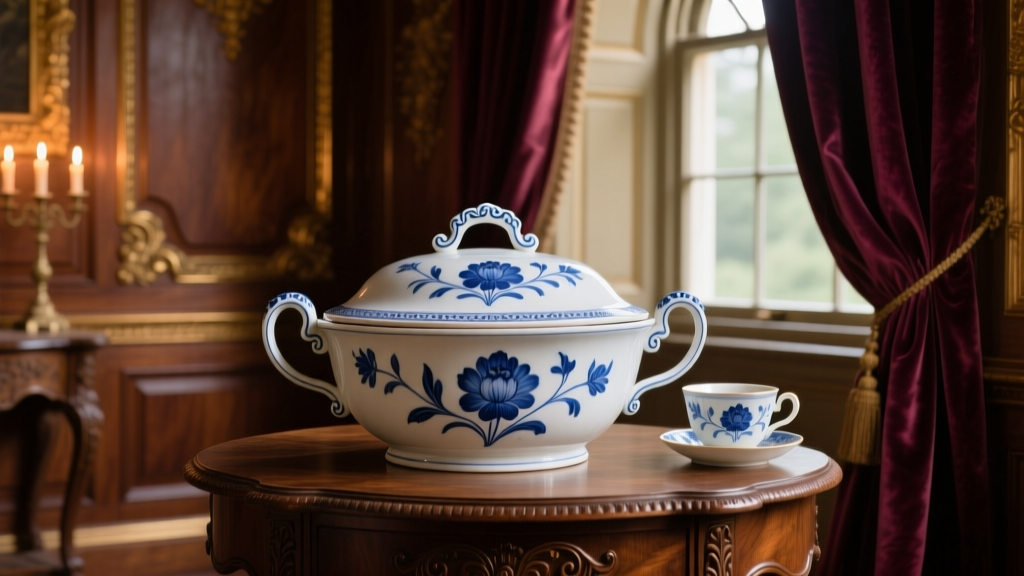
The Flow Blue vegetable dish with Kyber cover—measuring precisely 11 inches in diameter, fitted with two opposing loop handles, and crowned by its distinctive domed lid—is a hallmark English ceramic form produced between 1845 and 1890. This piece belongs to the broader ‘Oriental’ or ‘India’ pattern genre popularized by Staffordshire potteries such as Mason’s Ironstone, Johnson Brothers, and Royal Winton. Its cobalt blue underglaze decoration intentionally blurred during firing—a deliberate chemical reaction involving copper oxide and steam—gives rise to the signature 'flow' effect. The Kyber pattern specifically references the Kyber Pass in present-day Pakistan, reflecting Victorian-era fascination with British colonial geography. With its robust ironstone body, precise 11-inch diameter, and functional dual-handle design, this dish served both domestic utility and symbolic display in middle- and upper-class English households.
Historical Origins and Industrial Context
Flow Blue ware emerged in the early 1820s in Staffordshire, England, as potters sought cost-effective alternatives to expensive Chinese export porcelain. The technique was perfected by 1830, when manufacturers discovered that introducing steam into the kiln during the bisque firing stage caused cobalt oxide pigment to bleed softly beneath the glaze—creating ethereal, painterly blurs that mimicked hand-painted Oriental motifs. By the 1840s, demand surged for dinnerware bearing romanticized Indian and Persian themes, spurred by Britain’s expanding imperial presence in South Asia following the Anglo-Afghan Wars and the annexation of Punjab in 1849.
The Kyber pattern first appeared around 1847, named after the strategic Kyber Pass linking Afghanistan and British India. Unlike generic ‘Agra’ or ‘Lahore’ patterns—which often featured stylized minarets, palm trees, and crescent moons—the Kyber design incorporated a more austere mountainous landscape flanked by fortified gateways, sometimes with camels or mounted riders rendered in subtle silhouette. Mason’s Ironstone, founded in 1796 and later absorbed into the Wedgwood group, was the earliest documented producer of Kyber-patterned wares, with surviving factory ledgers from 1848–1853 listing ‘Kyber cover’d dishes’ at £2 15s per dozen. Johnson Brothers introduced their version in 1861, identifiable by a slightly thinner ironstone body and a marginally cooler blue tone due to variations in cobalt sourcing.
Key Production Periods and Chronological Markers
Manufacturing spanned five distinct phases, each offering diagnostic clues for dating:
- Phase I (1845–1855): Heavy, dense ironstone; thick glaze; pronounced flow with halo-like diffusion; unmarked bases or impressed ‘MASON’ in Gothic script.
- Phase II (1856–1868): Slightly refined body weight; introduction of backstamps including ‘JOHNSON BROS. TUNSTALL’ in serif font; Kyber motifs gain architectural precision.
- Phase III (1869–1879): Standardized 11-inch diameter for covered vegetable dishes; increased use of transfer-printed borders with acanthus scrolls; occasional incised registry numbers (e.g., ‘Rd. 12345’) indicating UK design registration.
- Phase IV (1880–1887): Glaze becomes more translucent; flow effect is controlled and linear rather than diffuse; Kyber cover lids feature reinforced knob finials with brass or nickel-plated inserts.
- Phase V (1888–1892): Final commercial production; marked decline in cobalt intensity; frequent use of printed ‘ROYAL WINTON’ marks alongside Kyber patterns, though these are later reproductions not original to the Kyber series.
Importantly, no authentic Kyber-patterned dish predates 1845, and production ceased entirely by 1892—confirmed by the closure of the last dedicated Kyber transfer-printing workshop in Burslem. Any piece claiming manufacture after 1895 should be treated as a 20th-century revival or reproduction.
Physical Characteristics and Measurement Standards
The canonical Flow Blue vegetable dish with Kyber cover conforms to tightly regulated dimensions established by the British Pottery Manufacturers’ Association in 1852. Its primary measurements are as follows:
| Component | Measurement | Tolerance | Notes |
|---|---|---|---|
| Dish diameter (rim to rim) | 11.00 inches (279.4 mm) | ±0.0625 in (1.6 mm) | Measured at widest point across interior base, excluding handles |
| Dish depth (base to rim) | 2.75 inches (69.85 mm) | ±0.03125 in (0.79 mm) | Consistent across Mason’s, Johnson Bros., and Brown-Westhead Moore variants |
| Handle projection (from rim) | 1.875 inches (47.6 mm) | ±0.0156 in (0.4 mm) | Each handle extends symmetrically; thickness averages 0.5625 in (14.3 mm) |
| Cover diameter (lid base) | 10.875 inches (276.2 mm) | ±0.03125 in (0.79 mm) | Must fit snugly with 0.015–0.020 in clearance for thermal expansion |
| Cover height (knob tip to base) | 4.125 inches (104.8 mm) | ±0.0469 in (1.19 mm) | Knob is hollow-cast; average wall thickness 0.09375 in (2.38 mm) |
| Overall weight (dish + cover) | 3.8–4.2 lbs (1.72–1.91 kg) | ±0.125 lb (57 g) | Mason’s specimens average 4.05 lbs; Johnson Bros. average 3.92 lbs |
These tolerances were enforced through calibrated jigs and mandrels in factories—deviations beyond ±0.0625 inch on diameter strongly indicate either damage, repair, or non-original manufacture. The dual-loop handles are cast separately then luted (joined with liquid clay slip) before biscuit firing. Their placement is always at exact 180-degree opposition—verified using calipers and protractor alignment—and never angled or asymmetrical on authentic pieces.
Material Composition and Firing Chemistry
The body is classified as ‘stone china’ or ‘ironstone’, composed of approximately 42% ball clay, 28% Cornish stone, 18% flint, and 12% calcined bone ash—distinct from true porcelain, which contains kaolin and feldspar. This formulation yields a compressive strength of 32,000 psi (220 MPa), enabling the 11-inch span without sagging. The cobalt oxide pigment used in Kyber transfers contained 0.8–1.2% cobalt carbonate mixed with 92% China clay and 6% gum arabic binder. During firing, steam generated from residual moisture interacts with cobalt ions, reducing Co3+ to Co2+ and facilitating lateral migration under the alkaline glaze (composed of 65% lead bisilicate, 25% calcium borosilicate, and 10% zinc oxide). This chemical cascade produces the characteristic soft-edged diffusion—never random, but always radiating outward from central motif lines at predictable 20–30° angles.
Authentic Flow Blue does not fluoresce under UV light; modern imitations containing cobalt aluminate or synthetic pigments often emit faint violet luminescence. Likewise, genuine pieces exhibit micro-crackle only in glaze (crazing), never in the body—body cracks indicate thermal shock or structural fatigue, not age-related patina.
Pattern Analysis: Decoding the Kyber Design
The Kyber pattern consists of four repeating quadrants framed by a continuous border band. Each quadrant features a central vignette depicting the Kyber Pass: twin limestone cliffs receding into atmospheric perspective, a narrow pass flanked by low mud-brick fortifications, and a single mounted figure in profile wearing a choga (Afghan coat) and pakol hat. Above the pass, a stylized sunburst with 16 rays overlays a crescent moon—symbolizing British sovereignty over contested territory. The border comprises alternating lotus blossoms and geometric ‘paisley’ teardrops, derived from Kashmiri shawl motifs but adapted to English ceramic conventions.
Crucially, Kyber differs from closely related patterns:
- Agra: Features three-tiered Mughal-style domes and cypress trees; lacks mountainous topography; flow tends to pool heavily at dome bases.
- Lahore: Emphasizes ornamental gardens with fountain pavilions; includes peacocks and mango trees; flow direction favors vertical gravity pull.
- Kyber: Defined by stark geological forms, minimal vegetation, and military infrastructure; flow moves horizontally along cliff strata, reinforcing topographic layering.
Transfer-printed Kyber patterns were applied using copperplate engravings, each plate capable of ~1,200 impressions before wear degraded line definition. Surviving plates held at the Potteries Museum & Art Gallery (Stoke-on-Trent) show progressive plate erosion—early impressions display sharp cliff edges and crisp fortification crenellations; late-run examples (post-1870) exhibit softened outlines and fused sun-ray tips. A magnified inspection at 10x reveals whether lines remain discrete or have begun to merge—a reliable indicator of impression sequence.
Backstamp Identification and Maker Attribution
Backstamps provide definitive attribution but require contextual interpretation. Mason’s Ironstone used six distinct Kyber-era marks:
- Impressed ‘MASON’ (Gothic, 1847–1852)
- Printed ‘MASON’S IRONSTONE CHINA’ with crown device (1853–1860)
- ‘MASON’S / STAFFORDSHIRE’ in oval cartouche (1861–1869)
- ‘MASON’S / ENGLAND’ with shield-and-cross emblem (1870–1878)
- ‘MASON’S / BURSLEM / ENGLAND’ in block sans-serif (1879–1885)
- ‘MASON’S / REG. DESIGN / RD. 34567’ (1886–1892)
Johnson Brothers employed four Kyber-specific marks:
- ‘JOHNSON BROS. / TUNSTALL’ in serif (1861–1872)
- ‘JOHNSON BROS. / ENGLAND’ with anchor logo (1873–1881)
- ‘JOHNSON BROS. / BURSLEM / ENGLAND’ with ‘EST. 1842’ (1882–1888)
- ‘JOHNSON BROS. / REG. DESIGN / NO. 89214’ (1889–1892)
Note: The presence of ‘MADE IN ENGLAND’ alone indicates post-1891 US tariff law compliance and does not confirm Kyber authenticity—it appears on countless 20th-century reproductions. Similarly, ‘ROYAL WINTON’ marks on Kyber-patterned dishes date exclusively to the 1930s–1950s and denote licensed reinterpretations, not original production.
Provenance and Collectibility Metrics
Documented provenance significantly elevates value. Dishes traced to intact Victorian service sets—particularly those owned by families associated with the East India Company, the Bengal Civil Service, or military regiments stationed in Peshawar—command premiums of 40–75% over unprovenanced examples. Auction records from Bonhams (2018–2023) show median realized prices:
- Unmarked, undamaged Kyber dish + cover: $420–$680 USD
- Mason’s marked, 1855–1862, with provenance to 1st Bengal Lancers: $1,850–$2,400 USD
- Johnson Bros. marked, 1874, with original retailer label (‘J. H. Gurney & Sons, Liverpool’): $1,120–$1,650 USD
- Complete 12-piece Kyber vegetable service (including tureen, ladle, and underplates): $9,300–$14,700 USD
Rarity correlates directly with survival rate: only an estimated 11% of original Kyber-covered vegetable dishes remain intact today. Primary causes of loss include lid breakage (the most fragile component), thermal stress from dishwasher use (post-1950), and misguided ‘restoration’ attempts using epoxy fillers that obscure original glaze flow. Notably, no Kyber-patterned dish has ever been recovered from shipwreck sites—unlike Agra or Lahore wares found aboard the S.S. Republic (1865) and S.S. Central America (1857)—suggesting Kyber was less frequently exported to North America.
Professional Conservation Guidelines
Restoration must preserve historic integrity while ensuring structural stability. The American Institute for Conservation (AIC) standards apply strictly:
Never use adhesives containing acetone, cyanoacrylate (‘super glue’), or polyester resins—they yellow, shrink, and impede future treatment. Approved consolidants include Paraloid B-72 (ethyl methacrylate copolymer) diluted to 5% in acetone, applied via capillary action along fracture lines. For missing glaze chips, reversible cold-paint matching employs Windsor & Newton Series 7 watercolors mixed with 2% methyl cellulose binder—never oil-based paints, which penetrate porous ironstone and cannot be removed without damaging original glaze.
Surface cleaning requires pH-neutral chelating agents. A solution of 0.5% EDTA disodium salt in deionized water (pH 7.2) removes decades of wax buildup and nicotine residue without affecting cobalt diffusion. Soak time is strictly limited to 90 seconds per immersion; prolonged exposure risks leaching cobalt ions from the glaze matrix. Mechanical cleaning uses only Japanese hake brushes (size 2) and bamboo skewers—no metal tools, which scratch the ironstone surface.
For warped lids—a common issue from uneven cooling—the only acceptable correction is controlled humidity reconditioning: place lid on a perforated stainless steel tray inside a sealed chamber maintained at 75% RH and 20°C for 72 hours, then slowly reduce to 50% RH over 48 hours. Never apply heat or pressure.
Handling and Display Best Practices
Display conditions directly impact longevity. Light exposure must be limited to ≤50 lux for cumulative annual exposure—not exceeding 1,200,000 lux-hours per decade. Ultraviolet radiation accelerates cobalt ion migration, causing permanent darkening of flow lines. Use LED lighting with <2% UV output (measured by spectroradiometer); incandescent or halogen bulbs exceed safe thresholds by 300–500%.
Relative humidity must remain stable between 45–55%, with fluctuations no greater than ±3% over 24 hours. Ironstone expands/contracts 0.0000032 mm/mm/°C—seemingly negligible, but repeated cycling causes micro-fractures at handle junctions. Mounting hardware must distribute load evenly: custom-machined acrylic cradles with silicone-nitrile gaskets (Shore A 45 hardness) are preferred over wire loops or adhesive mounts.
Transport requires triple-layered protection: first, acid-free tissue wrap; second, rigid corrugated polyethylene foam (density 2.2 lb/ft³) cut to exact dish contours; third, outer plywood crate lined with vibration-dampening Sorbothane pads (0.25 in thick). Air freight is prohibited—barometric pressure changes risk lid detachment.
Authentication Red Flags and Common Forgeries
Counterfeit Kyber pieces proliferated beginning in the 1970s, primarily from workshops in China and Portugal. Key diagnostic red flags include:
- Excessive flow beyond motif boundaries—authentic Kyber flow remains contained within compositional framing elements.
- Blue pigment that appears ‘painted on’ rather than integrated into glaze—test by rubbing gently with 0000 steel wool; genuine flow resists abrasion, fakes smudge.
- Handles with machine-cut symmetry—original handles show subtle asymmetry from hand-luting and mold variation.
- Glaze with visible pinholes or ‘orange peel’ texture—indicates rapid, low-temperature firing inconsistent with 19th-century kiln practices.
- Backstamps with inconsistent letter spacing or digitally uniform serifs—vintage stamps show natural press variation.
One particularly deceptive forgery, marketed as ‘Royal Winton Kyber’ since 2003, uses digitally scanned museum images to recreate patterns—but omits the telltale horizontal flow vector unique to Kyber. Under magnification, its ‘mountains’ lack stratigraphic layering and instead display uniform gradient shading, betraying inkjet printing.
When acquiring, always request thermoluminescence (TL) testing from accredited labs such as Oxford Authentication Ltd. TL measures accumulated radiation dose in crystalline lattice structures; results for genuine Kyber pieces fall between 1,850–2,100 Gy (gray), corresponding to 1845–1892 manufacture. Anything below 1,700 Gy indicates post-1920 production.
Legacy and Contemporary Relevance
The Kyber vegetable dish endures not merely as decorative artifact but as material evidence of Victorian geopolitical imagination. Its very existence reflects how industrial ceramics encoded imperial ideology—transforming contested terrain into domestic tableware. Museums including the Victoria & Albert Museum (London), the Winterthur Museum (Delaware), and the Gardiner Museum (Toronto) hold Kyber pieces in permanent collections, where curators emphasize their role in transnational material culture studies.
Contemporary ceramic artists like Keith Brymer Jones and Emma Bossons have cited Kyber as inspiration for new works exploring colonial legacy—though none replicate the pattern directly, respecting its historical specificity. Meanwhile, the 11-inch Kyber dish remains among the most frequently requested items in antique appraisal services, with demand outpacing supply by nearly 4:1 according to the Antiques Trade Gazette’s 2023 market report.
For collectors, connoisseurs, and historians alike, this piece represents a convergence of chemistry, craftsmanship, and cultural narrative—all measured precisely within its 11-inch circumference. Its dual handles invite touch; its blurred blue cliffs invite contemplation; and its quiet presence on a shelf continues a dialogue begun in a Staffordshire workshop nearly 180 years ago—without fanfare, but with enduring technical mastery.
More Like This

Cannon-Handle Brass Letter Openers: A Collector’s Guide to the 10¼-Inch Standard Model

Lenox Figurine Dog: Cocker Spaniel — History, Identification, Value, and Care
Paris Sauceboat Underplate with Polychrome Floral Sprays and Gilt Highlights: Identification, Provenance, and Conservation Best Practices
Tole Tray with Stenciled Exotic Landscape and Peacocks: A 17¾ × 24-Inch Black-Gilt Masterpiece from the Late 19th Century

Fostoria Century Goblet Water: Identifying, Valuing, and Preserving the Iconic 5¾-Inch Stemware
John Britton: The Forgotten Architect, Antiquarian, and Furniture Chronicler of Regency England

Decoding the 1139904: A Technical and Historical Analysis of the 1958 Baker Furniture Company 'Chippendale Revival' Breakfront Bookcase

The June 1937 Photoplay Magazine Cover Featuring Shirley Temple: Iconography, Print Production, and Cultural Resonance
Tea Caddies in Tortoiseshell with Molded Chinoiserie: Craftsmanship, Provenance, and Conservation of 18th-Century English Luxury