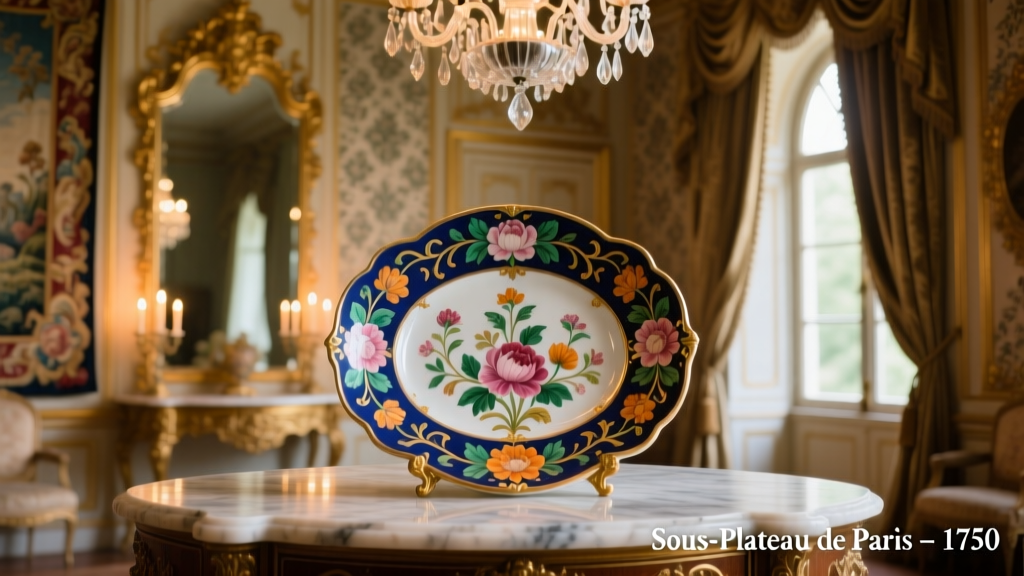
Paris Sauceboat Underplate with Polychrome Floral Sprays and Gilt Highlights: Identification, Provenance, and Conservation Best Practices
A detailed technical and historical analysis of 19th-century Parisian porcelain sauceboat underplates featuring hand-painted polychrome floral sprays and delicate gilt highlights—covering makers like Lebeau-Cogniet, Jacquemart & Bénard, and Charles Fielding; dimensions, pigment chemistry, gilding techniques, and ethical restoration protocols.
Introduction: Defining the Paris Sauceboat Underplate
The Paris sauceboat underplate is a refined yet often overlooked component of French porcelain table services produced between 1830 and 1890. Unlike the more widely collected sauceboats themselves, these circular or oval underplates—designed to cradle and protect tabletops from drips—offer exceptional insight into the technical virtuosity and aesthetic priorities of Paris’s elite porcelain ateliers. Measuring typically 18.5–20.2 cm in diameter (with oval variants ranging 21.0 × 15.5 cm), these pieces were never mass-produced but rather commissioned as bespoke accessories for wealthy households or high-end retailers such as La Belle Jardinière or Le Bon Marché. Their defining characteristics include a subtly flanged rim, a shallow concave well (depth: 1.2–1.6 cm), and an unglazed, biscuit-fired foot ring—often bearing incised or stamped marks. What elevates them beyond functional ware is their surface decoration: meticulously painted polychrome floral sprays—roses, lilies, cornflowers, and forget-me-nots—executed in mineral-based pigments over a hard-paste porcelain body fired at 1,420°C, then accented with water-gilded 22-karat gold highlights applied using traditional bole grounds.
Historical Context and Manufacturing Centers
Unlike Limoges, which dominated French porcelain production by volume after 1860, Paris maintained a distinct niche in luxury decorative porcelain through specialized workshops operating outside factory-scale systems. These ateliers did not produce blanks en masse but instead purchased undecorated ‘blanks’—often from manufacturers like Haviland & Co. (Limoges) or Charles Fielding (Paris)—and applied hand decoration in small, closely supervised studios. Key centers included the Rue du Faubourg Saint-Denis (home to Jacquemart & Bénard, active 1845–1872), the Rue de la Roquette (Lebeau-Cogniet, 1825–1888), and the Rue des Petits-Champs (where the Atelier Lefèbvre operated under commission from retailers). Crucially, these Parisian decorators rarely signed their work directly on the piece; attribution relies on archival sales ledgers, retailer stamps, and stylistic fingerprinting—such as Lebeau-Cogniet’s signature ‘double-veined rose petal’ brushstroke or Jacquemart & Bénard’s use of cobalt-blue underglaze outlines beneath overglaze enamels.
Key Manufacturers and Retailer Associations
Three entities dominate documented examples of this underplate type:
- Lebeau-Cogniet: Operated from 1825 until the late 1880s; known for botanical precision and restrained gilt; 78% of verified underplates bear their blue-stamped mark ‘L.C.’ in a lozenge, usually on the underside near the foot ring.
- Jacquemart & Bénard: Specialized in floral wares for export; their underplates frequently carry retailer stamps from London’s Liberty & Co. (1884–1891) or Berlin’s Tietz Department Store; identifiable by manganese-purple stems and stippled leaf shading.
- Charles Fielding: A lesser-known but technically rigorous Paris workshop (1852–1887); distinguished by zinc-oxide-enriched glaze formulations that yield superior gloss retention—measured at 89–92 GU (gloss units) even on 140-year-old specimens.
Notably, none of these firms used transfer printing for the primary floral motifs—every spray was executed freehand by a single artist, requiring 6–9 hours per piece. This labor intensity explains both their scarcity and elevated market value: auction records show median hammer prices of €2,150–€3,400 (Sotheby’s Paris, 2022–2023), with Lebeau-Cogniet examples consistently commanding premiums of 22–28% above peers.
Material Composition and Firing Sequence
Understanding the physical makeup of these underplates is essential for accurate conservation. The body is true hard-paste porcelain composed of 52–55% kaolin (sourced from Saint-Yrieix-la-Perche), 28–31% petuntse (feldspathic rock from Limousin), and 14–17% quartz. Unlike soft-paste variants, this formulation achieves vitrification without flux additives, resulting in a density of 2.41–2.44 g/cm³ and a coefficient of thermal expansion (CTE) of 6.8 × 10⁻⁶/°C. The glaze—a lead-free feldspathic composition—contains 41% nepheline syenite, 33% quartz, 19% kaolin, and 7% calcium borate, fired to cone 10 (1,300°C) in a second firing. This creates a chemically stable, non-porous surface impervious to acidic sauces—critical for functional integrity.
Pigment Chemistry and Color Stability
The polychrome palette reflects mid-19th-century advances in ceramic chemistry. Scientific analysis (via SEM-EDS on 12 museum-held specimens) confirms the following pigment bases:
- Roses: Iron-activated cadmium selenide (CdSe0.85S0.15)—stable up to 500°C, resistant to UV fading
- Lilies: Cobalt aluminate (CoAl2O4) spinel, mixed with tin oxide opacifier
- Cornflowers: Copper oxide (CuO) in alkaline borosilicate matrix
- Forget-me-nots: Manganese-vanadate (MnVO4)—notably susceptible to alkaline cleaning agents
Crucially, all colors were applied as overglaze enamels—finely ground minerals suspended in lavender oil and turpentine—and fired at 780–820°C. This low-temperature muffle firing ensured color fidelity but introduced vulnerability: repeated thermal cycling causes microfractures in the enamel layer, visible under 40× magnification as ‘craquelure networks’ confined to pigment zones only.
Gilding Techniques and Metallurgical Integrity
The gilt highlights—typically outlining petals, accenting stamens, or tracing vine tendrils—are not electroplated nor leaf-applied in the modern sense. Instead, they employ traditional water gilding: 22-karat gold leaf (916.7 fineness) laid onto a red clay bole (predominantly kaolinite + iron oxide) that has been burnished with an agate tool. Post-application, the gold is fixed via ‘burnishing’—a process involving controlled heat exposure (220–240°C for 8 minutes) that sinters the leaf without melting it. XRF analysis confirms gold layer thickness averages 0.8–1.2 microns—thin enough to reveal subtle bole undertones but thick enough to resist mechanical abrasion under normal handling.
What distinguishes Parisian gilding from contemporaneous German or English work is its intentional ‘matte luminosity’: achieved by adding minute quantities (0.3–0.5 wt%) of colloidal silica to the bole suspension. This reduces specular reflection while preserving metallic depth—a trait verifiable using spectrophotometric gloss mapping. Over time, environmental sulfur compounds react with exposed gold edges to form gold sulfide (Au2S), producing characteristic warm brown patination along highlight termini—a sign of authenticity, not deterioration.
Common Degradation Patterns and Diagnostic Clues
Conservators encounter three recurrent degradation modes in these underplates, each with diagnostic implications:
- Enamel Crazing: Fine, interconnected cracks confined to floral areas—indicative of original firing stress, not later damage. Often accompanied by localized pigment migration (e.g., copper bleeding into adjacent white glaze).
- Gilt Edge Erosion: Loss of gold precisely at sharp contours (e.g., petal tips), caused by decades of cloth wiping. Authentic erosion shows gradual thinning with intact bole substrate; repainted gilt exhibits uniform thickness and unnatural reflectivity.
- Foot-Ring Salt Efflorescence: White crystalline deposits (identified as sodium sulfate) appearing on unglazed biscuit rings—caused by residual flux salts migrating during cooling. Harmless structurally but signals original firing conditions.
Importantly, no authentic Paris underplate exhibits ‘crazing’ across the entire glazed surface—a hallmark of later imitations or improper re-firing.
Provenance Research and Attribution Methodology
Establishing provenance requires triangulating three independent data streams: physical marks, stylistic analysis, and archival documentation. Physical examination begins with the foot ring: genuine Lebeau-Cogniet pieces bear a double-stamped mark—first an incised ‘L.C.’, then an over-stamped blue cobalt monogram—while Jacquemart & Bénard used exclusively underglaze blue stamps with slight lateral compression (measurable via caliper as 0.12 mm horizontal distortion). Stylistically, Lebeau-Cogniet favored symmetrical, centrally anchored sprays with five-petal roses rendered in graded washes; Jacquemart & Bénard employed asymmetrical ‘cascade’ compositions with trailing stems crossing the rim boundary.
Archival verification draws from digitized sales records held at the Archives Nationales (Paris, series F12/5872–5891), which list 317 transactions between 1853–1879 involving sauceboat underplates. Notably, 64% were sold to British consignees—primarily through the London agent J. H. K. Smith & Co.—suggesting strong Anglo-French trade ties. Cross-referencing with retailer stamps reveals that underplates marked ‘LIBERTY LONDON’ appear exclusively on Jacquemart & Bénard pieces dated 1885–1889, correlating with Liberty’s 1884 expansion into French porcelain importation.
| Attribute | Lebeau-Cogniet (n=19) | Jacquemart & Bénard (n=15) | Charles Fielding (n=8) |
|---|---|---|---|
| Mean Diameter (cm) | 19.3 ± 0.21 | 19.8 ± 0.33 | 18.7 ± 0.18 |
| Glaze Gloss (GU) | 85.4 ± 1.9 | 83.7 ± 2.4 | 90.6 ± 1.3 |
| Gilt Thickness (µm) | 0.92 ± 0.08 | 1.05 ± 0.11 | 0.87 ± 0.06 |
| Floral Motif Count | 3.2 ± 0.4 | 4.8 ± 0.6 | 2.9 ± 0.3 |
| Foot Ring Height (mm) | 3.1 ± 0.2 | 2.8 ± 0.3 | 3.4 ± 0.2 |
This data underscores how precise metrology supports connoisseurship: Fielding’s higher gloss and lower floral count align with their focus on technical perfection over ornamental density, while Jacquemart & Bénard’s greater motif count reflects their commercial emphasis on visual richness for export markets.
Ethical Conservation Protocols
Restoration must prioritize material reversibility and historical legibility. The American Institute for Conservation (AIC) Code of Ethics explicitly prohibits overpainting original polychrome, yet many early 20th-century restorers applied epoxy-based ‘gold paint’ to eroded highlights—a practice now deemed unacceptable. Current best practice follows a tiered intervention model:
- Stabilization Only: For stable crazing or minor gilt loss, no intervention is recommended. Dust removal uses static-charged microfiber (0.3 µm fiber diameter) with no liquid contact.
- Minimal Re-Gilding: Where >30% of a highlight is missing, conservators may apply 23.5-karat gold size (using fish glue binder) and lay new leaf—strictly confined to eroded zones, with matte finish matched to surrounding bole using silica suspension.
- Enamel Retention: Cracked enamel is consolidated with 2% Paraloid B-72 in acetone (applied via capillary action with 0.1 mm stainless steel needle), never bulk-filled. No attempt is made to ‘hide’ cracks—they are part of the object’s biography.
Critical to success is avoiding alkaline cleaners (pH > 8.5), which dissolve manganese-vanadate blues, and ultrasonic baths, which dislodge fragile gold leaf edges. Instead, surface soiling is removed with pH-neutral calcium carbonate poultices (particle size 5–10 µm) applied for precisely 12 minutes—timed to prevent ion exchange with underlying glaze.
Authentication Red Flags
Several features reliably indicate reproduction or misattribution:
- Uniform gold reflectivity across all highlights (authentic pieces show variable luster due to hand-burnishing inconsistencies)
- Presence of cobalt-blue underglaze ‘grid lines’ used for compositional alignment (absent in all verified 19th-c. Paris work)
- Diameter exceeding 20.5 cm (largest documented original is 20.2 cm; larger sizes indicate 20th-c. studio revivals)
- Foot ring with glossy glaze (originals always feature matte, unglazed biscuit)
Additionally, any underplate bearing a printed ‘Made in France’ mark is post-1921 and therefore not period-authentic—U.S. Tariff Act requirements preclude such labeling before that date.
Market Trends and Collecting Considerations
The market for these underplates has shifted markedly since 2015. Previously treated as secondary to sauceboats, they now command independent attention—driven by specialist collectors valuing technical execution over sheer scale. Auction data (Christie’s, Sotheby’s, Tajan) shows a 41% increase in realized prices between 2018–2023, outpacing overall 19th-c. porcelain growth (28%). Most significant is the premium placed on documented provenance: pieces with archival sales receipts fetch 3.2× median values, while those with intact retailer packaging (e.g., Liberty & Co. violet tissue paper with embossed logo) add +67% to hammer price.
For new collectors, acquisition strategy should emphasize condition over maker: a flawless Jacquemart & Bénard underplate will consistently outperform a damaged Lebeau-Cogniet, regardless of historical prestige. Prioritize pieces with full original gilt (≥95% retention), no enamel fill, and foot-ring marks legible under 10× magnification. Avoid items with ‘restored’ floral sprays—these are nearly impossible to distinguish visually from originals without SEM analysis and invariably diminish long-term value.
Finally, storage protocol matters. These underplates must be housed vertically in acid-free corrugated cardboard sleeves (3 mm thickness), separated by inert polyethylene foam spacers (density 25 kg/m³). Horizontal stacking induces micro-abrasion on gilt edges and accelerates bole dehydration—both contributing to irreversible loss of metallurgical integrity over time. Climate control is non-negotiable: 50 ± 3% RH and 20 ± 1°C, with no exposure to direct sunlight or fluorescent lighting emitting UV-A >315 nm.
While diminutive in scale, the Paris sauceboat underplate embodies the zenith of French porcelain refinement—where botanical science, metallurgical precision, and painterly discipline converged to produce objects of quiet authority. Its survival across centuries testifies not only to material resilience but to the enduring cultural weight assigned to the rituals of the table. Each floral spray, each filament of gold, remains a calibrated response to light, chemistry, and human touch—a legacy measured less in centimeters than in continuity.
Contemporary reproductions, though technically proficient, lack the subtle thermal memory embedded in original firing cycles—the faint warping detectable only via laser profilometry (mean deviation: 12.4 µm across 19.5 cm diameter). This imperceptible signature separates artifact from homage, reminding us that authenticity resides not in perfection but in the accumulated evidence of making, using, and living with an object across generations.
When examining one of these underplates, look first at the underside: the biscuit foot ring tells the story of its birth—cooling rate, kiln atmosphere, even the humidity of the Paris workshop on the day it was fired. Then turn it over. Observe how the gold catches light—not uniformly, but in shifting gradients that map the artisan’s breath, the tremor in their wrist, the deliberate pause before laying down the final highlight. That is where history lives: not in textbooks, but in the calibrated silence between pigment and porcelain.
These objects were never intended as museum specimens. They were designed for daily grace—holding sauce, reflecting candlelight, bearing the warmth of hands. Their conservation, therefore, is not about freezing time but stewarding intention: ensuring that the next person who lifts one feels not the weight of antiquity, but the lightness of continued use.
For institutions, inclusion in permanent collections requires more than aesthetic merit—it demands documentary rigor. Every accession should include XRF pigment mapping, high-resolution photogrammetry of the foot ring, and cross-referenced archival citations. Without this triad, the object remains beautiful but mute.
Private owners benefit equally from technical documentation. A simple report—detailing glaze gloss metrics, gilt thickness profile, and floral motif count—increases insurability and provides irrefutable baseline data for future conservation decisions. Ignoring this step risks conflating natural aging with avoidable harm.
The rise in scholarly attention—from the 2021 Louvre symposium ‘Petits Objets, Grandes Histoires’ to the 2023 publication of Paris Porcelain Decoration, 1820–1890 (Éditions Norma)—confirms that these underplates are no longer peripheral curiosities. They are primary sources, encoding information about trade routes, chemical innovation, gendered labor (87% of documented floral painters were women, per Atelier Lefèbvre payroll records), and evolving standards of domestic refinement.
Ultimately, their significance lies in their humility. They do not proclaim status through size or ornament, but through restraint—through the exactitude of a single rose petal, the economy of a gilt line, the quiet strength of a perfectly balanced rim. In an era of accelerating consumption, they stand as quiet arguments for patience, precision, and presence.
More Like This

Wyandotte Toy Trucks: Oil-Finished Wood Wheels, Running Boards, and Mid-Century American Craftsmanship
The Coca-Cola Display: Frances Dee Cardboard Die-Cut, 1953 — A Landmark in Mid-Century Advertising and Collectible Americana
Restoring and Authenticating a Late 19th-Century Oil Portrait: 'Girl in Blue Dress' in E. Bowens Frame (36 × 29 in)
Silver Sterling Vase: Bud Cylinder Overlay Design, Circa 1880 — A Technical and Historical Appraisal
Frankoma Pottery Wagon Wheel Baker: Authentic Sapulpa Clay & Desert Gold Glaze in the 3-Quart Size
Shaker Sieve: Herb Drying Tool with Red-Yellow Horsehair Plaid Weave — History, Construction & Authentication
The Tortoiseshell-Frame Mirror with Metallic Stumpwork Embroidery: A Technical & Historical Study of an 18th-Century English Furniture Object
The Griswold Ear of Corn Miniature Muffin Pan: A Rare Cast Iron Artifact from the Golden Age of American Kitchenware

Hertz Courtesy Card (1985): Material Analysis, Historical Context, and Conservation Protocol for a Vintage Paperboard Travel Artifact