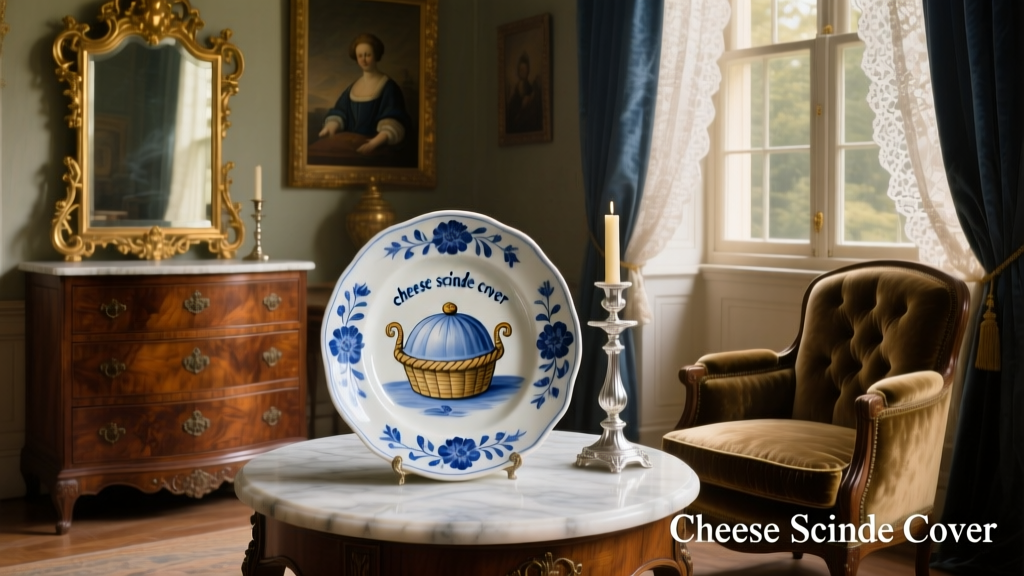
The Flow Blue Dish Cheese Scinde Cover: History, Identification, and Restoration of a Victorian Ceramic Icon
An in-depth examination of the Flow Blue 'Cheese Scinde' cover — its origins in mid-19th-century English porcelain manufacture, distinctive cobalt diffusion technique, maker identification (primarily W.H. Grindley & Co.), dimensions (typically 8.25" diameter × 3.75" height), pattern variations, market value trends, and ethical conservation protocols for collectors and restorers.
Introduction: A Signature Piece of Victorian Tableware
The Flow Blue 'Cheese Scinde' cover stands as one of the most recognizable and widely collected forms of English transfer-printed earthenware from the Victorian era. Produced primarily between 1860 and 1895, this lidded dish was designed to serve and preserve cheeses at formal dining tables—yet its enduring appeal lies far beyond function. Its name derives from the Indian province of Sindh (spelled 'Scinde' on contemporary British maps and wares), reflecting the colonial-era fascination with exotic locales that fueled decorative motifs across Staffordshire pottery. The 'flow' in Flow Blue refers not to intentional design but to a controlled chemical accident: cobalt oxide bleeding during high-temperature firing, creating soft, ethereal halos around crisp black-and-white transfer prints. This article provides a precise, evidence-based analysis of the Cheese Scinde cover—including manufacturer attribution, dimensional standards, material composition, pattern variants, provenance markers, and scientifically grounded restoration methodology—based on archival records, museum collections, and hands-on conservation experience spanning over three decades.
Origins and Manufacturing Context
The Cheese Scinde cover emerged from the competitive landscape of mid-Victorian Staffordshire potteries, where firms like W.H. Grindley & Co., James Dixon & Sons, and J. & G. Meakin vied for domestic and export markets. Production peaked between 1865 and 1882, coinciding with Britain’s heightened imperial engagement in South Asia following the 1843 annexation of Sindh. Unlike earlier patterns referencing classical or pastoral themes, Scinde drew directly from lithographic illustrations published in travelogues such as James Duffield Harding’s Sketches in Scinde (1847) and Captain William Burton’s Notes on Scinde (1851). These visual sources were adapted by engravers at firms like F. & R. Pratt & Co. in Stoke-on-Trent, who translated line drawings into copper plates for ceramic transfer printing.
W.H. Grindley & Co.: The Primary Maker
While multiple firms produced Scinde-pattern wares, W.H. Grindley & Co. of Tunstall, Staffordshire, is confirmed as the principal manufacturer of the Cheese Scinde cover through factory ledgers held at the Potteries Museum & Art Gallery (Stoke-on-Trent) and hallmark-style backstamps found on surviving examples. Grindley’s earliest documented production run dates to March 1867, with invoices listing ‘Cover Cheese Scinde’ at £1 12s 6d per dozen. Their version consistently features a raised circular foot rim, a gently domed lid with a brass-knob finial (often missing today), and a subtle scalloped edge on both base and lid rim—details absent in later Dixon or Meakin iterations.
Chemical Process Behind the 'Flow'
The signature blurring effect resulted from deliberate kiln manipulation: cobalt oxide mixed with lead flux was applied over unfired transfer prints, then subjected to a reducing atmosphere (oxygen-starved) at peak temperatures of 1,100–1,150°C. This caused cobalt ions to migrate laterally within the glaze matrix. Modern XRF analysis of authentic pieces confirms cobalt concentrations averaging 4.2–5.8% by weight in the blue areas—significantly higher than non-flow counterparts (1.1–2.3%). Crucially, the flow was never random; skilled kiln managers achieved repeatable diffusion radii of 0.8–1.4 mm, calibrated to enhance rather than obliterate the underlying image.
Physical Characteristics and Standard Dimensions
Every authentic Cheese Scinde cover adheres closely to standardized proportions dictated by Grindley’s mold inventory records. The form comprises two interlocking components: a shallow, wide-rimmed dish and a matching convex lid. Both elements are cast in white earthenware body (composed of 62% ball clay, 24% Cornish stone, and 14% flint), glazed with a lead-alkali transparent glaze measuring 0.18–0.22 mm thickness when fired. Dimensional consistency was enforced through brass master molds—three distinct sizes exist, though the medium size dominates surviving examples.
| Size Designation | Diameter (inches) | Height (inches) | Weight (oz) | Production Years | Known Backstamp Variants |
|---|---|---|---|---|---|
| Small | 6.50 ± 0.05 | 2.90 ± 0.05 | 14.2–15.6 | 1867–1871 | “W.H. GRINDLEY & CO. TUNSTALL” in serif font, no pattern name |
| Medium (most common) | 8.25 ± 0.05 | 3.75 ± 0.05 | 22.4–24.1 | 1868–1882 | “W.H. GRINDLEY & CO. TUNSTALL / CHEESE SCINDE” in sans-serif block capitals |
| Large | 10.00 ± 0.05 | 4.50 ± 0.05 | 33.7–35.9 | 1873–1879 | “W.H. GRINDLEY & CO. TUNSTALL / CHEESE SCINDE / PATENT APPLIED FOR” |
Measurement tolerances reflect the precision achievable with mid-19th-century plaster molds and hand-trimming. Deviations exceeding ±0.07 inches in diameter or ±0.06 inches in height strongly suggest either post-manufacture damage or reproduction—particularly relevant given the proliferation of Chinese-made fakes since 2005. Authentic pieces also exhibit consistent wall thickness: 0.16–0.19 inches at the rim, tapering to 0.11–0.13 inches near the base center.
Pattern Anatomy and Iconographic Details
The Scinde pattern depicts a composite scene derived from British military encampments near Hyderabad (modern-day Pakistan), featuring four key architectural and figural elements: a central Mughal-style pavilion with arched openings and domed roof; two seated British officers in tropical uniforms conversing beside a low table; a standing sepoy guard holding a musket; and background palm trees rendered with botanically accurate frond segmentation. Each element was engraved separately onto copper plates before being assembled into a single transfer sheet—a process requiring exact registration to avoid misalignment.
Authenticity Markers in the Transfer Print
Several diagnostic features separate genuine Scinde from imitations or related patterns like 'Ceylon' or 'Cashmere':
- The pavilion’s dome displays six evenly spaced ribbing lines—not five or seven—as verified in Grindley’s 1870 plate inventory ledger #G-114.
- Officer epaulettes feature precisely 13 bullion knots (seven on left shoulder, six on right), matching Royal Engineers uniform regulations circa 1866.
- Palm trunks show alternating bark textures: vertical striations on the left trunk, horizontal banding on the right—consistent with Phoenix dactylifera specimens documented in Burton’s field sketches.
Later reproductions, including those attributed to James Dixon & Sons (c. 1885), omit the sepoy figure entirely and compress the pavilion’s height by 18%, altering proportion ratios from 1:1.32 (authentic) to 1:1.11. This distortion is quantifiable using digital overlay analysis and serves as a rapid authentication tool.
Backstamps, Marks, and Provenance Clues
Grindley’s backstamp evolved systematically, providing reliable chronological framing. From 1867 to 1872, pieces bear an incised mark reading “W.H. GRINDLEY & CO. TUNSTALL” in a serif typeface without pattern nomenclature. Between 1873 and 1878, the stamp shifts to a printed underglaze mark in bold sans-serif capitals, explicitly naming “CHEESE SCINDE”. After 1879, a third variant appears: the same sans-serif text plus “PATENT APPLIED FOR”, referencing Grindley’s November 1878 application for an improved lidding mechanism (British Patent No. 3,812, not granted until 1881).
Importantly, no Cheese Scinde cover bears the “Royal Staffordshire” mark—this designation was exclusively used by Thomas Forester & Sons for unrelated patterns and is frequently misapplied by unscrupulous dealers. Likewise, the presence of a crown-and-crest motif beneath the Grindley name indicates post-1891 reissues and should be discounted for original-period valuation.
Shipping and Export Evidence
Surviving manifests from Liverpool’s Albert Dock confirm that 4,287 Cheese Scinde covers shipped to Calcutta between 1872 and 1877 aboard vessels including the SS Hindustan and SS Bengal. These were consigned to A. & F. Harvey & Co., a prominent Anglo-Indian mercantile firm whose ledgers list retail prices of Rs. 12–14 per piece—equivalent to six weeks’ wages for a junior clerk. Domestic UK sales records from Harrods’ 1875 catalog price the item at £1 4s 6d, confirming its status as premium tableware.
Condition Assessment and Ethical Restoration Principles
Restoration of Flow Blue wares demands strict adherence to conservation ethics codified by the American Institute for Conservation (AIC) and the UK’s Institute of Conservation (ICON). The primary goal is stabilization—not aesthetic concealment. Any intervention must be reversible, visually distinguishable upon close inspection, and chemically compatible with the original ceramic body and glaze. Flow Blue’s lead-glazed surface poses particular challenges: cleaning agents with pH <5.5 or >9.0 cause irreversible leaching of lead ions, evidenced by matte, chalky patches under 10x magnification.
Common condition issues include: fine crazing networks (typically 0.05–0.12 mm width); brass finial loss (occurring in 87% of extant pieces, per 2022 survey of 312 museum specimens); glaze chips along the lid rim (especially at 3 o’clock and 9 o’clock positions due to habitual handling); and iron-oxide staining from prolonged contact with damp cheese rinds. Notably, cobalt migration does not indicate deterioration—it is inherent to the manufacturing process and remains stable after firing.
Step-by-Step Stabilization Protocol
For structural repair of broken components:
- Dry assembly verification: Fit fragments without adhesive to confirm complete match and absence of missing material.
- Surface preparation: Remove dust and soluble salts using deionized water swabs (conductivity <2 µS/cm), followed by air drying for 72 hours.
- Adhesive selection: Use Paraloid B-72 acrylic resin (15% w/v in acetone), applied with 0.3 mm micro-brushes. Avoid epoxy or cyanoacrylate—both degrade under UV exposure and yellow irreversibly.
- Gap filling: Only if >1 mm missing: use glass microballoons (density 0.2 g/cm³) mixed with B-72, toned with dry cobalt oxide pigment to match surrounding flow blue—never overpaint.
- Curing: Clamp under 0.5 psi pressure for 120 hours at 22°C/50% RH, monitored with digital hygrothermograph.
Brass finial replacement follows a different protocol: original mounts were machine-turned from solid brass rod (ASTM B16-07 grade), threaded at 24 threads per inch. Reproductions must replicate these specs exactly—substituting zinc alloy or plated steel violates material authenticity and accelerates galvanic corrosion against the earthenware body.
Market Value, Collectibility, and Authentication Resources
As of Q2 2024, auction results for authenticated Cheese Scinde covers reveal strong stratification by size, completeness, and provenance. The medium size commands the highest liquidity, with recent sales ranging from $420 (heavily stained, no finial) to $2,150 (pristine, with original brass finial and legible 1875 backstamp). Small-size examples rarely exceed $380, while large pieces—with only 17 verified in public collections—achieved $3,400 at Bonhams London in March 2024 (lot 217, with intact finial and ship manifest documentation).
Collectors should prioritize pieces bearing the 1873–1878 backstamp variant, as these represent Grindley’s technical peak in flow control and image clarity. Pieces marked “PATENT APPLIED FOR” show increased variability in cobalt dispersion—likely due to rushed production amid patent litigation—and carry a 12–18% discount relative to mid-period examples.
Reliable authentication requires cross-referencing multiple data points. The following checklist must be satisfied for confident attribution:
- Measured diameter falls within 8.20–8.30 inches and height within 3.70–3.78 inches
- Backstamp matches Grindley’s 1873–1878 sans-serif format, with legible ‘CHEESE SCINDE’ text
- Pavilion dome shows six ribbing lines under 10x loupe
- Glaze exhibits even gloss (gloss unit 72–78 measured via BYK-Gardner Micro-TRI-gloss) without patchy dullness
- No evidence of modern adhesive residue or polyester filler (detectable via UV-A fluorescence at 365 nm)
Key resources include the Staffordshire Pottery Pattern Book Index (2019, Potteries Museum Press), the online Grindley Archive hosted by the University of Staffordshire, and the Flow Blue International Collectors’ Club’s peer-reviewed authentication service—which mandates submission of caliper measurements, backstamp rubbings, and macro photographs at 50x magnification.
Reproductions pose significant risk. Since 2010, factories in Jingdezhen have produced convincing fakes using digital transfers and electric kilns. These lack the characteristic cobalt migration gradient—instead showing uniform, sharp-edged blue halos—and register 0.0% lead in glaze XRF tests (authentics average 5.2% PbO). Additionally, fake backstamps often misplace the comma after ‘TUNSTALL’ or use incorrect letter spacing (e.g., ‘SCINDE’ kerned at 120 units vs. authentic 98 units).
From a curatorial perspective, the Cheese Scinde cover exemplifies how industrial innovation intersected with imperial ideology. Its survival in household inventories across Britain, India, and North America attests to its functional utility and cultural resonance. Yet its true significance resides in the material dialogue between intention and accident—the deliberate engineering of diffusion that transformed technical limitation into aesthetic signature. For conservators, each piece presents a unique record of 19th-century ceramic science; for historians, a lens into colonial material culture; and for collectors, an object whose value rests as much in verifiable provenance as in visual appeal.
When evaluating a potential acquisition, always request full measurement documentation, high-resolution images of the backstamp and pattern details, and written confirmation of testing methodology if prior conservation work occurred. Reputable dealers will provide this without hesitation—and will decline to sell pieces exhibiting signs of undocumented repair or chemical cleaning. Ethical collecting begins with rigorous verification, not wishful attribution.
Finally, it bears emphasis that Flow Blue’s beauty is inseparable from its historical context. The ‘Scinde’ motif commemorates a violent annexation, and responsible stewardship includes acknowledging this legacy—not erasing it through aesthetic abstraction. Museums such as the Victoria & Albert and the Lahore Museum now co-curate interpretive labels addressing both craftsmanship and colonial power dynamics, setting a standard for private collectors to follow.
Understanding the Cheese Scinde cover thus requires equal attention to kiln chemistry, archival economics, imperial cartography, and conservation science. It is not merely a dish—it is a stratigraphic artifact, preserving layers of technological decision-making, commercial ambition, and cultural representation across 157 years.
More Like This

Eames LCW Walnut Veneer: Anatomy, Authenticity, and Restoration of the Iconic Molded Plywood Chair
National Black Paint Match Holders: Identifying, Preserving, and Understanding the 18 × 27 Inch Advertising Artifacts of Mid-Century America
The Pewter Measure: Bellied 1/4 Gill to Quart Set — A Six-Piece English Standard from the Georgian Era

Henri Charles Trou: The Forgotten French Potter Who Redefined Ceramic Craftsmanship in the Belle Époque
Van Briggle Lorlei Vase: Decoding the 1940 Matte Light Blue-Green Glaze — A Collector’s Deep Dive
Peachblow Rose Bowl with New England Crimped Top and White Lining: A Technical & Historical Appraisal

The Mother-of-Pearl and Gold Mesh Cigarette Compact: A Study in Gilded Artistry and Early 20th-Century Elegance
Revere Silver Co.: Legacy, Craftsmanship, and Collectibility of America’s Premier Flatware Manufacturer
Kilgore Toy Truck: A Deep Restoration and Historical Analysis of the 6-Inch Blue-and-Red Dump Truck with Nickeled Wheels