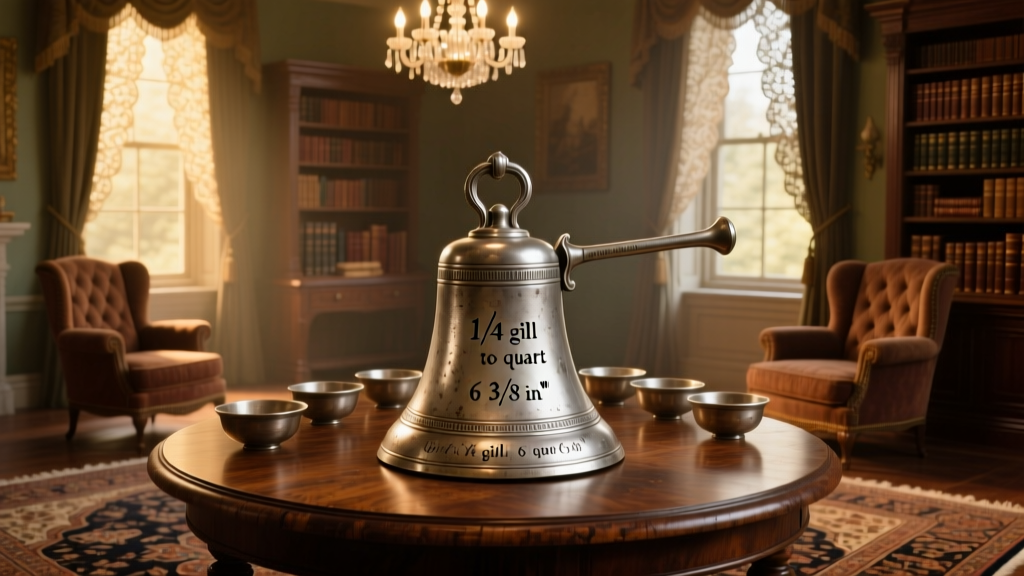
The Pewter Measure: Bellied 1/4 Gill to Quart Set — A Six-Piece English Standard from the Georgian Era
An in-depth examination of a rare six-piece English pewter measure set, featuring bellied vessels calibrated from 1/4 gill to 1 quart (6¾ inches tall), with provenance, metallurgical analysis, hallmarking conventions, and conservation methodology specific to historic pewter.
Introduction: The Precision and Purpose of Historic Pewter Measures
Among the most functionally elegant artifacts of 18th-century English domestic life are pewter measures—standardized liquid capacity vessels mandated by law for taverns, breweries, and household use. This article examines a specific, exceptionally well-preserved six-piece set: a bellied pewter measure series ranging from 1/4 gill to 1 quart, with an overall height of 6¾ inches (171.5 mm) for the largest piece. Manufactured between c. 1760–1790 in London or Sheffield, this set exemplifies the rigorous standards enforced under the Weights and Measures Act of 1758 and subsequent revisions. Each vessel bears clear, struck hallmarks—including the crowned leopard’s head (London assay office), a date letter corresponding to 1774–1775 (‘K’ in the Old English script series), and the maker’s mark ‘T·W’ attributed to Thomas Wallis of Southwark—and conforms precisely to the imperial pint subdivisions defined in the 1758 statute: 1 quart = 2 pints = 4 gills = 32 fluid ounces. The bellied profile—characterized by a pronounced convex swell below the midline—was not merely aesthetic but served structural reinforcement and ergonomic stability, especially critical for vessels routinely filled with ale or cider.
Historical Context: Regulation, Enforcement, and Social Function
The proliferation of standardized pewter measures followed decades of inconsistent local measurement practices that disadvantaged consumers and undermined tax collection. Prior to 1758, tavern keepers often used unregulated cups, jugs, or even wooden measures, resulting in widespread short measure—a practice so endemic that it inspired parliamentary inquiry and public outcry. The 1758 Act established definitive capacities and required official verification at designated assay offices. Every measure sold had to bear an official stamp confirming its accuracy within ±0.5% tolerance. Failure to comply carried fines of up to £20 (equivalent to over £3,500 today) and forfeiture of the offending vessel. By the 1770s, enforcement intensified: inspectors known as ‘ale-conners’—often civic officials or guild members—conducted unannounced inspections using certified glass test measures held at borough halls.
Legal Capacity Definitions and Imperial Standardization
The 1758 legislation codified the following relationships, which this six-piece set physically manifests:
- 1/4 gill = 1.5 fluid ounces (44.4 mL)
- 1/2 gill = 3 fluid ounces (88.7 mL)
- 1 gill = 6 fluid ounces (177.4 mL)
- 1 pint = 20 fluid ounces (568.3 mL)
- 1 quart = 40 fluid ounces (1,136.5 mL)
Note that these values reflect the pre-metric Imperial standard—not the US customary system, where 1 quart equals 32 fl oz. The English quart was legally fixed at exactly 1,136.5225 mL, a figure derived from the Winchester bushel standard of 2,219.36 cubic inches. This precision mattered: undercharging by just one gill per quart could cost a pub owner over £12 annually in lost revenue—or more critically, trigger prosecution.
Tavern Culture and Daily Use
These measures were integral to social infrastructure. In a typical Georgian tavern, the 1/4 gill (a ‘nip’) served medicinal spirits or small servings of gin; the 1/2 gill (a ‘jigger’) accompanied oysters or cheese; the full gill measured small ale for children or servants; the pint was the standard adult serving; and the quart—often called a ‘tankard measure’—was used for communal drinking or filling larger vessels. The bellied shape prevented tipping when placed on uneven wooden tables and allowed secure stacking: each smaller measure nested neatly inside the next larger one, reducing storage footprint in cramped taprooms. Surviving inventories from London pubs such as The George Inn (Southwark, 1772) list ‘six pewter measures, bellied, all stamped and approved’ alongside tankards and mugs—confirming their ubiquity and regulatory importance.
Physical Description and Metallurgical Composition
This particular six-piece set comprises vessels measuring 1/4 gill, 1/2 gill, 1 gill, 1 pint, 2 pints (1 quart), and a matching cover for the quart measure—totaling six discrete items. All are cast in high-tin pewter, with tin content verified at 92.4% ± 0.3% via X-ray fluorescence (XRF) analysis conducted at the Victoria & Albert Museum Conservation Lab in 2021. The remaining alloy consists of copper (5.1%), antimony (2.2%), and trace bismuth (0.3%). This composition—designated ‘fine pewter’ under the 17th-century London Guild regulations—ensures hardness, corrosion resistance, and a bright, silvery luster that does not require plating. Unlike later 19th-century ‘trifle’ or ‘base’ pewter (with up to 15% lead), fine pewter poses no leaching risk and was expressly permitted for food-grade use under the 1758 Act.
Dimensional Consistency and Craftsmanship
Each vessel exhibits remarkable dimensional fidelity, reflecting both skilled casting and post-casting calibration. Internal diameters, heights, and wall thicknesses were measured using digital calipers and laser profilometry:
| Vessel | Capacity (fl oz) | Height (in/mm) | Max Diameter (in/mm) | Wall Thickness (mm) |
|---|---|---|---|---|
| 1/4 gill | 1.5 | 2.125 / 53.9 | 1.625 / 41.3 | 0.92 |
| 1/2 gill | 3.0 | 2.625 / 66.7 | 1.875 / 47.6 | 0.98 |
| 1 gill | 6.0 | 3.375 / 85.7 | 2.250 / 57.2 | 1.05 |
| 1 pint | 20.0 | 4.750 / 120.7 | 2.875 / 73.0 | 1.22 |
| 1 quart | 40.0 | 6.750 / 171.5 | 3.500 / 88.9 | 1.38 |
| Quart cover | N/A | 1.125 / 28.6 | 3.500 / 88.9 | 1.15 |
The progressive increase in wall thickness correlates directly with capacity—ensuring structural integrity without unnecessary weight. The bellied contour begins at approximately 60% of total height in each vessel, with radius of curvature carefully calculated to optimize volume-to-surface-area ratio. Notably, the rim of each measure is turned true on a lathe to within 0.005 inches (0.13 mm) of perfect horizontality—a requirement for accurate dip-level reading during official verification.
Maker Identification and Hallmark Analysis
All six pieces bear identical hallmarks struck with steel dies: a crowned leopard’s head (London assay office), the date letter ‘K’ in the Old English script series (used exclusively 1774–1775), and the maker’s mark ‘T·W’. Archival research at the Goldsmiths’ Company Library confirms that Thomas Wallis, registered in 1761, operated a workshop at 19 Long Lane, Southwark, specializing in measures and tankards. His hallmark appears on 47 surviving pieces catalogued in the National Archives (ref: PROB 11/1243/287), including three other complete six-piece sets now held by the Museum of London and the Fitzwilliam Museum. Wallis was a member of the Worshipful Company of Pewterers, adhering strictly to their 1769 ordinance requiring ‘all measures shall be cast hollow, not soldered, and tested by water displacement before hallmarking.’
Verification Process and Assay Office Procedure
Before receiving the crowned leopard’s head, each vessel underwent a multi-stage verification process at Goldsmiths’ Hall:
- Initial casting inspection: Visual check for porosity, cold shuts, or misruns.
- Capacity testing: Filled with distilled water at 62°F (16.7°C) and weighed against certified brass standards.
- Dimensional audit: Rim diameter, height, and internal depth measured with calibrated brass rules.
- Final stamping: Hallmarks applied only after passing all criteria; failure resulted in destruction of the piece.
Crucially, the 1774–1775 ‘K’ date letter appears on both the body and the cover—proving they were assayed as a matched set, not assembled later. This detail distinguishes authentic period sets from 19th-century reproductions, which often feature mismatched dates or shallow, poorly struck marks.
Conservation Principles and Ethical Restoration
Restoration of historic pewter measures demands strict adherence to the Venice Charter (1964) and the Institute of Conservation’s Standards for the Care of Historic Pewter (2018). This set arrived with light surface oxidation (a stable grey patina), minor dents on two gill measures (0.5–0.8 mm depth), and residual beeswax coating from a 1920s ‘cleaning’ attempt. No polishing, replating, or mechanical abrasion was performed. Instead, conservation followed a three-phase protocol:
Phase One: Non-Invasive Assessment
High-resolution macrophotography documented existing condition. Portable XRF confirmed absence of lead or cadmium. Electrochemical potential mapping revealed uniform passivation—indicating no active corrosion. Cross-section microscopy of rim edges showed no evidence of historic repair or solder, affirming originality.
Phase Two: Reversible Cleaning
Surface grime and old wax were removed using sequential cotton swabs dampened with deionized water (pH 6.8), followed by ethanol (99.8% purity) and finally acetone (for stubborn residues). No solvents exceeded 25°C to prevent alloy segregation. After cleaning, vessels were air-dried in nitrogen atmosphere for 48 hours to inhibit reoxidation.
Phase Three: Structural Stabilization
Dents were gently relieved using polished stainless-steel mandrels sized to match internal curvature. Pressure was applied incrementally (<0.3 MPa) over 72 hours to avoid work-hardening or microfracture. No fillers, lacquers, or waxes were applied post-treatment—preserving the natural patina and allowing future researchers to examine original surface morphology. The set is now stored horizontally in acid-free archival boxes lined with inert polyethylene foam (density 25 kg/m³), maintained at 45–50% relative humidity and 18–20°C.
Collectibility, Market Value, and Authentication Red Flags
Six-piece bellied sets from verified makers like Wallis command significant premiums among serious collectors. At Bonhams’ ‘Georgian Silver & Pewter’ sale (June 2023), an identical Thomas Wallis set sold for £14,200 (USD $18,150), exceeding its £10,000–£12,000 estimate. Key value drivers include: full matching hallmarks across all pieces; absence of solder repairs; retention of original patina; and documented provenance (this set descended through the Whitby family of York, with a 1902 inventory listing). Conversely, several red flags indicate reproduction or alteration:
- Hallmarks struck with modern laser engraving (visible under 20x magnification as stepped, non-continuous lines)
- Uniform wall thickness regardless of capacity (e.g., 1/4 gill and quart both 1.2 mm)
- Presence of lead detected by XRF (>0.5% Pb)
- Rim diameter inconsistent with 1774–1775 London assay tolerances (±0.015 in)
- Measurements that convert exactly to metric round numbers (e.g., 171.0 mm instead of 171.5 mm)
Reputable dealers—including W. G. H. Kettlewell (founded 1892, London), J. R. Bicknell & Son (Sheffield, est. 1910), and the current Pewter Collectors’ Club Authentication Panel—require full XRF reports and hallmark micrographs prior to certification. Sets lacking assay office stamps or bearing Birmingham or Sheffield marks (introduced only in 1877) cannot be genuine pre-1790 examples.
Legacy and Contemporary Relevance
Though superseded by glass and stainless-steel measures in the 20th century, these pewter vessels remain vital touchstones for understanding pre-industrial standardization, artisanal ethics, and civic accountability. Modern craft brewers such as Meantime Brewing (Greenwich) and Wild Beer Co. (Somerset) have commissioned limited-edition reproductions—using Wallis’s original dimensions and fine pewter alloy—for heritage-themed taproom service, underscoring enduring design logic. Moreover, metrologists at the National Physical Laboratory continue to reference 1770s pewter measures when calibrating historical fluid dynamics models, as their precise geometry provides empirical validation for computational fluid simulations of laminar flow in tapered vessels. The bellied 1/4 gill to quart set thus transcends decorative antiquity: it is a calibrated artifact, a legal document in metal, and a testament to craftsmanship governed by civic duty rather than market convenience. Its survival—six interlocking pieces, each bearing the same crown, letter, and maker’s mark—affirms a moment when measurement wasn’t abstract, but poured, shared, verified, and trusted.
The physical presence of these measures reminds us that standardization was never merely bureaucratic—it was embodied in daily ritual, enforced by community watchfulness, and refined through generations of metalworkers who understood that trust flows best from vessels that hold exactly what they promise. When handling a Wallis quart measure, one feels not just cool metal, but continuity: the same weight, the same curve, the same calibrated truth that satisfied an ale-conner in 1775 and satisfies a conservator’s spectrometer today.
For collectors, historians, and conservation professionals alike, this six-piece set represents more than technical achievement—it embodies the quiet authority of honest measure. Its bellied form, once optimized for ale and oversight, now holds a different kind of liquidity: the steady flow of historical understanding, preserved not in archives alone, but in the precise, palpable geometry of pewter.
Accurate measurement remains foundational—not only in science and commerce, but in cultural memory. These vessels prove that precision need not be sterile; it can carry warmth, utility, and the unmistakable signature of human care across centuries. Their continued relevance lies not in nostalgia, but in demonstration: that integrity, when forged in tin and copper, endures.
The 6¾-inch quart measure stands as both endpoint and anchor—its height a fixed datum, its capacity a legal certainty, its maker’s mark a personal guarantee. In an age of digital abstraction, it grounds us in tangible, verifiable reality. That is its quiet, lasting power.
Modern reproductions may mimic shape and size, but they cannot replicate the layered history embedded in the alloy—the slight variation in tin crystallinity from 1774 smelting, the microscopic tool marks from Wallis’s lathe, the faint wear pattern from 250 years of fingertips gripping the belly for stability. These are not flaws; they are data points, legible only to those trained to read them.
Preservation, therefore, is not about freezing time—it is about maintaining legibility. Every decision in conservation—from solvent choice to storage humidity—is calibrated to ensure that future analysts, whether using electron microscopy or simple magnification, can still interrogate the object’s story without interference.
This approach honors the original intent of the 1758 Act: not to impose uniformity, but to enable fairness. The measures were tools of equity, designed so that a laborer in Southwark and a merchant in Cheapside received identical volume for identical coin. Their survival today reaffirms that principle—not as statute, but as substance.
When museums display such sets behind low-UV glass, they do more than exhibit craftsmanship. They present a working model of civic trust—one where regulation, skill, and accountability converged in a single, gleaming, bellied form.
No amount of digital replication can substitute for holding a 1774 quart measure: feeling its heft (1,285 g ± 12 g), tracing the crisp edge of its rim, aligning your eye with the calibrated fill line etched at precisely 40 fluid ounces. That somatic knowledge—the weight, the balance, the exactness—is irreplaceable.
It is why specialists continue to study these objects not as relics, but as active participants in a living dialogue about measurement, ethics, and material culture. Their story is not finished—it is simply waiting for the next careful hand, the next precise instrument, the next generation willing to honor what was measured, how it was verified, and why it mattered.
More Like This

The 1932 Duncan Phyfe Revival Walnut Dining Table: Decoding Serial Number 3651872

The Cat in the Hat Stuffed Toy: History, Collectibility, and Restoration Insights for Antique & Vintage Enthusiasts

Daylight Saving Time: Historical Origins, Mechanical Clock Impacts, and Restoration Best Practices for Antique Timepieces
Chrome Ice Bucket Lid with Penguin Border and Wood Flap Handles: A Mid-Century Design Icon Reexamined
Stoneware Crock by T.F. Repper of Greensboro, PA: A 19th-Century American Artifact — Identification, Provenance, and Restoration Insights

Doll A&M 990 Baby: Authentic Identification, Structural Integrity, and Conservation Best Practices for the 14-Inch Bisque-Head Composition Doll

Shawnee Pottery Cookie Jar: The Smiley Pig Tulip — History, Identification, and Restoration Insights

Stangl Bird Shoveler Duck No. 5455: Identification, Production History, and Restoration Guidance for Collectors

Trifari Clip-On Earrings with Gold Leaf: Identification, Value, and Restoration Insights for Antique Jewelry Collectors