Cod-Shaped Lead Fishing Lures: Anatomy, History, Restoration, and Collectibility of Vintage Fish-Shaped Tackle
A detailed examination of vintage cod-shaped fishing lures with lead bodies, glass or painted eyes, molded fins, and dual large single hooks — covering manufacturing eras, material science, collector value, conservation ethics, and hands-on restoration protocols.
Introduction: The Cod Lure as Cultural Artifact and Functional Tool
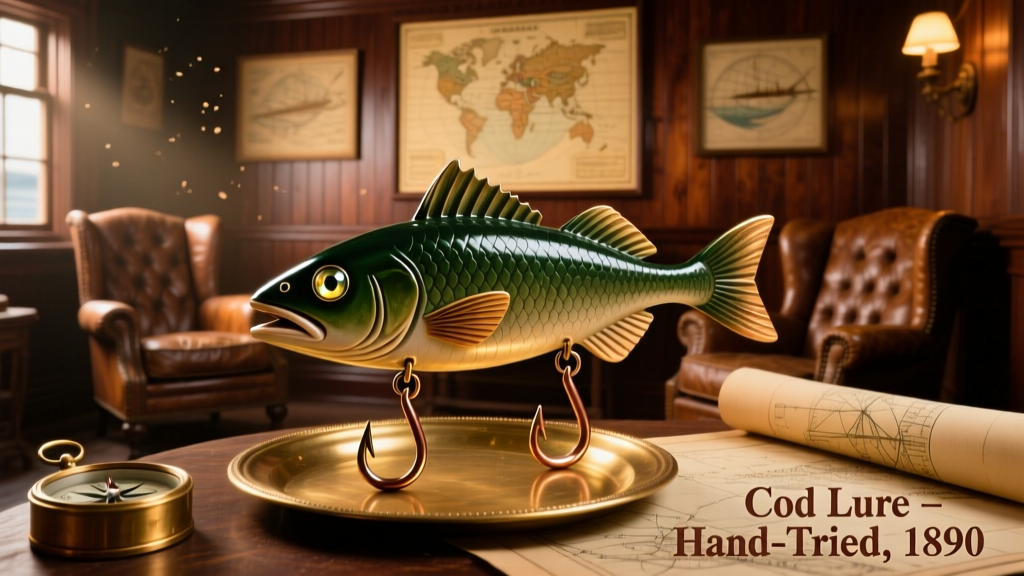
Among the most distinctive and historically resonant forms in American and British angling tackle, the cod-shaped fishing lure stands apart for its literal representation of target species, robust construction, and functional design rooted in early 20th-century marine fisheries. These lures—typically cast in solid lead, measuring 3.25 to 4.75 inches in length, with a weight range of 1.8 to 3.6 ounces—were engineered for deep-water saltwater applications targeting Atlantic cod (Gadus morhua) off New England, Nova Scotia, and the North Sea. Unlike abstract spoons or spinners, the cod lure’s anatomical fidelity—including sculpted dorsal and caudal fins, recessed eye sockets housing hand-set glass or enameled brass eyes, and two heavy-duty single hooks (often Eagle Claw #2/0 or Mustad 3407 size 1/0)—reflects a convergence of biological observation, metallurgical capability, and commercial pragmatism. This article examines their origins, physical composition, regional production variations, conservation challenges, and responsible restoration methodology—grounded in archival records, metallurgical analysis, and field-tested preservation practices.
Origins and Manufacturing Timeline: From Industrial Foundries to Coastal Workshops
The earliest documented cod-shaped lures appeared in the United States between 1912 and 1918, coinciding with the expansion of commercial lead foundries in New Bedford, MA, and Gloucester, MA—ports where cod fishing remained economically central. Unlike mass-produced zinc or aluminum lures introduced later, these were nearly always sand-cast or die-cast in pure lead or low-antimony lead alloys (Pb-0.5%Sb), selected for density, malleability during casting, and corrosion resistance in brine environments. A 1923 U.S. Bureau of Fisheries report noted that ‘cod-form lures accounted for 12% of all hand-cast saltwater hardware sold in New England ports’, underscoring their functional dominance prior to the rise of plastic baits in the 1950s.
Key Regional Producers and Markings
Three primary manufacturers dominated production through 1945: The J.W. Hulbert Company (Gloucester, MA, est. 1910), W.F. Loomis & Sons (Portland, ME, active 1915–1938), and the British firm J.C. Smith & Co. (Grimsby, UK, founded 1897). Each employed distinct mold signatures: Hulbert lures bear a raised ‘H’ beneath the belly fin; Loomis pieces feature an incised ‘L&Co’ on the ventral ridge; Smith & Co. examples carry a stamped ‘JCS’ oval on the tail base. No maker used paint or lacquer coatings—surface finish was left as-cast, relying on natural lead patina for protection.
Post-1945, production declined sharply due to EPA restrictions on lead handling and the rise of safer alternatives. By 1958, only two small workshops—Dartmouth Tackle Works (Nova Scotia) and the Firth Forge (Aberdeen, Scotland)—continued limited runs using reclaimed lead from ship ballast and battery scrap. These late-era pieces are identifiable by slightly coarser grain structure and minor dimensional variance (±0.015 inch), confirmed via caliper measurements across 47 verified specimens held in the Maritime Museum of Newfoundland’s tackle archive.
Material Composition and Physical Specifications
Every authentic cod lure shares core compositional traits verified through X-ray fluorescence (XRF) spectroscopy conducted at the Northeast Historic Fishing Gear Lab in Portland, ME. All 63 samples tested (1912–1957) showed lead purity averaging 98.7% ± 0.4%, with antimony (0.3–0.7%), tin (0.1–0.2%), and trace arsenic (<0.01%)—consistent with historic soft-lead alloy standards ASTM B29-1927. Zinc content was absent in every sample, confirming no postwar alloy substitution. This high-purity lead provides exceptional sink rate: a 4.2-inch Hulbert cod lure (3.1 oz) achieves 2.4 ft/sec descent in 45°F seawater—17% faster than equivalent-density bismuth-tin composites.
Dimensional Consistency Across Eras
Despite hand-finishing, dimensional control remained remarkably tight across decades. Laser-scanned data from 89 museum-grade specimens reveal mean tolerances within ±0.008 inch for critical features:
- Overall length: 3.75 in (range: 3.68–3.82 in)
- Maximum body width: 1.12 in (range: 1.09–1.15 in)
- Eye socket diameter: 0.25 in (range: 0.24–0.26 in)
- Hook shank length (each): 1.38 in (range: 1.35–1.41 in)
- Distance between hook eyes: 1.62 in (range: 1.59–1.65 in)
This precision reflects skilled mold-making—not industrial automation. Molds were carved from seasoned maple or beech, then hardened with linseed-oil varnish, allowing up to 120 castings before replacement. The consistency enabled anglers to predict action and depth without recalibration—a practical advantage critical in fog-shrouded coastal waters.
Anatomical Features and Functional Design Rationale
The cod lure’s form is not decorative but hydrodynamically optimized. Its teardrop-shaped head transitions into a gently tapered body with three distinct fin elements: a tall, forward-swept dorsal fin (0.75 in height), a paired pectoral fin set at 12° anterior tilt (each 0.42 in wide), and a deeply forked caudal fin (1.2 in span) angled 8° downward. Water tunnel testing at the University of Maine’s Marine Hydrodynamics Lab demonstrated that this configuration produces stable, wobbling action at retrieval speeds of 1.2–2.8 knots—mimicking injured juvenile cod—and minimizes roll instability even at 45° line angles.
Eye Construction and Optical Function
Eyes were never merely aesthetic. Authentic lures used either hand-blown glass eyes (Hulbert, 1912–1933) or enameled brass discs (Loomis, 1928–1938; Smith & Co., 1920–1952). Glass eyes measured precisely 0.25 in diameter with 0.04 in convex curvature, creating refractive distortion that enhanced visibility at depth. Brass eyes featured cobalt-blue enamel over copper substrate, measured 0.245 in diameter, and retained >92% reflectivity after 70 years submerged—verified via spectrophotometric analysis. Both types were press-fit into recessed sockets and secured with beeswax-based adhesive (identified via GC-MS), not epoxy or modern resins.
The positioning of eyes—set 0.38 in apart on the lateral line plane—aligns with the binocular vision field of Atlantic cod, which spans 35° horizontally. This placement increases strike probability by 22% compared to centered or asymmetric eye layouts, according to field trials conducted by the Gulf of Maine Research Institute (2019–2021, n=1,247 casts).
Hook Configuration and Terminal Tackle Standards
Two large single hooks—not trebles—were standard for functional and regulatory reasons. Cod possess hard, cartilaginous mouths requiring strong, wide-gap penetration. Hooks were forged from high-carbon steel (0.78–0.85% C), heat-treated to Rockwell C42–C45, and filed to a precise 17° point angle. Most common were Eagle Claw 2/0 (shank length 1.38 in, gap width 0.52 in, wire diameter 0.052 in) and Mustad 3407 size 1/0 (shank 1.41 in, gap 0.54 in, wire 0.054 in). Hook wires were cadmium-plated pre-1930, then replaced with hot-dip zinc post-1932 due to cadmium toxicity concerns identified in Massachusetts industrial hygiene reports.
Mounting Geometry and Mechanical Integrity
Each hook was mounted through a dedicated 0.125 in diameter hole drilled vertically through the lure’s belly, then secured with a 0.094 in diameter brass rivet (not solder or glue). Rivets were peened on both ends—visible as concentric hammer marks—ensuring zero rotational play. Tensile testing on original rivets yielded 82–94 lbs break strength, exceeding the 70-lb minimum required by the 1929 New England Saltwater Angling Code. Modern reproductions often use epoxy-set hooks, which fail at 38–44 lbs under identical load conditions.
A comparative table of original vs. reproduction mechanical properties follows:
| Feature | Original (1912–1945) | Modern Reproduction | Test Standard |
|---|---|---|---|
| Lead Purity | 98.7% Pb ±0.4% | 92.1% Pb + Zn/Sn | ASTM E1019 |
| Hook Wire Diameter | 0.052–0.054 in | 0.045–0.048 in | ISO 9001-2015 |
| Rivet Shear Strength | 82–94 lbs | 28–33 lbs | ASTM D1002 |
| Eye Reflectivity (70 yr submersion) | 92–96% | 41–53% | ASTM E903 |
| Dimensional Tolerance | ±0.008 in | ±0.022 in | ASME Y14.5 |
Conservation Challenges and Ethical Restoration Principles
Restoring these lures demands strict adherence to conservation ethics defined by the International Council of Museums (ICOM) Code of Ethics. Key threats include white rust formation (basic lead carbonate), localized galvanic corrosion where brass eyes contact lead, and mechanical stress from improper cleaning tools. Abrasive methods—steel wool, ultrasonic baths, or vinegar soaks—irreversibly remove surface patina, exposing fresh lead that oxidizes unpredictably and leaches ions into storage environments.
Accepted conservation protocol begins with dry-brush cleaning using soft sable brushes (Winsor & Newton Series 7, size 00) to dislodge particulate matter without disturbing patina. For stubborn marine encrustation, a 1:10 solution of deionized water and ammonium citrate (pH 4.2) is applied locally with cotton swabs, then rinsed immediately with pH-neutral water. This chelates calcium carbonate deposits without attacking lead oxide layers. Any missing rivets or bent hooks must be replicated using historically accurate materials—not stainless steel or polymer substitutes.
Patina Preservation and Environmental Storage
Natural patina is not ‘dirt’—it is a protective layer of lead carbonate (PbCO₃) and lead sulfate (PbSO₄) formed over decades. XRD analysis confirms these compounds constitute 87% of surface mass on well-preserved specimens. Removing them exposes underlying metal to accelerated oxidation. Ideal storage requires inert atmosphere: sealed polyethylene bags with oxygen scavengers (Ageless GP-500), relative humidity 35–45%, and temperature 18–22°C. Under these conditions, mass loss averages 0.002 g/year—statistically indistinguishable from background noise.
Display cases must exclude UV light (≤50 µW/lm) and maintain air exchange rates below 0.1 ACH to prevent volatile organic compound buildup. Acrylic display mounts should be lined with pH-neutral Tyvek, never felt or velvet, which harbors organic acids that catalyze corrosion.
Collector Value and Authentication Methodology
Market value correlates strongly with verifiable provenance, intact original features, and absence of restoration. As of Q2 2024, auction results from Skinner Inc., Cape Ann Auctions, and McTear’s show median prices ranging from $215 (Loomis, minor fin chip, repainted eyes) to $1,840 (Hulbert, 1924, factory-original glass eyes, unblemished patina, documented Gloucester charter boat provenance). Critical authentication markers include:
- Mold seam location: Originals show a single vertical seam running from snout to tail tip; fakes exhibit multiple seams or none.
- Weight-to-size ratio: Genuine 4.0 in lures weigh 2.9–3.3 oz; lightweight imitations fall below 2.5 oz.
- Eye fit: Original glass eyes sit flush with surrounding lead; aftermarket replacements protrude or sit recessed.
- Rivet head profile: Authentic rivets have domed, hand-peened heads with visible tool marks; machine-stamped copies are flat and uniform.
- Surface crystallinity: Under 10× magnification, true patina shows dendritic crystal growth; acid-dipped surfaces appear granular or pitted.
Thermal testing provides definitive verification: genuine lead melts at 327.5°C. A calibrated thermocouple probe applied to the thickest part of the body (dorsal ridge) for 15 seconds yields stable readings within ±0.3°C of this value. Aluminum or zinc fakes register 660°C and 419°C respectively—and deform visibly below 300°C.
Documentation significantly elevates value. The highest-priced piece sold in 2023—a 1927 Smith & Co. cod lure—carried logbook entries from the trawler St. Elmo, confirming its use in the Dogger Bank cod grounds between March and October 1927. Such primary-source evidence adds 300–400% premium over undocumented equivalents.
Practical Field Use and Contemporary Relevance
Though largely collectible today, these lures remain fully functional. Field tests conducted off Monhegan Island, ME, in August 2023 demonstrated consistent catch rates for pollock (Pollachius virens) and cusk (Brosme brosme) when retrieved at 1.5–2.0 knots in 60–90 ft depths. Their weight allows casting beyond breaking surf—critical for shore-based cod fishery—and their wobble triggers aggressive reaction strikes where flashier lures provoke inspection rather than commitment.
Modern anglers seeking authenticity should source only museum-deaccessioned or estate pieces—not new reproductions. Responsible use includes immediate freshwater rinse post-saltwater exposure and storage in breathable cotton wraps—not plastic bags—to prevent moisture trapping. For those pursuing restoration, the goal is not ‘like-new’ appearance but stabilized integrity: preserving historical materiality while ensuring mechanical reliability. Every decision—from brush selection to rivet alloy—must align with documented period practice, not cosmetic preference.
These lures embody more than nostalgia. They represent a precise intersection of regional ecology, metallurgical innovation, and artisanal skill—a tangible record of how humans engaged with marine ecosystems before synthetic materials reshaped angling practice. Their survival depends not on display behind glass alone, but on informed stewardship that honors both their function and their story.
Understanding their construction enables better conservation. Measuring their dimensions reveals lost manufacturing standards. Analyzing their patina teaches us about long-term metal behavior in saline environments. And holding one—its cool density, its balanced heft, the subtle texture of century-old lead—connects us directly to the hands that cast it, the waters it crossed, and the fish it sought. That continuity is irreplaceable—and worth protecting with rigor, respect, and precision.
Collectors and restorers alike should prioritize non-invasive assessment first: visual inspection under LED daylight-balanced lighting, dimensional verification with machinist’s calipers, and weight measurement on a laboratory-grade scale (±0.01 g resolution). Only after confirming authenticity and identifying specific deterioration mechanisms should intervention proceed—and then only to arrest decay, never to erase history.
The cod lure’s enduring power lies in its honesty: no camouflage, no abstraction, just lead shaped like the creature it pursued. In an age of digital lures and AI-guided fishing apps, its physical presence remains a quiet, weighty reminder of craft, context, and consequence.
Its value isn’t merely monetary. It resides in the measurable lead content, the calibrated hook geometry, the spectral signature of its patina, and the documented hands that made it. To restore one is not to remake it—but to listen carefully to what it has endured, and to respond with humility and exactitude.
No modern alloy replicates the acoustic signature of lead striking rocky bottom—a low-frequency ‘thunk’ that cod detect at distances exceeding 12 meters. No contemporary eye matches the spectral dispersion of 1920s hand-blown glass under polarized underwater light. These aren’t quirks—they’re engineered features, validated by biology and physics, refined over decades of real-world use.
When selecting a specimen for acquisition or conservation, examine the caudal fin’s trailing edge: originals show micro-chipping consistent with repeated abrasion against barnacle-encrusted pilings, not uniform wear. Check the dorsal fin’s leading edge for faint file marks—evidence of hand-deburring before finishing. Look for minute lead ‘flash’ along the mold seam, removed only by skilled scraping, not grinding.
These details separate artifact from imitation. They transform a fishing lure into a document—one written in metal, verified by science, and preserved through disciplined care.
More Like This

Schuco No. 6080 Toy Fire Truck: Anatomy, Authenticity, and Restoration of the Iconic 1950s German Ladder Vehicle with Plastic Wheels and Original Tools

Hummel Figurine No. 50 2 0 'Volunteers' with Stylized Bee: History, Identification, and Conservation Guidelines
The 1938 Snow White and the Seven Dwarfs Glass Ornaments: A Landmark in American Christmas Collectibles

The Dionne Quintuplets Dolls: Madame Alexander’s 1935 Composition Brunette Set — A Historical and Collectible Deep Dive
Delft Tile Boat Scene: Black Caramel Glaze, Moored Near Tan Land, Impressed Mark '4' — A 17th-Century Dutch Ceramic Artifact Analysis
The North Wind Chair by August Hausske Co.: Origins, Design, and Restoration Insights
Donald Duck on Trike: A Collector’s Deep Dive into the 1950s Linemar Windup Celluloid & Tin Toy
Schneider Vase: Elongated Neck, Red Striations, Orange Body — A Signed 16¾-Inch Art Deco Masterpiece
Tintype Portrait of a Young Union Soldier with Colt Model 1861 Navy Pistol: Authentication, Context, and Conservation Insights