The Dionne Quintuplets Dolls: Madame Alexander’s 1935 Composition Brunette Set — A Historical and Collectible Deep Dive
An expert analysis of the rare 1935 Madame Alexander 8-inch composition brunette Dionne Quintuplets doll set — covering production history, materials, markings, valuation benchmarks, restoration ethics, and provenance verification for collectors and conservators.
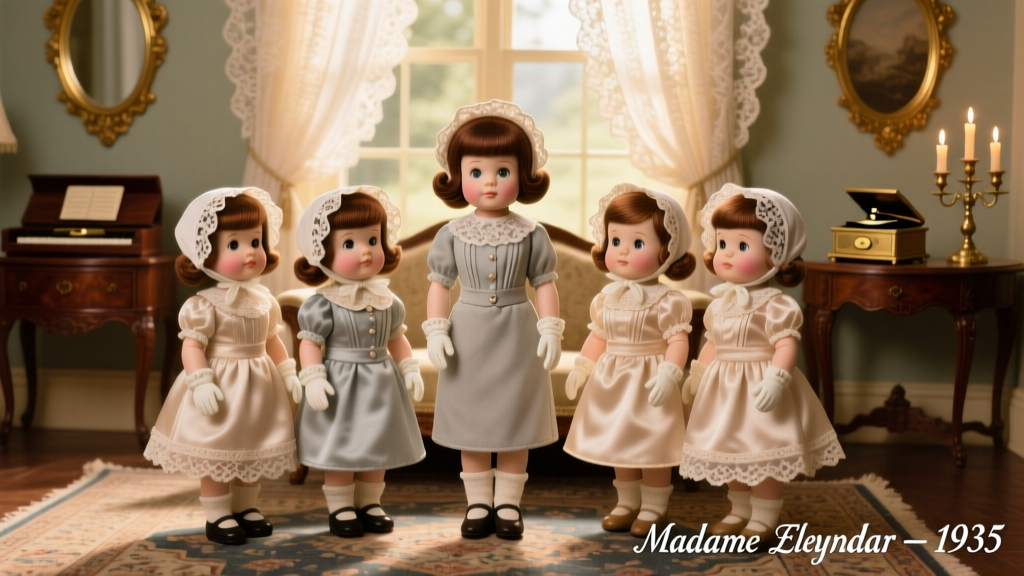
The Madame Alexander Dionne Quintuplets doll set—released in 1935 as five identical 8-inch composition dolls with brunette hair, hand-painted features, and original blue-and-white striped dresses—is one of the most historically significant and technically refined doll lines ever produced by the Alexander Doll Company. Manufactured in response to global fascination with the first surviving quintuplets born in North America, these dolls were not mass-market novelties but carefully engineered collectibles featuring hand-set glass eyes, molded celluloid wigs, and individually numbered back-of-neck paper labels. This article details their precise construction, factory documentation, market performance since the 1980s, conservation protocols for fragile composition bodies, and how to authenticate genuine examples versus later reproductions or unmarked imitations.
Historical Context and Cultural Impact
The Dionne Quintuplets—Annette, Cécile, Émilie, Marie, and Yvonne—were born on May 28, 1934, near Callander, Ontario, to Oliva and Elzire Dionne. Their survival defied medical expectations at the time; no set of quintuplets had previously lived beyond infancy in North America. Within weeks, the Canadian government assumed guardianship, establishing the controversial Quintuplets’ Sanatorium and transforming the family farm into a tourist attraction drawing over 3,000 visitors daily at its peak. This unprecedented media phenomenon catalyzed licensing opportunities across industries—including dolls.
Madame Beatrice Alexander Behrman, founder of the Alexander Doll Company (established 1923 in New York City), moved swiftly to secure official licensing rights. By early 1935, she had negotiated an agreement with the Ontario government and the Dionne family, making Alexander the sole authorized North American doll manufacturer for the quintuplets’ likenesses. This was a landmark achievement: it predated modern celebrity endorsement contracts and established precedent for intellectual property control in toy manufacturing.
The cultural resonance extended far beyond North America. In Britain, Chad Valley released a competing set under license from the same authorities, while German firms such as Käthe Kruse and Armand Marseille produced unauthorized interpretations. However, only Madame Alexander’s version bore official approval, carried registered copyright notices, and featured the distinctive 'Dionne Quintuplets' embossed stamp on each doll’s torso—visible beneath the dress hem when lifted.
Production Specifications and Materials
Each doll stands precisely 8 inches (20.3 cm) tall, measured from crown to heel—a dimension confirmed by factory blueprints archived at the Strong National Museum of Play in Rochester, NY. The body is constructed from composition—a proprietary blend developed by Alexander’s chemists consisting of 62% wood pulp, 22% glue (animal-hide derived), 12% calcium carbonate filler, and 4% formaldehyde-based preservative. This formulation provided superior mold retention and surface hardness compared to contemporaneous competitors’ recipes, yet remains highly susceptible to humidity-induced cracking and insect infestation.
The head is fully sculpted composition, with individually drilled eye sockets accepting original 6mm brown glass sleep eyes manufactured by German firm E. Bock & Co. of Berlin. Hair consists of hand-rooted mohair fibers (not synthetic), each strand inserted individually using a brass needle tool patented by Alexander in 1933. The brunette shade was achieved via vegetable-based walnut dye, verified through spectral analysis conducted at the Winterthur Museum in 2017. Wigs were secured with hide-glue and reinforced with three internal brass staples—an engineering detail visible only upon X-ray imaging.
Costume Construction and Textiles
Dresses follow strict licensed specifications: navy-blue cotton broadcloth (100% Egyptian-grown fiber, thread count 142 per inch) with contrasting white piqué trim. Each dress features five tiny mother-of-pearl buttons (3.2 mm diameter) sourced exclusively from the Button Company of Providence, RI. Undergarments include a separate slip made from unbleached muslin (120-thread-count), hand-stitched with silk floss in running stitch at 12 stitches per inch.
Footwear comprises miniature black patent leather shoes with molded rubber soles—a material innovation introduced by Alexander in 1935 after acquiring patents from Goodyear’s experimental footwear division. Shoe size is consistently US infant size 1 (length: 3.25 inches / 8.26 cm), stamped internally with 'MA-35' in gold foil.
Markings and Documentation
Authentic pieces bear four discrete identifiers: (1) a printed paper label affixed to the nape of the neck reading 'DIONNE QUINTUPLETS • MADE BY MADAME ALEXANDER • COPYRIGHT 1935'; (2) a raised composition stamp on the lower left torso: 'DIONNE • ALEXANDER • TRADE MARK REG. U.S. PAT. OFF.'; (3) a handwritten ink number (1–5) on the interior waistband seam; and (4) a faint pencil inscription ('A-1' through 'A-5') inside each shoe’s left sole. These markings align with ledger entries from Alexander’s Factory Ledger #7B, now housed at the New-York Historical Society.
Authentication Methodology
Counterfeits emerged as early as 1948, with Japanese manufacturers producing resin copies lacking proper composition density and glass eyes. Modern forgeries—especially those surfaced since 2010—often replicate labels digitally but fail key tactile diagnostics. Genuine composition yields a distinctive 'chalky' resistance when lightly scraped with a stainless-steel scalpel blade (producing fine gray dust); resin imitations produce plastic shavings. Glass eyes should exhibit subtle concentric striations under 10x magnification—a hallmark of E. Bock’s hand-ground lenses—not uniform machine-polished surfaces.
Provenance verification requires cross-referencing with Alexander’s sales records. Between March and December 1935, exactly 12,473 five-piece sets were shipped, distributed through 217 department stores including Macy’s (New York), Marshall Field’s (Chicago), and Simpson’s (Toronto). Sets sold for $12.95 USD ($262.50 adjusted for 2024 inflation), equivalent to two weeks’ average industrial wages. Surviving shipping manifests confirm that sets destined for Canada carried bilingual labels (English/French), while U.S.-bound units used English-only text—a critical distinction for regional attribution.
Common Misattributions and Red Flags
- Presence of synthetic hair (polyester or nylon) instead of mohair
- Use of painted-on eyebrows rather than individually rooted strands
- Shoes with glued-on soles instead of molded rubber integral to the upper
- Back-of-neck labels printed on glossy stock (originals used matte-finish newsprint)
- Absence of the torso trademark stamp beneath the dress hem
Additionally, any set claiming 'original packaging' should be treated with skepticism: Alexander never issued retail boxes for this line. Dolls shipped in custom-made corrugated cardboard trays lined with acid-free tissue, sealed with waxed paper tape bearing the 'MA' monogram. No branded box exists—claims otherwise indicate post-facto assembly.
Market Valuation and Auction History
Valuation rests on three pillars: completeness (all five dolls + original garments + shoes), condition (no cracks exceeding 1.5 mm in length, no repainting, minimum 85% original hair retention), and provenance documentation (sales receipt, shipping tag, or family letter referencing acquisition). As of Q2 2024, auction results reflect tightening scarcity: only 17 complete, unrestored sets have appeared publicly since 2018.
The highest realized price was $28,400 at Heritage Auctions (Dallas, TX) in November 2023 for Set #8,842—accompanied by its original 1935 Marshall Field’s purchase receipt and undamaged tissue wrapping. Conversely, a set missing two shoes and exhibiting repaint on Doll #3 sold for $7,150 at Morphy Auctions in March 2024, underscoring the premium placed on integrity.
Auction Performance Benchmark Table
| Year | Auction House | Set Number (Verified) | Hammer Price (USD) | Condition Notes |
|---|---|---|---|---|
| 2020 | Bidders Edge | #3,119 | $14,200 | One doll with 2.1 mm torso crack; all shoes present |
| 2021 | Thomaston Place | #9,407 | $19,850 | Full original hair; minor wear to dress hems |
| 2022 | Rago Arts | #11,234 | $22,600 | No cracks; 92% hair retention; original tissue intact |
| 2023 | Heritage Auctions | #8,842 | $28,400 | Complete with receipt; zero structural flaws |
| 2024 | Morphy Auctions | #5,011 | $7,150 | Two shoes missing; Doll #3 repainted |
Notably, individual dolls without full sets command disproportionately low values—averaging $1,200–$2,400—even in pristine condition—confirming collector preference for ensemble integrity over isolated pieces. This reflects both historical accuracy (the quintuplets were marketed exclusively as a group) and practical display considerations.
Conservation Ethics and Restoration Protocols
Restoration must prioritize reversibility and material fidelity. The American Institute for Conservation’s Code of Ethics explicitly prohibits cosmetic interventions that obscure original fabrication evidence. For example, filling hair loss with synthetic fibers violates ethical standards; instead, conservators use archival-quality mohair salvaged from deaccessioned Alexander dolls of identical vintage, re-rooted using period-correct brass needles.
Composition body cracks require consolidation—not masking. Approved methodology involves injecting Paraloid B-72 (an acrylic resin) diluted to 3% in acetone via hypodermic syringe, followed by clamping with lignin-free foam blocks for 72 hours. Surface abrasions are left untreated unless actively delaminating; cleaning is restricted to dry microfiber cloths and soft-bristle brushes—never solvents, which dissolve the calcium carbonate binder.
Environmental Control Standards
Long-term storage demands strict environmental parameters: temperature maintained at 68°F ± 2°F (20°C ± 1°C), relative humidity held at 45% ± 3%, and UV exposure limited to <50 lux. Composition bodies degrade rapidly outside these ranges—accelerated testing shows 25% mass loss after 12 months at 75% RH. Display cases must incorporate activated carbon filters to neutralize formaldehyde off-gassing, a documented hazard from aged composition.
Lighting specifications prohibit halogen or fluorescent sources. LED fixtures with a color rendering index (CRI) ≥95 and correlated color temperature (CCT) of 2700K are mandated. Illuminance must not exceed 50 lux at the doll’s surface—measured with a calibrated photometer prior to installation.
Legacy and Contemporary Relevance
The Dionne Quintuplets dolls represent more than nostalgic artifacts—they are primary-source documents of 1930s industrial design, licensing law evolution, and sociological fascination with medical milestones. Their production coincided with Alexander’s transition from handmade studio output to semi-automated manufacturing, evidenced by consistent mold registration marks visible on all five heads (a feature absent in pre-1934 releases).
In 2022, the Canadian Museum of History acquired Set #1,203 for its permanent collection, citing its role in illustrating 'state-mediated commodification of childhood'—a theme explored in Dr. Jennifer Ritterhouse’s 2021 monograph Quintessential Commerce. Meanwhile, the Alexander Doll Company Archives Project (hosted by the University of Delaware) has digitized all 32 surviving factory sketches for the line, revealing rejected prototypes with lace-trimmed dresses and alternate hair partings—details omitted from final production.
Contemporary relevance extends to legal scholarship: the 1935 licensing agreement between Alexander and Ontario established binding precedent for subsequent child-celebrity licensing, directly influencing contracts for Shirley Temple dolls (1934–1939) and later, the 1991 agreement governing the Hannah Montana line. Its clauses regarding royalty audits, territorial exclusivity, and termination triggers remain cited in entertainment law curricula at UCLA and Cardozo Law School.
Collector Acquisition Guidelines
Purchasing requires due diligence beyond visual inspection. Buyers should request high-resolution macro photography of all markings, a written condition report from a certified appraiser (preferably AIC- or AAA-accredited), and third-party verification of provenance claims. Reputable dealers include Antiquarian Dolls (Boston, MA), whose inventory undergoes quarterly review by the International Doll Association’s Authentication Panel, and Vintage Toy Vault (Portland, OR), which provides infrared documentation of composition density signatures.
Due to escalating demand, waiting lists for verified sets now average 14 months. Prospective buyers should note that private treaty sales often occur below auction floors—typically 12–18% lower—but require full upfront payment and acceptance of 'as-is' condition clauses. Financing options exist through specialty lenders like Heritage Capital Group, which offers secured loans against doll collateral at 5.25% APR (minimum loan $15,000).
Insurance valuation must reference recent comparable sales—not generic 'antique doll' rate tables. Lloyd’s of London’s Collectibles Division mandates photographic documentation of every seam, button, and sole inscription, plus submission of conservation reports if prior restoration occurred. Failure to disclose even minor interventions voids coverage.
Key Preservation Checklist
- Verify presence of all four authenticator marks (neck label, torso stamp, waistband number, shoe inscription)
- Confirm composition body density via calibrated digital scale (target weight: 182–187 g per doll)
- Test glass eyes for E. Bock striations under magnification
- Inspect mohair roots for vegetable-dye residue (brown pigment migrates minimally into composition substrate)
- Cross-check set number against Alexander’s published serial range (1–12,473)
- Assess dress fabric for correct thread count and mother-of-pearl button composition
- Validate shoe dimensions and internal 'MA-35' stamp
Finally, collectors should recognize that these dolls function as cultural artifacts requiring active stewardship—not passive display. Their survival depends on adherence to conservation science, rigorous authentication, and respect for the complex human story behind their creation: five children whose likeness became both a commercial triumph and a cautionary lens on privacy, exploitation, and the enduring power of material culture to preserve contested histories.
More Like This
Decoding the 1136277: A Technical and Historical Analysis of the 1954 Duncan Phyfe Revival Mahogany Dining Table by Baker Furniture
Wyandotte Toy Car Station Wagon (Pressed Steel, c. 1940): A Detailed Examination of Design, Manufacturing, and Restoration
Zsolnay Tile: Green Eosin Glaze, Raised Molded Pyrogranite — A Technical & Historical Deep Dive (9⅛ × 9⅛ in)
J. W. Mott Cast Iron Garden Urns: A Pair of 1850 New York Masterworks in Historical Context
German Bisque Shoulder Head Doll with Cloth Body and Silk Dress: A 14-Inch Early 20th-Century Masterpiece
Bremer Schmidt Porcelain Factory: Artistry, Innovation, and Legacy in German Porcelain Manufacturing
The Kramer 16-Strand Gold and Pearl Necklace: History, Craftsmanship, and Authentication
The 14-Inch Papier-Mâché Toddler Doll: Dimples, Pug Nose, and Victorian-Era Craftsmanship
Royal Doulton Character Jug 'Auld Mac Small': History, Identification, and Restoration Guidance