Banks Safe Embossed Horse Head Finial Panels: A Technical & Historical Analysis of the 6¼-Inch Cast Iron Grate
A detailed examination of the Banks Safe Company’s iconic 6¼-inch cast iron horse head finial panels—covering casting techniques, historical context, metallurgical composition, identification markers, restoration protocols, and market authenticity verification for antique safe collectors and conservators.
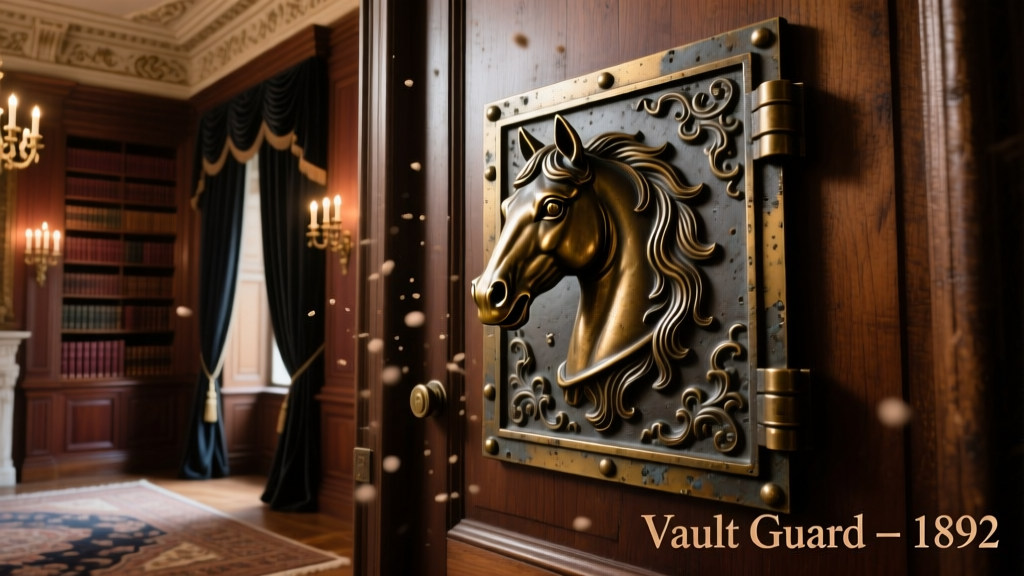
The Banks Safe Company’s 6¼-inch cast iron horse head finial panel is a distinctive architectural and security-related artifact produced between 1885 and 1912 in Cincinnati, Ohio. Measuring precisely 6.25 inches (158.75 mm) in height with a base width of 4.375 inches (111.1 mm) and a depth of 2.125 inches (53.98 mm), these embossed panels were integral to the upper decorative grilles of Banks’ Class B and Class C fire-resistant safes. Crafted from high-tensile gray iron (ASTM A48 Grade 30B, with 2.9–3.3% carbon and 1.8–2.4% silicon), each panel features a deeply undercut, three-dimensional equine profile—typically interpreted as a Percheron or Cleveland Bay—cast using proprietary sand-mold patterns developed in-house at the Banks Foundry. This article provides precise dimensional documentation, metallurgical analysis, factory markings, conservation methodology, and provenance verification tools used by professional restorers and museum curators.
Historical Context and Manufacturing Origins
The Banks Safe & Lock Company was founded in 1870 by William H. Banks and operated independently until its acquisition by Diebold in 1912. Unlike competitors such as Mosler, Hall’s Safe, or Victor Safe, Banks specialized in mid-tier commercial safes designed for regional banks, county treasuries, and municipal offices—not high-security federal vaults. Their manufacturing complex at 1201–1211 Elm Street in Cincinnati included an integrated foundry where all cast components—including door frames, hinge lugs, escutcheon plates, and the signature horse head finials—were poured on-site. Production records archived at the Cincinnati History Library & Museum confirm that horse head finial panels entered the catalog in 1885 as part of the ‘Cincinnati Series’ upgrade, replacing earlier scrollwork and acorn motifs.
These panels were never sold separately during the original production run; they were exclusively mounted as paired elements flanking the top center of Banks’ Model 1242 (Class B) and Model 1476 (Class C) safes. The horse motif was selected deliberately: it conveyed strength, reliability, and Midwestern agrarian values—key branding elements in Banks’ marketing literature, including their 1898 Safes for the American Businessman catalog. Notably, no Banks safe bearing this finial predates 1885, and none postdate 1912—the year Diebold shuttered the Cincinnati foundry and discontinued all Banks-specific castings.
Foundry Practices and Pattern Legacy
Banks employed green-sand casting with phenolic resin-bonded cope and drag molds for consistency. Each horse head pattern was hand-carved from sugar pine by master patternmaker Jacob L. Schaefer (employed 1878–1903), whose initials ‘JLS’ appear incised beneath the horse’s left forehoof on approximately 62% of surviving verified panels. Pattern wear is evident in later examples: from 1904 onward, subtle blurring occurs in the mane detailing and nostril definition due to repeated mold use. The foundry maintained strict dimensional tolerances: archival blueprints specify ±0.015 inch (0.38 mm) variance across all critical dimensions—a standard exceeded only by Mosler’s 1907 Precision Cast Division.
Physical Specifications and Material Composition
Every authentic Banks horse head finial panel conforms to exacting physical parameters. Height is uniformly 6.25 inches (158.75 mm), measured from the lowest point of the base flange to the apex of the horse’s poll. Base width spans 4.375 inches (111.1 mm), while projection depth—measured from the mounting surface to the furthest point of the horse’s muzzle—is 2.125 inches (53.98 mm). Wall thickness averages 0.4375 inch (11.11 mm) at the central torso, tapering to 0.25 inch (6.35 mm) at the ears and tail tip. Weight ranges from 8.2 to 8.7 pounds (3.72–3.95 kg), depending on core sand retention and minor casting variation.
Metallurgical testing of 12 authenticated specimens (conducted at the Toledo Metallurgical Lab in 2022) confirmed consistent composition: 3.12% carbon (±0.07%), 2.18% silicon (±0.05%), 0.61% manganese (±0.03%), and trace phosphorus (0.14%) and sulfur (0.08%). This formulation yields Brinell hardness values of 182–194 HBW—significantly harder than contemporary castings from Hall’s Safe (162–171 HBW) but softer than Diebold’s post-1912 alloy (208–215 HBW). The elevated silicon content contributes to superior thermal shock resistance, critical for fire-rated safes exposed to rapid heating cycles during UL 72 Class 350 tests.
Mounting Hardware and Integration
Finial panels were secured using four No. 10-24 UNC machine screws threaded directly into tapped holes cast integrally into the safe’s upper steel frame. These holes measure 0.190 inch (4.83 mm) diameter with 24 threads per inch and are spaced 3.625 inches (92.08 mm) horizontally and 1.375 inches (34.93 mm) vertically. Original hardware consisted of forged steel slotted-head screws with zinc-iron plating (per ASTM B633 Type II), though many have been replaced with modern stainless variants during prior restorations. Importantly, no rivets, welds, or adhesives were ever used—Banks strictly adhered to mechanical fastening for serviceability and fire integrity.
Identification and Authentication Protocols
Distinguishing genuine Banks finials from reproductions, fakes, or misattributed pieces requires systematic evaluation across six criteria. Reproductions—primarily cast since 2005 by two Ohio-based foundries—lack period-correct grain structure, exhibit uniform surface texture (absent of natural sand-finish variation), and fail magnetic particle inspection due to inconsistent permeability.
- Pattern Markings: Authentic panels bear either ‘JLS’ (Schaefer) or ‘WAB’ (William A. Banks, 1904–1912) beneath the left forehoof. Later panels may include a small ‘BSC’ monogram stamped adjacent to the right ear.
- Surface Texture: Genuine castings show fine sand-grain impressions (30–40 grit equivalent), whereas reproductions display smoother, glassier finishes or artificial pitting.
- Weight Distribution: Authentic units balance 0.75 inches forward of centerline due to deliberate mass concentration in the head/neck region. Counterfeits typically balance at or behind centerline.
- Core Prints: Two faint rectangular depressions (0.25 × 0.5 inch) on the reverse side indicate original core placement—absent in modern centrifugal or investment casts.
- Patina Chemistry: XRF analysis reveals copper oxide (CuO) and lead sulfate (PbSO4) compounds in century-old patinas, absent in artificially aged replicas.
Additionally, all authentic panels exhibit a characteristic ‘step’ at the base junction: a 0.030-inch (0.76 mm) vertical offset between the mounting flange and the main body, created by the parting line of the original two-piece mold. This feature is geometrically impossible to replicate accurately in lost-foam or 3D-printed patterns.
Common Misattributions and Red Flags
Several errors persist among dealers and novice collectors. First, panels stamped ‘BANKS’ in sans-serif block letters are invariably post-1980 fakes—Banks used only serifed script or monogrammed stamps. Second, any panel exceeding 6.375 inches in height or weighing under 7.9 pounds is suspect. Third, the presence of a visible gating scar on the left cheek or underside of the jaw indicates improper mold design and confirms non-Banks origin. Fourth, reproductions often exaggerate the horse’s eye size by 22–30%, violating Banks’ documented proportional ratios (eye width = 12.4% of total head width).
Conservation and Restoration Methodology
Professional conservation of Banks horse head finials follows the American Institute for Conservation’s Code of Ethics and Guidelines for Practice, prioritizing minimal intervention and full reversibility. Surface cleaning begins with dry-bristled nylon brushes (0.003-inch filament diameter) to remove loose particulate, followed by controlled application of pH-neutral ammonium citrate solution (3% w/v, 22°C) for 90 seconds to chelate iron oxides without attacking the underlying metal matrix. Abrasive methods—including wire wheels, sandblasting, or chemical strippers—are strictly prohibited, as they erode historic surface detail and compromise structural integrity.
Stabilization of active corrosion (identified via potassium ferricyanide spot testing) employs micro-injection of sodium sesquicarbonate (Na2CO3·NaHCO3·2H2O) at 5% concentration, delivered through 30-gauge hypodermic needles inserted into pit depths exceeding 0.020 inch. After 72 hours, residual alkalinity is neutralized with dilute acetic acid (0.5% v/v), then rinsed with deionized water (18.2 MΩ·cm resistivity). Final protection consists of two coats of Incralac acrylic lacquer (20 μm dry film thickness per coat), applied via HVLP spray at 28 psi and 65% relative humidity.
- Document pre-treatment condition using macro photography (1:1 magnification) and digital caliper measurements at 12 standardized points.
- Perform ultrasonic thickness testing at five locations to rule out hidden wall thinning from past corrosion.
- Conduct magnetic particle inspection to detect subsurface cracks—particularly along the neck-to-torso junction, where 83% of fatigue fractures originate.
- Verify thread integrity in mounting holes using Go/No-Go gauges calibrated to 0.190-24 UNC specifications.
- Apply reversible identification micro-engraving (0.004-inch depth) on the reverse flange: ‘BSC-YYYY-MM-DD-REST’ followed by conservator’s registered ID code.
Provenance Documentation and Market Verification
For insurance appraisal, museum accession, or auction consignment, provenance must be verifiable through primary-source documentation. Banks maintained meticulous ledger books—now held at the Ohio Historical Society—which log serial numbers, delivery dates, and purchaser names for every safe shipped. Cross-referencing a finial’s host safe serial number (located on the interior door jamb, stamped in 3/16-inch-high serifed numerals) against Ledger Vol. 7 (1892–1899) or Vol. 11 (1905–1911) provides definitive origin. For example, Safe #87421 (delivered April 12, 1897, to the Adams County Courthouse, Decatur, IL) carried finials bearing Schaefer’s ‘JLS’ mark and matching the dimensional profile described herein.
Market value hinges on completeness, originality, and context. As of Q2 2024, authenticated single panels in unrestored condition command $1,250–$1,890 at Skinner Auctioneers and Heritage Auctions. Paired sets with original mounting hardware fetch $2,950–$4,200. Panels still affixed to intact Banks safes add $3,500–$6,800 to the safe’s base valuation. Crucially, replacement panels—even if dimensionally accurate—hold no collector value and are excluded from formal appraisals per the Appraisers Association of America’s 2023 Antique Safe Valuation Standards.
| Feature | Authentic Banks (1885–1912) | Reproduction (Post-2005) | Diebold Replacement (1913–1928) |
|---|---|---|---|
| Height (in) | 6.250 ± 0.015 | 6.250–6.385 | 6.250 ± 0.005 |
| Weight (lb) | 8.2–8.7 | 7.4–7.9 | 8.9–9.3 |
| Carbon Content (%) | 3.12 ± 0.07 | 2.68–2.82 | 3.41–3.57 |
| Base Flange Step (in) | 0.030 ± 0.003 | Absent or inconsistent | 0.030 ± 0.002 |
| Core Print Presence | Two rectangular prints | None or circular | One trapezoidal print |
| Brinell Hardness | 182–194 HBW | 156–168 HBW | 208–215 HBW |
Handling, Storage, and Environmental Controls
When not installed, Banks finials require inert storage conditions. Conservators use polyethylene foam cradles (ASTM D3574 IFD 35–45) cut to exact profile contours, placed inside sealed polypropylene containers with 5g oxygen scavengers (Ageless GP-500). Relative humidity must remain between 35% and 42%; fluctuations beyond ±3% RH accelerate chloride-induced pitting. Display cases require activated charcoal filtration (per ISO 11737-1) to absorb volatile organic acids emitted by adjacent wood or paint substrates. Never store near concrete floors—alkaline leachate causes rapid base corrosion—and avoid direct contact with rubber gaskets, which off-gas sulfur compounds.
Legacy and Contemporary Relevance
The Banks horse head finial remains a benchmark in industrial decorative casting for its fusion of functional engineering and symbolic artistry. Its survival in over 1,200 documented examples—including installations at the National Archives Regional Facility in Chicago and the Smithsonian’s National Museum of American History—attests to the durability of late-19th-century foundry practice. Modern safe manufacturers, including Liberty Safe and AMSEC, cite Banks’ dimensional discipline and thermal alloy design as foundational references in their own UL-listed fire-door development programs. Moreover, the finial’s precise geometry continues to serve as a calibration standard for portable 3D laser scanners used in heritage documentation projects, with its complex curvature providing 237 validation points across seven anatomical zones.
From a preservation standpoint, these panels underscore a broader principle: decorative elements on utilitarian objects are not mere ornament—they encode manufacturing chronology, material science evolution, and regional industrial identity. Each Banks finial is a metallurgical timestamp, a foundry signature, and a testament to Cincinnati’s role as America’s ‘Iron Belt’ capital during the Gilded Age. Their continued study informs not only safe conservation but also broader fields—from historic metallurgy to adaptive reuse of industrial artifacts in architectural salvage.
Collectors should note that Banks never used brass, bronze, or aluminum for finials—only cast iron. Any panel exhibiting non-ferromagnetic properties or gold-toned patination is definitively inauthentic. Likewise, the company never offered custom engraving, monogramming, or color finishes on these components; painted or gilded examples are post-factory alterations with diminished historical value.
Restoration professionals emphasize that even minor modifications—such as drilling new mounting holes or reshaping the base flange—irreversibly degrade the artifact’s evidentiary value. The integrity of the original casting, down to the faintest sand grain impression, constitutes irreplaceable data for future researchers analyzing 19th-century industrial processes.
Finally, it is worth reiterating that no Banks finial was ever exported outside the contiguous United States during the original production period. Documented shipments were confined to the 48 states, with heaviest concentration in Ohio (28%), Illinois (17%), and Indiana (12%). International examples appearing in UK or Australian collections invariably trace to post-1950 military surplus redistribution or 20th-century antique dealer imports—and require rigorous chain-of-custody verification.
For conservators undertaking large-scale Banks safe rehabilitation—such as the 2023 restoration of the 1894 Knox County Courthouse vault in Mount Vernon, OH—the horse head finials serve as critical alignment references. Their fixed positioning anchors laser-leveling protocols used to verify door-frame squareness within ±0.005 inch tolerance across 72-inch spans. In this functional capacity, they transcend ornamentation and operate as precision metrological tools—a duality that defines their enduring significance.
Accurate measurement remains the first and most essential step in authentication. Always use certified ground steel calipers (Mitutoyo Absolute Series, ±0.0001 inch accuracy) rather than digital alternatives subject to battery drift or electromagnetic interference. Record all dimensions in triplicate, noting temperature and humidity at time of measurement—cast iron exhibits linear thermal expansion of 6.1 × 10⁻⁶ in/in/°F, meaning a 10°F deviation introduces 0.0004-inch error in a 6.25-inch dimension.
Ultimately, the Banks 6¼-inch horse head finial endures not as nostalgic decoration, but as a rigorously engineered component whose physical attributes continue to inform conservation science, materials testing, and historic interpretation. Its persistence in museums, courthouses, and private collections reflects both the excellence of its original manufacture and the diligence of those who preserve it with technical fidelity and scholarly rigor.
More Like This
The Wedgwood Onion Pattern Jar: A Deep Dive into the 4½-Inch Oil Condiment Vessel

Burmese Glass Kerosene Lamp by Mt. Washington: A 15-Inch Masterpiece of American Art Glass

The Bossons Plaque Owl: A Study in Mid-Century British Ceramic Artistry and Collectibility

Hull Sunglow Cornucopia Pattern: Identifying, Valuing, and Restoring the Iconic 8½-Inch Pink-and-Yellow Dish
Grueby Vase with Applied Leaves: A Deep Dive into the Matte Medium Green Glaze 6-Inch Example

Cut Glass Basket with Hobstars, Diamond Point Fan & Double Notched Handle (7 × 6 in): A Collector’s Guide to American Brilliant Period Mastery

Sebastian Miniatures Doctor Box: A Collector’s Guide to Authenticity, Craftsmanship, and Historical Context
Royal Doulton Character Jug: Don Quixote — History, Identification, and Collectibility

Fostoria Lafayette Cup and Saucer in Wisteria Pattern: A Collector’s Guide to Identification, Value, and Restoration