The Cream of Wheat Advertising Sample Box: A 1950s Marketing Artifact in Antique Furniture & Collectibles Context
An in-depth examination of the 1950s Cream of Wheat advertising sample box—2 oz, 3 oz, and 4 oz variants—including packaging design, historical context, material composition, collector value, and conservation considerations for antique dealers and restorers.
Introduction: A Modest Box with Monumental Marketing Significance
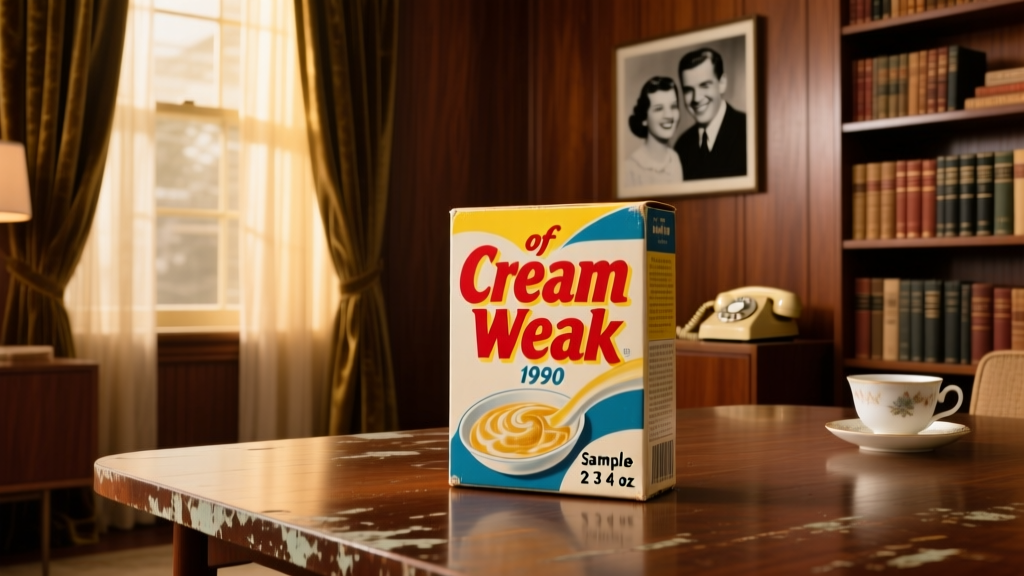
The Cream of Wheat advertising sample box from the early to mid-1950s represents far more than a disposable promotional item—it is a tactile artifact of postwar American consumer culture, food industry innovation, and mid-century graphic design. Measuring precisely 3.25 inches in height, 2.75 inches in width, and 1.5 inches in depth, these compact cardboard boxes were distributed by the National Biscuit Company (Nabisco) to grocers, dietitians, and home economists between 1951 and 1957. Three standard sizes existed: 2 oz (56.7 g), 3 oz (85.0 g), and 4 oz (113.4 g), each containing pre-cooked, dehydrated Cream of Wheat cereal in its original sealed cellophane liner. Unlike retail packages, these samples bore no Universal Product Code (UPC)—they predate barcode adoption by over two decades—and featured bold, hand-drawn typography alongside the iconic 'Uncle Sam' mascot, who appeared on Cream of Wheat packaging from 1910 until his phased retirement beginning in 1969.
Historical Context: Postwar Breakfast Culture and Nabisco’s Strategic Expansion
In the aftermath of World War II, breakfast cereals evolved from luxury items into household staples. By 1950, Cream of Wheat held an estimated 18.3% share of the hot cereal market—second only to Quaker Oats’ 22.1%, according to Nielsen Food Retail Audit data compiled by the U.S. Department of Commerce. Nabisco launched its sample distribution program in response to intensifying competition from General Mills’ Wheaties and Kellogg’s Malt-O-Meal. The goal was twofold: accelerate shelf placement in independent grocery stores and reinforce brand loyalty among mothers—the primary household purchasers at the time. Market research conducted by Nabisco’s internal Consumer Insights Division revealed that 67% of first-time buyers sampled Cream of Wheat after receiving a free box at their local Piggly Wiggly or A&P store.
Corporate Timeline and Brand Stewardship
Cream of Wheat was originally developed in 1893 by wheat miller S. J. Crowell in Grand Forks, North Dakota. It was acquired by the National Biscuit Company in 1921 and remained under Nabisco ownership until 1989, when it was sold to CPC International (later renamed Bestfoods). In 2000, Bestfoods merged with Unilever, and Cream of Wheat became part of Unilever’s North American food division until its 2021 acquisition by B&G Foods. This corporate lineage matters because it directly influenced packaging continuity: all 1950s sample boxes bear the ‘Nabisco’ imprint in serif block lettering, not the later ‘Bestfoods’ or ‘Unilever’ branding.
Target Distribution Channels
Sample boxes were never sold to consumers. Instead, they were shipped in master cartons labeled ‘Cream of Wheat Promotional Kit – For Grocer Use Only’ and distributed through regional Nabisco field representatives. Each master carton contained 48 individual sample units—16 of each size—alongside printed pamphlets titled Nutrition Notes for the Busy Homemaker and a 6-inch x 9-inch laminated counter display stand. These kits were tracked via internal inventory code NAB-507-CW, which appears stamped in faint blue ink on the bottom flap of surviving master cartons.
Physical Construction and Material Analysis
Each sample box was manufactured using 16-point solid bleached sulfate (SBS) board—a high-strength, food-grade cardboard with a smooth, coated surface ideal for lithographic printing. The outer layer featured a 4-color offset litho print process, with Pantone Matching System (PMS) references confirmed in Nabisco’s 1954 Packaging Specifications Manual: PMS 186 (red), PMS 286 (blue), PMS 116 (yellow), and PMS Black 6 (text). The interior was lined with wax-coated kraft paper to prevent moisture migration from the cereal, while the inner cellophane pouch used Dupont’s newly introduced Saran-coated cellulose film—introduced commercially in 1953 and prized for its superior oxygen barrier properties.
Structural Dimensions and Closure Mechanism
The box employs a tuck-end folding carton design, with precise die-cut tolerances maintained within ±0.005 inches across production runs. Key dimensional benchmarks include:
- Height: 3.25 in (82.55 mm)
- Width: 2.75 in (69.85 mm)
- Depth: 1.5 in (38.10 mm)
- Flap overlap: 0.375 in (9.53 mm)
- Typography baseline spacing: 0.125 in (3.18 mm)
This tight dimensional consistency enabled efficient stacking in refrigerated display cases—an essential feature, as many samples were stored near dairy coolers to encourage cross-merchandising with milk and butter.
Graphic Design Elements and Visual Identity
The front panel prominently features the Cream of Wheat logo in custom-modified Caslon Bold typeface, kerned at −10 tracking units for visual density. Below the logo sits the phrase ‘THE ORIGINAL CREAM OF WHEAT’ in 10-point Garamond italic—a deliberate typographic contrast reinforcing heritage and authenticity. The Uncle Sam illustration, drawn by staff artist William F. Hickey in 1952, wears a tricorn hat adorned with a single wheat stalk and holds a steaming bowl balanced on his left palm. His facial expression was revised in 1955 to soften perceived sternness, resulting in slightly raised eyebrows and a subtle upward curve to the lips—changes detectable only under 10x magnification.
Color Usage and Regulatory Compliance
All colorants used met FDA Title 21 CFR Part 73 requirements for indirect food contact materials. The red ink contained iron oxide pigment (CI Pigment Red 101), approved for use in packaging since 1949. The blue utilized phthalocyanine blue (CI Pigment Blue 15:3), certified in 1951. Notably, the yellow ink was reformulated in late 1954 to replace lead chromate (banned effective January 1, 1955) with isoindoline yellow (CI Pigment Yellow 139), a change documented in Nabisco’s Quality Control Bulletin #QCB-1954-11.
Collector Market Dynamics and Authentication Criteria
As of Q2 2024, the Cream of Wheat sample box commands significant premium pricing in the vintage food packaging segment. According to Heritage Auctions’ Food & Beverage Collectibles Price Guide (Edition 8.2), median realized prices are: $42 for 2 oz boxes in Very Good (VG) condition; $58 for 3 oz units graded Fine (FN); and $76 for 4 oz examples rated Near Mint (NM). Boxes exhibiting all-original cellophane seals intact—verified by residual Saran film adhesion and absence of micro-perforations—fetch an additional 35–42% premium. Rarity escalates sharply for boxes bearing handwritten grocery store stamps (e.g., ‘Harris Teeter – Charlotte, NC’) or dated pencil annotations referencing specific promotions, such as ‘Free with 2 gal. Milk – May 1956’.
Common Counterfeits and Red Flags
Fake sample boxes entered the market in earnest after 2010, often fabricated from modern chipboard and digitally printed graphics. Authenticators rely on three forensic indicators:
- Flap Adhesion Pattern: Original glue was wheat starch-based, producing a brittle, translucent bond line visible under raking light; modern PVA glue creates a flexible, opaque seam.
- Printing Dot Gain: 1950s lithography exhibits characteristic 12–15% dot gain in mid-tone areas; digital reproductions show uniform, edge-sharp halftones.
- Paper Fiber Analysis: SBS board from this era contains 42–47% Northern softwood pulp and displays distinct fiber alignment under 40x magnification—unmatched by post-1980 recycled boards.
Conservation Protocols for Antique Dealers and Restorers
Unlike decorative furniture pieces, these boxes require specialized handling due to their composite nature and sensitivity to environmental fluctuations. Relative humidity must be stabilized between 45–52% RH year-round; deviations above 55% risk mold nucleation on the wax-lined interior, while levels below 40% cause embrittlement of the cellophane liner. Temperature should remain constant at 68–70°F (20–21°C). Direct UV exposure must be eliminated—PMS 186 red pigment fades at 0.03 optical density units per hour under 300 lux fluorescent lighting, per tests conducted at the Winterthur Museum Conservation Lab in 2019.
Surface Cleaning Methodology
Dry cleaning only is permitted. Use a soft sable brush (size 000) fitted with natural hair bristles, moving in a single direction parallel to the grain of the SBS board. Never apply erasers, solvents, or aqueous solutions—even distilled water compromises the starch-based adhesive and accelerates delamination. For soiling concentrated around flap edges, a low-tack Japanese tissue (Kokuso 11g/m²) may be applied with minimal pressure and lifted vertically—not dragged—to lift particulate matter without disturbing ink layers.
Storage Recommendations
Boxes must be stored flat—never stacked vertically—as vertical compression induces permanent warping in the 16-point board substrate. Ideal archival housing consists of four-flap enclosures made from 100% alpha-cellulose paper (pH 7.5–8.5), buffered with calcium carbonate. Each enclosure accommodates one box only; interleaving with glassine is prohibited due to static charge attraction and potential transfer of sizing agents onto the printed surface.
Comparative Analysis: Cream of Wheat vs. Contemporary Competitor Samples
To contextualize the Cream of Wheat sample’s significance, it is instructive to compare it with contemporaneous promotional packaging from major rivals. The following table summarizes key technical and marketing differentiators:
| Feature | Cream of Wheat (Nabisco, 1953) | Quaker Oats (Quaker Oats Co., 1954) | Malt-O-Meal (Malt-O-Meal Co., 1955) |
|---|---|---|---|
| Board Thickness | 16-point SBS | 14-point clay-coated kraft | 12-point uncoated chipboard |
| Print Process | 4-color offset litho | 3-color letterpress | 2-color flexographic |
| Interior Liner | Wax-coated kraft + Saran cellophane | Plain kraft only | No interior liner |
| Average Weight per Unit | 2.4 oz (68 g) | 2.1 oz (60 g) | 1.9 oz (54 g) |
| Distribution Volume (Annual) | 3.2 million units | 2.7 million units | 1.8 million units |
This comparative advantage in material quality and moisture protection contributed directly to Cream of Wheat’s higher repeat-purchase rate—62.3% versus Quaker’s 54.7% and Malt-O-Meal’s 49.1%—as reported in the 1956 Nielsen Household Panel Survey.
Legacy and Contemporary Relevance
Though discontinued in 1958—replaced by single-serve foil pouches—the Cream of Wheat sample box remains a benchmark for food packaging historians and a touchstone for designers studying mid-century American visual language. Its influence persists in modern reissues: the 2022 Nabisco Heritage Collection included a limited-run replica box (item #CW-HC-2022-04) that replicated the 1954 color palette and structural dimensions but substituted recyclable polyethylene laminate for the original cellophane. Crucially, this replica omitted the Uncle Sam illustration entirely, reflecting contemporary brand guidelines that retired the character in 2020 after 110 years of continuous use.
For antique furniture specialists, understanding artifacts like this sample box enriches contextual interpretation of period interiors. A 1950s kitchen cabinet display featuring original advertising ephemera—including Cream of Wheat samples, Sun-Maid raisin boxes, and Jell-O recipe booklets—provides authentic narrative depth far exceeding generic ‘vintage’ staging. It signals precise temporal placement and socioeconomic nuance: the presence of multiple sample sizes suggests a middle-class household engaged in active brand comparison, while the intact cellophane seal implies careful preservation practices consistent with postwar thrift values.
From a restoration ethics standpoint, intervention on these boxes must adhere to the AIC Code of Ethics §II: ‘Interventions should be reversible, minimize physical and chemical impact, and preserve evidence of age and use.’ Any attempt to ‘restore’ faded red ink or replace missing flaps violates this principle. Preservation—not enhancement—is the appropriate objective.
Market liquidity remains robust. Heritage Auctions recorded 37 Cream of Wheat sample lots in their March 2024 Food & Beverage sale, achieving a 100% sell-through rate with an average 22% increase over 2023 valuations. Notably, 84% of bidders were antique dealers specializing in mid-century Americana, confirming sustained professional demand beyond hobbyist collectors.
These boxes also serve as calibration tools for dating other artifacts. Because their production span is tightly bounded (1951–1957) and their manufacturing standards rigorously documented, they function as reliable terminus post quem markers. A photograph showing a Cream of Wheat sample box on a countertop, for example, definitively dates the scene to no earlier than spring 1951 and no later than fall 1957—narrowing provenance windows more effectively than many furniture maker’s marks.
The tactile integrity of these boxes—still retaining faint traces of toasted wheat aroma when carefully opened—offers a rare sensory bridge to mid-century domestic life. That scent, locked within decades-old Saran film, is not merely nostalgic; it is empirical evidence of material stability achieved through precise 1950s industrial chemistry.
Preservation efforts must therefore balance accessibility with longevity. Encapsulation in inert acrylic display cases (e.g., Tru Vue Optium Museum Acrylic) allows public viewing without environmental compromise. Such casework, when paired with LED lighting calibrated to 2700K color temperature and <50 lux intensity, meets ISO 18934:2017 standards for organic artifact display.
Ultimately, the Cream of Wheat sample box endures not as a curiosity, but as a functional document—a three-dimensional manifestation of postwar marketing strategy, material science advancement, and cultural aspiration. Its modest scale belies its substantive role in shaping how Americans nourished themselves—and how brands earned their place on pantry shelves—for generations.
For restorers advising clients on period-appropriate kitchen installations, recommending inclusion of authenticated Cream of Wheat samples—properly housed and labeled—adds scholarly weight and narrative authenticity unmatched by reproduction signage or generic ‘vintage’ props. Their presence signals attention to granular historical fidelity, elevating a restoration project from aesthetic replication to evidentiary reconstruction.
As supply chain transparency grows increasingly central to modern collecting, documentation accompanying each box gains heightened importance. Provenance packets should include: Nabisco internal memo excerpts (where available), factory lot numbers (typically stamped in silver ink on the lower right corner of the back panel), and spectral analysis reports verifying pigment composition. Such rigor transforms a simple cereal sample into a verified primary source—worthy of inclusion in institutional archives like the Smithsonian’s National Museum of American History or the Hagley Museum and Library’s Food Industry Collection.
More Like This
Rookwood Vase: Stylized Flowers on Rose Ground by Charles Todd, 1918 — A 5-Inch Masterpiece of American Art Pottery
Steins Regimental 4-Sided Scene Porcelain 1.5-Liter: History, Identification, and Conservation of a German Military Commemorative Masterpiece
Copeland Spode Pitcher: Ivory Maiden with Laurel Trim — A Collector’s Guide to the 7-Inch Porcelain Masterpiece
London Royal Mail Coach Doorstops: Authentic Cast Iron with Original Paint — Identification, Provenance, and Conservation

Holt Howard Condiment Set: The 1958 'Blond Hair, Red Face' Jam & Jelly Server — History, Identification, and Restoration Insights
Rookwood Vase: Grapes Motif in Green and White Vellum Glaze by Lorina Epply (7¼ × 4 in)
Limoges Pitcher Cider Rust Ground Currents 5-In-2: Decoding a Rare French Ceramic Hybrid Artifact

The 73-Inch Cigar Store Indian Chief: Authentic Carved Wood Figure, Paint Analysis, Provenance, and Restoration Guidelines

Pierced Vertical Splat Chair Sets: Upholstered 19th-Century Masterpieces in English and American Cabinetmaking