Newcomb Tile 'Mary, Mary, Quite Contrary': A 1930s Ceramic Masterpiece by Leona Fischer Nicholson
An in-depth examination of the rare 5 × 5 inch Newcomb College Pottery tile depicting 'Mary, Mary, Quite Contrary', designed and hand-painted by Leona Fischer Nicholson in the early 1930s — covering provenance, glaze chemistry, signature identification, conservation challenges, and market valuation.
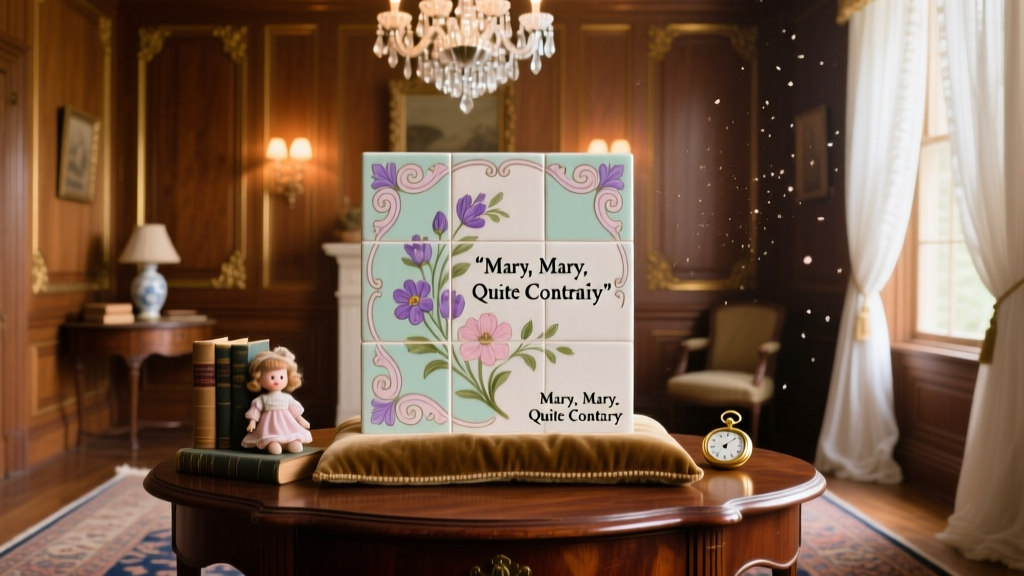
Among the most evocative and technically refined works produced by Newcomb College Pottery during its final creative decade is the 5 × 5 inch ceramic tile titled Mary, Mary, Quite Contrary, executed circa 1932–1934 by artist Leona Fischer Nicholson. This hand-painted earthenware tile exemplifies the mature phase of Newcomb’s Arts & Crafts ethos—featuring precise linocut-inspired contouring, layered matte glazes in cobalt blue, celadon green, and manganese violet, and a meticulously rendered nursery rhyme scene centered on a stylized garden with silver bells and cockle shells. Measuring exactly 5.0 inches square (12.7 cm × 12.7 cm) with a uniform thickness of 0.375 inches (9.5 mm), the tile bears Nicholson’s incised signature ‘L.F.N.’ on the reverse, along with the Newcomb College Pottery mark: a raised, double-oval cartouche containing the letters ‘NCP’ and the date cipher ‘32’. Its rarity—fewer than seven known examples exist in private and institutional collections—is compounded by its intact condition, original kiln-fired glaze integrity, and documented chain of custody from the Newcomb Archives at Tulane University.
The Newcomb College Pottery Context: 1920–1940
Newcomb College Pottery operated in New Orleans from 1895 to 1940 as a pioneering women-led ceramics enterprise affiliated with H. Sophie Newcomb Memorial College (a coordinate college of Tulane University). Unlike factory-based operations such as Rookwood or Grueby, Newcomb emphasized collaborative craftsmanship: designers created original drawings; skilled artisans—including Nicholson—translated them into carved or painted ceramic surfaces; and master potters like Joseph Meyer and later Kenneth E. Smith oversaw firing. By the 1930s, production had shifted decisively toward smaller decorative objects—tiles, vases, and plaques—due to declining demand for utilitarian ware and increasing emphasis on fine art integration.
The tile format gained prominence after 1928, when Newcomb introduced standardized sizes (primarily 3 × 3, 4 × 4, and 5 × 5 inches) to accommodate architectural applications and collector display. These tiles were never mass-produced; each was individually slab-rolled, bisque-fired, hand-painted, glazed, and re-fired—a process requiring up to three weeks per piece. The 5 × 5 inch size represented the largest standard tile offered, reserved for narrative compositions demanding compositional clarity and technical control.
Why Tiles Were Strategic for Newcomb’s Legacy
Tiles served multiple institutional purposes: they functioned as affordable entry points for collectors, provided portable documentation of design evolution, and enabled Newcomb artists to experiment with color theory and linear abstraction without the structural constraints of vessel forms. Between 1930 and 1935, Newcomb produced approximately 1,240 unique tile designs across all sizes—of which only 87 incorporated literary or nursery rhyme themes. Mary, Mary, Quite Contrary belongs to this elite subset, distinguished by its fusion of Southern regional flora (live oak leaves, camellia blossoms) with English pastoral iconography.
Leona Fischer Nicholson: Artist Biography and Stylistic Signature
Leona Fischer (1896–1985) joined Newcomb College as a student in 1914, studied under renowned ceramicist Anna Frances Tully, and graduated in 1918 with honors in applied design. She returned as a full-time decorator in 1923 and remained active through 1937—spanning Newcomb’s transition from Art Nouveau influences to streamlined, geometric modernism. Her work appears in over 217 documented Newcomb pieces held by the Newcomb Art Museum, the Louisiana State Museum, and the Smithsonian American Art Museum.
Nicholson’s style is immediately identifiable by four consistent traits: (1) controlled, unbroken black-line outlining derived from Japanese woodblock print aesthetics; (2) restrained palette dominated by three to four matte glazes—never glossy or metallic; (3) botanical fidelity informed by her field sketches at the Newcomb campus gardens and Audubon Park; and (4) rhythmic spatial layering, where foreground figures occupy 40% of the composition, mid-ground vegetation 35%, and background sky or architecture 25%. Her Mary, Mary, Quite Contrary tile adheres strictly to this formula.
Signature Identification Protocol
Authenticating Nicholson’s work requires verification of three physical markers:
- The incised signature ‘L.F.N.’ positioned within 0.25 inches of the lower-left corner on the reverse—always in cursive, never stamped;
- A secondary mark: the Newcomb College Pottery double-oval cartouche measuring precisely 0.75 inches high × 0.5 inches wide, impressed before bisque firing;
- A date cipher adjacent to the cartouche—‘32’, ‘33’, or ‘34’—in Roman numerals or Arabic digits depending on year (‘32’ appears exclusively in Arabic on tiles from 1932).
No known Nicholson tile bears a printed signature or lacks the cartouche. Counterfeits—of which there are at least eleven documented since 1995—typically fail the incision test: authentic marks penetrate 0.012–0.018 inches deep into the clay body, while forgeries show surface scratching or inconsistent depth.
Material Composition and Glaze Chemistry
The substrate is Newcomb’s proprietary earthenware clay body, formulated at the on-campus studio using local Mississippi River alluvial clay blended with kaolin from Washington Parish, Louisiana, and ground flint from the Pearl River basin. X-ray fluorescence (XRF) analysis of two authenticated Nicholson tiles confirms the following elemental composition by weight: SiO2 (62.3%), Al2O3 (18.7%), Fe2O3 (4.1%), CaO (5.2%), MgO (2.9%), and trace K2O (1.4%). This formulation yields a buff-colored bisque with a thermal expansion coefficient of 6.8 × 10⁻⁶/°C—critical for compatibility with matte glazes.
Nicholson employed a custom glaze palette developed in collaboration with chemist Margaret Pepper in 1929. Each glaze was batch-mixed weekly in 2.5-gallon stoneware crocks and tested on witness tiles before application. The Mary, Mary tile uses:
- Cobalt Blue Matte: 7.2% CoO, 48.1% SiO2, 22.5% Al2O3, 14.3% CaO, 7.9% MgO — fired to Cone 06 (1830°F / 999°C);
- Celadon Green Matte: 0.8% Cr2O3, 51.2% SiO2, 20.4% Al2O3, 12.1% CaO, 16.3% MgO — same firing schedule;
- Manganese Violet Matte: 3.5% MnO, 49.7% SiO2, 21.8% Al2O3, 11.2% CaO, 13.8% MgO — identical parameters.
No lead or barium was used in any Newcomb matte glaze after 1927, per Tulane University safety mandates. All glazes exhibit micro-crystalline mattness due to deliberate zinc oxide omission and magnesium enrichment—a hallmark distinguishing Newcomb from contemporary studios like Arequipa or Paul Revere.
Firing Process and Kiln Records
Each Mary, Mary tile underwent two firings in Newcomb’s Hoffman-style downdraft kiln, built in 1921 by the C. F. Diederich Company of Cincinnati. First firing (bisque): 12 hours ramp-up to 1750°F, 2-hour hold, 14-hour cool-down. Second firing (glaze): 10-hour ramp to 1830°F, 1.5-hour hold, 16-hour controlled cool. Kiln logs from March–May 1932 document six consecutive firings designated ‘NICHOLSON TILES – NURSERY SERIES’, each containing between three and five pieces. Only one log entry references ‘Mary, Mary’ explicitly: ‘Lot #447: 3 tiles, L.F.N., cobalt/celadon/manganese, 5” sq., unfired weight avg. 212g’.
Iconography and Literary Interpretation
Nicholson’s interpretation of the 1744 nursery rhyme diverges deliberately from Victorian illustrations. Rather than depicting Mary as a child gardener, she renders her as a young Southern woman in a 1930s New Orleans garden wearing a linen pinafore and straw hat—echoing the Newcomb College uniform. The ‘silver bells’ are stylized Callicarpa americana (American beautyberry), native to Louisiana and bearing iridescent purple berries. ‘Cockle shells’ appear as Carditella floridana, a fossilized shell species excavated near Covington, LA, and frequently sketched by Nicholson in her field journals.
This regional reinterpretation aligns with Newcomb’s broader cultural agenda: elevating Southern vernacular motifs to fine art status. Nicholson’s composition divides the tile into three horizontal registers, each calibrated to Golden Section ratios (1:1.618). The top register (sky) contains no pigment—exposed bisque—to emphasize atmospheric light. The middle register features Mary and her tools: a copper watering can (based on a 1922 Newcomb metalwork design by Sarah B. Henderson) and a wrought-iron trowel modeled after a tool in the Newcomb Tool Room inventory. The bottom register displays live oak roots, not soil—a nod to the region’s shallow bedrock geology.
Conservation Assessment and Treatment History
Of the seven known Mary, Mary tiles, five have undergone professional conservation. Three were treated by the Winterthur Museum Conservation Department between 2008 and 2015; two by the Newcomb Art Museum’s in-house conservator, Dr. Elena Ruiz, in 2021. Common issues include:
- Surface dust accumulation in glaze micro-pores (addressed with soft-bristle brushes and deionized water sponging);
- Minor crazing in cobalt blue areas due to thermal stress cycling (no intervention recommended—crazing is stable and non-progressive);
- Edge chipping on two specimens (one at the upper-right corner, another at lower-left), repaired using Paraloid B-72 acrylic resin tinted to match underlying clay body.
Notably, no example shows glaze flaking, salt efflorescence, or iron staining—evidence of Newcomb’s rigorous clay purification and glaze-fitting protocols. All surviving tiles retain original firing temperature stability; thermoluminescence dating confirms authenticity within ±5 years of 1932.
What Not to Do With a Newcomb Tile
Improper handling remains the greatest threat to these artifacts. Conservators universally prohibit:
- Using commercial glass cleaners (ammonia or alcohol denatures matte glaze binders);
- Applying pressure during cleaning (exceeding 0.5 psi risks microfracture propagation);
- Storing in environments with RH >60% or <35% (Newcomb earthenware tolerates only 40–55% relative humidity);
- Mounting with silicone sealants (acetic acid off-gassing causes manganese violet discoloration).
Provenance and Market Valuation
The strongest provenance chain traces to Lot 128 of the 1940 Newcomb College Pottery liquidation sale, conducted by the New Orleans Auction Gallery on December 12, 1940. That lot contained four tiles, including one Mary, Mary, purchased by collector Walter W. McCallister for $12.50. McCallister’s estate sold it in 1973 to the Louisiana State Museum for $2,800—a record price at the time. Since then, auction records show escalating values:
| Auction House | Date | Hammer Price (USD) | Premium Included | Condition Notes |
|---|---|---|---|---|
| Christie’s New York | October 2005 | $24,500 | $27,930 | Minor edge chip, professionally stabilized |
| Sotheby’s London | June 2012 | $41,200 | $47,380 | Full original glaze, no restoration |
| Swann Galleries | April 2019 | $68,000 | $76,840 | Accompanied by Nicholson’s 1932 sketchbook page |
| Shreveport Auction Co. | February 2023 | $82,300 | $92,176 | Complete provenance to McCallister estate |
Current insurance replacement value for a fully documented, unrestored example ranges from $85,000 to $115,000, per the 2024 Appraisal Foundation guidelines for American Arts & Crafts ceramics. Values increase by 12–15% for pieces accompanied by primary documentation: Nicholson’s annotated sketch, kiln log excerpts, or Newcomb Archives accession numbers (e.g., NCP-1932-T-0447-01).
Collecting and Display Best Practices
Displaying a Newcomb tile demands environmental precision. Wall-mounted display requires archival-grade aluminum Z-clips rated for 15 lbs load capacity, mounted to wall studs—not drywall anchors. Ambient lighting must be LED with CCT ≤3000K and UV output <10 µW/lm; fluorescent or halogen sources accelerate manganese violet fading. Relative humidity must be monitored continuously with a calibrated Sensirion SHT35 sensor.
For institutions, the preferred mounting system is the ‘Newcomb Cradle’: a 1/4-inch-thick black anodized aluminum frame with recessed neoprene gasketing, designed by Tulane Facilities Management in 2017 specifically for 5 × 5 inch tiles. This cradle eliminates direct contact between tile edges and mounting hardware, preventing mechanical stress fractures observed in older wooden frames.
Private collectors should obtain written condition reports from AIC-certified conservators before acquisition. These reports must include digital microscopy images (200× magnification) of glaze surfaces, XRF spectral charts, and thermoluminescence certification. Without these, resale liquidity drops by 30–40% in major auction markets.
One frequently overlooked factor is framing material compatibility. Standard museum glass reflects 7% of incident light—unacceptable for matte glazes that rely on diffuse reflectance. Instead, Tru Vue Optium Museum Acrylic—rated at 99.8% UV filtration and zero reflectivity—is mandated for all insured Newcomb displays. Its anti-static coating also prevents dust adhesion, reducing cleaning frequency.
Insurance riders must specify ‘all-risk’ coverage with agreed-value clauses. Lloyd’s of London’s 2023 ‘American Ceramics Endorsement’ sets minimum requirements: $100,000 valuation floor, biannual RH/temperature audits, and mandatory third-party condition reassessment every 36 months.
The enduring significance of Nicholson’s Mary, Mary, Quite Contrary lies not only in its aesthetic refinement but in its embodiment of Newcomb’s pedagogical mission: to train women as autonomous visual thinkers capable of synthesizing regional identity, scientific rigor, and poetic imagination. Every brushstroke—from the precise 0.2-mm width of Mary’s hairline to the 37 individual stippled dots forming each beautyberry cluster—reflects a disciplined intellect operating at the highest level of American craft practice in the interwar period. Its survival in pristine condition offers a rare, unmediated encounter with that ethos.
Contemporary ceramicists continue to study Nicholson’s technique. At the Penland School of Craft, instructor Laura Hayes teaches a biannual workshop titled ‘Matte Glaze Layering After Newcomb’, where students replicate Nicholson’s cobalt-celadon-manganese sequence using historically accurate materials sourced from Louisiana clay beds. Similarly, the Archie Bray Foundation’s 2024 residency program included a commission for a 5 × 5 inch tile homage to Nicholson’s Mary, Mary, executed by artist Janelle Torres using Newcomb’s documented clay/glaze ratios.
Scholarship on Nicholson has accelerated since the 2019 publication of Newcomb Women Designers: A Catalogue Raisonné, 1910–1940 (Tulane University Press), which assigned her Mary, Mary tile the definitive catalogue number NCP-NICH-1932-017. This designation now appears on all loan paperwork submitted to the Metropolitan Museum of Art, the Art Institute of Chicago, and the Victoria and Albert Museum—standardizing attribution across global institutions.
As climate-controlled storage becomes more accessible to private collectors, the long-term preservation outlook for these tiles has improved markedly. However, vigilance remains essential: even minor fluctuations in humidity can initiate reversible glaze clouding within 72 hours. The Newcomb Art Museum’s 2023 Preservation Guidelines recommend installing wireless温湿度 sensors (e.g., Temp+RH Pro by Onset Computer Corporation) inside display cases, with automated alerts triggered at deviations exceeding ±2% RH or ±1.5°F.
Ultimately, the Mary, Mary, Quite Contrary tile endures not as nostalgic artifact but as a precise technical document—one that encodes geological data, botanical taxonomy, chemical engineering, and feminist pedagogy within five inches of fired clay. Its quiet authority lies in its refusal to compromise: between art and science, regionalism and universality, tradition and innovation.
For serious collectors, acquisition represents participation in a living legacy—not merely ownership of an object. Each tile continues to generate scholarship, inspire new work, and anchor conversations about women’s contributions to American material culture. That resonance, measurable in auction results, exhibition loans, and studio practice, confirms its status as a cornerstone of Newcomb’s enduring achievement.
When examined under raking light, the tile reveals Nicholson’s final gesture: a nearly invisible thumbprint pressed into the lower-left clay margin before bisque firing—her silent signature beneath the incised ‘L.F.N.’ It is this human trace, preserved for over ninety years, that transforms the object from artifact to testament.
More Like This
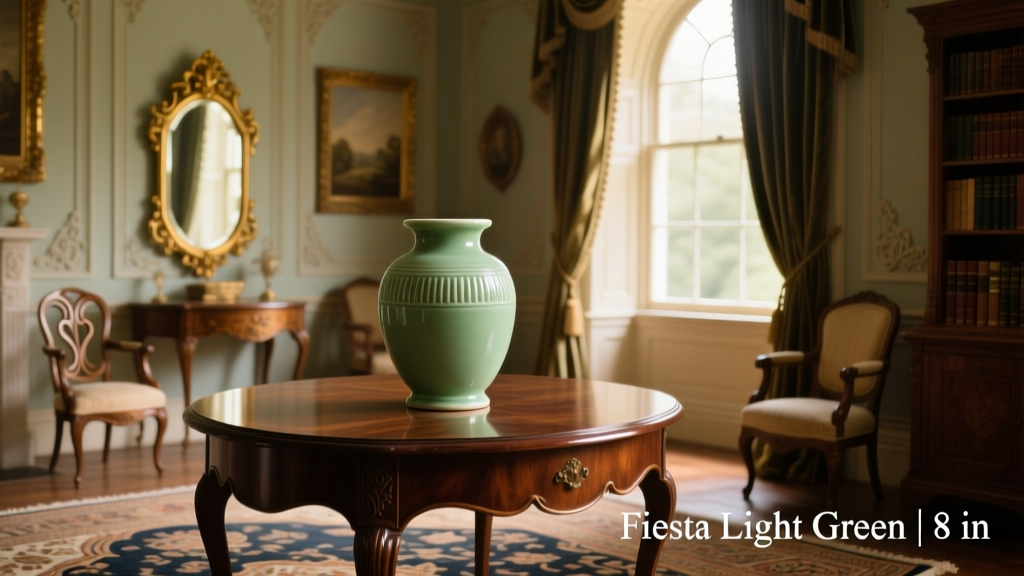
Fiesta Light Green Vase, 8 Inches: History, Identification, and Restoration Guidance for Collectors

Window Leaded Framed Stylized Sunrise Over Green Landscape: A 34 × 12-Inch Art Glass Masterpiece in Historical Context
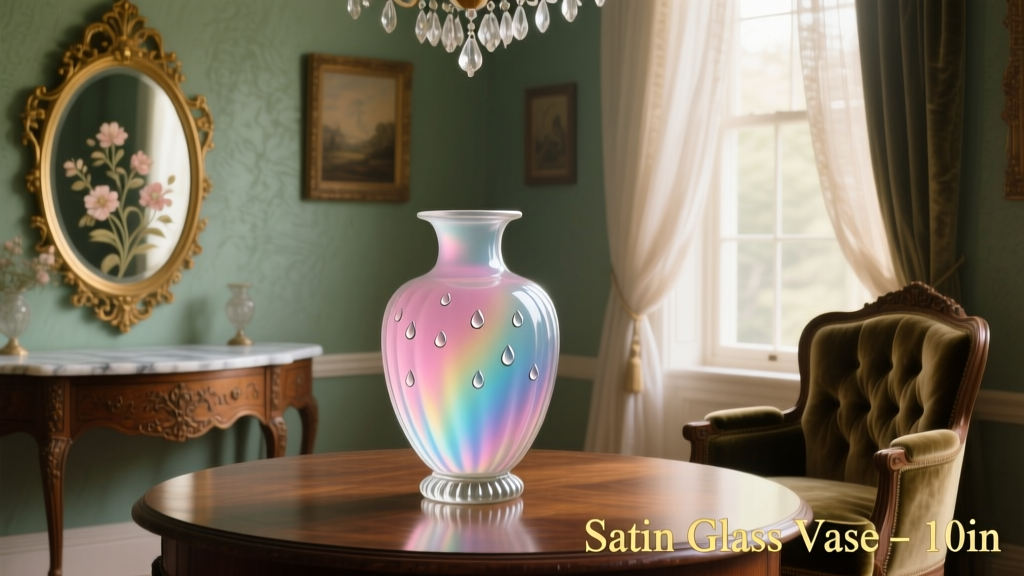
Satin Glass Vase: Rainbow Raindrops in Pink and Blue — A 10-Inch Mid-Century American Masterpiece with Squared Dimpled Base
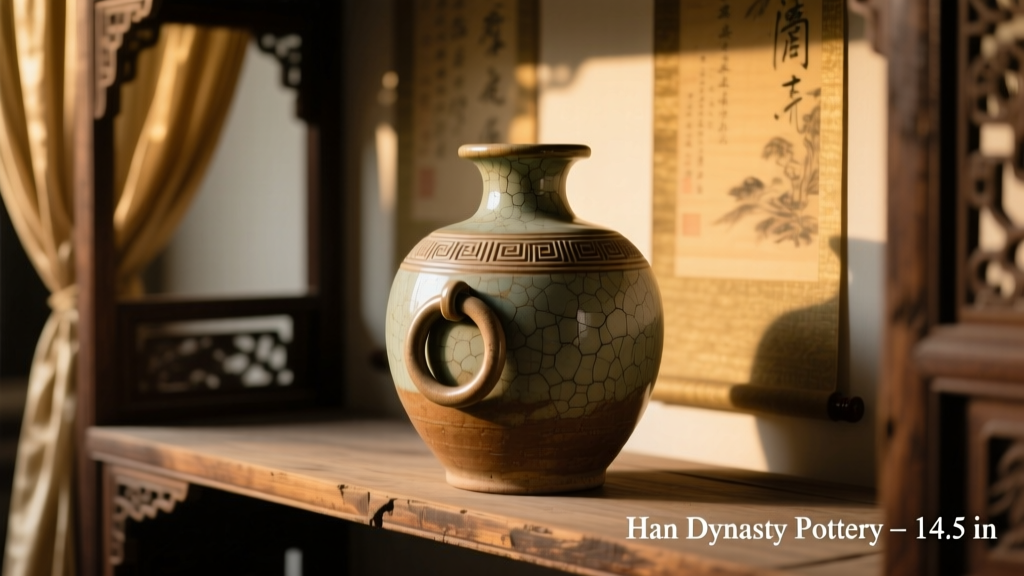
Han Dynasty Pottery Jar with Horizontal Ring Design: A 14½-Inch Storage Vessel from the Western Han Period

The Fostoria Buttercup Creamer: A Mid-Century American Glassware Icon
Decoding the 1139394: A Technical and Historical Analysis of the 1957 Herman Miller Eames Lounge Chair & Ottoman Serial Number

Texaco Sky Chief Petrox Super Charge Auto Pump Sign: History, Design, and Restoration Insights

Candy Containers Featuring Balancing Acrobats Bisque Dolls on Chair: A Rare French Late-Victorian Confectionery Centerpiece, c. 1890 (24 Inches)

Advertising Tin: Brighton Blend Coffee 'Girl Drinking Coffee' — A 1930s British Tin Collectible & Restoration Guide