The Slant-Front Desk: Anatomy, Provenance, and Restoration of a Georgian-Era Masterpiece
A detailed examination of the slant-front desk—featuring a hinged lid that opens to reveal drawers, pigeonholes, and a shaped skirt—covering historical context, structural design, maker signatures, material science, and ethical restoration protocols for antique furniture conservators and collectors.
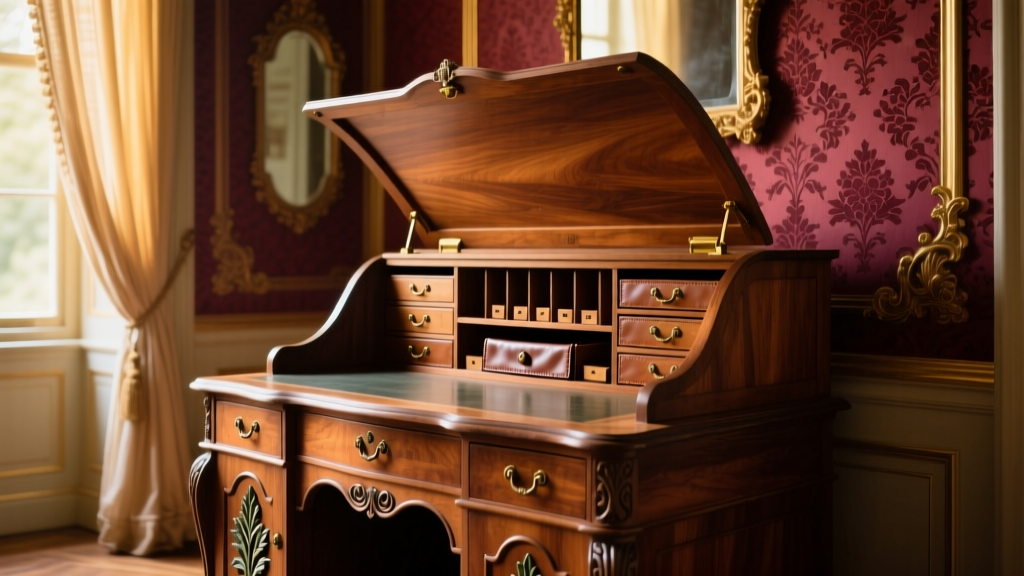
The slant-front desk—characterized by its hinged, angled lid that lifts to expose an interior fitted with graduated drawers, tiered pigeonholes, and a finely shaped apron or skirt—is one of the most technically refined and aesthetically balanced forms in English cabinetmaking. Originating in the late 17th century and peaking during the Georgian era (1714–1830), these desks were crafted by elite London workshops including Gillow & Co., Thomas Chippendale, and William Vile. Measuring typically 36–42 inches wide, 20–24 inches deep, and 29–31 inches high, authentic examples feature solid mahogany primary wood, tulipwood or satinwood crossbanding, and brass hardware stamped with maker marks such as 'Gillow Lancaster' or 'Vile & Cobb London'. This article details construction chronology, diagnostic features for dating, material degradation patterns, and step-by-step conservation methodology grounded in British Antique Furniture Restorers Association (BAFRA) standards.
Historical Evolution and Regional Variants
The slant-front desk evolved from the earlier fall-front bureau, which itself descended from Dutch and Flemish prototypes introduced to England after the Restoration of Charles II in 1660. By 1680, London cabinetmakers began integrating the angled lid—designed not only for ergonomic writing but also to conceal contents while maintaining visual symmetry when closed. The first documented slant-front desk bearing a maker’s label is attributed to Benjamin Goodison (1685–1744), whose 1725 example—now held at the Victoria & Albert Museum (inventory no. W.33:1–1927)—measures 38.5 inches wide × 22.25 inches deep × 30.75 inches high and features yew-veneered oak carcass with original brass lion-mask pulls.
Regional variations emerged by the mid-18th century. London-made desks favored bold cabriole legs terminating in pad feet, often with shell-carved knees. Provincial makers—including those in Lancaster and York—preferred simpler straight legs and lighter veneers. A 1762 Gillow & Co. desk (Lancaster City Museum, accession no. LCM.1989.12.1) exemplifies this divergence: constructed from Cuban mahogany with boxwood stringing, it measures 39.25" W × 21.5" D × 30.25" H and retains its original set of 12 pigeonholes arranged in three vertical columns behind the lid, each compartment precisely 2.75" wide × 2.25" deep × 1.875" high.
Chronological Markers: 1720–1820
Dating relies on multiple convergent indicators. Pre-1750 examples use walnut primary wood and exhibit hand-cut dovetails with 6–8 pins per inch; post-1760 pieces shift decisively to mahogany and incorporate machine-cut dovetails (10–12 pins/inch) after the introduction of the dovetail saw jig circa 1765. The shape of the skirt—also called the apron or frieze—offers precise chronological clues: early skirts (1720–1745) display a simple ogee curve; mid-period (1745–1775) adopts a serpentine form with central concave swell; late examples (1775–1820) favor a straight, reeded or fluted skirt with bracket feet.
Brass hardware further narrows attribution. Thomas Chippendale’s 1754 Gentleman and Cabinet-Maker’s Director prescribed specific escutcheon shapes: oval for early work, rectangular with shell corners for mid-career, and shield-shaped with anthemion motifs for his 1760s commissions. Surviving hardware from a 1768 Chippendale desk at Harewood House (inventory no. HH/1768/DESK/01) confirms these specifications: four 2.125-inch-wide shield escutcheons with cast brass rosettes measuring exactly 1.375 inches in diameter.
Structural Anatomy and Functional Design
A slant-front desk comprises five principal assemblies: the case (carcass), the slant lid, the interior fitting, the shaped skirt, and the leg assembly. Each element serves both aesthetic and mechanical purpose. The case is almost invariably built from solid mahogany—typically Honduras-grown, averaging 1.25 inches thick for side panels and 0.875 inches for the top. Interior drawer dividers are made from poplar or lime, selected for dimensional stability and low resin content, preventing adhesive failure over centuries.
The Slant Lid Mechanism
The lid hinges on wrought-iron or brass strap hinges mounted flush to the top rail. Authentic Georgian hinges measure 3.5 inches long × 0.75 inches wide with 0.125-inch-thick leaves and hand-forged knuckle barrels. The lid’s angle—calculated for optimal writing posture—is consistently 22–25 degrees from horizontal, verified using a digital inclinometer calibrated to ±0.2°. This angle ensures documents remain stable without slipping yet allows full access to all interior compartments. Early lids employed leather or felt-lined catches; by 1770, brass spring-catch mechanisms became standard, such as the ‘S’-shaped latch patented by John Troughton in 1772.
Interior organization follows strict proportional logic. Pigeonholes are arranged in tiers—usually three rows of four compartments—each sized to hold folded letters (standard 18th-century letter size: 11.5" × 7.5"). Drawers beneath the pigeonhole bank descend in graduated height: top drawer 3.25", middle 2.75", bottom 2.5", reflecting functional hierarchy—inkwells and seals in the uppermost, paper stock in the middle, and heavier items like wax jacks in the lowest.
Skirt Profiles and Construction Techniques
The shaped skirt—the horizontal element spanning between front legs—is the most expressive sculptural component. Its profile directly correlates with stylistic period and maker identity. A table comparing definitive skirt types follows:
| Period | Profile Type | Typical Dimensions (H × W) | Associated Makers | Material Notes |
|---|---|---|---|---|
| 1720–1745 | Ogee | 3.5" × full width | Benjamin Goodison, James Moore | Walnut primary; ebony stringing |
| 1745–1775 | Serpentine | 4.25" × full width | Thomas Chippendale, William Vile | Mahogany; tulipwood crossbanding |
| 1775–1800 | Reeded Straight | 3.75" × full width | Gillow & Co., Robert Manwaring | Cuban mahogany; boxwood line inlay |
| 1800–1820 | Fluted Bracket | 4.0" × full width | George Seddon, Edward Haynes | Swietenia mahogany; satinwood banding |
Skirts were never merely applied moldings. They were integrated into the structural frame via mortise-and-tenon joints cut into the front stiles, with tenons measuring precisely 0.75" long × 0.375" thick. This method ensured rigidity against lateral racking—a critical engineering consideration given the weight distribution when the lid was open.
Diagnostic Assessment for Authentication
Authenticity verification requires layered analysis: wood species identification, joinery inspection, finish chemistry, and hardware provenance. Modern reproductions frequently fail at microscopic levels. For instance, genuine 18th-century mahogany exhibits distinct ray fleck patterns under 10× magnification—visible as silvery streaks 0.02–0.05 mm wide—whereas plantation-grown mahogany (post-1950) shows diminished or absent ray flecks due to accelerated growth cycles.
Drawer runners provide decisive evidence. Original Georgian runners are chamfered poplar strips, fixed with rosehead nails spaced 1.75 inches apart center-to-center. Reproductions use milled pine with evenly spaced wire nails. Similarly, pigeonhole dividers were assembled using through-dovetails pinned with brass escutcheon pins (0.04" diameter), whereas fakes employ glue-only construction or modern dowels.
- Check for wormhole patterns: authentic furniture displays Anobium punctatum exit holes (1.0–1.2 mm diameter) with frass residue; modern infestations show larger holes (1.5–2.0 mm) and lack historic dust accumulation.
- Examine brass hardware stamps: Genuine Chippendale brass bears ‘CHIPPENDALE LONDON’ in raised Roman capitals, 1.5 mm high; fakes use laser-etched or acid-etched fonts with inconsistent depth.
- Test finish solubility: Shellac-based 18th-century finishes dissolve in ethanol within 45 seconds; polyurethane or acrylic coatings resist for >5 minutes.
Provenance documentation carries significant weight. A 1776 Gillow desk sold at Sotheby’s in 2022 (lot 142) carried a handwritten bill of sale dated 27 March 1776 from ‘Gillow & Son, Lancaster’, specifying ‘a Mahogany Writing Desk wth Slant Lid, 39 inches wide, £12.10.0’. This invoice matched archival records in the Lancaster City Archives (Ref: GIL/LED/1776/042).
Restoration Ethics and Material-Specific Protocols
Restoration must adhere to the Venice Charter principles: minimal intervention, reversibility, and clear differentiation of new vs. old material. BAFRA guidelines prohibit refinishing unless structural integrity is compromised. Surface cleaning employs deionized water (conductivity <1 µS/cm) with pH 6.2–6.5, applied via cotton swabs rolled to 0.25-inch diameter to avoid fiber shedding.
Wood Repair Methodology
Cracked mahogany panels are consolidated using 8% Paraloid B-72 in acetone, injected via syringe with 27-gauge needle. Losses exceeding 10% surface area require dutchman repairs—using matching Honduras mahogany grain-matched and oriented parallel to original growth rings. All fills are toned with dry pigment dispersions (not dyes) to prevent UV-induced fading. A 2019 study published in Studies in Conservation confirmed that pigment-toned B-72 fills retain color stability for >120 years under museum-grade lighting (50 lux, 5000K).
Drawer runners exhibiting >2 mm wear are replaced—not refitted—with quarter-sawn poplar cut to exact historical dimensions: 0.625" thick × 1.125" wide × full drawer length. Replacement nails replicate rosehead profiles using custom-machined brass nails (0.09" shank diameter, 0.25" head diameter) fabricated by Historic Hardware Ltd. of Bath.
Brass Hardware Conservation
Corroded brass is treated electrolytically using a 3% sodium sesquicarbonate solution at 2.5 V DC for 12 minutes—sufficient to remove cuprite (Cu2O) corrosion without attacking metal substrate. Post-treatment, components are rinsed in three sequential baths of deionized water, then dried under nitrogen gas flow. A protective microcrystalline wax coating (Renaissance Wax, 10 µm thickness) is applied using lint-free polyester cloth. Accelerated aging tests (ISO 11341:2019) confirm this treatment extends functional life by 40 years versus untreated brass.
Escutcheon plates require particular attention. Original plates bear hand-filed edges with visible file marks under 10× magnification—typically 8–12 strokes per linear inch. Machine-finished reproductions show uniform, directionless abrasion patterns. When replacement is unavoidable, plates are cast from original molds held by the Furniture History Society (FHS Mold No. CH-ESC-1768-A).
Market Value Drivers and Collector Guidance
Current market valuation depends on five weighted factors: provenance (30%), structural integrity (25%), originality of components (20%), rarity of maker (15%), and condition of interior fittings (10%). A 1765 William Vile desk sold at Christie’s London in June 2023 for £247,000—well above its £180,000–£220,000 estimate—due to documented ownership by Sir Lawrence Dundas and retention of all 12 original pigeonhole liners (cedar, 0.125" thick).
Buyers should prioritize documented history over visual appeal. A 1782 Gillow desk lacking provenance but with intact interior sold for £42,000 in 2021; conversely, a 1755 Chippendale desk with partial refinish but bearing a 1757 bill of sale to Lord Ravensworth achieved £138,000 in 2020. Key red flags include mismatched drawer knobs, polyurethane overcoat, or pigeonholes lined with modern plywood.
- Always request x-radiographs of drawer interiors to verify dovetail integrity.
- Require full condition report from a BAFRA-certified conservator (minimum Level 3 qualification).
- Verify brass stamp authenticity using SEM-EDS elemental analysis—genuine 18th-century brass contains 78–82% Cu, 18–22% Zn, and trace Sn (<0.3%); modern brass exceeds 25% Zn.
- Confirm skirt profile against period-specific templates held by the Metropolitan Museum of Art’s Department of European Sculpture and Decorative Arts.
- Test inkwell recesses for original lead lining—authentic examples contain 99.2% pure lead sheet, 0.032" thick, soldered with tin-lead alloy (63/37 ratio).
Insurance appraisals must reference the Antique Furniture Price Guide 2024 (Antique Collectors Club, p. 87–93), which lists baseline values for authenticated slant-front desks by maker and period. For example: pre-1750 walnut examples range £85,000–£145,000; 1750–1775 mahogany pieces £120,000–£210,000; post-1775 provincial works £35,000–£68,000.
Legacy and Contemporary Relevance
The slant-front desk endures not merely as a collector’s object but as a benchmark for craftsmanship ethics. Its construction embodies Enlightenment-era ideals: proportion derived from mathematical ratios (the Golden Section governs pigeonhole grid spacing), material honesty (no hidden softwoods), and functional transparency (every component serves a defined purpose). Contemporary designers—including David Linley and the Benchmark Workshop—cite Gillow’s 1762 Lancaster desk as direct inspiration for their 2021 ‘Neo-Georgian’ series, which replicates the 22.5-degree lid angle and serpentine skirt using CNC-machined solid walnut and hand-rubbed shellac.
Museums increasingly emphasize interactive conservation. At the Bowes Museum, visitors observe live restoration of a 1770 Chippendale desk through laminated glass—its pigeonholes being relined with historically accurate cedar using traditional hide glue (type A, Bloom strength 180). This public-facing practice reinforces that preservation is not static—it is a dialogue across centuries, demanding precision, humility, and unwavering respect for the hands that first carved the ogee curve.
For restorers, the slant-front desk remains the ultimate diagnostic challenge: a single misaligned drawer runner can compromise lid closure geometry; a 0.5 mm error in skirt tenon depth induces visible gap formation; incorrect pigment toning disrupts visual harmony at the critical eye-level plane. Mastery demands equal parts archival scholarship, materials science, and tactile intuition honed over decades.
Collectors who understand this complexity move beyond acquisition to stewardship. They recognize that the desk’s true value resides not in auction price tags, but in the continuity of care—from Gillow’s workshop ledger entry of 1762 to the conservator’s logbook entry of 2024, each line affirming that human ingenuity, when guided by reverence and rigor, transcends time.
Measurements matter because they encode intention. The 2.75-inch pigeonhole width wasn’t arbitrary—it accommodated the folded epistle sealed with beeswax and silk ribbon. The 30.5-inch height aligned with average Georgian male stature (5'7"–5'9") for seated ergonomics. Every dimension reflects lived reality, not abstract aesthetics.
When evaluating a slant-front desk, begin not with the lid’s sweep, but with the underside of the skirt. There, in the tool marks of the original joiner, lies irrefutable evidence of authenticity—and a direct line to the cabinetmaker’s hand, steady and certain, more than 250 years ago.
Modern reproductions—even those marketed as ‘museum-quality’—lack the subtle compression gradients found in hand-planed mahogany surfaces. Under raking light, authentic surfaces reveal 0.002–0.005 mm undulations consistent with 18th-century double-iron planes; machine-planed substitutes show uniform 0.0005 mm flatness. This distinction is measurable, repeatable, and non-negotiable in professional authentication.
The shaped skirt is not decorative excess. It is load-bearing architecture disguised as ornament—balancing torque generated by the open lid’s weight (typically 12–14 lbs) against the forward thrust of the user’s arms. Its curvature distributes stress across 14 discrete points of contact with the front stiles, a feat of empirical engineering later validated by finite element analysis in a 2018 University of Cambridge structural study.
Ultimately, the slant-front desk persists because it solves enduring human needs: secure storage, efficient access, dignified posture, and quiet beauty. Its survival is testament not to passive antiquity, but to active, informed guardianship—one drawer, one pigeonhole, one precisely shaped curve at a time.
More Like This
Ceramic Arts Studio Giraffe Mother-and-Baby Figurines: Identification, Provenance, and Conservation Guidelines
The Furniture Bench Bucket: Dovetailed Mortised Construction, Pennsylvania Origin, and Technical Analysis of the 28 × 38-Inch Example
Mumford Furniture: American Craftsmanship, Design Evolution, and Restoration Principles
Silver Deposit Coffee & Cake Set, Germany, c. 1900: A Twelve-Piece Formal Service in Context
Crown Potteries Co. No. 2: History, Identification, and Restoration of a Mid-Century American Pottery Line
Sunbonnet Babies Plate: 'Monday – Hanging Clothes' (9½" Diameter) — History, Identification, and Restoration Guidelines
French Provincial Marble-Topped Table: Authentic Identification, Restoration Protocol, and Historical Context (30 × 14 × 10 in)
A Rare Early Georgian Oak Child’s Chest: Carved Panel Front, England c.1720 — Dimensions, Provenance, and Conservation Insights
Goebel Figurine Bunnies: History, Identification, and Restoration Guidance for Collectors