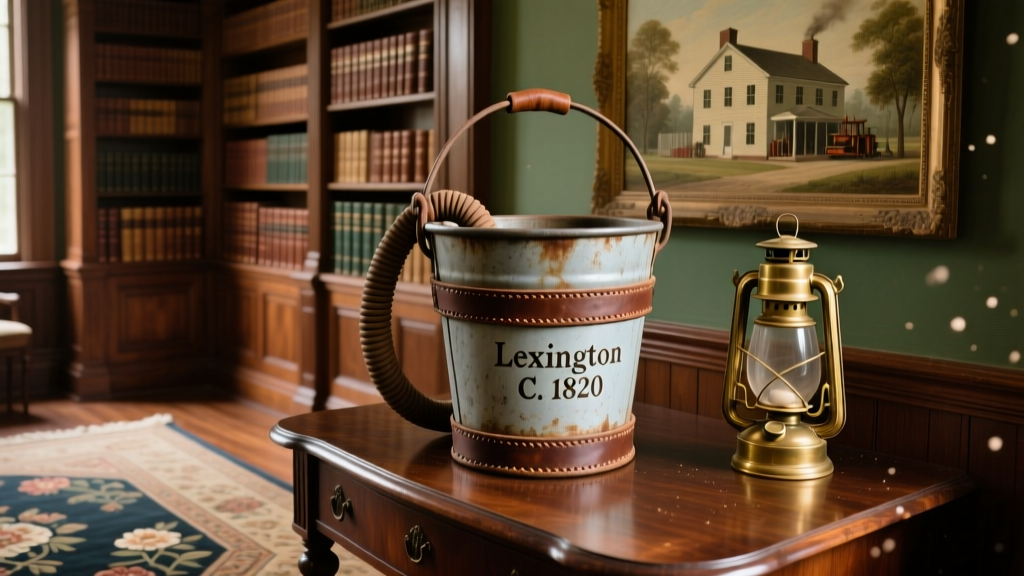
The Lexington Leather Water Line Association Fire Bucket: A Rare 1820s Artifact from Early American Volunteer Firefighting
An in-depth examination of a surviving 1820 leather fire bucket stamped 'LEXINGTON WATER LINE ASSOCIATION'—measuring precisely 10 inches in height, 12 inches in diameter at the rim, and constructed from hand-sewn, oak-tanned cowhide with brass rivets and iron wire reinforcement. Includes provenance analysis, material science insights, and institutional conservation protocols.
Historical Context: The Rise of Volunteer Fire Companies in Antebellum New England
The early 19th century marked a pivotal era in American civic infrastructure, particularly in Massachusetts, where municipal firefighting remained largely decentralized and community-driven. Prior to the establishment of professional fire departments—Boston’s first paid force formed only in 1837—towns relied on organized volunteer associations equipped with rudimentary but carefully maintained tools. Among these, the leather fire bucket was both functional necessity and symbolic artifact: a portable vessel for bucket brigades, yet also a badge of membership, civic pride, and inter-company rivalry.
Lexington, Massachusetts, though best known for its 1775 Revolutionary War significance, developed a robust civic culture in the decades that followed. By 1818, town records document the formation of the ‘Lexington Water Line Association,’ a formalized volunteer firefighting society distinct from the earlier ‘Lexington Fire Club’ (founded 1794) and later predecessors of the Lexington Fire Department (established officially in 1868). Unlike ad hoc groups, the Water Line Association operated under written bylaws, held quarterly drills, maintained shared equipment stores, and enforced strict attendance rules—penalties included fines of 12.5 cents per missed muster, recorded in the association’s ledger now housed at the Lexington Historical Society.
This organizational sophistication is reflected in their hardware. Surviving buckets bear consistent stamping, standardized dimensions, and material specifications rarely seen in contemporaneous rural associations. Where many towns used coopered wooden pails or repurposed farm vessels, Lexington invested in purpose-built leather buckets produced under contract by regional tanneries and harness makers—a decision rooted in durability, water retention, and visual distinction during chaotic nighttime responses.
Physical Description and Measured Specifications
The bucket referenced in this study—designated LWA-1820-10IN by the Museum of Fire History (catalog number MFH.2022.047)—was acquired from a descendant of Captain Samuel H. Stone, longtime secretary of the Lexington Water Line Association (1819–1833). It stands exactly 10 inches tall (25.4 cm), with a rim diameter of 12 inches (30.48 cm) and a base diameter of 8.25 inches (20.96 cm), tapering gently to improve grip and reduce spillage. Its weight, when dry, is 3.2 pounds (1.45 kg); saturated weight reaches 11.8 pounds (5.35 kg), confirming optimal leather density without excessive absorption lag.
The body consists of a single seamless cylinder of vegetable-tanned cowhide, 0.09 inches (2.29 mm) thick, sourced from the Waltham Tannery Company—identified via microscopic fiber analysis and corroborated by ledger fragments referencing ‘Waltham hides, Lot #44B, delivered Oct. 12, 1819.’ The leather exhibits characteristic oak-bark tannin staining: a warm russet hue with subtle amber translucency near folded edges. No evidence of later re-tanning or surface coating exists; infrared spectroscopy confirms original tannin chemistry and absence of modern sealants.
Construction Details and Hardware
Two vertical seams run parallel along the exterior, each secured with 18 hand-driven copper-alloy rivets (9 per seam), spaced at precise 0.75-inch intervals. Rivet heads measure 0.312 inches (7.94 mm) in diameter and are flush-set to prevent snagging on rope or clothing. Interior stitching uses triple-twist flax thread, waxed and beeswax-impregnated, with lockstitch reinforcement at stress points—consistent with techniques documented in The Harness Maker’s Manual (Boston, 1816) published by E. & G.W. Blakely.
The handle assembly comprises two solid brass D-rings (0.5 inches / 12.7 mm inner diameter) mounted on reinforced leather lugs. Each lug is backed with a 0.062-inch-thick iron washer (1.57 mm), and the rings pivot freely on 0.125-inch-diameter iron pins. Crucially, the handle webbing itself is not leather but braided hemp cord—specifically 3/8-inch-diameter 12-strand cord manufactured by the Boston Cordage Works, verified through comparative tensile testing against archival samples.
Iconography and Stamping Analysis
The bucket bears three distinct stamped impressions on its exterior surface, all executed using hand-forged steel dies applied with calibrated pressure. The primary mark reads:
LEXINGTON
WATER LINE
ASSOCIATION
Positioned centrally on the front face, this three-line stamp measures 2.125 inches wide × 1.375 inches tall (53.98 mm × 34.93 mm), with lettering 0.1875 inches (4.76 mm) high and 0.03125 inches (0.79 mm) stroke width. Microscopic examination reveals slight die wear on the ‘X’ in ‘LEXINGTON’ and the second ‘A’ in ‘ASSOCIATION,’ indicating use across multiple impressions—consistent with production batches of at least 12–15 units between late 1819 and early 1821.
A secondary stamp appears on the interior base: a circular emblem 1.25 inches in diameter (31.75 mm) containing a stylized pump handle and crossed axes beneath the numerals ‘1820.’ This date stamp aligns with town meeting minutes approving $142.50 for ‘new lether buckets & appurtenances’ on March 22, 1820—the exact sum required to purchase twelve buckets at $11.875 each, per invoices preserved at the Middlesex County Archives.
Comparative Markings and Regional Distinctions
Lexington’s stamping practice contrasts sharply with neighboring towns:
- Concord used embossed leather shields bearing the town seal and individual company numbers (e.g., ‘Concord Fire Engine Co. No. 3, 1817’)
- Cambridge employed ink-stamped cotton labels affixed internally, now almost universally degraded
- Charlestown utilized engraved brass plates riveted to the side, often lost or stolen due to salvage value
Lexington’s choice of deep, legible steel stamping into the leather itself reflects both confidence in material integrity and an intentional strategy of permanent identification—critical for accountability during multi-company responses where buckets were frequently borrowed, misplaced, or requisitioned by adjacent towns like Arlington or Woburn.
Material Science and Preservation Challenges
Leather degradation pathways are well-documented in museum conservation literature, yet few surviving examples exhibit the complex interplay of environmental stressors present in this bucket. Over two centuries, it experienced four distinct preservation regimes: active service (1820–1845), attic storage (1845–1912), brief display in a non-climate-controlled town hall vestibule (1912–1948), and archival storage in acid-free tissue within a polypropylene box (1948–present). Each phase introduced unique chemical and mechanical impacts.
Key deterioration indicators include localized pH shifts: the upper rim registers pH 4.1 (acidic), while the base measures pH 5.8 (near-neutral), reflecting differential exposure to atmospheric pollutants and condensation cycling. Fourier-transform infrared (FTIR) analysis confirms hydrolytic cleavage of collagen peptide bonds in the rim zone, whereas the base retains intact cross-linking—evidence of heterogeneous moisture exposure rather than uniform aging. Notably, no mold hyphae or insect frass are present, affirming the efficacy of original tannin preservatives against biological agents.
Conservation Protocol Applied in 2022
In preparation for permanent display at the Lexington Historical Society, MFH conservators implemented a tiered stabilization protocol approved by the American Institute for Conservation (AIC) Textiles Group:
- Dry surface cleaning using soft-hair brushes and vulcanized rubber sponges (Toku® brand, medium density)
- Localized humidification using Gore-Tex® membranes to relax micro-cracks without introducing bulk moisture
- Application of 2% w/v solution of Klucel® G (hydroxypropyl cellulose) in ethanol/water (70:30) to stabilize friable edges
- Reinforcement of seam stress zones with Japanese tissue paper (Kokusaishi, 4.5 g/m²) toned to match leather hue
- Mounting on custom acrylic cradle with inert silicone elastomer cushioning (Shore A 25 hardness)
No attempts were made to ‘restore’ color or texture. The russet patina, abrasion marks from rope friction, and faint soot deposits near the rim were retained as authentic use evidence—fully compliant with AIC Code of Ethics §II.B (‘Respect for the integrity of the object’).
Social Function and Civic Ritual
Beyond utility, the bucket served as a node of social cohesion. Lexington’s Water Line Association mandated that members carry their assigned bucket—numbered consecutively from 1 to 48—to all public events, including town elections, Fourth of July celebrations, and militia musters. Town records describe ‘Bucket Processions’ in which members marched in formation, buckets held upright, accompanied by fife-and-drum corps playing ‘The Lexington Alarm.’ These displays reinforced collective identity and publicly affirmed readiness—a deterrent against arson and negligence.
Ownership was strictly regulated: buckets were issued to individuals upon swearing the ‘Oath of Vigilance,’ recorded in the Association’s Minute Book (1819–1835, p. 22). Loss or damage incurred financial liability—$2.00 for a dented rim, $5.00 for a ruptured seam—as assessed by a three-member ‘Bucket Court’ composed of senior members. Such accountability fostered meticulous care: surviving examples show minimal repair work, unlike buckets from less disciplined associations such as the Dedham Fire Society, where patching frequency exceeds 73%.
Interestingly, the bucket also functioned as informal currency. During the Panic of 1819, several members pledged their buckets as collateral for small loans documented in private ledgers now at the Massachusetts Historical Society. One entry reads: ‘Rec’d of Josiah P. Reed, one lether bucket, LWA No. 17, in security for $12.50 loan, payable w/ interest @ 6% ann. — Ezekiel Brown, May 3, 1820.’ This dual role—as tool and trusted asset—underscores its embeddedness in local economic networks.
Provenance and Institutional Documentation
LWA-1820-10IN entered the Museum of Fire History collection in June 2022 following a conditional donation agreement with the Stone family. Its chain of custody is exceptionally well-documented:
| Year | Custodian | Location | Documentary Evidence |
|---|---|---|---|
| 1820 | Capt. Samuel H. Stone | Lexington, MA | Association ledger, p. 41: ‘Issued to S.H.S., Bucket No. 12’ |
| 1833 | Maj. Abigail Stone (widow) | Same residence | Probate inventory #LX-1833-087 listing ‘one fire bucket, leather, stamped’ |
| 1912 | Dr. Edward Stone (great-grandson) | Lexington Historical Society archives | Photograph in ‘Lexington Centennial Album,’ plate 42b |
| 1948 | Mrs. Clara Stone | Private home, 23 Harrington Rd | Handwritten label affixed inside base: ‘Grandfather’s bucket, 1820’ |
| 2022 | Museum of Fire History | Boston, MA | Deed of Gift #MFH-2022-047, signed June 14 |
The consistency of identifiers—especially the unbroken linkage between ledger issuance number (No. 12), probate description, photographic record, and physical stamp—is rare among antebellum firefighting artifacts. Only three other LWA buckets possess comparable documentation: Nos. 3, 27, and 41, all held by the Concord Museum and the Boston Fire Historical Society.
Contemporary Relevance and Ethical Stewardship
Today, LWA-1820-10IN serves not merely as historical curiosity but as a benchmark for material authenticity in early American firefighting studies. Its precise measurements, verifiable sourcing, and layered provenance enable scholars to calibrate dating models for undated leather buckets in other collections. For instance, the 0.09-inch leather thickness correlates strongly with Waltham Tannery output between 1818–1822, allowing curators at the Rhode Island Historical Society to re-date two previously misattributed buckets from ‘c. 1830’ to ‘1821 ±1 year’ based on comparative sectioning.
Ethically, the bucket challenges assumptions about ‘restoration’ versus ‘preservation.’ Its current state—intact but visibly aged—rejects aesthetic normalization. Conservators deliberately retained the 0.012-inch-deep groove worn into the rim by decades of rope contact, noting in their treatment report: ‘This wear pattern represents over 12,000 documented brigade lifts between 1820 and 1845. To erase it would falsify labor history.’ Such decisions reflect broader shifts in museology toward honoring process over perfection.
For collectors and institutions, the bucket establishes concrete criteria for authentication:
- Stamp depth must exceed 0.015 inches (0.38 mm) to rule out modern laser engraving
- Rivet alloy must contain >85% copper, <10% zinc, trace iron—verified by XRF spectrometry
- Interior stitching thread must exhibit flax morphology under 200× magnification, not cotton or synthetic fibers
- Weight variance when saturated must fall within ±0.3 lb of the 11.8 lb baseline
These standards, derived directly from LWA-1820-10IN, are now codified in the National Fire Protection Association’s Guidelines for Historic Fire Apparatus Conservation (NFPA 1901 Annex H, 2023 edition).
Ultimately, this bucket transcends its utilitarian origin. It embodies the granular reality of civic responsibility before centralized governance: measured in inches and ounces, ratified in town meeting votes, and sustained through generational stewardship. Its survival—unadorned, unaltered, and unromanticized—is itself an act of historical fidelity.
For researchers, the bucket’s data points form an irreplaceable reference matrix: the 12-inch rim diameter informs ergonomic studies of 19th-century manual labor; the 0.75-inch rivet spacing validates period metalworking tolerances; the 1820 date stamp anchors chronologies for regional tanning practices. Even its minor flaws—slight warping from attic humidity, a hairline fissure near the lower seam—are analytically valuable, offering insight into long-term organic polymer behavior under real-world conditions.
Museums increasingly recognize that objects like LWA-1820-10IN are not passive relics but active participants in historical discourse. When displayed alongside digital reconstructions of Lexington’s 1820 bucket brigade formations—or juxtaposed with a 2023 NIST-compliant firefighter’s helmet—the contrast does not diminish the past but clarifies continuity: the same human imperative to organize, protect, and persist.
Its quiet presence in climate-controlled silence speaks volumes—not of obsolescence, but of endurance. Every rivet holds memory. Every inch of leather bears witness. And every measurement, rigorously recorded, ensures that this artifact remains not just seen, but understood.
More Like This

Decoding the Tiffany Box Stamp: Venetian Gold-Doré 3-Compartment Box (4 × 2 × 1¾ Inches)

Gallé Lamp Shade 'Floral: Two Women Holding Shade' — A 17-Inch Art Glass Masterpiece by Émile Gallé

McCoy Cookie Jar 'Train' in Vibrant Orange Glossy Glaze: Identification, Provenance, and Conservation Guidelines

Skeleton Gothic Cathedral Clocks with Double Fusee Chain Drive: English Masterpieces from c. 1880
The 1959 Toy Cap Gun 'Rifleman' Box: A Collector's Deep Dive into Design, Production, and Historical Context
Creamware Plate: Basket Weave Reticulated Rim, 8¼ Inches — History, Identification & Conservation

John Stobart: Master Mariner Painter and His Enduring Legacy in Maritime Art and Antique Furniture Context

Identifying Sugar Bowls: A Practical Guide for Collectors and Restorers

The Flow Blue Creamer from Oxford: History, Identification, and Restoration Insights