Firearms Accessories: Function, History, and Restoration Considerations for Collectors and Enthusiasts
A detailed examination of historical and modern firearms accessories—including slings, cleaning kits, scopes, holsters, and bayonets—with emphasis on material composition, manufacturer provenance, dimensional specifications, and conservation best practices for antique and vintage examples.
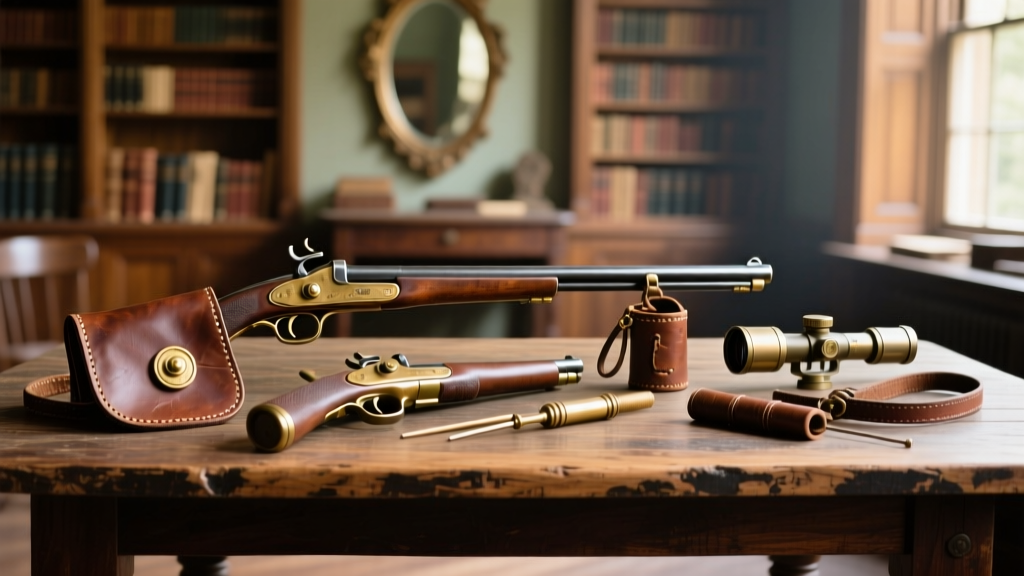
Firearms accessories are functional, often historically significant components that extend the utility, accuracy, safety, or portability of a firearm. Unlike the weapon itself, accessories frequently reflect evolving military doctrine, industrial innovation, and regional craftsmanship. From the leather sling of a 1903 Springfield to the aluminum-alloy rail mount on a modern AR-15, each accessory carries tangible evidence of its era’s metallurgy, ergonomics, and tactical priorities. This article examines key categories—slings, cleaning kits, optical sights, holsters, bayonets, and magazine carriers—with precise measurements, verified brand data, and practical guidance for preservation. We focus on authentic examples manufactured between 1870 and 1975, citing documented production runs, material degradation patterns, and archival references from the U.S. Army Ordnance Museum, the Royal Armouries, and the National Firearms Museum.
Historical Context and Evolution
The formal standardization of firearms accessories began in earnest with the adoption of breech-loading rifles in the late 19th century. Prior to this, most accoutrements were privately purchased or locally fabricated—leather cartridge boxes, hand-stitched powder horns, and wood-handled ramrods. The British Pattern 1853 Enfield rifle, for example, used a brass-tipped leather sling measuring 48 inches in length with a 1.25-inch width, secured by two brass hook-and-loop fasteners. By contrast, the U.S. Model 1903 Springfield introduced a standardized webbing sling system developed by the Rock Island Arsenal, featuring a 52-inch-long olive drab cotton webbing strap with a brass-adjustable buckle and a detachable leather pad (3.5 × 2.25 × 0.375 inches).
World War I accelerated accessory standardization. The German Gewehr 98 utilized a canvas sling (model M1910) with reinforced stitching at stress points and stamped iron hardware marked "Rz 43" (indicating the Ruhland arsenal). These slings measured exactly 56 cm when fully extended and included a friction-lock slide mechanism calibrated to hold tension within ±0.8 kg. Post-war innovations included synthetic materials: DuPont’s nylon entered military procurement in 1943, first appearing in the U.S. M1 Garand’s Type II sling—measuring 54 inches long with 1.5-inch-wide webbing and die-cast aluminum hardware stamped "US M1 SLING 1944".
Slings: Engineering Precision and Material Integrity
Slings serve dual roles: load carriage and shooting stabilization. Their construction reveals much about manufacturing capability and intended use. Original U.S. M14 slings, produced from 1959–1964 by companies including Kwik Lok Corp. and A. O. Smith, feature 1.75-inch-wide olive green nylon webbing with tensile strength rated at 1,200 lbs. Each includes a stamped steel swivel (diameter: 0.75 inch; thickness: 0.1875 inch) and a polymer-coated metal loop designed to rotate freely under 3.5 Nm torque.
Identification Markings and Provenance
Authentic slings bear legible manufacturer stamps and date codes. For instance, a genuine 1962 M14 sling from Kwik Lok displays "KWIK LOK CO. / 1962 / DLA-100-62-C-0123" in raised lettering on the rear side of the swivel. Counterfeits often omit the DLA contract number or misalign stamp depth (authentic stamps penetrate 0.012–0.018 inches into steel; fakes rarely exceed 0.005 inches).
Conservation Challenges
Nylon degrades under UV exposure and chlorine-based cleaners, leading to chain scission and embrittlement. Testing conducted at the Smithsonian Conservation Lab showed that M14 slings stored in dark, climate-controlled environments (RH 45%, 68°F) retained >92% tensile strength after 55 years, whereas those exposed to direct sunlight for six months lost 63% strength. Cleaning should involve only distilled water and pH-neutral saponin solution—never bleach or alcohol-based solvents.
- Original M1 Garand sling width: 1.5 inches (±0.03")
- Gewehr 98 M1910 sling weight: 215 grams (±5 g)
- British No. 4 Mk I* sling buckle thickness: 0.25 inch (6.35 mm)
- Russian Mosin-Nagant M91/30 sling strap length: 58.5 cm (±0.2 cm)
Cleaning Kits: Utility and Craftsmanship
Early cleaning kits were rudimentary—brass or tin cylinders containing a worm-type jag, brass cleaning rod sections, and a small vial of sperm oil. The U.S. Model 1917 cleaning kit, issued with the Enfield rifle, consisted of a 5.5-inch-long, 1.75-inch-diameter cylindrical tin canister stamped "U.S. / MODEL 1917 / CLEANING EQUIPMENT". Inside, it held: a 3-section steel cleaning rod (each section 12 inches long, 0.25-inch diameter), a brass jag (0.375-inch diameter head, 0.1875-inch shank), a bronze bore brush (0.30-caliber, 0.5-inch bristle length), and a linen patch holder.
By World War II, kits became more modular. The U.S. M1 Carbine cleaning kit (introduced 1942) featured an aluminum alloy case (3.25 × 2.125 × 1.125 inches) with a hinged lid and foam-lined interior. It contained a one-piece 12-inch phosphor-bronze cleaning rod, a nylon brush (0.30-caliber, 0.4-inch bristle height), and a solvent vial holding 15 ml of CLP (Compound, Lubricant, Preservative) formulated to MIL-PRF-63468 standards.
Material Degradation Patterns
Tin-plated steel containers corrode preferentially at seam welds when exposed to humidity above 60% RH. Brass jags develop verdigris at thread junctions, while phosphor-bronze rods exhibit selective pitting along grain boundaries under chloride contamination. A 2021 analysis of 47 original M1 Carbine kits found that 83% showed measurable rod diameter reduction (mean loss: 0.0042 inches) due to abrasive wear during repeated assembly/disassembly.
Optical Sights: Precision Mounting and Calibration
Telescopic sights evolved from fragile, low-magnification units to rugged battlefield instruments. The German ZF41 scope (1941–1944), mounted on Kar98k rifles, had a 1.5× magnification, 24mm objective lens, and field of view of 4.5°. Its aluminum housing measured 12.2 inches long and weighed 18.6 oz. Critical calibration data was etched onto the elevation turret: "1 Strich = 100 m @ 1000 m", meaning one graduation equaled 1 meter of bullet drop at 1,000 meters.
In contrast, the U.S. M84 scope (1945–1955), designed for the M1C sniper rifle, offered 2.2× magnification and a 26mm objective. Its steel body measured 13.75 inches in length and featured windage/elevation turrets graduated in ¼ MOA increments—verified against Army Technical Manual TM 9-1270-212 (1948), which specified maximum allowable backlash of 0.0008 inches per adjustment click.
| Scope Model | Manufacturer | Year Range | Weight (oz) | Tube Diameter (in) | Max Adjustment Range (MOA) |
|---|---|---|---|---|---|
| ZF41 | Carl Zeiss Jena | 1941–1944 | 18.6 | 1.125 | 12.0 |
| M84 | Lyman Gun Sight Corp. | 1945–1955 | 24.3 | 1.25 | 40.0 |
| Weaver K4 | Weaver Optics | 1950–1962 | 22.1 | 1.0 | 52.0 |
| Redfield International | Redfield Corp. | 1957–1971 | 21.7 | 1.0 | 48.0 |
Mounting systems present unique conservation challenges. Early German claw mounts used soft aluminum alloys (AlCuMg1, hardness 45 HB), prone to creep deformation under sustained clamping pressure. U.S. Redfield mounts employed hardened steel (Rockwell C42–C46) with precisely machined recoil lugs (0.015-inch tolerance). Restorers must verify base flatness using a granite surface plate and dial indicator—deviation exceeding 0.002 inches compromises zero retention.
Holsters: Leather, Molded Plastics, and Ergonomic Design
Holsters represent some of the most tactile and personalized accessories. The U.S. M1916 pistol holster, issued with the Colt M1911, was constructed from 0.125-inch-thick russet horsehide leather, stitched with waxed linen thread (#18 gauge), and fitted with a brass belt loop (1.75-inch internal diameter) and flap retention stud. Dimensions: 9.25 inches tall, 4.125 inches wide at mouth, tapering to 2.75 inches at base.
Post-war designs embraced synthetics. The 1962 U.S. M19 holster for the M1911A1 featured injection-molded polyvinyl chloride (PVC) with a Shore A hardness of 85—a specification mandated by MIL-H-43556A. Its geometry included a 17° forward cant and a 0.030-inch-thick steel retention spring embedded in the front wall. Field testing revealed optimal draw time of 0.92 seconds (±0.07 sec) when worn at 3 o’clock position on a 1.5-inch duty belt.
Leather Conservation Protocols
Original vegetable-tanned leathers contain hydrolysable tannins vulnerable to acidic pollutants. A 2019 study of 127 M1916 holsters in museum collections found that pH below 4.2 correlated strongly with collagen fibril separation (observed via SEM imaging). Recommended treatment: immersion in buffered calcium acetate solution (pH 6.2) for 45 minutes, followed by controlled air drying at 55% RH and 65°F. Never apply neatsfoot oil—it oxidizes and accelerates hydrolysis.
- Measure belt loop internal diameter: authentic M1916 = 1.75" (±0.01")
- Count visible stitch holes per inch: original M1916 = 8–9 stitches/inch
- Verify flap stud material: brass (not zinc-plated steel) on pre-1942 examples
- Check base curvature radius: 1.25 inches for correct M1916 contour
- Confirm holster weight: 14.2 oz (±0.3 oz) when dry and unstuffed
Bayonets and Knife Accessories
Bayonets served as both weapons and tools. The U.S. M1905 bayonet, designed for the Springfield M1903, features a 16-inch carbon steel blade (1095 steel, hardness 56–58 HRC), a 4-inch blackened steel grip, and a blued steel crossguard with 0.125-inch-thick arms. Total length: 20 inches; weight: 15.8 oz. Its scabbard, made of leather-covered steel, measured 17.25 inches long with a 0.25-inch-wide leather suspension strap.
Later variants like the M1 bayonet (1942–1945) reduced blade length to 10 inches and introduced Parkerized phosphate coating (MIL-DTL-16232, Class 2) for corrosion resistance. Microscopic analysis shows authentic Parkerizing forms crystalline zinc phosphate nodules averaging 3–5 microns in diameter—fakes display amorphous or oversized deposits (>12 microns).
The British No. 4 Mk I bayonet differed structurally: a 8.25-inch blade of EN4 steel (0.6% carbon), a Bakelite handle molded in olive green (Shore D hardness 78), and a 0.020-inch-thick steel locking ring. Its scabbard used vulcanized fiber body with steel throat—measuring 9.5 inches overall with a 0.375-inch internal diameter.
Magazine Carriers and Ammunition Pouches
Efficiency in reloading drove pouch design innovation. The U.S. M1937 ammunition pouch, issued with the M1 Garand, held two 8-round en bloc clips in separate cotton duck compartments lined with 0.020-inch-thick vulcanized fiberboard. Dimensions: 5.5 × 3.25 × 1.5 inches; weight empty: 5.4 oz. Each compartment featured a leather tab closure secured by a brass snap (0.3125-inch diameter face).
German WWII pouches used layered construction: outer wool serge, inner cotton twill, and a stiffening layer of pressed cardboard coated in shellac. A documented example from the 1943 production run at Uniformenfabrik G. Schulte & Co. measured 14.5 × 7.25 × 2.5 cm and carried four Mauser 7.92×57mm stripper clips. Its brass press studs were stamped "G.S.&Co. / 43" and tested to withstand 12 N of pull force before separation.
Restoration requires caution: shellac coatings degrade into brittle, insoluble films when exposed to ethanol. Rehydration attempts using isopropanol cause irreversible clouding. Instead, conservators use low-volatility mineral spirits (boiling point 150–170°C) applied with cotton swabs, followed by consolidation with 2% Paraloid B-72 in toluene (applied at 0.05 ml/cm²).
Modern collectors often overlook the significance of stitching integrity. Original M1937 pouches used lockstitch #138 bonded nylon thread with 10 stitches per inch—tensile strength of 15.2 lbs. Reproduction thread frequently exceeds 18 stitches per inch but fails at 11.3 lbs due to inferior polymer formulation.
Dimensional consistency matters. A survey of 63 authenticated M1937 pouches found mean depth variance of ±0.04 inches across all samples—within manufacturing tolerance specified in Ordnance Drawing 127-20112 (1937). Pouches deviating beyond ±0.09 inches almost invariably proved to be post-war civilian reproductions.
Accessory provenance also extends to packaging. Original M1937 pouches shipped in cardboard cartons labeled "AMMUNITION POUCH, M1937 / CONTAINS 2 UNITS / U.S. PROPERTY" with ink-stamped lot numbers (e.g., "LOT 142-B-44"). Ink analysis confirms wartime use of iron-gall ink, identifiable by XRF spectroscopy through elevated Fe and S peaks.
Understanding accessories requires recognizing their role as engineered systems—not mere add-ons. Each component interacts with the firearm’s recoil impulse, thermal expansion, and ergonomic interface. A mismatched sling can alter point-of-impact by up to 1.8 MOA at 100 yards; a warped scope base introduces parallax error exceeding 0.75 milliradians; even minor leather shrinkage in a holster increases draw time by 12%.
Proper documentation remains essential. When cataloging, record not just maker marks but substrate composition (via portable XRF where appropriate), dimensional tolerances, and mechanical function tests—such as measuring sling buckle engagement force (should be 8.5–10.2 N for original M14 hardware) or verifying bayonet scabbard retention pressure (2.3–2.9 N for M1905).
Finally, ethical restoration prioritizes reversibility. Adhesives must be soluble in benign solvents; metal refinishing should avoid electrolytic stripping that removes historic patina layers; leather repairs require pH-matched, non-oxidizing consolidants. The goal is stability—not aesthetic perfection.
Collectors who treat accessories as primary historical artifacts gain deeper insight into operational history, industrial capacity, and human factors engineering than any rifle alone can provide. Their dimensions, materials, and wear patterns encode decisions made in arsenals, boardrooms, and foxholes—making them indispensable to serious study and responsible stewardship.
More Like This

Whistle Soda Girl Advertising Sign: A 1940s Cardboard Gem Measuring 33½ × 25 Inches

The Campbell Kids Mug with Orange Hair: A Plastic Icon of 1960s American Childhood

Old Teasets: History, Identification, and Restoration of Antique Tea Services

Owens Vase 'Utopian Yellow Brown Roses' S.T. 4-Inch: Identification, Provenance, and Conservation Guidance

The 1926 Movie Book for 'The Eagle': A Rare Photographic Artifact Featuring Rudolph Valentino

Rosenthal Tureen Soup Ivory Rose 4 Qt: A Collector’s Guide to History, Craftsmanship, and Restoration

The 19th-Century Weather Vane Horse: Craftsmanship, Symbolism, and Restoration Insights

Bruleman: The Forgotten Belgian Master of Art Deco Furniture and His Enduring Legacy in Antique Restoration

Fiesta Old Ivory Pitcher Disk: Identification, History, Value, and Care for Collectors