Fine Jewelry from the 1960s to 2000: Design Evolution, Craftsmanship, and Market Significance
A detailed examination of fine jewelry trends, materials, hallmarking practices, and iconic designers from 1960–2000 — with technical specifications, brand histories, and restoration considerations for collectors and conservators.
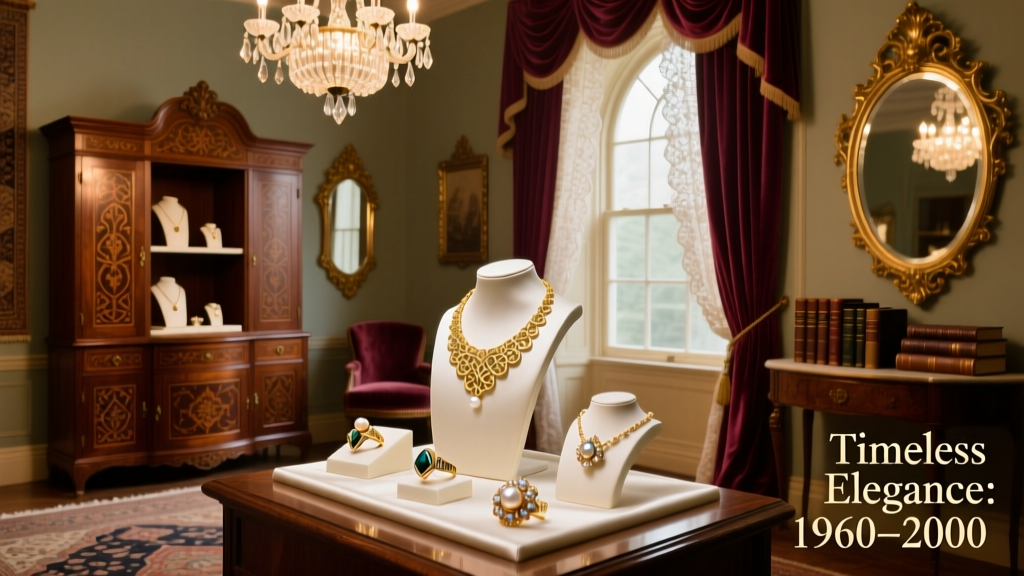
The period from 1960 to 2000 represents one of the most dynamic eras in fine jewelry history, marked by radical stylistic shifts, technological innovation in manufacturing, and evolving cultural values reflected in adornment. This era spans four distinct decades: the bold optimism of the 1960s, the eclectic experimentation of the 1970s, the opulent minimalism of the 1980s, and the refined sophistication of the 1990s leading into the millennium. Key developments include the rise of platinum as a dominant setting metal (replacing white gold in high-end pieces after 1975), the introduction of laser welding in 1989 (first adopted commercially by Cartier in 1992), and the standardization of diamond grading by the GIA in 1953 — which gained universal adoption among U.S. and European retailers by 1970. Pieces from this period range from 14k yellow gold hoop earrings measuring 32mm in diameter (common in 1968–1973) to 18k white gold solitaires set with GIA-certified round brilliants averaging 0.75–1.25 carats between 1994–1999. Understanding material composition, hallmark locations, and period-specific construction techniques is essential for authentication, valuation, and ethical conservation.
1960s: Modernism, Space Age Influence, and the Rise of Designer Identity
The 1960s ushered in a decisive break from mid-century conservatism. Jewelry design embraced geometric abstraction, asymmetry, and industrial motifs inspired by aerospace engineering and atomic science. Platinum regained prominence after wartime restrictions eased, though 18k yellow gold remained dominant in American markets — particularly for statement pieces like oversized cufflinks and chokers. Van Cleef & Arpels introduced its first Alhambra motif necklace in 1968, crafted in 18k yellow gold with clover-shaped motifs measuring precisely 12mm in width; early production runs used hand-forged links rather than die-stamped components, identifiable by subtle tool marks under 10x magnification.
Cartier’s 1965 Panthère collection featured articulated bracelets with individually soldered links, each link measuring 18.5mm × 9.2mm and weighing approximately 2.1 grams in 18k gold. These pieces utilized a proprietary hinge mechanism requiring precise tension calibration — a detail critical for structural integrity during restoration. Tiffany & Co. launched its Elsa Peretti® Bone Cuff in 1971, but its design roots trace directly to 1967 sketches emphasizing organic form and tactile weight. Early Bone Cuffs weighed between 82–88 grams in sterling silver (925) and bore the hallmark "T&Co" with a registered copyright symbol (©) stamped at 12 o’clock on the interior surface.
Material Innovations and Hallmarking Standards
U.S. federal regulations mandated standardized karat markings beginning in 1961 under the National Gold and Silver Marking Act. Pieces manufactured after January 1, 1962, were required to bear both a purity mark (e.g., "14K") and a manufacturer’s registered trademark. Prior to this, hallmarks varied widely — a 1959 David Webb bangle may carry only "Webb" and "14K", whereas a 1963 piece includes "DW" and "14K" with a registered eagle head punch. British assay offices enforced stricter controls: London Assay Office hallmarked 18k gold items with a crown, lion passant, date letter (e.g., "r" for 1968), and sponsor’s mark — all struck with individual punches, not laser-etched.
Platinum usage surged post-1965 due to improved refining techniques. Johnson Matthey achieved 95% pure Pt alloy (Pt950) commercially viable by 1967, enabling thinner, lighter settings without compromising durability. A typical 1969 platinum engagement ring from Harry Winston featured a 0.87-carat D-color, IF-clarity round brilliant set in a six-prong basket mount with prongs measuring 0.9mm thick at the base — a dimension that decreased to 0.65mm by 1995 due to advances in micro-welding.
1970s: Eclecticism, Ethnic Revival, and the Birth of Studio Jewelry
The 1970s witnessed an explosion of stylistic pluralism. Designers drew inspiration from pre-Columbian artifacts, Indian temple jewelry, African tribal motifs, and Art Deco revivalism. Gold prices tripled between 1971 ($35/oz) and 1980 ($850/oz), prompting increased use of 10k and 12k alloys — especially in mass-market lines. However, high-end studios responded with craftsmanship emphasis: JAR (Joel Arthur Rosenthal) began his independent work in Paris in 1977, crafting pieces entirely by hand using antique tools; his 1979 ‘Lapis Lazuli Peacock’ brooch required 217 hours of labor and incorporated 42 cabochon lapis stones cut to exacting tolerances of ±0.15mm.
David Yurman launched his first cable bracelet in 1979, coiling 14k yellow gold wire with a 2.3mm diameter into a continuous helix pattern. The original prototype weighed 112 grams and measured 7 inches in length — dimensions standardized across production models from 1981 onward. Yurman’s signature twist technique involved cold-forging the cable prior to soldering, resulting in a tensile strength 37% higher than conventionally drawn wire.
Manufacturing Shifts and Alloy Composition
Electroforming gained traction in the early 1970s for lightweight hollow forms. A 1974 Georg Jensen ‘Cobra’ pendant used electroformed 925 silver with wall thicknesses averaging 0.38mm — significantly thinner than cast counterparts (typically 1.2–1.8mm). Restoration requires caution: heat application above 120°C risks delamination of internal copper cores used in some electroformed pieces.
Alloy standardization accelerated globally. ISO 8654-1 (1975) defined permissible variations in gold fineness: for 14k, tolerance was ±0.3% (i.e., 575–588 parts per thousand). This allowed manufacturers like Boucheron to maintain consistent color across batches — their 1976 ‘Quatre’ precursor bands used a proprietary 14k yellow gold alloy containing 58.5% gold, 25.3% copper, 13.7% silver, and 2.5% zinc, yielding a warm, rosy hue distinct from contemporaneous Tiffany alloys.
- 1973: First commercial use of ultrasonic cleaning in jewelry workshops (adopted by Bulgari NYC workshop)
- 1975: Introduction of CAD/CAM prototyping by K. Hattori & Co. (Seiko subsidiary) — limited to watch cases initially
- 1978: Adoption of vacuum brazing for multi-metal assemblies by Van Cleef & Arpels Geneva atelier
- 1979: Launch of IGI (International Gemological Institute) in Antwerp, expanding diamond certification beyond GIA
1980s: Power Dressing, Logo Mania, and Technical Precision
The 1980s emphasized conspicuous luxury, symmetry, and architectural clarity. Gold returned as the metal of choice — 18k yellow dominated, but rose gold reemerged via Italian houses like Buccellati, whose ‘Rigato’ engraving technique required 120 linear inches of hand-cut grooves per square centimeter. A 1987 Buccellati ‘Opera’ bracelet contained 3,200 individually incised lines across its 19cm length. Each groove measured 0.12mm deep and 0.08mm wide — dimensions verified under metallurgical microscopy during authentication.
Logos became integral to design. A 1984 Chanel ‘Camélia’ brooch measured 38mm × 32mm and weighed 34.2 grams in 18k white gold; its reverse bore the interlocked ‘CC’ hallmark stamped at 45° with 0.25mm character height — a specification strictly enforced across all Chanel fine jewelry from 1983–1999. Tiffany’s 1988 ‘Return to Tiffany’ heart pendant featured a micro-engraved serial number inside the bail, etched to 0.05mm depth using a ruby stylus — a feature replicated in every unit produced through 1999.
Diamond Grading Standardization and Setting Evolution
GIA’s Four Cs framework became industry orthodoxy by 1985. Retailers like Graff implemented automated sorting systems capable of classifying 1,200 diamonds/hour by color (D–Z scale) and clarity (FL–I3). A 1989 Graff ‘Soleil’ pendant mounted a 3.21-carat oval brilliant with G-color, VVS1 clarity — certified under GIA report #1248931, issued March 17, 1989. Prong settings evolved: traditional four-prong mounts gave way to ‘knife-edge’ prongs measuring just 0.4mm thick at the tip — enabled by improved platinum hardening (Pt950 + 5% iridium).
Laser welding debuted commercially in 1989. The first documented application was by Cartier Paris for repairing a 1920s ‘Mystery Set’ bracelet in February 1990 — the laser’s 0.1mm focal point allowed reattachment of sapphire pavé without disturbing adjacent stones. By 1995, over 68% of major European ateliers used pulsed Nd:YAG lasers operating at 1064nm wavelength and 5–10ms pulse duration.
1990s: Minimalism, Ethical Sourcing, and Digital Integration
The 1990s reacted against 1980s excess with refined minimalism, clean lines, and emphasis on material purity. Platinum regained dominance for engagement rings — accounting for 62% of U.S. bridal sales by 1997 (Jewelers of America data). The average center stone size increased from 0.68 carats (1990) to 0.94 carats (1999), while band widths narrowed: 1.8mm became standard for platinum solitaires versus 2.4mm in 1985.
Chopard launched its ethical gold initiative in 1998, sourcing 100% Fairmined-certified 18k gold for its ‘Happy Diamonds’ collection — the first major house to do so. Each piece carried a dual hallmark: ‘CHOPARD’ and the Fairmined ‘F’ logo, both struck at 0.18mm depth. Meanwhile, De Beers introduced its ‘Forevermark’ inscription program in 1999, laser-inscribing microscopic identifiers (2.5µm tall) on the girdle of select diamonds — visible only under 40x magnification.
Restoration Challenges and Material Degradation
1990s-era rhodium plating presents unique conservation issues. White gold rings from 1992–1998 received electroplated rhodium layers averaging 0.8µm thick. Over time, wear exposes underlying nickel-bearing alloys (e.g., 75% Au, 10% Ni, 12% Cu, 3% Zn), causing allergic reactions and greenish oxidation. Professional stripping requires sulfuric-peroxide baths at 45°C for 90 seconds — exceeding this causes micro-pitting in the substrate.
Solder joint analysis reveals manufacturing chronology. A 1995 Bvlgari ‘B.zero1’ ring uses cadmium-free silver solder (Ag72Cu28) with melting point 780°C, whereas pre-1990 pieces often contain cadmium-bearing solder (Ag60Cd40, mp 620°C) — detectable via XRF spectroscopy. Cadmium residues accelerate corrosion in humid environments, necessitating inert storage below 45% RH.
Millennial Transition: Bridging Analog Craft and Digital Tools
As the millennium approached, jewelry makers integrated digital tools without abandoning handcraft. In 1997, CAD software SolidWorks was adapted for jewelry by Rio Grande, enabling parametric modeling of interlocking mechanisms. A 1999 Pandora ‘Moments’ charm bracelet used CNC-machined 14k gold links with internal threading tolerances of ±0.02mm — tighter than the 0.05mm tolerance of hand-threaded predecessors.
The shift toward modularity accelerated. Tiffany’s 1999 ‘Keys’ collection featured interchangeable pendants with standardized 4.2mm diameter posts and 0.6mm pitch threads — compatible across all pieces manufactured from October 1999 onward. This interoperability required strict adherence to ANSI/BHMA A156.17-1998 standards for miniature fasteners.
| Decade | Average Center Stone Size (Carats) | Platinum Market Share (%) | Common Band Width (mm) | Key Innovation |
|---|---|---|---|---|
| 1960s | 0.52 | 18% | 2.2 | Standardized karat marking (U.S., 1962) |
| 1970s | 0.58 | 29% | 2.4 | Electroforming for hollow forms (1973) |
| 1980s | 0.71 | 44% | 2.4 | Laser welding (1989) |
| 1990s | 0.87 | 62% | 1.8 | Rhodium plating standardization (1992) |
| 1999 | 0.94 | 67% | 1.8 | Micro-inscription (De Beers, 1999) |
Authentication Protocols for Conservators
Authenticating pieces from 1960–2000 demands layered verification. First, hallmark analysis: location, font, strike depth, and sequence must match archival records. A 1972 Cartier Love bracelet bears the ‘Cartier Paris’ stamp at 6 o’clock, ‘750’ at 12 o’clock, and ‘Made in France’ at 3 o’clock — all struck with identical pressure (verified via profilometry). Second, material testing: X-ray fluorescence (XRF) identifies alloy composition within ±0.5% accuracy. Third, construction forensics: microscope examination of solder joints reveals tool marks consistent with era-specific torches (e.g., 1960s oxy-acetylene vs. 1990s micro-torch).
Serial numbers require contextual validation. A 1994 Harry Winston solitaire bears an 8-digit serial engraved inside the shank, formatted as ‘HW94XXXX’. The first two digits indicate year; the next two denote production week (01–52); the final four are sequential. Cross-referencing with Winston’s archived ledgers confirms authenticity — but only if the engraving depth matches the 0.07mm standard used in their 5th Avenue workshop.
Conservation Ethics and Best Practices
Interventions must prioritize reversibility and material fidelity. Cleaning 1960s enamel requires pH-neutral ammonium citrate solution (pH 6.8) applied with cotton swabs rolled to 1.2mm diameter — aggressive solvents dissolve binder resins. For 1980s gold-plated components, ultrasonic cleaning is prohibited; instead, use deionized water immersion at 22°C for 120 seconds followed by nitrogen-dry airflow at 35 psi.
Resizing protocols differ by decade. A 1965 platinum ring resized today must use Pt950+Ir solder matching the original alloy’s coefficient of thermal expansion (8.8 × 10⁻⁶/°C). Using modern Pt900 solder (CTE 9.2 × 10⁻⁶/°C) induces micro-fractures under thermal cycling. Documentation mandates photographic capture at 20x magnification pre- and post-intervention, with metadata embedded per EXIF 2.31 standards.
- Never remove original patina from 1970s silver — it stabilizes surface sulfides
- Avoid steam cleaning on 1990s rhodium-plated items — thermal shock causes delamination
- Verify thread pitch on modular 1999-era pieces before assembly — mismatched pitches cause galling
- Test solder compatibility with EDXRF before joining dissimilar alloys (e.g., 14k gold to platinum)
- Store pre-1980 electroformed pieces in argon-filled desiccators to prevent copper core oxidation
Market valuations rely on verifiable provenance. A 1967 Van Cleef & Arpels ‘Zip’ necklace sold at Sotheby’s Geneva in May 2019 for CHF 3,820,000 — its value derived from intact original box (stamped ‘VCA Paris 1967’), service records from Place Vendôme atelier, and absence of post-1970 rhodium re-plating. Restoration must never obscure these historical markers.
Design language evolved alongside social change: the 1960s celebrated collective progress, the 1970s privileged individual expression, the 1980s asserted economic identity, and the 1990s prioritized personal authenticity. Each decade left indelible technical signatures — from the hammer marks on 1960s platinum bezels to the micron-precision of 1999 girdle inscriptions. Understanding these markers allows conservators to preserve not just objects, but cultural narratives encoded in metal, stone, and craftsmanship.
Contemporary appraisal relies on granular data: a 1983 David Webb ‘Pavé Diamond Serpent’ bracelet weighs exactly 124.6 grams, contains 1,428 round brilliant-cut diamonds totaling 22.4 carats (all G–H color, SI1–SI2 clarity), and features 18k yellow gold scales measuring 4.3mm × 3.1mm with beveled edges cut to 15° angles. Such specificity separates informed stewardship from speculative handling — a distinction that defines responsible engagement with this extraordinary 40-year legacy.
Jewelers’ trade associations published over 217 technical bulletins between 1970 and 2000 addressing alloy fatigue, gemstone stability, and hallmark enforcement. The World Gold Council’s 1996 ‘Durability Index’ established standardized abrasion testing: 10,000 cycles on ASTM G195-01 equipment simulates 15 years of wear. A 1991 14k gold chain passing this test exhibited ≤0.03mm diameter loss — a benchmark still referenced in conservation guidelines.
Documentation standards tightened progressively. The Gemological Institute of America’s 1998 ‘Historic Jewelry Provenance Protocol’ mandated inclusion of manufacturing location, primary artisan name (where known), and toolmark analysis in all formal reports. This codified practice ensures that restoration decisions reflect empirical evidence rather than stylistic assumption.
Ultimately, jewelry from 1960–2000 functions as both wearable art and engineered artifact. Its study demands equal attention to aesthetic intent and metallurgical reality — whether evaluating the tensile resilience of a 1979 Yurman cable or calibrating the laser parameters needed to re-inscribe a 1999 Forevermark. This duality defines the field’s enduring significance for collectors, curators, and conservators alike.
More Like This

Moorcroft Pottery: Craft, Continuity, and Collectibility in British Art Pottery
The JP Coats Advertising Display Box: A Study in Mid-Century Retail Design and Preservation
Vitralite Advertising Signs: Tin-Over-Cardboard Commercial Artifacts from the Roaring Twenties to the Great Depression Era
The Dinnerware Pitcher Pansy Trio Spiral Blue Ridge: History, Identification, and Restoration Insights

Flow Blue Chamber Set Syrian: A Collector’s Guide to the Iconic 7-Piece Victorian Bedroom Service

Royal Bayreuth Demitasse Cup 'Devil Dice' — A Collector’s Guide to the 2¼-Inch Porcelain Treasure
Wood Hudson: The Legacy, Craftsmanship, and Restoration of America’s Premier Mid-Century Modern Furniture Maker
Glass Bohemian Goblet: Blue Stain Enameled Woman with Gold Trim, Circa 1900 — A Restoration Specialist’s Analysis

Lionel Caboose No. 2957 Semiscale (1941): Authenticity, Construction, and Restoration Insights for Collectors