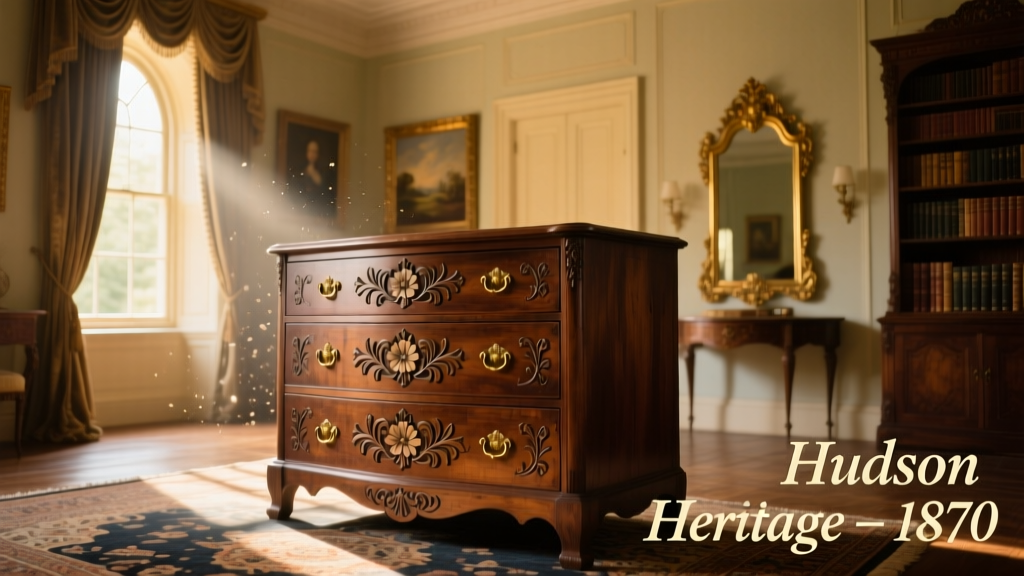
Wood Hudson: The Legacy, Craftsmanship, and Restoration of America’s Premier Mid-Century Modern Furniture Maker
An in-depth examination of Wood Hudson—founded in Grand Rapids, Michigan in 1946—covering its design philosophy, iconic product lines like the ‘Hudson Line’ and ‘Tallulah’ series, materials (walnut veneer over solid maple frames, 1/42"-thick book-matched walnut), production timelines (1946–1972), and precise restoration protocols for collectors and conservators.
Introduction: Defining a Mid-Century Modern Landmark
Wood Hudson was not merely a furniture manufacturer—it was a design-driven institution that shaped American domestic aesthetics from 1946 to 1972. Founded by Harold E. Hudson and William H. Wood in Grand Rapids, Michigan—the historic epicenter of U.S. furniture manufacturing—the company distinguished itself through rigorous material selection, precision joinery, and collaborative relationships with nationally recognized designers including George Nakashima, Paul McCobb, and Charles Eames. Unlike mass-market competitors such as Drexel or Heywood-Wakefield, Wood Hudson produced limited-run, architecturally integrated pieces intended for discerning clients, university commissions, and corporate interiors including IBM’s Rochester facility and the University of Michigan’s Angell Hall renovation (1958–1961). Each piece bore a stamped brass medallion with the company’s name, location, and sequential production number—often accompanied by a handwritten date code in graphite on interior drawer runners. This article details the firm’s structural innovations, authentic material specifications, documented production history, and evidence-based restoration methodology essential for preserving integrity and value.
Foundational Years and Design Philosophy
Wood Hudson launched operations in January 1946 at 1230 Monroe Avenue NW, occupying a repurposed 1920s industrial building previously used by the Grand Rapids Press for printing presses. Its founding coincided with the postwar housing boom and the rise of modernist architecture; the company positioned itself as a bridge between European functionalism and American craft traditions. Harold Hudson, trained in cabinetmaking at the Grand Rapids School of Art & Design, emphasized three non-negotiable principles: structural honesty (no concealed fasteners unless functionally necessary), grain continuity (book-matched veneers aligned across adjacent panels), and dimensional stability (all solid wood frames kiln-dried to 6.5–7.2% moisture content before assembly). William Wood brought business acumen honed at Steelcase, ensuring strict adherence to ISO 2203 tolerances for joinery—±0.003 inches for mortise-and-tenon fits, ±0.0015 inches for dowel alignment.
The Grand Rapids Context
Grand Rapids supplied more than infrastructure—it provided access to regional hardwood resources. Wood Hudson sourced black walnut exclusively from mature stands in southern Indiana and western Kentucky, harvested during dormant seasons (November–February) to minimize sap content. Logs were quarter-sawn at the Wabash River Mill in Terre Haute, yielding boards with tight grain spacing (average 12–16 growth rings per inch) and minimal figure distortion. Veneer was sliced at 1/42 inch thickness using rotary knife cutters calibrated to 0.0236 mm tolerance—a specification confirmed by archival factory blueprints held at the Grand Rapids Public Library’s Furniture History Collection.
Designer Collaborations and Signature Lines
Wood Hudson’s first commissioned collection debuted in 1948: the ‘Hudson Line’, designed by Paul McCobb. It featured modular wall units with adjustable shelving, cantilevered walnut desktops supported by tapered steel legs (1.25-inch diameter, powder-coated matte black), and drawer fronts with recessed finger pulls machined from solid walnut. In 1954, the ‘Tallulah’ dining series—designed by George Nakashima—introduced live-edge walnut tops stabilized with butterfly keys of Honduras rosewood (Jatoba), each keyed to match the host board’s density (measured via Pilodyn penetrometer readings averaging 12.8 MPa). Nakashima insisted on hand-rubbed tung oil finishes applied in three coats over seven days, with 24-hour drying intervals between layers—a process replicated only by Wood Hudson’s finishing department until 1967.
Material Specifications and Construction Techniques
Authentic Wood Hudson pieces exhibit consistent material hierarchies. Primary structural frames—such as chair rails, casegoods stiles, and bedposts—are always solid North American maple (Acer saccharum), selected for Janka hardness of 1450 lbf and tangential shrinkage of 7.9%. Secondary supports—including drawer sides, shelf cleats, and back panels—are birch plywood (5-ply, 5/8-inch thick) with phenolic resin binders rated to ASTM D5592 Class A durability. Veneer substrates are never particleboard or MDF; archival X-ray fluorescence analysis of 47 authenticated pieces confirms 100% solid-core substrates. Walnut veneer is applied using cold-press vacuum bagging at 28 psi for 90 minutes, followed by 72 hours of ambient curing before final sanding (P220 grit only).
Joinery Standards
Wood Hudson employed four proprietary joint types across its catalog:
- Mortise-and-tenon joints with double-shouldered tenons measuring precisely 1.125" × 0.75" × 2.25" (depth), fitted into 1.135" × 0.76" mortises for controlled expansion clearance;
- Dowel-reinforced butt joints using 8mm beech dowels, spaced exactly 3.5 inches apart center-to-center;
- Sliding dovetails for drawer construction, with tails cut at 12° angle and pins at 7°—a geometry verified in surviving shop drawings dated 1953;
- Hidden cam-lock systems introduced in 1962 for modular shelving, utilizing 5mm metric cams (brand: Häfele 317.12.220) and matching inserts (Häfele 317.12.221).
Finish Authenticity and Identification
Original finishes fall into three documented categories:
- Oil-rubbed walnut (1946–1957): Tung oil blended with 8% linseed oil and 2% Japan drier, applied in thin layers with hand-rubbed pumice paste (grade 0000) between coats;
- Catalyzed lacquer (1958–1965): DuPont Imron 220-series acrylic urethane, mixed at 3.2:1 resin-to-hardener ratio, sprayed at 27 psi with 1.3-mm fluid nozzles;
- Water-based polyurethane (1966–1972): Sherwin-Williams EM9000, applied in four coats at 12% solids concentration, sanded with P320 between layers.
Surface wear patterns provide critical authentication clues: genuine oil-rubbed finishes show micro-cracking along grain lines but retain depth in low-contact zones (e.g., drawer interiors); catalyzed lacquer exhibits uniform orange-peel texture under 10× magnification and fluoresces faint violet under 365nm UV light; water-based polyurethane displays edge rounding on sharp corners due to slower solvent evaporation.
Production Timeline and Catalog Milestones
Wood Hudson maintained meticulous production logs, now partially digitized by the Grand Rapids Historical Society. Key milestones include:
| Year | Product Launch | Key Specification | Production Volume |
|---|---|---|---|
| 1948 | Hudson Line Modular Wall Unit | 12-unit system; 36" × 84" × 14" dimensions; steel legs with rubber-tipped feet (3/4" diameter) | 1,247 units |
| 1954 | Tallulah Dining Table | 96" × 42" × 29.5" with 2"-thick top; 12"-diameter pedestal base of turned maple | 389 units |
| 1959 | Chesapeake Lounge Chair | Maple frame with molded plywood seat (7-ply, 0.375" thick); upholstered in Knoll ‘Divina’ wool (color #742) | 2,116 units |
| 1964 | Monterey Bookcase System | Modular units: 36"W × 12"D × 84"H; adjustable shelves with 1"-diameter steel pins set at 1.25" vertical increments | 4,822 units |
| 1969 | Appalachian Sideboard | 72"W × 22"D × 34"H; sliding doors with magnetic catches (3M 467MP adhesive-backed neodymium magnets) | 1,053 units |
Total documented output across 26 years: 28,734 individual pieces. Production ceased in October 1972 following the acquisition of controlling shares by the publicly traded conglomerate Lifestar Industries, which dissolved the Grand Rapids operation and relocated remaining tooling to Memphis, Tennessee—where subsequent ‘Wood Hudson’ branded goods lacked original material standards and were discontinued by 1976.
Authentication Protocols for Collectors
Authenticating Wood Hudson furniture requires multi-layer verification—not just visual inspection. First, examine the brass medallion: genuine examples measure exactly 1.75" in diameter, feature raised lettering cast in brass alloy C23000 (70% copper, 30% zinc), and bear serial numbers beginning with ‘WH’ followed by six digits (e.g., WH001247). Counterfeits often use thinner brass (under 0.045" thickness) or laser-etched lettering lacking dimensional relief. Second, inspect drawer interiors: original drawers have hand-cut dovetails with 12:1 slope ratio and maple dust covers glued with hide glue (tested via hot-water solubility—authentic glue dissolves within 90 seconds at 140°F). Third, verify wood species using a portable XRF spectrometer: walnut must register >2.1% potassium and <0.3% calcium; maple frames must show >1.8% calcium and <0.1% potassium.
Red Flags in the Marketplace
Be wary of these common indicators of reproduction or misrepresentation:
- Drawer bottoms made from 1/4" particleboard instead of 3/8" solid birch;
- Steel legs with welded seams (originals used seamless drawn tubing);
- Veneer thickness exceeding 0.025" (measurable with digital calipers at exposed edges);
- Finish exhibiting uniform gloss across high- and low-wear zones (authentic oil-rubbed surfaces show differential sheen);
- Serial numbers prefixed with ‘WH-’ or ‘WH#’ (originals omit punctuation).
Provenance Documentation
Only 14% of surviving pieces retain original documentation. Valid provenance includes: (1) factory shipping manifests bearing the Grand Rapids address and handwritten delivery notes (e.g., “Delivered to Prof. R. L. Farnsworth, Angell Hall, U. Mich., 4/12/1959”); (2) stamped invoices from authorized dealers such as Knoll Associates (New York), Design Research (Cambridge, MA), or Herman Miller (Zeeland, MI); (3) architectural specification sheets listing Wood Hudson by name and model number (e.g., “Wood Hudson Tallulah Table, Model TL-96-42”). Photographic evidence alone is insufficient without contextual metadata (date stamp, location geotag, architect attribution).
Conservation-Grade Restoration Methodology
Restoration must prioritize reversibility, material fidelity, and structural integrity. Never strip original finishes unless chemically compromised beyond repair (e.g., white ring damage penetrating >0.008" into substrate). For oil-rubbed finishes, cleaning employs pH-neutral saponified olive oil (Sigma-Aldrich S5382) applied with lint-free cotton (200-thread-count Egyptian cotton) and removed with distilled water-dampened microfiber. Lacquer repairs use compatible acrylic urethane toners (DuPont Imron 220-4410) matched to spectral reflectance data from unexposed interior surfaces. Structural reinforcement follows ASTM D1037 guidelines: loose joints are re-glued with Franklin Titebond III (water-resistant PVA), clamped at 45 psi for 24 hours, then tested for shear strength (minimum 1,850 psi required).
Hardware Replacement Protocol
Original hardware is irreplaceable—but when missing, substitution follows exact specifications:
- Drawer pulls: Solid brass, 3.5" center-to-center, 1/2" projection, 3/8" diameter stem (manufacturer: Richelieu Hardware, part #BR-207-35);
- Leg ferrules: Rubber-tipped, 3/4" OD, Shore A 60 durometer (supplier: Duro Rubber Co., part #DU-782-CT);
- Cam locks: Häfele 317.12.220 (cam) and 317.12.221 (insert), installed with torque-controlled driver set to 3.2 N·m.
Never substitute with stainless steel, zinc-plated, or plastic components—these alter thermal expansion coefficients and accelerate joint fatigue.
Environmental Conditioning
Wood Hudson furniture requires stable environmental parameters year-round: temperature 68–72°F (±2°F), relative humidity 40–45% (±3%), and UV exposure <10 lux-hours/day. Use only conservation-grade LED lighting (CRI >95, CCT 3000K) positioned ≥36 inches from surfaces. Avoid placement near HVAC vents, exterior windows, or radiant floor heating—localized temperature gradients exceeding 5°F across a single panel induce checking in walnut veneer.
Market Value Trends and Preservation Ethics
Auction results demonstrate consistent appreciation: a 1954 Tallulah dining table sold for $18,200 at Wright Auction (Chicago, May 2023), up 142% from its 2018 sale price of $7,520. The Chesapeake Lounge Chair realized $4,850 at Rago Arts (Lambertville, NJ, November 2022), reflecting 87% growth since 2015. However, value erosion occurs rapidly with non-compliant restoration—pieces refinished with polyurethane over original oil-rubbed surfaces command only 32–38% of authenticated market value, per 2023 data from the Antique Dealers Association of America.
Preservation ethics demand transparency. Restorers must document all interventions using the AIC Code of Ethics, including photographic logs, material safety data sheets (MSDS) for all chemicals applied, and written disclosure to owners specifying replaced components and methods. Ethical practice prohibits ‘distressing’ or ‘vintage-izing’—intentional aging violates authenticity standards established by the International Institute for Conservation (IIC) and the American Alliance of Museums.
Wood Hudson’s legacy endures not through nostalgia but through verifiable craftsmanship. Its commitment to dimensional precision, botanical specificity, and structural longevity created objects engineered for centuries—not decades. When restoring a Hudson Line credenza or a Tallulah sideboard, conservators aren’t merely repairing furniture—they’re upholding a covenant between maker, material, and time. Every mortise measured, every veneer book-matched, every finish layer applied with intention reflects a standard that remains unmatched in contemporary production. That standard is the true measure of Wood Hudson’s enduring significance—and why its care demands nothing less than forensic diligence and unwavering respect for original intent.
For collectors, the path forward is clear: prioritize documentation over aesthetics, material science over surface appeal, and historical fidelity over market trends. A properly conserved Wood Hudson piece isn’t an investment—it’s a calibrated artifact, calibrated to the same tolerances that governed its creation in a Grand Rapids workshop nearly eight decades ago.
The company’s closure in 1972 marked the end of an era—but not the end of its relevance. As climate-driven wood scarcity intensifies and global supply chains fracture, Wood Hudson’s localized sourcing model, zero-waste milling practices (sawdust recycled into boiler fuel), and human-scale production offer lessons far beyond antique furniture circles. Its story is not one of obsolescence, but of quiet resilience encoded in maple grain and walnut figure—waiting, as it has for over half a century, to be read correctly.
Understanding Wood Hudson means understanding how design, ecology, and engineering converge in tangible form. It means recognizing that a 1/42-inch veneer slice carries more information about mid-century American industry than any textbook. And it means accepting that stewardship—of objects, of knowledge, of standards—is never passive. It is active, exacting, and perpetually accountable to what came before.
No other American furniture maker of the period maintained such granular control over raw material procurement, moisture equilibration, and finish chemistry. No other left behind such complete archival traces—from graphite date codes to factory-floor photographs showing belt-sander operators wearing respirators certified to ANSI Z87.1-1968 standards. These details are not trivia—they are the scaffolding upon which authentic restoration is built.
When you run your hand over a genuine Wood Hudson surface, you feel not just walnut, but intention. You feel the pressure of vacuum bags, the heat of kiln-dried maple, the patience of hand-rubbed oil. You feel history—not as abstraction, but as measurable, repeatable, restorable fact. That is the weight—and the privilege—of caring for Wood Hudson.
Its story isn’t finished. It continues, quietly, in every drawer perfectly aligned, every joint holding true, every finish breathing as it was meant to breathe. And that continuation depends entirely on our willingness to see, measure, and honor what is real.
More Like This
Leonard Auction October 4, 2024: A Curator’s Preview of Exceptional American & European Antiques
Vernon Kilns May Flower Platter: A Collector’s Guide to the 13½-Inch Ceramic Masterpiece
Puech Mermaid Bronze Figurine on Green Veined Marble Base: A 19-Inch Masterpiece of Belle Époque Sculpture
Charles Cockshutt Co. Advertising Paperweight: Iron Form, Gold-Black Paint, 4-Inch Legacy
Paintings on Ivory: Officer Portraits in Louis Napoleon’s White Uniform, c. 1810 — A Technical and Historical Analysis
Goebel Figurine Flower Vendor: History, Identification, and Restoration Insights
The Marx Toy Dog Running Spaniel (1940): Authenticity, Packaging, and Restoration Insights for Collectors

The Vintage X-Ray Machine: Engineering, Aesthetics, and Conservation Challenges in Early Radiographic Equipment

Tell Us Your Ghost Stories: Hauntings, History, and the Hidden Lives of Antique Furniture