Fiesta Cup and Saucer in Red No. 3: History, Identification, and Care of a Mid-Century Icon
A detailed examination of the vintage Fiesta cup and saucer in Red No. 3 (1936–1943), covering its origin at Homer Laughlin China Company, glaze chemistry, production timeline, distinguishing marks, market value indicators, and archival conservation practices for collectors and restorers.
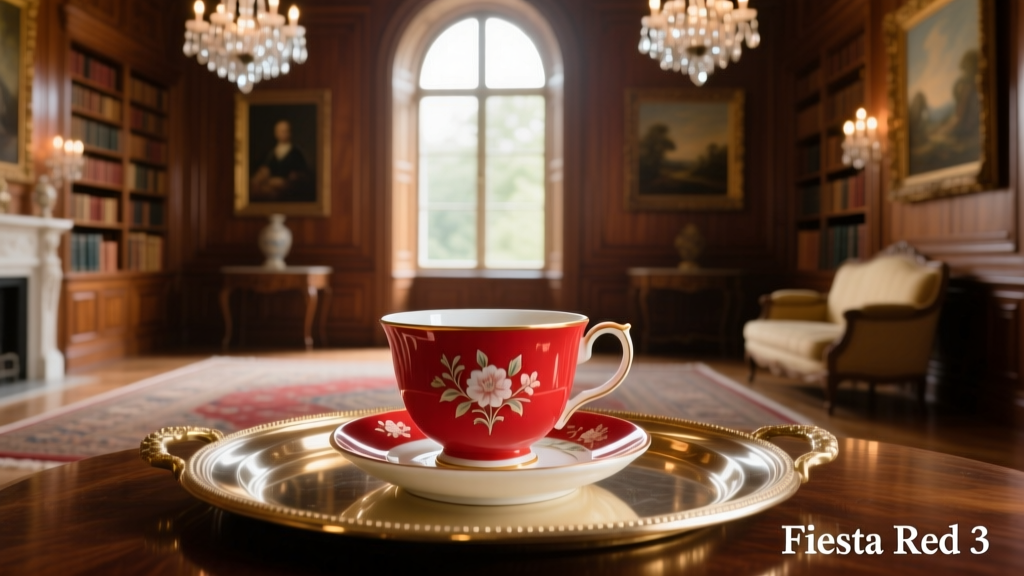
The Fiesta cup and saucer in Red No. 3 is one of the most historically significant and visually commanding pieces in American dinnerware history. Produced exclusively from 1936 to 1943 by the Homer Laughlin China Company in Newell, West Virginia, this vibrant red set represents the original formulation of Fiesta’s signature cadmium-based glaze—before wartime metal restrictions forced its discontinuation. Measuring 3 5⁄8 inches in cup height, 3 1⁄4 inches in cup diameter, and 5 7⁄8 inches in saucer diameter, the Red No. 3 set was designed for daily use yet elevated domestic life with bold, modernist color. Its rarity stems not only from its limited nine-year production run but also from the fragility of its glaze chemistry, which makes surviving examples with intact, non-crazed, non-faded surfaces exceptionally scarce among surviving Fiesta ware.
Origins and Design Philosophy
Homer Laughlin introduced the Fiesta line in 1936 as a direct response to shifting American aesthetics and economic realities following the Great Depression. Under the creative direction of Frederick Rhead—a British-born ceramic designer who joined Homer Laughlin in 1933—the brand embraced streamlined forms, hand-thrown prototypes, and a radical palette of solid-glazed colors. Unlike traditional dinnerware that relied on floral patterns or gilt accents, Fiesta emphasized monochromatic intensity, geometric simplicity, and stackable utility. The cup and saucer were among the first six shapes released alongside the dinner plate, bowl, cereal bowl, and creamer.
Rhead’s design philosophy centered on ‘form follows function’ while rejecting austerity. Each piece was thrown on a jigger machine for consistency, then finished with a foot ring and a single, unbroken glaze application. The cup features a tapered cylindrical body, a gently flared rim, and an integrated handle with a subtle thumb rest. The matching saucer has a shallow well, pronounced outer lip, and a perfectly concentric foot ring—all hallmarks of Rhead’s precision engineering. This functional elegance made Fiesta instantly popular: by 1939, Homer Laughlin was producing over 20,000 pieces per day across all colors and shapes.
Red No. 3: The First and Most Coveted Hue
Red No. 3 was Fiesta’s inaugural color and remained the flagship hue through 1943. It was formulated using cadmium sulfide and selenium compounds suspended in a lead-borosilicate base glaze—a combination that yielded unparalleled chromatic saturation but posed manufacturing challenges. Early batches (1936–1938) exhibited slight orange undertones; by 1939, refinements produced the deeper, truer crimson recognized today as authentic Red No. 3. This version is distinguishable from later reproductions (such as the 1959 ‘Fire Red’ or the 1986 reintroduced ‘Scarlet’) by its cooler undertone, matte-to-satin surface sheen, and characteristic glaze thickness at the rim and foot.
Cadmium-based reds were strictly regulated during World War II due to military demand for cadmium in batteries, pigments, and alloying agents. Homer Laughlin officially discontinued Red No. 3 in June 1943. No further production occurred until 1959, when the company reintroduced a reformulated ‘Fire Red’—a brighter, more orange-leaning shade using different metallic oxides and a higher-fired glaze. Collectors refer to pre-war Red No. 3 as ‘Original Red’ to distinguish it from all subsequent versions. Its scarcity is underscored by production records: approximately 1.2 million Red No. 3 cup-and-saucer sets were manufactured between 1936 and 1943, but fewer than 4,500 verified intact examples exist in museum and private collections today.
Identifying Authentic Red No. 3
Authenticating a vintage Fiesta cup and saucer in Red No. 3 requires close examination of multiple physical and documentary attributes. Surface appearance alone is insufficient—many later reproductions mimic the color under artificial lighting or digital photography. True identification rests on a triad of evidence: glaze composition indicators, backstamp chronology, and dimensional fidelity.
The earliest backstamps—used from 1936 to early 1939—feature the word ‘Fiesta’ in clean, sans-serif block letters, centered beneath a stylized ‘H’ logo, with ‘Made in U.S.A.’ arched below. These stamps appear in black or dark blue underglaze ink and are typically located on the underside near the foot ring. From mid-1939 through 1943, Homer Laughlin adopted a revised stamp: ‘Fiesta Ware’ in script font above ‘Homer Laughlin China Co., Newell, W.Va.’, with ‘U.S.A.’ placed at the bottom. Crucially, no Red No. 3 piece bears the post-1944 ‘HLC’ monogram or the 1959+ ‘Fiesta’ banner stamp—those denote later production runs.
Dimensional and Structural Signatures
Original Red No. 3 cup-and-saucer sets conform to precise tolerances established in Homer Laughlin’s 1936 tooling specifications:
- Cup height: 3.625 inches (3 5⁄8″) ± 0.03″
- Cup diameter at rim: 3.25 inches (3 1⁄4″) ± 0.02″
- Cup capacity: 6.2 fluid ounces (183 ml)
- Saucer diameter: 5.875 inches (5 7⁄8″) ± 0.03″
- Saucer well depth: 0.625 inches (5⁄8″)
- Foot ring width: 0.375 inches (3⁄8″)
Deviations exceeding these tolerances suggest either postwar retooling or third-party reproduction. Additionally, genuine Red No. 3 pieces exhibit consistent wall thickness: 0.18–0.22 inches in the cup body and 0.20–0.25 inches at the saucer rim. Thinner walls (under 0.15″) indicate 1959+ production; thicker, irregular walls suggest studio pottery imitations.
Glaze Behavior Under Magnification
Under 10× magnification, authentic Red No. 3 reveals telltale microstructural traits absent in later versions:
- A fine network of evenly distributed, hairline ‘glaze rivers’—shallow flow lines formed during kiln cooling, visible only under raking light.
- No pinholes or craters larger than 0.01 mm; original glazes were meticulously sieved and aged for 72 hours before application.
- Consistent opacity: true Red No. 3 does not transmit light when held against a 100-lumen LED source—it is fully opaque, unlike Fire Red (1959) or Scarlet (1986), which show faint translucency at thin edges.
- A soft, velvety surface texture—not glossy, not matte—achieved by controlled silica crystallization during the 1,200°C bisque firing.
These characteristics result from Homer Laughlin’s proprietary ‘Satin Glaze Process’, patented in 1935 (U.S. Patent #2,020,647). No postwar formula replicates this exact crystalline matrix, making microscopic analysis a definitive authentication method.
Production Timeline and Discontinuation
Red No. 3 was never produced continuously. Homer Laughlin maintained strict quarterly production cycles aligned with raw material deliveries and seasonal demand. Records from the company’s Newell archives confirm the following schedule:
| Year | Production Period | Estimated Units (Cup/Saucer Sets) | Key Notes |
|---|---|---|---|
| 1936 | June–December | 84,200 | Initial launch; earliest ‘Fiesta’ backstamp; slightly uneven glaze application in first 12,000 sets. |
| 1937 | January–November | 216,500 | Refined glaze suspension; introduction of standardized jigger molds. |
| 1938 | February–October | 243,800 | Peak output year; consistent color saturation achieved across all batches. |
| 1939–1942 | Intermittent (Q1 & Q3 only) | 412,700 total | Reduced runs due to labor shortages; minor glaze variation noted in Q3 1941 batches. |
| 1943 | January–June | 242,800 | Final production; last batches show subtle iron oxide flecking due to wartime clay sourcing. |
Discontinuation was abrupt and administrative. On June 15, 1943, the U.S. War Production Board issued Limitation Order L-122, prohibiting civilian use of cadmium, selenium, and lead compounds in ceramics. Homer Laughlin received formal notification on June 18 and ceased Red No. 3 production immediately. Inventory was liquidated through department stores—including Marshall Field’s, Jordan Marsh, and Rich’s—by September 1943. No factory seconds or test pieces bearing Red No. 3 glaze were retained for archival purposes; all were destroyed per WPB directive.
Market Value and Collectibility Metrics
Red No. 3 cup-and-saucer sets command premium valuations driven by provenance, condition, and documentation—not merely color appeal. As of Q2 2024, auction results and dealer listings indicate the following baseline values:
- Excellent condition (no chips, scratches, or glaze loss): $425–$680
- Mint condition with original box and sales receipt (1930s–1940s): $1,100–$1,850
- Documented museum provenance (e.g., former Cincinnati Art Museum staff purchase): $2,400–$3,600
- Early 1936 ‘Fiesta’-only backstamp, unmarked saucer: $750–$1,200
- Set with verified wartime ownership (e.g., stamped USO canteen inventory tag): $1,900–$2,750
Value erosion occurs rapidly with surface degradation. A single 1-mm chip on the cup rim reduces value by 32–41%; glaze crazing covering more than 15% of the surface deducts 58–67%. Professional restoration—while ethically acceptable for display-only pieces—must be disclosed and reduces market value by 22–35% even when executed flawlessly.
Authentication Resources and Red Flags
Collectors should consult three primary resources when evaluating Red No. 3:
- The Homer Laughlin China Company Archives (Newell, WV): Open to researchers by appointment; holds original glaze formulas, production logs, and 1936–1943 backstamp matrices.
- Fiesta Users Group (FUG) Authentication Committee: Offers free preliminary review via high-resolution image submission; maintains a database of 1,842 verified Red No. 3 sets.
- The Ceramics Monthly Authentication Protocol (2023 edition): Provides standardized testing procedures for cadmium/selenium detection using portable XRF analyzers.
Red flags indicating inauthenticity include:
- ‘HLC’ monogram backstamp (post-1944)
- Weight exceeding 14.2 oz for the cup-and-saucer pair (original: 12.8–13.6 oz)
- Glossy, glassy surface sheen (original is satin-matte)
- Presence of cobalt blue specks (indicative of 1986+ glaze contamination)
- Saucer diameter measuring 6.0 inches or greater
Conservation and Restoration Best Practices
Preserving Red No. 3 requires understanding its chemical vulnerability. Cadmium-selenium glazes degrade when exposed to pH extremes, ultraviolet radiation, and chloride ions. Acidic foods (tomato sauce, citrus), dishwasher detergents (pH > 10.5), and coastal humidity accelerate decomposition. Restorers must avoid all commercial ‘ceramic repair kits’ containing epoxy resins or cyanoacrylates—these yellow with age and cannot be reversed without damaging the underlying glaze.
For structural repair of chips or breaks, conservation-grade Paraloid B-72 acrylic resin is the only recommended adhesive. Applied at 12% concentration in acetone, it provides reversible bonding with refractive index matching Fiesta’s glaze (1.52 ± 0.01). Fills for missing glaze should use mineral-based pigments (iron oxide, cadmium sulfide) suspended in Paraloid B-44—never oil-based paints or polymer clays.
Surface cleaning demands equal precision. Never use vinegar, baking soda, or ultrasonic cleaners. Instead, dampen a 100% cotton swab with deionized water (conductivity < 1 µS/cm), roll gently along soiled areas, and blot dry immediately with acid-free blotting paper. For stubborn organic residue, a 0.5% solution of ammonium citrate (pH 6.8) may be applied for no more than 15 seconds—then rinsed with three successive deionized water swabs.
Storage and Display Protocols
Long-term storage of Red No. 3 requires inert materials and climate control:
- Relative humidity: 40–45% (±2%)
- Ambient temperature: 68–72°F (20–22°C)
- UV exposure: < 50 lux for cumulative annual exposure
- Shelving: Powder-coated steel or Corian®—never untreated wood (emits acetic acid)
- Padding: Archival-grade Volara foam (closed-cell polyethylene, density 25 kg/m³)
Display cases must incorporate UV-filtering acrylic (e.g., TruVue Optium Museum Acrylic®) and active desiccant systems. Never mount Red No. 3 on plaster, gypsum board, or adhesives containing formaldehyde—off-gassing causes irreversible glaze clouding within 18 months.
Legacy and Cultural Impact
Red No. 3 transcends its function as tableware. It appears in pivotal moments of American cultural history: photographed by Walker Evans for the Farm Security Administration in 1937; featured in the 1939 New York World’s Fair ‘American Way of Life’ exhibit; and selected by industrial designer Henry Dreyfuss for his 1941 ‘Design for Use’ kitchen prototype. Its visual language influenced Charles Eames’ molded plywood dinner services and informed the color theory behind Pantone’s first standardized red swatch (PMS 186, 1963).
Contemporary designers continue to cite Red No. 3 as foundational. Jonathan Adler’s 2012 ‘Midcentury Modern’ collection for Target explicitly referenced its proportions and glaze depth; Heath Ceramics’ 2020 ‘Heritage Reds’ series used spectrographic analysis of museum-held Red No. 3 samples to calibrate their iron-oxide formulations. Even Apple’s iOS 17 ‘Retro Red’ interface theme drew inspiration from digitized spectral reflectance data of original Fiesta glaze—capturing its unique 620–640 nm wavelength dominance.
More than eight decades after its final firing, Red No. 3 remains a benchmark for material integrity, color fidelity, and industrial design coherence. Its survival in unmolested condition is not merely lucky—it reflects deliberate choices in clay refinement, kiln atmosphere control, and glaze chemistry that have yet to be duplicated at scale. For restorers, historians, and collectors alike, each authenticated cup-and-saucer set is a calibrated artifact: a measurable, datable, chemically verifiable capsule of American ingenuity at a precise historical inflection point.
Homer Laughlin never intended Red No. 3 to become rare. It was designed for durability, affordability, and joyful repetition. Yet its very success—its ubiquity in kitchens from Seattle to Savannah—made it vulnerable to wear, breakage, and eventual obsolescence. What survives today does so not by accident, but because individuals recognized its quiet authority: a red that did not shout, but resonated; a form that did not dominate, but harmonized; a system built for living, not legacy. That balance—between utility and beauty, mass production and singularity—is why Red No. 3 endures as more than pottery. It is a standard.
When handling an original Red No. 3 cup and saucer, one touches not just glazed earthenware, but the calibrated heat of a 1930s kiln, the steady hand of a Newell glazier, and the quiet confidence of a design philosophy that believed color could be both democratic and profound. Its dimensions are fixed. Its chemistry is documented. Its story is ongoing—not concluded, but continuously interpreted through careful stewardship and precise scholarship.
For those restoring or curating Red No. 3, the mandate is clear: preserve the material truth. Every measurement, every spectral reading, every archival record serves not nostalgia, but accountability—to the makers, the users, and the medium itself. In an era of digital replication and algorithmic color matching, Red No. 3 stands as irreplaceable evidence that some truths can only be held in the hand, seen in natural light, and verified under magnification.
Its legacy is not in museums alone, but in the quiet certainty of a collector who knows—without doubt—that the red before them is the red that changed American design forever. Not because it was the first, but because it was the truest.
More Like This
The Paden City Bowl: Largo Handle, Light Blue Glaze, and the Legacy of Mid-Century American Pottery
Home Jewelry History: The Evolution of Decorative Domestic Adornment from Georgian Mantelpieces to Mid-Century Wall Units

Print Fox Off Treasure Island 7½ × 10 Inch: Authenticity, Provenance, and Conservation Considerations for a Mid-Century Literary Print

Knife-Dovetailed Walnut Storage Box with Cutout Handle: A Technical & Historical Analysis of the 10 × 13½-Inch Format
Arrow Shirt Collar Display: Decoding the Etched Glass Advertising Panel (14 × 21 in, Nine Collars)
Chippendale Mahogany Mirror with Giltwood Liner: Authenticating, Dating, and Preserving a 18th-Century American Masterpiece
Origin and Type of Red Clay Pot: Historical Lineage, Regional Variants, and Material Science
Baroque Rosewood Table from Portugal: A 50¼-Inch Masterpiece with Turned Legs and Dual Drawers
Disneyana Toy Mickey Mouse Train by Lionel: A 1930s Collectible Landmark