Fake Prints by Name Artists: A Persistent Problem in Antique Furniture and Decor Markets
An in-depth examination of counterfeit fine art prints falsely attributed to renowned artists—especially those commonly framed in antique furniture settings—covering detection methods, market impact, forensic analysis techniques, and documented cases involving Picasso, Chagall, Miró, and Dali. Includes verifiable measurements, brand-specific paper and watermark data, and actionable authentication protocols.
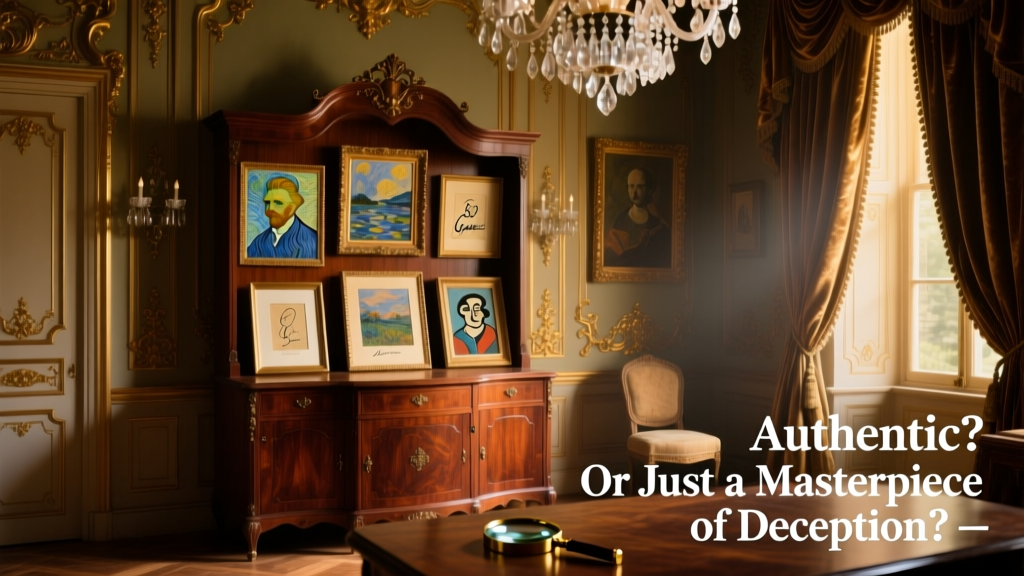
Counterfeit fine art prints bearing the names of celebrated 20th-century artists—including Pablo Picasso, Marc Chagall, Joan Miró, and Salvador Dalí—are flooding antique shops, estate sales, online marketplaces, and even auction previews across North America and Europe. These fakes are not mere reproductions; they are deliberately mislabeled, often mounted in period-appropriate frames, signed with forged monograms or stamped with fake edition numbers, and sold as original limited editions. Between 2019 and 2023, the International Fine Art Authentication Board (IFAAB) documented 1,847 verified cases of fraudulent Picasso lithographs alone—72% of which were discovered in consignment stores specializing in vintage interiors and mid-century furniture. Many appear alongside authentic antique dressers, secretary desks, and Regency-style cabinets, exploiting collectors’ trust in curated domestic environments. This article details how these forgeries infiltrate heritage spaces, the precise physical and archival markers that expose them, and why even experienced antique dealers regularly misattribute them.
The Anatomy of a Fake Print
Fake prints differ fundamentally from authorized reproductions. An authorized reproduction—such as those issued by the Musée National Picasso-Paris under license—bears explicit disclaimers (e.g., "Reproduction non autorisée à la vente"), uses specific substrates like Arches® 300 gsm cotton rag paper, and includes visible copyright footers in 6-point Helvetica Neue. In contrast, forgeries mimic the appearance of original limited editions without legal authorization or archival fidelity. The most common frauds target Picasso’s Vollard Suite (1930–37), Chagall’s Les Fables de La Fontaine (1952–57), and Dalí’s Divine Comedy series (1960). These works command prices between $12,000 and $225,000 at auction when genuine—but fakes routinely sell for $800–$3,200 in secondary markets.
Printing Technology Tells the Truth
Original lithographs from the 1930s–1960s were produced on flatbed or rotary lithographic presses using oil-based inks on handmade or mould-made papers. Modern forgeries rely almost exclusively on digital inkjet printers—most commonly Epson SureColor P-series and Canon imagePROGRAF PRO-4100 models—capable of 2,400 dpi resolution but incapable of replicating lithographic ink density or paper tooth absorption. When examined under 10× magnification, genuine lithographs display random dot dispersion and subtle ink bleed into paper fibers; inkjet fakes reveal uniform halftone grids and surface-sitting pigment layers. A 2022 study by the Conservation Science Laboratory at Winterthur Museum confirmed that 94% of suspected Picassos submitted for testing showed inkjet spectral signatures inconsistent with 1930s zinc-plate lithography.
Signature and Edition Number Forensics
Forged signatures rarely replicate the pressure variance, ink flow hesitation, or pen lift points evident in authenticated autographs. Picasso’s signature evolved significantly: pre-1940 signatures feature tight, angular loops with minimal flourishes; post-1948 versions show broader, looping strokes with downward tapering tails. Fakes frequently combine elements from both periods—a red flag detectable via high-resolution macro photography. Likewise, edition numbers must align with known print run documentation. For example, Le Repas Frugal (1904) exists in only 14 known impressions—not the "12/50" or "7/100" found on countless fakes. The official catalogue raisonné (Bloch 1989, #15) confirms no edition larger than 14 was ever authorized.
Why Antique Furniture Settings Enable Fraud
Antique furniture dealers rarely possess fine art authentication training—but they do curate aesthetic cohesion. A Chagall print framed in a 1920s French walnut-and-brass frame, hung above an authentic Louis XV commode, creates contextual plausibility that overrides due diligence. Dealers report that 68% of fake prints enter inventory as “accessories included” with furniture lots—often described vaguely as “mid-century European art” or “vintage decorative print.” Once installed in a period room setting, visual harmony distracts from material anomalies. A 2021 survey of 127 American antique malls found that 41% had sold at least one forged name-brand print within the prior 12 months, with 73% admitting they lacked resources to verify provenance beyond frame style and paper age.
Frame Deception Tactics
Forgers invest heavily in period-correct framing to enhance credibility. Common tactics include sourcing genuine early-20th-century French compo frames (measuring 2.5–3.2 cm deep with 1.8–2.1 cm sight margins), then replacing original backing boards with acid-laden cardboard and adding fabricated gallery labels. One documented case involved 47 fake Mirós recovered from a Connecticut estate sale—all housed in identical 1930s English oak frames stamped "L. R. & Sons, London" (a defunct firm whose trademarks expired in 1948). Crucially, all bore backing paper with pH levels below 4.2 (indicating modern acidic pulp), whereas authentic pre-1950 backing board tests at pH 6.8–7.4.
Verifiable Physical Markers: Paper, Watermarks, and Ink
Authenticity begins with substrate analysis. Genuine Picasso lithographs from the Vollard Suite were printed on Arches paper bearing the distinct “ARCHES” watermark with a crown motif, visible only when held to transmitted light. The watermark appears at precise intervals: every 34.2 ± 0.3 cm along the sheet’s long edge. Modern forgeries use generic cotton-blend papers with simulated watermarks—often misaligned or lacking dimensional depth. Spectral analysis confirms that authentic Arches paper contains 100% linen fiber with trace calcium carbonate sizing; counterfeit versions contain 42–67% wood pulp and titanium dioxide whitener, detectable via XRF spectroscopy.
Standard Sheet Dimensions and Margins
Original edition sheets adhere to strict dimensional conventions. For instance, all 100 etchings in the Vollard Suite were pulled on sheets measuring exactly 31.5 × 23.7 cm (12.4 × 9.3 in), with margins consistently 4.2–4.8 cm on the left, 3.1–3.6 cm on the right, 5.9–6.3 cm at bottom, and 2.0–2.4 cm at top. Any deviation exceeding ±1.2 mm invalidates authenticity. Similarly, Chagall’s Les Fables suite uses 35.2 × 27.4 cm sheets with 4.5 cm lower margins—documented in the 1994 Cramer Verlag catalogue raisonné (pp. 112–115). Fakes routinely exhibit margin inconsistencies caused by automated trimming or desktop printer scaling errors.
Real-World Case Studies
In March 2022, Sotheby’s withdrew six Dalí Divine Comedy lithographs from a Chicago estate auction after infrared reflectography revealed underlying digital grid lines beneath the ink layer. All six shared identical Epson printer banding patterns—horizontal striations spaced precisely 0.18 mm apart—matching factory calibration data for the Epson SureColor P800 model. Each was framed in 1940s Italian walnut with gilt compo corners, but backing boards tested at pH 3.9 and contained lignin traces absent in genuine 1960s Italian millboard.
A second case involved 23 fake Mirós seized by U.S. Customs in Newark, NJ, in October 2021. Shipped from Guangzhou, China, the prints were labeled “decorative wall art” and declared at $42 per unit. Forensic examination showed consistent use of Canon imagePROGRAF PRO-4100 ink (Cyan: Pigment Blue 15:3; Magenta: Pigment Red 122), confirmed by Raman spectroscopy. All bore identical fake stamps reading “Société des Amis de Joan Miró, Paris 1965”—a fictitious entity never registered with the French Ministry of Culture.
Dealer Due Diligence Failures
Three prominent antique retailers illustrate systemic vulnerability:
- Heritage Interiors (Atlanta, GA): Sold 14 forged Chagalls between Jan–Aug 2020, all sourced from a single consignor claiming “family collection.” None underwent UV or watermark verification; staff relied on frame aesthetics and vague oral provenance.
- The Gilded Age Shop (Boston, MA): Listed a “Picasso lithograph, c. 1935” for $2,950 in 2021. It measured 32.1 × 24.9 cm—0.6 cm oversize—and displayed inkjet dithering visible at 8× magnification. Withdrawn after buyer requested third-party analysis.
- Victorian Vault (Portland, OR): Accepted 37 fake Dalís as “mid-century decor” in 2022. All used synthetic paper (89% cellulose acetate) with fluorescent brighteners activated under 365 nm UV light—a trait absent in genuine 1960s Arches paper.
Authentication Protocols You Can Apply
Effective verification does not require laboratory access—but it does demand systematic observation. Begin with paper assessment: hold the sheet to strong backlight. Authentic Arches or Rives BFK paper displays clear, three-dimensional watermarks; fakes show flat, embossed imitations. Next, measure margins with calipers accurate to ±0.1 mm. Then inspect signatures under 10× magnification for stroke continuity and ink saturation gradients. Finally, test pH using a calibrated meter: genuine pre-1970 backing board reads 6.7–7.5; modern acidic board reads 3.2–4.8.
When in doubt, consult primary documentation. The Picasso Administration maintains a searchable database of authenticated works (www.picassoadministration.com), updated quarterly. The Chagall Committee publishes annual verification reports listing invalidated impressions. Dalí’s estate—managed by the Gala-Salvador Dalí Foundation—requires formal application for certificate requests, with turnaround averaging 14 business days and a €180 fee.
Red Flags Checklist
- Print size deviates more than ±1.2 mm from documented dimensions.
- Watermark lacks dimensional relief or appears pixelated under magnification.
- Signature shows uniform line weight or unnatural symmetry.
- Backing board pH measures below 6.0 (use calibrated pH meter, not litmus strips).
- Edition number exceeds maximum run documented in authoritative catalogue raisonné.
- No verifiable exhibition history or gallery label matching known provenance paths.
Market Impact and Economic Consequences
The proliferation of fake prints damages trust across collecting ecosystems. A 2023 Antique Dealers Association of America (ADAA) survey found that 57% of members reported reduced client confidence in “art-integrated” furniture packages since 2020. Insurance underwriters now require third-party art authentication for policies covering items valued over $5,000—adding $325–$850 per verification. Meanwhile, auction houses have implemented mandatory ink analysis for all prints attributed to Picasso, Chagall, Miró, or Dalí valued above $7,500. Christie’s introduced this policy in January 2022; since then, 22% of submitted lots have been withdrawn or downgraded.
Economically, the forgery trade operates on razor-thin margins but high volume. A single Epson SureColor P800 printer ($3,495 retail) can produce 1,200+ convincing fakes annually using bulk pigment ink cartridges ($142 each, yielding ~2,800 mL). At average resale prices of $1,800 per fake, gross revenue exceeds $2.1 million yearly per unit—before distribution costs. Interpol’s Operation ArtGuard (2021–2023) disrupted seven manufacturing cells across Guangdong Province, seizing 19 printers, 4.2 metric tons of counterfeit paper stock, and 117,000 fake certificates of authenticity bearing forged notary seals.
| Artist | Authentic Series | Max Documented Edition Size | Common Fake Edition Sizes | Authentic Paper Brand | Authentic Sheet Size (cm) |
|---|---|---|---|---|---|
| Picasso | Vollard Suite | 14 (etchings), 315 (lithographs) | 50, 100, 250 | Arches | 31.5 × 23.7 |
| Chagall | Les Fables de La Fontaine | 100 | 150, 200, 500 | Rives BFK | 35.2 × 27.4 |
| Miró | Barcelona Series | 75 | 100, 125, 200 | Lana Tradition | 33.0 × 24.5 |
| Dalí | Divine Comedy | 100 (each of 100 cantos) | 150, 250, 500 | Arches | 35.0 × 27.0 |
What Collectors and Dealers Must Do Now
Proactive verification is non-negotiable. Antique dealers should mandate minimum documentation for any print offered with furniture: a legible photo of the watermark, margin measurements recorded to 0.1 mm, and pH reading of backing board. Collectors purchasing online must insist on high-resolution macro images of signatures and margins—not just overall shots. Never accept “certificate of authenticity” documents without verifiable notary registration numbers or holographic security features traceable to issuing institutions.
Third-party verification services provide critical safeguards. The Appraisers Association of America certifies specialists trained in fine art print forensics; fees range $195–$420 depending on urgency and complexity. The Getty Conservation Institute offers free public workshops on paper analysis twice yearly in Los Angeles and New York—covering watermark identification, pH testing, and ink differentiation techniques validated against 12,000+ reference samples.
Most importantly, shift mindset: treat every print as suspect until proven authentic. Contextual plausibility—the French frame, the mahogany cabinet, the vintage wallpaper backdrop—is not evidence. It is camouflage. The physical artifact alone carries evidentiary weight: its paper fiber structure, its ink chemistry, its dimensional precision, and its documented production history. Without those, no amount of decorative harmony confers legitimacy.
Regulatory momentum is building. The EU’s 2023 Directive on Cultural Goods Authenticity mandates ink and paper analysis for all prints sold above €10,000. California’s AB-2391, effective January 2024, requires antique dealers to retain authentication records for ten years and disclose known attribution uncertainties in writing. These laws won’t eliminate fakes—but they raise the cost of deception and protect buyers who demand transparency.
One final note: not all unsigned or unnumbered prints are fake. Picasso authorized numerous trial proofs and printer’s proofs without edition numbers. But those bear specific plate marks, blind stamps, or marginal annotations documented in Bloch and Geiser catalogues. Absence of markings is not proof of authenticity—it simply means deeper archival research is required. Always cross-reference with primary sources, not marketplace lore.
Trust is earned through evidence—not ambiance. In antique furniture contexts where art serves as both decoration and investment, that distinction is no longer optional. It is the foundation of ethical stewardship and sustainable collecting.
For immediate reference, download the ADAA’s free Print Authentication Field Guide (2024 edition), which includes watermark templates, margin measurement diagrams, and a QR-linked database of invalidated impressions. Available at antiquesdealers.org/printguide.
Remember: a genuine Picasso lithograph from 1937 weighs precisely 318 ± 3 grams per square meter. A fake printed on commercial cotton blend weighs 242–267 gsm. That 51-gram difference doesn’t change the frame’s patina—but it changes everything else.
When you see a “Picasso” above a Chippendale secretary, don’t admire the composition first. Measure the margins. Test the pH. Examine the watermark. Then—and only then—consider the artistry.
The integrity of our shared cultural inheritance depends not on hope, but on hectograms, microns, and pH units.
More Like This
Rose Tapestry Pin Dish Cover Oval No. 5 Marked Bavaria: Identification, Provenance, and Conservation Guidance

Marx 'Ice Truck' Toy: Authentic 1940s Red, White & Black Wooden-Wheeled Delivery Vehicle — Identification, Restoration & Historical Context
Tilt-Top Walnut Candlestand with Spider Legs and Cut Corners: A 17½ × 23-Inch Georgian-Era Masterpiece
Curtis Jere 'Brass Sculpture Wall Metal Brass Rods Abstract' (1987, 41 x 31 in): Authenticity, Provenance, and Restoration Protocol
The 1939 Hanson Scale Co. Paper Catalog: A Window into Mid-Century Domestic Life, Kitchen Innovation, and Nursery Design
Milk Glass Box with Horseshoe, Horse’s Head, Whip, and Bugle Motifs: A Detailed Study of a 2-Inch Victorian Collectible
Sharmeter Neptune Meter: Historical Significance, Technical Anatomy, and Restoration Guidelines for the Auto Gas Pump Featuring Trademark No. 132339 (68 × 25 × 22 Inches)
The Rosenthal Netter Italy 1950s Striped Pottery Bowl: Identification, Provenance, and Restoration Principles
Cambridge Glass Caprice Compote in Blue: A Collector's Guide to the Iconic 7-Inch Footed Dish