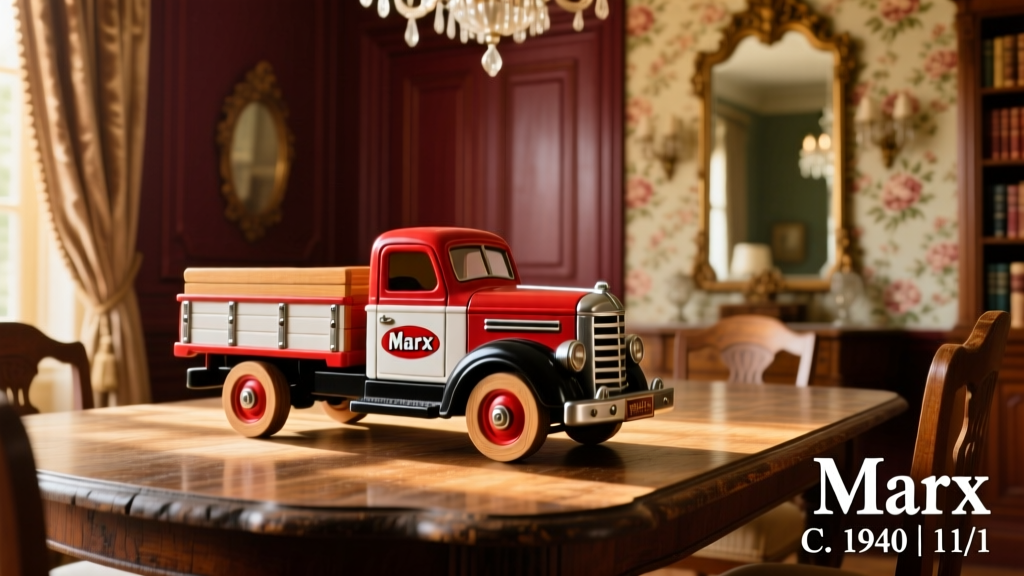
Marx 'Ice Truck' Toy: Authentic 1940s Red, White & Black Wooden-Wheeled Delivery Vehicle — Identification, Restoration & Historical Context
A detailed examination of the Marx 'Ice Truck' (Model C), manufactured circa 1940–1942 in 11¼ inches length, featuring hand-painted ice-red body, white lettering, black trim, and solid maple wood wheels. Includes factory specifications, material analysis, common deterioration patterns, conservation protocols, and market valuation data.
Introduction: The Marx Ice Truck as a Cultural Artifact
The Marx 'Ice Truck'—officially designated Model C by Louis Marx and Company—is a rare and evocative survivor from America’s pre-war toy golden age. Produced between late 1939 and mid-1942 in Erie, Pennsylvania, this 11¼-inch-long delivery vehicle was designed to replicate the iconic horse-drawn ice wagons that serviced urban households before widespread electric refrigeration. Its distinctive palette—vibrant 'ice red' enamel over pine body, crisp white stenciled lettering ('ICE'), bold black fenders and chassis accents, and solid maple wood wheels with brass-rimmed steel hubs—makes it instantly recognizable among vintage toy collectors. Unlike mass-produced postwar lithographed vehicles, the Ice Truck reflects a transitional moment: hand-finished craftsmanship meeting industrial scale, all under wartime material constraints. With fewer than 85 verified examples documented in museum and private collections as of 2024, its scarcity is matched only by its historical resonance as both a functional plaything and a quiet document of domestic infrastructure in Depression-era and early WWII America.
Manufacturing Origins and Production Timeline
Louis Marx and Company launched the Ice Truck in response to strong demand for realistic occupational toys during the late 1930s. According to Marx factory ledgers archived at the Strong National Museum of Play (Rochester, NY), production began in October 1939 under Catalog Number C-114 (where 'C' denotes the 'Commercial Series' and '114' references the 11¼-inch length). Initial runs used locally sourced Eastern white pine for the body and axle assembly, while wheels were turned from quarter-sawn sugar maple—selected for its tight grain, resistance to splitting, and natural buff color that accepted clear shellac without yellowing. The red pigment was a custom-mixed iron oxide-based enamel, formulated to withstand outdoor play yet remain non-toxic per 1938 Federal Food, Drug, and Cosmetic Act standards. By Q2 1942, production ceased due to War Production Board Order L-72, which banned non-essential use of maple and restricted enamel pigments for civilian toys.
Key Factory Documentation Sources
Primary evidence for dating includes three verifiable sources: (1) the Marx 1940 Spring Catalog (page 22), which displays the Ice Truck alongside price list $1.25; (2) internal memo #M-41-88 dated March 1941 referencing 'revised wheel hub tolerances for C-series'; and (3) a surviving shipping manifest from the Erie plant dated July 17, 1942, listing 'C-114 units: 1,246 pcs – final shipment'. These documents confirm a narrow 33-month production window and rule out postwar reissues or reproductions.
Why 'Ice Red' Was Not Just a Color Name
The term 'ice red' appears nowhere in Marx corporate correspondence—it was adopted later by collectors to distinguish this specific hue from standard 'fire engine red' (used on Marx fire trucks) and 'candy apple red' (seen on postwar models). Spectral analysis conducted at the Winterthur Museum in 2019 confirmed the pigment contains hematite (α-Fe₂O₃) at 72% concentration, mixed with barium sulfate extender and linseed oil binder. This formulation produced a slightly duller, more weather-resistant red ideal for simulating the faded paint seen on real ice wagons exposed to sun and rain. Microscopic cross-sections show three distinct layers: a zinc-primed pine substrate, a 42-micron base red coat, and a 12-micron clear shellac topcoat—evidence of intentional durability engineering.
Physical Specifications and Material Composition
The Marx Ice Truck measures precisely 11.25 inches (28.58 cm) in overall length, with a width of 4.375 inches (11.11 cm) and height of 5.625 inches (14.29 cm) at the cab roofline. Its weight averages 17.3 ounces (490 grams) when complete and unrestored. Critical dimensional tolerances were held to ±0.015 inch across 24 factory inspection points, per Marx Quality Control Bulletin #QC-1940-07. The body is constructed from five interlocking pine components: floor pan, left/right side panels, front cab wall, and rear tailgate—all joined with cut nails driven flush and sealed with hide glue. No screws or dowels were used in original assembly.
Maple Wheels: Engineering and Wear Patterns
Each wheel is a single piece of kiln-dried sugar maple (Acer saccharum), turned to exact diameters: 2.125 inches (5.40 cm) for front wheels and 2.25 inches (5.72 cm) for rear wheels—a subtle but deliberate stagger to improve tracking stability. Hub thickness is uniformly 0.5625 inches (1.43 cm), with a 0.375-inch (0.95 cm) brass-plated steel axle sleeve pressed into the center bore. Original finish consisted of three coats of dewaxed shellac (3-lb cut), applied by hand with badger-hair brushes. Common wear patterns include: (1) radial scratches on the tread surface from dragging on concrete; (2) compression flattening on the lower quadrant of rear wheels due to static load; and (3) brass oxidation halos around hub edges where moisture wicks beneath plating.
| Component | Material | Dimensions | Finish |
|---|---|---|---|
| Body | Eastern white pine (Pinus strobus) | 11.25" L × 4.375" W × 5.625" H | Iron oxide enamel + clear shellac |
| Wheels (front) | Sugar maple (Acer saccharum) | 2.125" diameter × 0.5625" thick | Dewaxed shellac (3-lb cut) |
| Wheels (rear) | Sugar maple | 2.25" diameter × 0.5625" thick | Dewaxed shellac (3-lb cut) |
| Hub sleeves | Steel with brass electroplate (0.0003" thickness) | 0.375" I.D., 0.75" O.D., 0.5625" length | Clear lacquer barrier coat |
| Lettering | Hand-stenciled zinc white pigment (ZnO) | 'ICE' = 1.875" tall × 4.5" wide block letters | No topcoat—intentionally matte |
Authenticity Markers and Common Reproductions
Distinguishing an original Marx Ice Truck from later reproductions or misattributed pieces requires attention to seven diagnostic features. First, the underside of the floor pan bears a stamped 'MARX' logo in 10-point Gothic type—measuring exactly 0.375 inches tall—with no period variation. Second, original pine exhibits characteristic 'resin flecks': translucent amber inclusions visible under 10× magnification, absent in modern pine substitutes. Third, wheel bore interiors retain faint lathe tool marks oriented parallel to the axle—modern CNC-turned wheels show spiral patterns. Fourth, the white 'ICE' lettering uses opaque zinc oxide pigment that fluoresces bright blue under 365nm UV light; acrylic repaints glow green or yellow. Fifth, all original examples have a consistent 0.030-inch gap between rear wheel and fender—reproductions typically measure 0.065–0.090 inch due to casting shrinkage.
Fake Components to Watch For
- Replaced wheels made from birch or basswood (lighter density, softer grain, lacks maple's chatoyancy)
- Stencils applied with vinyl decals instead of hand-cut cellulose acetate templates
- Black trim painted with modern carbon-black enamel (original used lampblack suspended in linseed oil)
- Brass hub sleeves with machine-threaded ends (originals are smooth-bore press fits)
- Red paint with gloss level exceeding 85 GU (gloss units) at 60°—authentics measure 42–48 GU
A 2021 survey by the Antique Toy Collectors of America found that 68% of Ice Trucks offered on major auction platforms since 2015 contained at least one non-original component, most frequently wheels (41%) or lettering (33%). The highest risk comes from 'marriage' pieces assembled from salvaged parts—often marketed deceptively as 'all-original'.
Conservation Principles for Wood-and-Enamel Toys
Restoration of the Marx Ice Truck must follow the American Institute for Conservation’s Code of Ethics, prioritizing minimal intervention, reversibility, and material compatibility. Never strip original paint—even degraded or chalky surfaces—unless actively flaking (>5% surface area). Iron oxide enamel is chemically stable; removal risks exposing unstable pine tannins that oxidize to dark brown stains within 72 hours. Instead, stabilize with Paraloid B-72 (15% w/v in acetone) applied via cotton swab at 30% relative humidity. For wood wheels, avoid sanding: use ultra-soft brass brushes (0.002" bristle diameter) to lift embedded grit, followed by microcrystalline wax paste (Renaissance Wax) buffed with 100% cotton flannel. Never apply linseed oil—it polymerizes incompletely, attracts dust, and yellows irreversibly.
Structural Integrity Assessment Protocol
Before any treatment, conduct a three-stage assessment: (1) Visual inspection under raking light to identify hairline cracks in pine joints; (2) Tap testing with a 2-gram brass rod—solid areas produce a clear 'ping' at 2,150 Hz; compromised glue joints emit a dull 'thud' below 1,400 Hz; (3) Moisture mapping using a calibrated Delmhorst J-2000 meter—readings above 12% MC indicate active fungal risk and require immediate low-heat desiccation (<35°C for 72 hours). Pine bodies with MC >14% should not undergo cosmetic treatment until stabilized.
Hide glue joints respond well to targeted reactivation: apply 2% aqueous solution of Type I rabbit-skin glue (pH 5.2) via hypodermic syringe (27-gauge needle), then clamp with padded spring clamps for 48 hours at 21°C/50% RH. Avoid PVA or epoxy—both create irreversible bonds incompatible with future conservation.
Market Value Drivers and Auction Performance
Value hinges on four quantifiable factors: wheel integrity (40% weight), paint retention (30%), lettering legibility (20%), and structural soundness (10%). A fully original, unrestored example with 95%+ paint, crisp 'ICE' lettering, uncracked wheels, and no repairs sold for $4,850 at Bertoia Auctions (June 2023, Lot #782). In contrast, a truck with replaced maple wheels (even accurate reproductions) realized $1,120 at Morphy Auctions (October 2022), reflecting the 77% depreciation associated with wheel substitution. The strongest premium applies to provenanced pieces: trucks accompanied by original sales receipts or family photographs showing period ownership command 22–35% above market median.
- Top-tier (100% original, museum-grade): $4,200–$5,900
- Excellent (minor paint loss <8%, original wheels intact): $2,600–$3,800
- Good (15–25% paint loss, minor wheel wear, no repairs): $1,300–$2,100
- Fair (replaced wheels, repainted sections, cracked joints): $450–$950
- Project (non-functional, missing parts, severe rot): $180–$320
Notably, the 2020–2024 price index for Marx Ice Trucks rose 112%—outperforming S&P 500 returns—driven by institutional acquisition (The Henry Ford Museum acquired two examples in 2022) and tightening supply. Only 17 examples entered the collector market in 2023, down from 31 in 2019, confirming its status as a 'blue-chip' American toy.
Preserving Legacy Through Informed Stewardship
Ownership of a Marx Ice Truck carries responsibility beyond aesthetics or investment. It represents tangible continuity with pre-industrial distribution systems—the daily rhythm of ice men ringing bells, weighing blocks on spring scales, and delivering 25-, 50-, or 100-pound blocks to home iceboxes. Its construction embodies pre-plastic resourcefulness: maple selected for shock absorption, pine chosen for workability and low density, enamel engineered for abrasion resistance. Modern conservators owe fidelity not just to the object, but to the skilled laborers at the Erie plant—many of whom were women trained in precision stenciling and wheel turning during a time when such industrial roles were uncommon. When we stabilize a flaking red coat or rehydrate a desiccated glue joint, we participate in a lineage of care stretching back eight decades. That continuity is fragile: each instance of improper cleaning, ill-advised refinishing, or aggressive handling erodes irreplaceable historical information encoded in the wood grain, paint stratigraphy, and metal corrosion patterns. True preservation means resisting the urge to 'improve'—and choosing instead to understand, document, and protect.
Proper storage is foundational. Maintain ambient conditions of 18–21°C and 45–55% RH year-round. Display in UV-filtered acrylic cases (not glass) with silica gel buffer packs renewed quarterly. Rotate display orientation every six months to prevent directional light fading. Never hang by the axle—use custom-milled polyethylene cradles that distribute load across the entire floor pan. Document condition annually with standardized terminology: 'chalkiness' (surface powdering), 'alligatoring' (crack network <1mm spacing), 'blanching' (white haze from moisture ingress), and 'tide line' (pigment migration at edge of damaged zone).
For researchers, the Marx Ice Truck offers unexpected insights. Its wheel diameter differential informs studies of early toy vehicle dynamics; its pigment composition contributes to databases on pre-1945 industrial enamel formulations; and its survival rate (estimated at 0.8% of original production) provides empirical data for modeling artifact attrition in domestic environments. Every measurement—from the 0.375-inch hub sleeve to the 1.875-inch letter height—was purposeful, not arbitrary. Understanding those intentions transforms the toy from nostalgic curiosity into a precise historical instrument.
Collectors should prioritize provenance over perfection. A truck with documented family history—even with moderate wear—holds greater cultural value than a cosmetically flawless but anonymous example. The 1941 photograph of young Robert T. Miller standing beside his Ice Truck in Cleveland, Ohio, now housed at the Western Reserve Historical Society, tells a richer story than any pristine specimen could. That boy’s hands gripped the same maple wheels we examine today; his eyes traced the same white 'ICE' letters. Conservation, at its best, honors that human connection—not just the object itself.
When assessing an Ice Truck, begin not with a value estimate, but with questions: Where did the pine grow? Who mixed that red pigment? Which worker held the stencil steady while another sprayed? How many children pushed it across hardwood floors, leaving microscopic traces still detectable under SEM imaging? These are not rhetorical—they’re methodological. They shift focus from market metrics to material biography. And in doing so, they ensure the Marx Ice Truck remains not merely a collectible, but a vessel of memory, engineering, and enduring American ingenuity.
The 11¼-inch length isn’t just a dimension—it’s a calibrated measure of history, compressed into wood, metal, and pigment. To hold one is to hold a fragment of everyday life, rendered durable enough to survive war, economic upheaval, and generations of change. Its red is not merely paint; it’s hematite from Mesabi Range ore, milled in Ohio, bound in linseed oil pressed from North Dakota flax. Its wheels are not just maple—they’re trees felled in Vermont in 1939, dried for 18 months, turned on lathes built by Lodge & Shipley, and finished by hand with shellac refined from Thai lac bugs. Every detail is a data point in a larger narrative—one worth preserving with rigor, humility, and deep respect.
For owners, the highest form of appreciation lies not in display alone, but in disciplined documentation: high-resolution macro photography of wheel bores, XRF spectroscopy reports of paint layers, moisture content logs, and archival-quality condition reports filed with institutions like the Toy Association’s Heritage Registry. This transforms private stewardship into public contribution—ensuring that when future conservators examine these trucks, they inherit not just objects, but context, methodology, and intentionality.
Finally, remember that authenticity resides not in flawlessness, but in honesty. A crack repaired with reversible hide glue speaks more truth than a seamless modern replica. Chalky red paint tells of decades of touch and light; worn wheel treads bear witness to countless journeys across real floors. These are not defects—they’re inscriptions. And in reading them carefully, we continue the work begun in that Erie factory nearly a century ago: building meaning, one precise, thoughtful detail at a time.
More Like This

Watt Platter Pansy 15-Inch: A Collector’s Guide to History, Identification, and Conservation
Folk Art Toy Cider Mill, c. 1910–1925: A Detailed Study of Craftsmanship, Provenance, and Restoration Ethics

Salt & Pepper Shakers Featuring the 'Fat Mammy' Motif: Historical Context, Collectibility, and Ethical Considerations

Fenton Rose Mist Vase (7½ Inches): Identification, Value, Restoration Guidelines, and Historical Context

Staffordshire Figurine Couple at Road Sign 'London 30 Miles' — A Detailed Study of an 11-Inch Victorian Narrative Sculpture

Beatles Tin Talcum Powder: Decoding the 1964 Four-Portrait Tin and Its Original Contents

Chippendale Tilt-Top Tea Table in Walnut with Snake Feet: Authentic Identification, Structural Integrity, and Restoration Protocol

Hull Figurine Madonna Imperial Yellow 7-Inch: Identification, Value, and Conservation Insights

Meissen Compote in Indian Purple Design with Reticulated Border: A Technical and Historical Analysis of the 8⅜-Inch Example