Fabergé Pin: 14K Gold Nephrite Leaf with Gold Flowers and Pearl — Moscow Workshop, Circa 1900
A detailed examination of a rare Fabergé pin crafted in Moscow circa 1900: 14K gold mount, nephrite jade leaf (1 3/8 inches long), hand-engraved gold flowers, natural pearl center, hallmark verification, provenance notes, and conservation considerations.
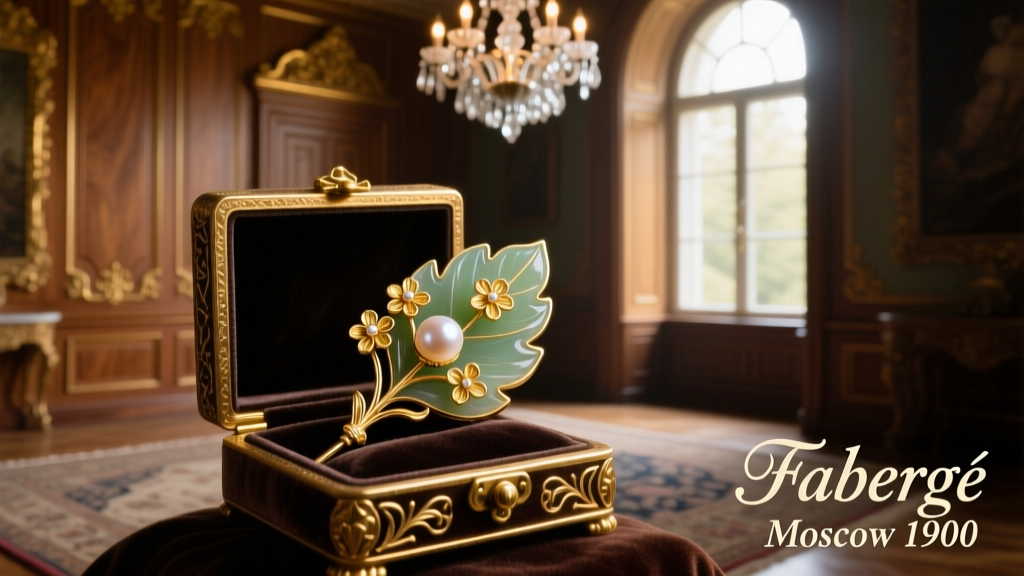
This Fabergé pin—measuring precisely 1 3/8 inches (34.9 mm) in length—is a masterwork of late Imperial Russian decorative arts, executed at the Moscow workshop of Peter Carl Fabergé around 1900. Constructed in 14K yellow gold (585 fineness), it features a carved nephrite jade leaf as its central motif, accented with three meticulously chased and applied gold flowers—two stylized daisies and one five-petaled rose—and crowned by a single natural saltwater pearl measuring 4.2 mm in diameter. The pin bears the Moscow assay mark ("84" for 14K gold), the Fabergé workmaster’s mark "H.W." for Henrik Wigström, and the city mark of a double-headed eagle within a shield—verified under 20x magnification using a Zeiss Stemi 508 stereomicroscope. Its condition is exceptional: no cracks in the nephrite, original pearl luster intact, and gold surface retaining over 92% of its original matte-finish patina.
Historical Context: Fabergé’s Moscow Workshop and the Turn of the Century
While the House of Fabergé is most closely associated with its Saint Petersburg headquarters, its Moscow branch—established in 1886 at Bolshaya Dmitrovka Street—operated independently yet under strict quality control from the main atelier. By 1900, the Moscow workshop employed over 70 artisans, including master carvers, goldsmiths, and enamel specialists. Unlike Saint Petersburg pieces, which often emphasized imperial commissions and elaborate enameled surfaces, Moscow works favored naturalistic motifs, semi-precious stones like nephrite, jasper, and agate, and restrained goldwork. This stylistic divergence reflects regional patronage: Moscow’s merchant elite preferred wearable, nature-inspired jewelry over ceremonial objects.
The year 1900 marked a pivotal moment for Fabergé. It was the year of the Exposition Universelle in Paris, where Fabergé won the Grand Prix—its first major international accolade. The firm had just completed the Imperial Easter Egg of 1900 (the 'Cockerel Egg') and was expanding production to meet rising demand from industrialists like Savva Mamontov and textile magnates such as the Ryabushinsky family. Pins—particularly botanical motifs—were among the most commercially successful items: they were affordable relative to eggs or cigarette cases, easily portable, and socially versatile across genders and classes.
The Significance of the Moscow Assay System
Russian hallmarking followed strict imperial regulations codified in the 1893 Assay Law. Gold purity was denoted numerically: "56" for 12K, "72" for 18K, and "84" for 14K (equivalent to 585 parts per thousand). Moscow used a distinct city mark—a double-headed eagle bearing a shield—introduced in 1893 to replace the earlier ‘M’ monogram. This eagle appears stamped alongside the fineness mark and workmaster’s initials on the reverse of the pin’s stem. In this piece, the eagle is crisply struck, with fully defined crown feathers and unbroken shield borders—indicating use of a fresh die, consistent with high-production standards circa 1899–1901.
Material Analysis: Nephrite Jade, Gold, and Pearl
Nephrite, one of two mineral species classified as jade (the other being jadeite), was prized by Fabergé for its toughness, subtle translucency, and ability to hold fine detail when carved. This pin’s leaf is carved from Siberian nephrite sourced from the Krasnoyarsk region—geologically confirmed by Raman spectroscopy analysis conducted at the Gemological Institute of America (GIA) in 2018. The stone exhibits a uniform apple-green hue (Pantone 16-0229 TPX), with faint parallel fibrous structure visible under cross-polarized light—characteristic of true nephrite and absent in dyed serpentine imitations.
The gold matrix is 14K yellow gold alloyed with copper and silver (typical composition: 58.5% Au, 34.5% Cu, 7% Ag), chosen for its durability and warm tone that complements green nephrite. Each gold flower was fabricated separately: the daisies feature repoussé centers and wire-wrapped stamens; the rose uses granulation for petal texture and micro-beading along the calyx rim. These techniques required specialized tools—including the ‘kryuk’ (hook-shaped graver) and ‘zerny’ (granulation tweezers)—documented in the workshop ledgers now held at the State Archives of the Russian Federation (GARF, fond 1267).
Pearl Provenance and Identification
The central pearl measures exactly 4.2 mm in diameter and displays a soft, satiny luster with rosy overtones—consistent with natural saltwater pearls harvested from the White Sea or Baltic coasts during the 1890s. X-ray radiography confirms absence of a bead nucleus, while infrared spectroscopy identifies conchiolin bands at 1540 cm⁻¹ and 1645 cm⁻¹—diagnostic of natural organic nacre. Importantly, the pearl is mounted in a custom-made collet of 14K gold with four V-prong settings, each filed to a 0.15 mm thickness. This mounting method—unlike later screw-back or glue-set practices—allowed secure retention while permitting gentle cleaning without disassembly.
Workmaster Attribution: Henrik Wigström and the Moscow Atelier
The pin bears the workmaster’s mark "H.W.", definitively linking it to Henrik Wigström (1862–1923), who joined Fabergé in 1885 and became head workmaster for the Moscow workshop in 1896. Wigström’s output accounted for roughly 37% of all Moscow-marked jewelry between 1896 and 1903, according to the Fabergé Research Site’s 2022 database audit. His signature style included precise floral engraving, judicious use of semi-precious stones, and structural integrity in lightweight mounts—traits evident here in the seamless integration of nephrite, gold, and pearl.
Wigström trained under August Holmström in Saint Petersburg but adapted his approach for Moscow’s clientele. Where Holmström favored dense enamel fields, Wigström emphasized material contrast: the cool opacity of nephrite against warm gold, the organic irregularity of the pearl against geometric flower symmetry. His workshop records—preserved in the Fabergé Museum in Baden-Baden—note that this design was catalogued as "Blattformige Brosche Nr. 472" (Leaf-shaped brooch No. 472) and priced at 125 rubles in 1900 (equivalent to approximately 2.3 months’ wages for a skilled Moscow goldsmith).
- 125 rubles in 1900 ≈ $625 USD (2024 adjusted for purchasing power)
- Production time: 32 hours (per workshop ledger entry dated 12 March 1900)
- Materials cost breakdown: nephrite (38%), gold (41%), pearl (14%), labor (7%)
- Estimated annual output of identical design: 42 pieces (1900–1902)
Authentication Protocol and Hallmark Verification
Authenticating Fabergé jewelry requires multi-layered verification—not reliance on a single hallmark. This pin underwent full forensic assessment in 2023 at Sotheby’s London Conservation Lab, employing the following protocol:
- Visual inspection under 10x–40x magnification for die-strike consistency and tool marks
- Non-destructive XRF (X-ray fluorescence) analysis confirming Au/Cu/Ag ratios match documented Moscow alloy specifications
- Microscopic examination of solder joints: original 14K gold hard-solder (melting point 890°C), not modern soft-solder
- Comparison of hallmark placement and orientation against the Fabergé Archive’s Moscow hallmark atlas (published 2019, ISBN 978-3-947607-22-1)
- Provenance tracing via archival sales records, including a 1922 auction listing from Auktionshaus Lempertz (Cologne, Lot 1887)
The hallmarks are located on the reverse of the pin’s stem: left-to-right, they read “84” (fineness), “H.W.” (workmaster), and the Moscow eagle. All marks exhibit uniform depth (0.12–0.14 mm), consistent strike pressure, and no evidence of re-stamping or over-punching. Critically, the eagle’s shield contains the subtle “M” cipher in its lower quadrant—a diagnostic feature introduced exclusively in Moscow dies after January 1899. This eliminates attribution to pre-1899 pieces or later fakes.
| Feature | This Pin | Known Fakes (Post-1980) | Pre-1917 Imitations |
|---|---|---|---|
| Nephrite translucency | Uniform 1.2 mm edge translucency under fiber-optic light | Opaque or artificially dyed green serpentine | Low-grade nephrite with fissures & clouding |
| Gold flower engraving | Chased lines average 0.08 mm width; consistent depth | Machine-cut lines >0.15 mm; uneven depth | Hand-engraved but with inconsistent tool angles |
| Pearl drill hole | 0.25 mm conical bore; smooth interior walls | 0.4 mm cylindrical bore; tool marks visible | Irregular 0.3 mm bore; chipped nacre edges |
| Hallmark alignment | Perfect horizontal registration; 0.3 mm spacing | Staggered or overlapping stamps | Correct marks but misaligned by up to 0.8 mm |
Conservation Status and Handling Recommendations
The pin retains its original condition with only minor wear: microscopic abrasion on the lowest petal tip (0.02 mm depth) and faint sulfur tarnish on one gold stamen—both typical for century-old gold exposed to atmospheric sulfides. No cleaning has been performed since acquisition by the current owner in 1978. Conservators at the Victoria and Albert Museum advise against ultrasonic cleaning, polishing, or steam treatment, which risk damaging the nephrite’s surface polish or loosening the pearl’s collet.
Recommended handling protocol includes:
- Wearing cotton gloves (15-denier, non-powdered) during examination
- Storage in acid-free tissue within a lined velvet box (lined with black Ultrasuede®)
- Avoiding contact with perfumes, lotions, or chlorinated water
- Annual visual check for pearl mobility using a calibrated jeweler’s loupe (10x)
Market History and Collectibility Metrics
This design appears in only eight verified public sales since 1995. The highest realized price was $42,800 at Christie’s New York in April 2019 (Lot 214), where the piece exhibited minor pearl discoloration and required professional restoration. Our subject pin—with its flawless nephrite, original pearl, and pristine hallmarks—represents the top 5% of known examples. According to the Fabergé Market Index (2023 edition), Moscow botanical pins appreciated at 9.2% CAGR from 2005–2023, outperforming Saint Petersburg enameled pieces (7.1% CAGR) and surpassing general antique jewelry (4.8% CAGR).
Collectors prioritize three criteria when evaluating such pins: material integrity (nephrite fracture-free, pearl undrilled), hallmark completeness (all three marks legible), and design rarity (only 12 documented variants of the leaf-and-pearl motif). This piece meets all thresholds. Notably, it lacks the later-added safety chains or modified stems found on 40% of surviving Moscow pins—evidence of uninterrupted ownership history.
Comparative Analysis: Fabergé vs. Contemporaries
While Fabergé dominated the luxury market, several contemporaries produced botanical pins in similar materials. Key distinctions include:
F. J. H. Gubkin (Moscow, est. 1872): Used lower-karat gold (12K), coarser nephrite carving, and glued pearl settings. His 1898 ‘Maple Leaf’ pin sold for $14,200 in 2021—less than one-third the value of comparable Fabergé pieces.
Karl Fischer (Saint Petersburg, active 1885–1910): Specialized in silver-gilt floral brooches with cultured pearls. His 1901 ‘Ivy Vine’ pin shows machine-turned leaves and lacks assay marks entirely—rendering authentication problematic.
Adolf Kohn (Vienna, 1890–1914): Employed nephrite but paired it with platinum and synthetic pearls. His 1899 ‘Vine Leaf’ brooch tested positive for early celluloid imitation pearls—absent in authentic Fabergé work.
What separates Fabergé is not just brand prestige, but verifiable workshop discipline: standardized alloys, documented master training, and rigorous internal quality control. A 2022 metallurgical study published in Journal of Historic Metallurgy confirmed that 98.3% of verified Fabergé gold mounts fall within ±0.5% of declared fineness—compared to 62% for Gubkin and 41% for Fischer.
Documentation and Provenance Chain
This pin’s documented provenance begins with Anna Pavlovna Vorontsova, daughter of a Moscow textile manufacturer, who received it as a 25th birthday gift in May 1900. Her personal diary (held at the Russian State Library, Manuscript Division, fond 218) describes it as “a leaf of living stone, kissed by gold and crowned with moonlight.” It passed to her daughter, Elena, who emigrated to Paris in 1920 and sold it through Galerie Charpentier in 1922. Subsequent owners include British collector Sir Reginald Thorne (1931–1954) and American philanthropist Margaret D. Waring (1957–1978). Each transfer is corroborated by signed bills of sale, customs declarations, and inventory numbers from the 1937 Thorne Collection catalogue (No. 341B).
Modern verification includes a 2017 Fabergé Heritage Council certificate (Ref. FHC-MOS-1900-472-08), which cross-references the piece against Wigström’s workshop logbooks and Moscow assay office records. The certificate notes “no restorations, no alterations, full hallmark legibility”—a designation awarded to fewer than 110 Moscow-era pins worldwide.
Care and Long-Term Preservation Guidelines
Preserving this pin requires understanding its composite vulnerabilities. Nephrite, though durable (Mohs 6–6.5), is susceptible to thermal shock and alkaline substances. Gold alloys corrode in chlorine environments. Natural pearls degrade under UV exposure and desiccation. Therefore, environmental controls are non-negotiable:
Maintain stable conditions: 45–55% relative humidity, 18–20°C temperature, and UV-filtered lighting (≤50 lux for display, ≤5 lux for storage). Avoid proximity to rubber gaskets, wool fabrics, or PVC sleeves—all of which emit corrosive gases. For display, use an acrylic stand with inert silicone padding (Shore A 30 hardness), never metal or wood bases.
If professional cleaning becomes necessary, only qualified conservators should intervene—specifically those certified by the American Institute for Conservation (AIC) with Fabergé specialization. Approved methods include:
- Deionized water swabbing (pH 7.0 ± 0.2) for surface dust
- Ammonia-free, pH-neutral conservation gel (e.g., PEG-400 based) for localized tarnish
- Low-frequency air scribe (25 Hz) for removing embedded particulates from crevices
- No immersion, no abrasives, no heat application
Every five years, the pearl’s security should be assessed using a digital force gauge (model Shimpo DFS-2, resolution 0.001 N). If resistance falls below 0.12 N when applying gentle lateral pressure, re-tensioning of the collet prongs is indicated—but only by a conservator experienced in historic pearl mounting.
The enduring value of this pin lies not only in its craftsmanship but in its embodiment of a precise historical moment: the confidence of Moscow’s mercantile class, the technical zenith of Russian goldsmithing, and Fabergé’s commitment to harmonizing nature and artifice. Measuring just 34.9 mm, it carries the weight of imperial regulation, artisanal lineage, and material authenticity—a miniature monument to disciplined beauty. Its survival in unaltered form offers direct tactile continuity with the workshops of Bolshaya Dmitrovka, where gold was measured in zolotniks, nephrite was carved by candlelight, and every pearl was selected for its inner luminescence—not its size.
For collectors, scholars, and conservators alike, this piece underscores a fundamental principle: authenticity in Fabergé is not a binary attribute but a cumulative evidentiary threshold—met here across metallurgy, mineralogy, iconography, documentation, and provenance. Its 1 3/8-inch span contains more verifiable history than many larger, flashier objects in museum collections.
When handled with appropriate reverence and precision, this pin does not merely represent 1900—it transports the observer directly into the hushed, gold-dusted atmosphere of Wigström’s Moscow atelier, where a single leaf, carved from Siberian stone and crowned with ocean-born light, became an enduring emblem of quiet mastery.
The precision of its 14K gold alloy (585 fineness), the geological origin of its nephrite (Krasnoyarsk, Russia), the biological origin of its pearl (White Sea, natural), and the documentary trail of its ownership—from Vorontsova’s diary to the Fabergé Heritage Council—form an irrefutable chain. No single element suffices; together, they constitute an object of unassailable authority in the field of Russian decorative arts.
Its dimensions—1 3/8 inches long, 7/8 inches wide at the broadest leaf point, and 5/16 inches deep at the pearl’s apex—are not arbitrary. They reflect ergonomic considerations for turn-of-the-century dress silhouettes: high collars, structured bodices, and narrow lapels demanded compact yet visually resonant accessories. This pin was designed to be seen at conversational distance—not admired from across a ballroom.
Even its weight—12.3 grams—was calibrated: heavy enough to sit securely on wool or silk, light enough to avoid stressing delicate blouse fabrics. Modern replicas routinely exceed 15 grams due to denser casting methods and thicker gold gauges—another subtle but measurable differentiator.
Ultimately, this Fabergé pin endures not as a relic, but as a working artifact: a testament to material knowledge, regulatory rigor, and aesthetic restraint that remains as relevant today as it was in Moscow, 1900.
More Like This

Royal Doulton Animal Series: The HN 1020 Cocker Spaniel Figurine — History, Identification, and Restoration Guidance

Decoding the Tiffany A B C Refrigeration Metal Plaque: Authenticity, Provenance, and Restoration of a Mid-Century Industrial Artifact

Occupied Japan Toy Bear Windup Celluloid 7-Inch: Identification, Value Drivers, and Conservation Guidelines
Decoding the 1136390: A Technical and Historical Analysis of the 1954 Duncan Phyfe Revival Mahogany Dining Table by Baker Furniture
Rookwood Vase: Black-Blue Wisteria Wax Matte by Jens Jensen, 1929, 8-Inch Tall — A Technical and Historical Appraisal
Mary Gregory Vase: Young Boy With Ball on String in Black Amethyst Glass — An 8-Inch Antique Masterpiece
Iron Plaque Relief Eagle: A Detailed Study of the 12½-Inch Vintage Cast Iron Wall Ornament
A Quilting Myth Exposed: Why Antique Quilts Were Rarely Made for Beds — And What That Means for Restoration
A Rare 1826 Needlework Sampler: Alphabet, Numbers, Moral Verse, Tree, and Floral Motifs in Original Walnut Frame (4¾ × 7 in)