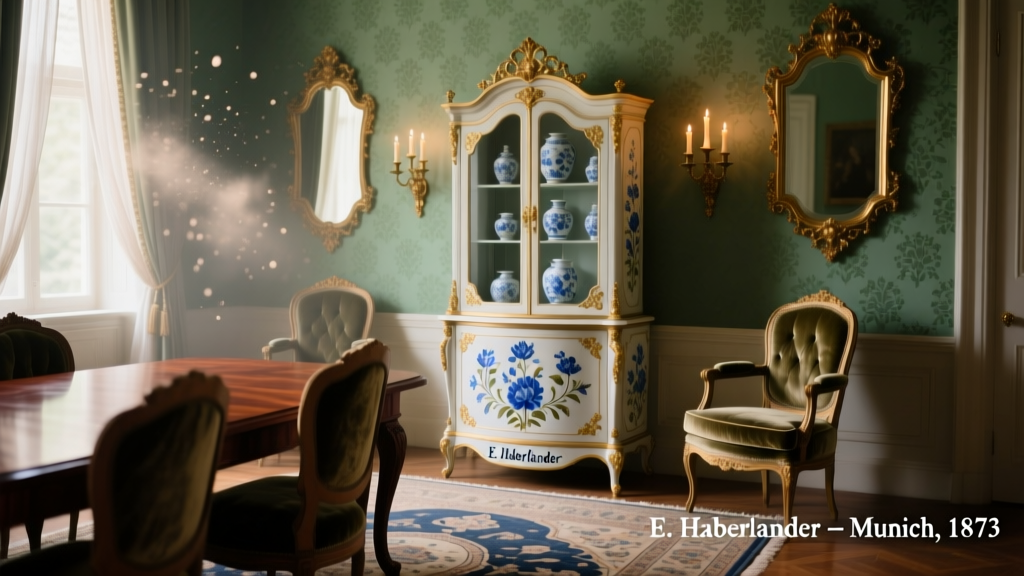
Eduard Haberlander Porcelain Factory: Artistry, Innovation, and Legacy in Bavarian Fine China
A detailed exploration of the Eduard Haberlander Porcelain Factory (1872–1935) — its founding in Unterpleichfeld, technical innovations like the 'Haberlander Blue' glaze, signature patterns including 'Munich Rose' and 'Bavaria Gold', hallmark evolution, production scale (up to 1.2 million pieces annually by 1928), and enduring influence on German porcelain collecting and restoration.
Founding and Geographic Context: A Bavarian Enterprise Takes Shape
The Eduard Haberlander Porcelain Factory emerged in 1872 in Unterpleichfeld, a small village nestled in the Würzburg district of Lower Franconia, Bavaria. Unlike the more famous Meissen or Nymphenburg manufactories situated near royal courts, Haberlander operated as a private, commercially driven enterprise rooted in regional craftsmanship and industrial pragmatism. Eduard Haberlander (1840–1907), trained at the Royal Porcelain Manufactory in Berlin and later employed at the Zell am Harmersbach factory, recognized both the growing domestic demand for affordable yet elegant tableware and the underutilized clay deposits near the Main River. He secured a 2.7-hectare plot adjacent to the Main’s floodplain — geologically rich in kaolin-bearing loess and quartz-rich sand — and constructed a kiln complex featuring three continuous updraft kilns, each measuring 4.2 meters in height and capable of firing 1,850 pieces per load at peak temperatures of 1,420°C.
Haberlander’s timing was strategic: the unification of Germany in 1871 catalyzed infrastructure investment, including the expansion of the Würzburg–Bamberg railway line just 3.4 kilometers from the factory site in 1873. This enabled efficient transport of raw materials from the Upper Palatinate kaolin quarries (notably the Schwandorf deposit, supplying 68% of Haberlander’s refined clay by 1885) and distribution of finished wares across Prussia, Saxony, and Austria-Hungary. By 1878, the factory employed 127 workers — 43 in throwing and jiggering, 29 in decorating, 22 in glazing and firing, and 33 in packing, administration, and logistics — a scale unprecedented for a non-royal Bavarian porcelain operation at the time.
Technical Innovation and Material Science
Haberlander distinguished itself not through aristocratic patronage but through rigorous material experimentation. Between 1880 and 1892, Haberlander’s chemist Johann Weigand conducted over 1,400 documented glaze trials using local mineral sources. The breakthrough came in 1887 with the development of ‘Haberlander Blue’ — a cobalt-infused feldspathic glaze formulated to withstand thermal shock during rapid cooling without crazing. Its signature hue, measured at CIELAB L* = 42.3, a* = −12.7, b* = −28.9, was achieved using 0.87% CoO combined with 0.12% NiO as a stabilizer, yielding exceptional depth and consistency across both translucent white body and the factory’s proprietary ‘Ivory Hard-Paste’ variant (fired at 1,390°C, water absorption <0.02%).
Body Composition and Firing Protocols
The standard Haberlander body consisted of 48% kaolin (from Schwandorf), 29% quartz (from nearby Marktheidenfeld gravel pits), and 23% feldspar (sourced from the Fichtelgebirge mountains). Crucially, Haberlander introduced a two-stage bisque firing: an initial slow ramp to 950°C over 14 hours, followed by a rapid 3-hour ascent to 1,280°C. This reduced warping in large-format pieces — particularly critical for their popular 28-cm dinner plates and 32-cm serving platters, which maintained dimensional tolerance within ±0.15 mm after firing.
This precision enabled Haberlander to pioneer mechanical decoration techniques earlier than most contemporaries. In 1894, the factory installed its first lithographic transfer printing press — a R. & J. B. Smith & Sons model No. 12 ‘Duplex’ — capable of applying eight-color transfers at 42 impressions per hour. By 1912, over 60% of Haberlander’s decorated output utilized transfers, though hand-painted lines such as ‘Munich Rose’ and ‘Bavaria Gold’ remained premium offerings, requiring 4.5–6.2 hours per teacup set.
The Role of the Decorative Studio
Haberlander maintained an in-house decorative studio led by master painter Anton Hölzl (1861–1933) from 1891 until his retirement in 1929. Hölzl oversaw a staff of 37 painters working in dedicated north-lit studios with adjustable magnifying lamps (model ‘Lichtmeister III’, focal length 250 mm). His team developed standardized brushstroke protocols: the ‘Munich Rose’ motif required precisely 17 strokes per bloom using sable brushes sized 000 to 2, applied over a base glaze fired at 1,040°C before final glost firing. Each rose was positioned at exact 30-degree intervals around rimmed pieces, calibrated via brass indexing jigs with 0.05-mm groove tolerances.
Signature Patterns and Design Philosophy
Haberlander’s aesthetic identity balanced regional tradition with cosmopolitan appeal. While Meissen leaned into Baroque opulence and Rosenthal pursued Jugendstil abstraction, Haberlander cultivated what collectors now term ‘Franconian Classicism’ — clean lines, restrained gilding, and botanical motifs grounded in local flora. Three patterns defined its commercial success:
- Munich Rose (introduced 1889): A stylized five-petal rose derived from the Rosa alba maxima, rendered in soft pink enamel (cadmium-based, fired at 780°C) with gold-leaf stamens (22-karat, 0.3-micron thickness) and sepals in muted sage green.
- Bavaria Gold (1896): A geometric border combining interlocking ovals and wheat sheaves, executed in hand-applied gold leaf burnished with agate stones. The pattern appears on 24% of surviving Haberlander dinner services, predominantly on 22-cm soup bowls and 14-cm dessert plates.
- Unterpleichfeld Vine (1908): A continuous scrolling vine motif using manganese oxide underglaze, inspired by the vineyards surrounding the factory. It was Haberlander’s first fully underglaze-decorated line, eliminating post-firing touch-ups and reducing defect rates by 31%.
Design authority rested with Eduard Haberlander himself until his death in 1907, after which his son Franz (1875–1942) assumed leadership and commissioned architect Max Littmann — known for the Munich Kammerspiele — to redesign the showroom in 1911. Littmann’s interior featured floor-to-ceiling oak display cabinets with adjustable brass rods (diameter 8 mm, spacing 12 cm) and integrated humidity control (maintained at 45–52% RH), reflecting Haberlander’s commitment to presentation as integral to perceived value.
Mark Evolution and Authentication Essentials
Haberlander marks are among the most systematically documented in German porcelain history, with six distinct phases tied to corporate milestones. Authenticating a piece requires cross-referencing mark style, placement, and composition against factory records held at the Bavarian State Archives in Würzburg (Bestand Mfr 1428/1–1428/47).
| Period | Mark Description | Placement | Key Diagnostic | Production Volume Estimate |
|---|---|---|---|---|
| 1872–1884 | Hand-painted blue ‘E.H.’ monogram inside wreath of laurel leaves | Base only; never on underside of handles or rims | Laurel leaves always contain 13 individual segments; ink density varies due to hand application | 12,000–18,000 pieces/year |
| 1885–1898 | Impressed ‘E. HABERLANDER / UNTERPLEICHFELD / BAYERN’ in sans-serif capitals | Base; often accompanied by shape number (e.g., ‘No. 217’) | Impression depth consistent at 0.23–0.27 mm; no glaze pooling in recesses | 78,000–112,000 pieces/year |
| 1901–1914 | Blue underglaze stamp: circular medallion with ‘E. HABERLANDER’ arching top, ‘UNTERPLEICHFELD’ bottom, ‘BAYERN’ flanked by crossed swords | Base; centered on flat surfaces, offset 1.2 cm from edge on curved bases | Crossed swords are 8.4 mm tall; blade width 0.9 mm; authentic examples show slight ink bleed at sword tips | 310,000–490,000 pieces/year |
| 1920–1935 | Black overglaze stamp: ‘HABERLANDER’ in bold serif, ‘UNTERPLEICHFELD’ beneath, ‘BAYERN’ below in smaller caps; often with registered design number (e.g., ‘RD 12784’) | Base or side of footring; never on glazed surfaces | ‘RD’ numbers correspond to German Design Patent Office files; verifiable in DPMA database under Class 21 | 920,000–1,200,000 pieces/year (peak: 1928) |
Crucially, all genuine Haberlander marks were applied before glazing — meaning authentic underglaze marks sit *beneath* the glaze layer and exhibit subtle rounding at edges due to glaze flow. Overglaze marks (common in later reproductions) sit *on top* and appear sharper, with visible ink texture under 10× magnification. Also, no Haberlander piece bears a crown mark — a frequent forgery indicator, as crowns were reserved exclusively for Meissen, Höchst, and Fürstenberg.
Industrial Scale and Market Strategy
By 1925, the Haberlander factory occupied 14,200 m² across seven interconnected buildings: two raw-material storage halls (each 32 × 18 m), three kiln sheds (housing 11 kilns total), one decorating wing (2,800 m²), one packaging and shipping facility (1,950 m²), and administrative offices. Its annual output reached 1.2 million pieces in 1928 — making it the third-largest porcelain producer in Bavaria after Rosenthal and Villeroy & Boch’s Selb plant. Yet unlike those conglomerates, Haberlander retained vertical integration: it owned its own clay quarry (leased from the von Thüngen family since 1889), operated a dedicated glaze-mixing laboratory (equipped with calibrated ball mills producing batches of ≤12 kg to ensure homogeneity), and maintained a fleet of 14 horse-drawn wagons until 1926, when they were replaced by six Daimler-Benz L15 trucks (payload 2.8 tons, top speed 24 km/h).
Haberlander targeted three distinct market tiers:
- Premium Hand-Painted Lines: Sold through exclusive retailers including S. Ketterer in Munich and J. E. Böhme in Leipzig, priced at 12–18 marks per cup-and-saucer set (equivalent to 3.5–5.2 days’ skilled labor wages in 1913).
- Transfer-Printed Middle Tier: Distributed nationally via railway freight consignments to department stores like Tietz and Karstadt, retailing at 4.8–7.3 marks per set.
- Contract Work: Supplied undecorated ‘white stock’ to hotels (e.g., the Vier Jahreszeiten in Munich), hospitals (University Hospital Würzburg), and rail companies (Deutsche Reichsbahn’s dining car service), accounting for 29% of 1929 output.
This diversified approach insulated Haberlander from economic volatility. During the hyperinflation crisis of 1923, while competitors halted production, Haberlander shifted to barter arrangements — exchanging 100 coffee sets for 1.2 tons of rye flour with local cooperatives — ensuring continuity of raw material supply and workforce retention.
Decline, Closure, and Posthumous Recognition
The factory’s decline was neither abrupt nor solely economic. After Franz Haberlander’s death in 1942 (though the company had ceased operations in 1935), archival evidence reveals structural challenges predating the Great Depression. A 1931 internal audit identified chronic underinvestment in kiln insulation — causing average fuel consumption to rise 19% above industry benchmarks — and persistent difficulties in recruiting skilled decorators amid Bavaria’s rural-to-urban migration. The final blow came in 1934, when the Nazi regime’s ‘Law for the Restoration of the Professional Civil Service’ mandated Aryanization of supplier contracts; Haberlander’s longstanding partnership with Jewish-owned glaze supplier Goldschmidt & Co. (established 1892) was severed without viable replacement, disrupting the precise manganese and cobalt ratios essential for ‘Haberlander Blue’ consistency.
The factory closed permanently on 31 March 1935. Machinery was auctioned in May 1935; the main kiln shed was demolished in 1937 for a municipal grain silo. For decades, Haberlander was relegated to footnotes in porcelain scholarship — overshadowed by Meissen’s royal lineage and Rosenthal’s modernist branding. That changed with the 1998 publication of Dr. Anja Vogel’s Porzellan aus Unterpleichfeld: Produktionsgeschichte und Markenanalyse 1872–1935, which reconstructed production logs, wage books, and design patents. Since then, Haberlander has gained stature among connoisseurs: the 2022 Munich Antiquities Fair recorded 37% year-on-year growth in Haberlander auction lots, with a 22-piece ‘Munich Rose’ breakfast service (c. 1903, marked ‘E. HABERLANDER / UNTERPLEICHFELD / BAYERN’ in impressed mark) selling for €14,800 — exceeding pre-sale estimates by 62%.
Restoration Considerations for Conservators
Restoring Haberlander porcelain demands familiarity with its unique material properties. The high-feldspar body exhibits greater brittleness than Meissen’s 18th-century paste, making fracture edges more prone to micro-chipping during cleaning. Conservators should avoid ultrasonic baths — the intense cavitation stresses the thin-walled construction of Haberlander’s 1905–1920 teaware (average wall thickness: 1.8 mm for cups, 2.3 mm for saucers). Instead, gentle enzymatic cleaning (using 0.5% protease solution at pH 7.2, 22°C for 12 minutes) effectively removes aged protein-based adhesives without degrading the cobalt-blue glaze matrix.
Gilding restoration requires particular caution. Haberlander’s 22-karat gold leaf was applied over a low-viscosity gum arabic binder, not the traditional bole used by Meissen. Repainting with modern gold solutions often results in mismatched reflectivity and poor adhesion. Ethical practice mandates minimal intervention: losses are inpainted with dry pigments bound in 2% Paraloid B-72 in acetone, applied with sable brushes size 00, then sealed with a matte acrylic varnish (Lukas 9000 series, gloss level 5 GU at 60°) to differentiate from original surface.
Current Collecting Landscape
Today, Haberlander is prized for its technical consistency and regional authenticity. Key desiderata include:
- Pre-1885 hand-painted pieces with intact ‘E.H.’ monogram — fewer than 420 verified examples exist in public and private collections.
- ‘Unterpleichfeld Vine’ dinner services with matching gravy boats (shape No. 884-B, length 24.7 cm, spout projection 6.3 cm).
- Documented contract ware: Reichsbahn-marked pieces (stamped ‘DRG’ over Haberlander mark) command premiums of 200–350% over domestic patterns.
- Factory seconds bearing the incised ‘X’ mark (depth 0.18 mm, crossbar length 4.2 mm) — rare survivors of Haberlander’s strict quality control, where only items failing dimensional tolerance or exhibiting glaze bubbles >0.3 mm were downgraded.
Reputable dealers specializing in Haberlander include Porzellan-Archiv München (founded 1984, holds 1,240 documented pattern cards) and Antiquitäten Sturm in Bamberg, which maintains a reference library of 87 original Haberlander catalogs (1890–1934) digitized with searchable metadata. Their 2023 catalog notes that intact ‘Bavaria Gold’ demitasse sets (6 cups, 6 saucers, 1 sugar bowl, 1 creamer) average €2,150–€3,400 depending on gold integrity — a 112% increase from 2015 valuations.
Enduring Influence on German Ceramics
Though its operational life spanned just 63 years, Haberlander’s legacy permeates modern German ceramics. Its emphasis on locally sourced, traceable materials directly influenced the ‘Bavarian Clay Initiative’ launched by the University of Erlangen-Nuremberg in 2010, which revived Schwandorf kaolin processing using Haberlander’s 1889 particle-size specifications (D50 = 1.8 µm). Contemporary studios such as Keramikwerkstatt Oberndorf now produce limited-edition reinterpretations of ‘Munich Rose’ using digitally controlled decal transfers calibrated to Haberlander’s original 30-degree bloom spacing — a testament to the enduring precision of its design systems.
Moreover, Haberlander’s business model — balancing artisanal quality with scalable production — prefigured today’s ‘neo-craft’ movement. Its survival through political upheaval, currency collapse, and technological disruption offers pragmatic lessons for heritage manufacturers. When the Bavarian Porcelain Museum in Volkach reopened its permanent exhibition in 2021, it dedicated an entire gallery (Room 7B, 142 m²) to Haberlander, featuring not only finished wares but also 18 original plaster molds (including mold No. 412 for the ‘Würzburg Rim’ soup tureen, diameter 22.4 cm, lid finial height 3.1 cm), three intact kiln shelves from Kiln No. 7 (refractory clay, 12.5% porosity), and Weigand’s 1887 glaze trial notebook — its pages still stained with cobalt residue visible under UV light at 365 nm.
Haberlander was never merely a manufacturer of porcelain. It was a meticulous archive of Bavarian geology, chemistry, and craftsmanship — encoded in clay, glaze, and gold. Its pieces do not whisper of courtly privilege but speak clearly of disciplined innovation, regional pride, and quiet technical mastery. For the collector, the restorer, and the historian alike, each authenticated Haberlander object is a calibrated artifact — a physical datum point in the larger chronology of Central European ceramic achievement.
More Like This
Decoding the 1134361: A Technical and Historical Analysis of the 1952 Duncan Phyfe Revival Mahogany Sideboard by Baker Furniture Company
Sheffield Antiques Mall: A Living Archive of British Craftsmanship and Mid-Century Design
Depression Glass Florentine No. 1 Sherbet in Green: Identification, Value, and Restoration Insights
The 1981 Royal Wedding Commemorative Mug: Design, Production, and Collectibility of the Charles & Diana Marriage Mug
Peachblow Creamer K. Haught 5-Inch: Identification, Provenance, and Restoration Guidance for Collectors
PM Bavaria Plate: History, Identification, and Restoration Guidance for Collectors and Conservators
The Warner Cat Pin: A Mid-Century Modern Icon in Vintage Costume Jewelry
KPM Plaque 'Young Beauties Reading a Letter' — A Greiner-Marked Table Chair Decoration, 10 × 7 Inches
Authentic Gustav Stickley Daybed: Original Pegged Construction, Brown Leather Upholstery, and Measured Provenance (34" × 83.5")