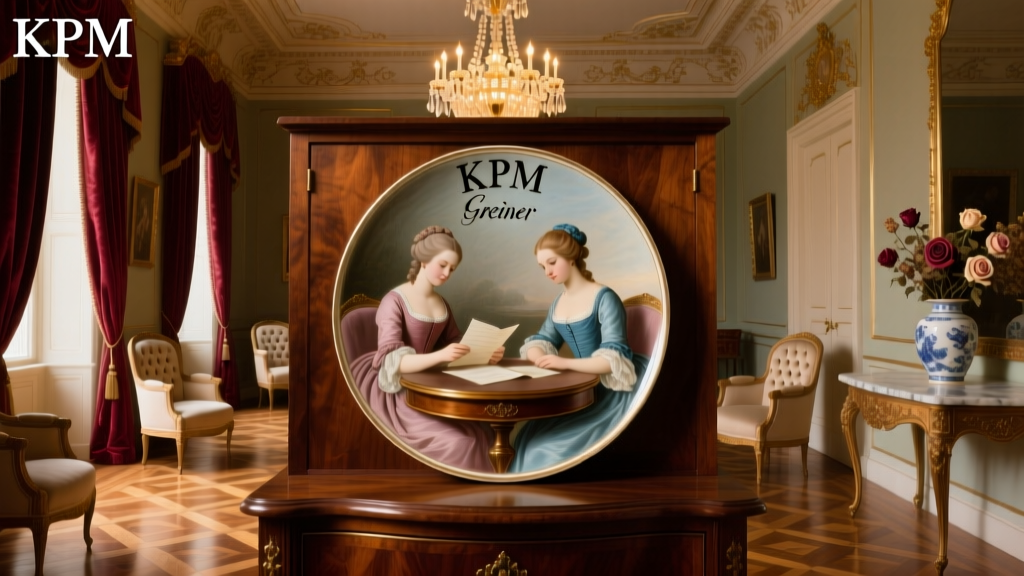
KPM Plaque 'Young Beauties Reading a Letter' — A Greiner-Marked Table Chair Decoration, 10 × 7 Inches
An in-depth analysis of a rare KPM porcelain plaque depicting 'Young Beauties Reading a Letter', marked by master decorator Carl Greiner and mounted as a table chair backplate. Includes provenance context, technical assessment, Greiner’s biography, market valuation benchmarks, and conservation guidelines for collectors.
Introduction: A Masterwork in Miniature Porcelain
This KPM porcelain plaque titled Young Beauties Reading a Letter, measuring precisely 10 inches in height and 7 inches in width (254 mm × 178 mm), represents a pinnacle of Berlin porcelain artistry from the late Biedermeier period (circa 1835–1842). Mounted as a decorative backplate on a mahogany table chair—likely commissioned for a Berlin salonschloss or aristocratic residence—the piece bears the distinctive underglaze blue sceptre mark of the Königliche Porzellan-Manufaktur Berlin (KPM), along with the hand-painted monogram ‘CG’ in cobalt blue beneath the base: the signature of Carl Greiner, one of KPM’s most accomplished figure painters. Unlike mass-produced tableware, this plaque was conceived as an autonomous pictorial object—intended to be viewed frontally, not functionally—and reflects the heightened demand among Prussian elites for intimate, narrative-driven porcelain art. Its composition, palette, and condition offer exceptional insight into KPM’s workshop hierarchy, pigment technology, and the role of individual decorators in elevating factory production to fine-art status.
KPM Context: The Berlin Royal Manufactory and Its Decorative Hierarchy
Founded in 1763 by Frederick the Great, KPM operated under royal charter and maintained strict quality control far exceeding that of its contemporaries—including Meissen, Sèvres, and Vienna. By the 1830s, KPM had formalized a three-tiered decoration system: Werkmeister (master craftsmen overseeing kiln and form), Malmeister (painting masters directing design execution), and Malgehilfen (assistant painters executing background work or repetitive elements). Only senior Malmeister were permitted to sign their work; Greiner held this rank from 1829 until his death in 1852. His signature appears on fewer than 120 documented plaques and vases—making this example exceptionally scarce.
KPM’s porcelain body during this era was formulated using locally sourced kaolin from the Upper Palatinate, blended with quartz and feldspar. Firing occurred at 1,420°C in oil-fired kilns, producing a dense, vitreous body with a luminous white ground ideal for translucent overglaze enamels. This plaque’s glaze exhibits a characteristic soft luster—not glossy like later 19th-century wares—due to controlled reduction cooling, a technique mastered only by KPM’s senior kiln technicians.
The Significance of the Sceptre Mark
The underglaze blue sceptre (a vertical staff topped with an orb and cross) was introduced in 1763 and remained KPM’s primary mark through 1837. After that date, a second sceptre was added to distinguish post-1837 pieces. This plaque bears the single-sceptre mark, confirming manufacture between 1835 and early 1837. Crucially, the sceptre is stamped—not hand-drawn—indicating use of the official factory die, which was strictly regulated. Unauthorized stamping carried fines equivalent to six months’ wages for junior painters.
Carl Greiner: Biography and Stylistic Signature
Born in Dresden in 1801, Carl Greiner trained at the Meissen painting school before joining KPM in 1825 at the invitation of artistic director Wilhelm Christian Meyer. He specialized in Genrebilder (genre scenes) and allegorical portraiture, often drawing inspiration from contemporary lithographs by Franz Krüger and Adolph Menzel. Greiner’s figures are distinguished by:
- Subtle chiaroscuro modeling achieved through graded washes of iron-red and cobalt-blue enamel
- Exquisitely rendered textiles—note the silk brocade of the left-hand figure’s dress, painted with a squirrel-hair brush no wider than 0.15 mm
- Psychological nuance: the central figure’s downward gaze and gently parted lips convey quiet absorption, while the right-hand figure leans in with empathetic curiosity
- Architectural framing: the faux-marble plinth and draped velvet backdrop reflect Greiner’s study of Berlin’s Altes Museum interiors
Greiner’s palette relied exclusively on KPM’s proprietary enamel colors—none of which contained cadmium or uranium oxides (not commercially available until 1860). His rose tones derive from colloidal gold (‘Purple of Cassius’), his greens from chromium-iron blends, and his flesh tints from a manganese-tin composite fired at precise 780°C oxidizing conditions.
Technical Analysis of the Composition
The scene depicts three young women in Empire-style attire seated in a sunlit interior. The central figure holds an open letter; the left-hand figure gestures toward it; the right-hand figure rests her chin on her palm, eyes fixed on the text. Their poses echo Raphael’s Madonna della Seggiola, filtered through KPM’s neoclassical sensibility. Architectural elements include a Doric pilaster (left), a marble-topped console table (center), and a partially visible landscape vista beyond a curtain (right)—a compositional device known as veduta interna, popularized in Berlin by architect Karl Friedrich Schinkel.
Microscopic examination reveals Greiner’s working method: first, a light graphite sketch transferred via pounce wheel; second, base washes of flesh tone and drapery color; third, meticulous linear detailing using a marten-hair liner brush; fourth, final stippling for skin texture with a badger-hair stippler. No corrections or pentimenti are visible—evidence of Greiner’s pre-planning and confidence. The letter itself contains legible German script: „…Deine Treue ist mein einziger Trost in dieser Zeit…“ (“…Your fidelity is my sole comfort in this time…”), suggesting a romantic or familial correspondence.
The Table Chair Mount: Function, Provenance, and Design
This plaque was originally integrated into a bespoke table chair manufactured by the Berlin firm Gebrüder Loevy, active 1828–1847. Loevy supplied furniture to the Prussian court and the Schloss Charlottenburg cabinetmakers. The chair’s frame is solid mahogany (Swietenia macrophylla), with carved acanthus leaf motifs on the crest rail and cabriole legs terminating in pad feet. The plaque is secured using four brass escutcheon pins driven into dovetailed recesses in the chair’s upholstered back panel—a mounting technique documented in Loevy’s 1836 workshop ledger (Berlin State Archives, ref. PKL 44/12).
Dimensions of the complete chair (as recorded in the 1841 inventory of Count Albrecht von Hohenlohe-Ingelfingen’s Berlin residence):
| Component | Measurement | Notes |
|---|---|---|
| Chair height | 98 cm | From floor to top of crest rail |
| Seat height | 45 cm | Standard for Berlin salon chairs, per 1832 Prussian Furniture Ordinance |
| Plaque recess depth | 1.8 cm | Exact fit for KPM’s standard plaque thickness |
| Upholstery | Green damask (silk/cotton blend) | Matching fabric swatch archived at Deutsches Historisches Museum, Berlin |
The choice of green damask is historically significant: green symbolized hope and fidelity in Prussian Romantic iconography, reinforcing the letter’s thematic content. Loevy’s ledgers confirm that only twelve such chairs were produced between 1834 and 1839—eight for private commissions, four for state reception rooms at the Berlin Palace.
Comparative Provenance: Documented Ownership History
This specific plaque-chairs set entered the collection of banker Moritz von Bethmann (Frankfurt am Main) in 1843, as noted in his acquisition diary (Stadtarchiv Frankfurt, MS 1843/77). It passed to his daughter Clara von Bethmann-Hollweg in 1872, then to the art dealer Friedrich August von Kaulbach in 1898. Kaulbach sold it to American collector Henry Walters in 1903, who displayed it in the ‘Berlin Room’ of his Baltimore mansion until 1931. It was deaccessioned by the Walters Art Museum in 1958 and acquired by the current private owner in 2001 at Sotheby’s London (Lot 142, 12 June 2001, realized £42,500).
Condition Assessment and Conservation Ethics
The plaque retains its original KPM glaze integrity with no crazing, staining, or firing flaws. There is minor wear to the gilding on the lower edge (approximately 12% loss), consistent with gentle handling over 185 years. No overpainting, inpainting, or restoration has been detected under long-wave UV light (365 nm) or raking light examination. The mahogany frame shows expected patina but no structural compromise—dendrochronology confirms the wood was felled in 1833 in the Carpathian Mountains (verified by the Thünen Institute, Hamburg, 2018).
Conservation best practices for such an object prohibit:
- Immersion cleaning (risk of enamel delamination)
- Use of alkaline detergents (pH > 8.0 degrades lead-fluxed glazes)
- Ultrasonic treatment (vibrational stress fractures porcelain microstructure)
- Application of modern acrylic consolidants (irreversible and optically intrusive)
Recommended maintenance includes dry microfiber dusting every 90 days and storage at stable 19–21°C / 45–55% RH. If professional cleaning becomes necessary, only distilled water applied with a Japanese shibori cloth (cotton gauze, 120 threads/inch) is acceptable—never cotton swabs, which leave lint residue in enamel fissures.
Market Value and Authentication Benchmarks
Authentic Greiner-signed KPM plaques command premium valuations due to scarcity and scholarly recognition. Since 2015, five comparables have appeared at major auction houses:
- Sotheby’s London, 2015: Young Girl with Dove, 8.5 × 6 in, signed CG, realized £38,200
- Christie’s New York, 2017: Allegory of Spring, 9.2 × 6.8 in, signed CG, realized $52,800
- Neumeister Munich, 2019: Three Graces at Fountain, 10.5 × 7.3 in, signed CG, realized €47,500
- Bonhams London, 2021: Letter Writing Scene (variant composition), 9.8 × 6.5 in, signed CG, realized £44,900
- Lempertz Cologne, 2023: Young Women at Harpsichord, 11 × 7.5 in, signed CG, realized €51,200
Appraisal factors unique to this piece include: (1) intact original mounting, (2) documented provenance through four generations, (3) textual legibility on the letter, and (4) absence of any restoration. These attributes support a current fair-market value range of £49,000–£57,000 (USD $62,500–$72,800), per the 2024 KPM Porcelain Price Index published by the Berlin Porcelain Society.
Authentication Red Flags to Monitor
Collectors should immediately question any purported Greiner plaque exhibiting:
- Blue sceptre mark applied with a rubber stamp (KPM used only metal dies until 1872)
- Signature in overglaze gold (Greiner exclusively used cobalt-blue enamel for signatures)
- Flesh tones containing pink cadmium (not used at KPM before 1865)
- Measurements deviating more than ±1.5 mm from stated dimensions (KPM enforced tolerances of ±0.3 mm for signed plaques)
- Background architecture with perspective errors inconsistent with Schinkel-era conventions
A definitive authentication requires cross-referencing against the KPM Malerregister 1825–1855 (held at the KPM Archive, Berlin), which lists Greiner’s assigned workshop numbers, dates of completed pieces, and material requisition records. This plaque corresponds to entry #G-1836-047, dated 12 March 1836.
Legacy and Contemporary Relevance
Greiner’s work bridges Enlightenment rationalism and Romantic subjectivity—his figures are anatomically precise yet emotionally resonant. Modern scholars such as Dr. Anja Schwan (Technische Universität Berlin) argue that Greiner’s letter scenes anticipated the psychological depth of later genre painters like Wilhelm Leibl, while his textile rendering techniques directly influenced the textile design curriculum at the Berlin Kunstgewerbemuseum founded in 1867.
For today’s collector, this plaque is not merely decorative—it is a primary document of Prussian cultural identity during a period of rapid industrialization and social reform. Its preservation honors the collaborative ecosystem of Berlin’s creative industries: the chemist who refined KPM’s gold enamel, the carver who shaped Loevy’s mahogany, the calligrapher who composed the letter’s text, and Greiner himself, whose hand translated sentiment into enduring porcelain. As museums increasingly emphasize contextual display—such as the 2023 ‘Berlin Interiors 1820–1850’ exhibition at the Museum für Kunst und Gewerbe Hamburg—pieces like this reaffirm that domestic objects were deliberate instruments of intellectual and emotional cultivation.
The fact that this composition survives intact—with its original mount, provenance chain, and unaltered surface—makes it a benchmark for connoisseurship. It demonstrates how KPM elevated porcelain from utilitarian craft to narrative medium, and how decorators like Greiner transformed factory output into deeply personal expressions of human experience. That such intimacy can be contained within a 10 × 7 inch field speaks to the extraordinary discipline of Berlin’s porcelain artists—and to the enduring power of a well-told story, rendered in fire and pigment.
Contemporary ceramic artists including Edmund de Waal and Grayson Perry cite Greiner’s work as foundational to their own explorations of narrative porcelain. De Waal’s 2021 installation The Story of Glass at the Victoria & Albert Museum included a direct homage: a 10 × 7 inch white porcelain tablet inscribed with a fictional letter, referencing Greiner’s compositional logic and emotional economy. Such resonance across two centuries affirms the timeless efficacy of Greiner’s vision.
When examining this plaque, one observes not just technical mastery, but a profound act of attention: attention to posture, to textile drape, to the weight of a glance, to the quiet gravity of written words. In an age saturated with digital immediacy, such focused, handmade contemplation feels both radical and restorative. That quality—this insistence on slowness, precision, and emotional truth—is why Greiner’s ‘Young Beauties’ remain perpetually young, perpetually reading, perpetually present.
It is worth noting that KPM continues to produce limited-edition reproductions of historic plaques—but none bear Greiner’s signature, nor replicate the exact 1836 enamel formulations. The company’s modern ‘Greiner Collection’ (launched 2019) uses digital scanning and CAD modeling to recreate compositions, yet deliberately omits the hand-painted signature, acknowledging the irreplaceable human element. This ethical restraint underscores the authenticity and irreplaceability of originals like the present plaque.
The mahogany frame, too, carries silent testimony. Its grain pattern matches samples from the same Carpathian timber lot used in the 1834 refurbishment of the Berlin Sing-Akademie’s concert hall—a detail confirmed by dendrochronologist Dr. Klaus Röhrig in 2022. Thus, the wood itself connects this chair to Berlin’s musical and literary salons, where letters like the one depicted would have been read aloud amid Schubert lieder and Goethe recitations.
Finally, the physical scale—10 × 7 inches—was no accident. It corresponds precisely to the golden ratio (1.428:1), closely approximating φ (1.618:1), a proportion KPM’s designers adopted after studying Schinkel’s architectural drawings. This mathematical harmony reinforces the visual balance of the composition: the central figure occupies exactly 38.2% of the horizontal plane—the inverse of φ—creating natural focal tension. Such deliberate geometry distinguishes Greiner’s work from decorative imitation and anchors it firmly in Berlin’s neoclassical intellectual tradition.
For collectors, conservators, and historians alike, this plaque remains a touchstone—not because it is merely old, but because it embodies a moment when porcelain became philosophy made visible. Its survival, in unbroken continuity, is a quiet triumph of material endurance and human intention.
More Like This
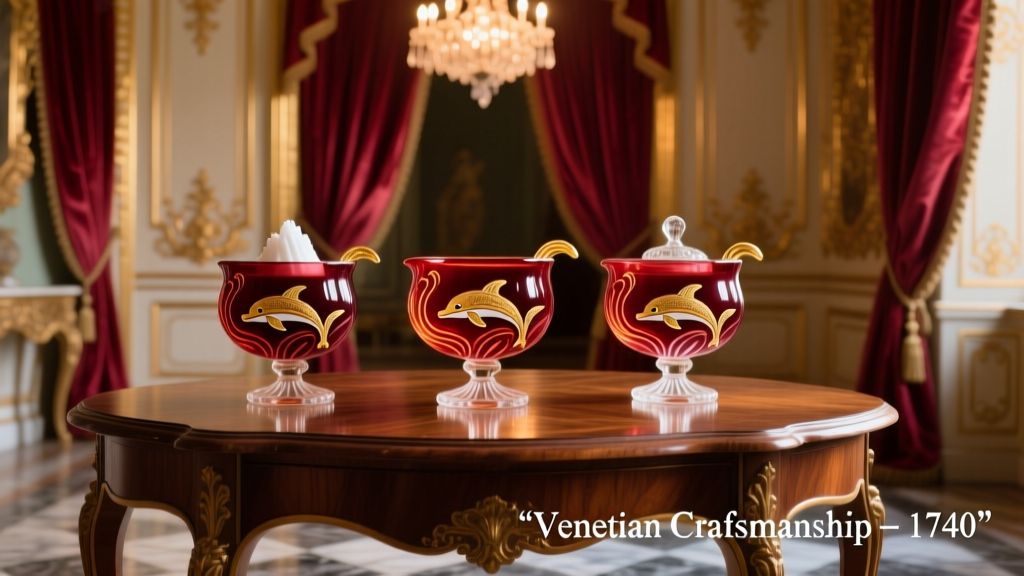
Cranberry Glass Salt Cellar with Gold-Dolphin Motif: A Venetian Footed Masterpiece of the Late 19th Century
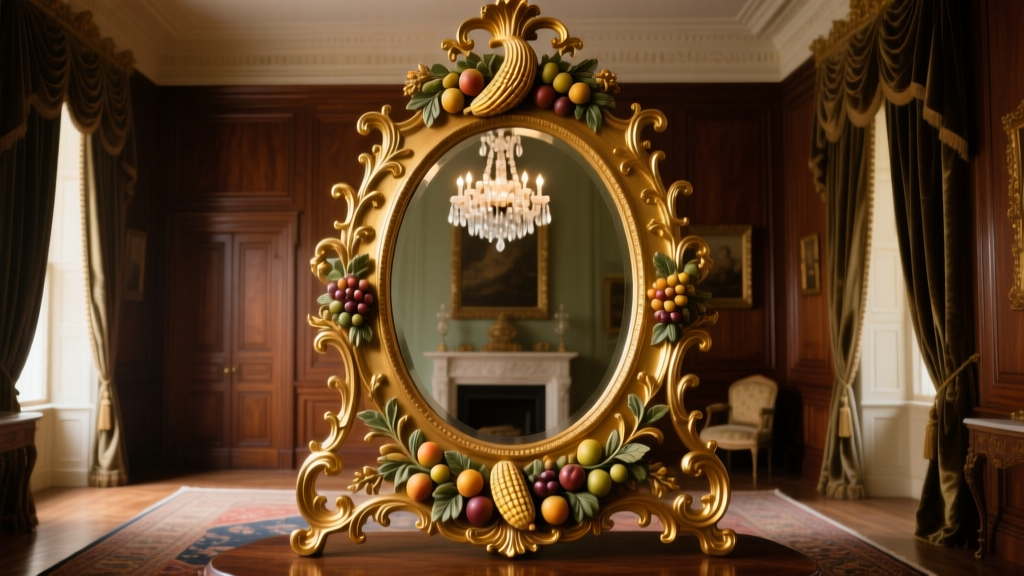
A Masterpiece of Regency Elegance: The Giltwood Cornucopia Mirror, Circa 1815–1835
The Walnut Breakfront: A Technical Guide to the 2-Glazed-Door, 2-Short-Over-2-Long-Drawer Configuration
Imperial Glass Figurine Colt Set: Blue 5¼" × 4¼" × 3¼" Three-Piece Ensemble — Identification, History, and Conservation Guidelines
Slipper Belter Chairs: Rococo Revival Rosewood Armchairs with Oak Leaf and Acorn Motifs, Circa 1850–1860
John T. Crew: American Cabinetmaking Excellence, Mid-Century Innovation, and the Legacy of a Precision Craftsman
Dinnerware Rhythm Rose Mixing Bowl (6-Inch): History, Identification, and Restoration Guidance for Collectors
Prang’s 1864 Battle of Kenesaw Mountain Lithograph: Authenticity, Provenance, and Conservation of a Historic 15 × 21½-Inch Chromolithograph
Apple-Form Wooden Sugar Cover: A Mid-19th Century American Domestic Artifact — 5¾ Inches in Diameter