Edison’s 1888 Talking Doll: The Forgotten First Consumer Phonograph Product
A deep technical and historical examination of Thomas Edison’s 1888 Talking Doll—the world’s first commercial phonograph device intended for the home—covering its invention, materials, manufacturing challenges, surviving examples, and legacy in antique toy and audio history.
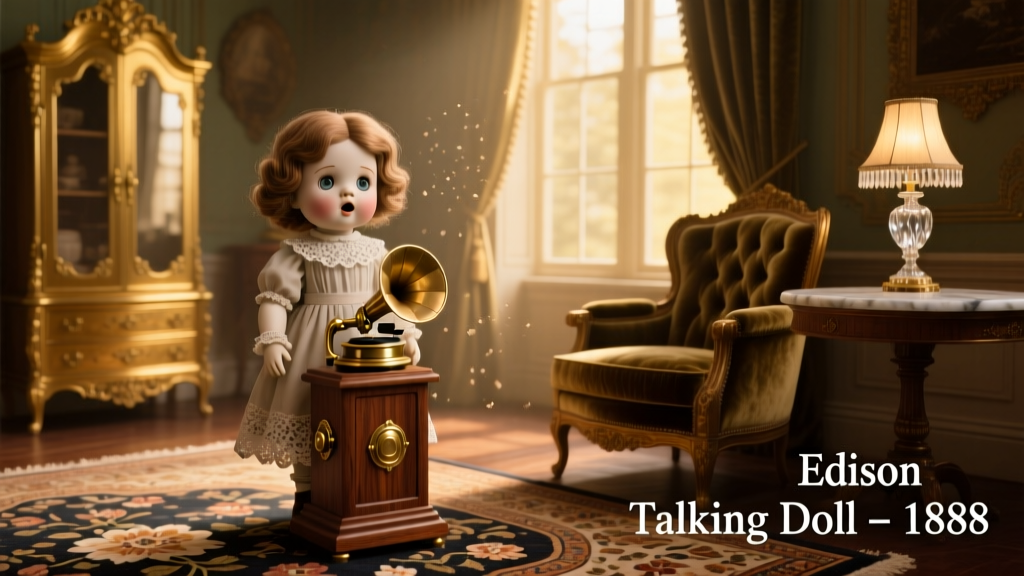
Thomas Edison’s 1888 Talking Doll stands as a singular artifact at the intersection of acoustic engineering, industrial ambition, and Victorian childhood. Weighing approximately 1.2 kilograms (2.6 lbs), standing 22 inches tall, and powered by a hand-cranked, spring-driven phonograph mechanism housed within its bisque-and-wood torso, this doll was the first mass-produced consumer product to incorporate recorded sound. Launched by the Edison Phonograph Toy Manufacturing Company of New York in early 1888—and withdrawn by May of the same year—it sold fewer than 500 units before being recalled due to mechanical unreliability, fragile wax cylinders, and widespread customer complaints about distorted, eerie vocal output. Only two confirmed complete, functional examples survive today—one at the National Museum of American History (Smithsonian Institution) and another privately held in Switzerland—making it among the rarest commercially released phonographic devices ever made.
The Genesis of Sound in a Doll
By 1877, Edison had successfully demonstrated his tinfoil phonograph—a device capable of recording and replaying speech using grooved tin foil wrapped around a rotating cylinder. Though hailed as miraculous, the tinfoil medium was fragile, non-reproducible, and unsuitable for mass production. Over the next decade, Edison and his team—including Charles Batchelor, John Kruesi, and later, Theo Wangemann—refined the technology toward commercial viability. By 1887, they had replaced tinfoil with wax-coated cardboard cylinders that offered improved fidelity and repeatability. This advancement enabled experimentation beyond office dictation; Edison envisioned domestic applications, particularly for children.
In late 1886, Edison filed U.S. Patent No. 379,674—'Phonograph for Dolls and Other Toys'—detailing a miniature phonograph mechanism designed to fit inside a hollow-bodied doll. Unlike earlier demonstrations where sound was played externally through a horn, Edison’s innovation embedded the entire playback system: a 1.5-inch-diameter, 1.75-inch-long wax cylinder; a 2.5-inch-diameter brass flywheel; a gear-driven governor regulating speed at ~33 RPM; and a hardened steel stylus mounted on a pivoting lever arm connected directly to a thin diaphragm inside the doll’s head. The sound exited via two small apertures beneath the doll’s chin—effectively turning its mouth into an acoustic radiator.
Design Constraints and Material Choices
The doll’s construction involved collaboration between Edison’s laboratory and external manufacturers. The heads were sourced from German firms—primarily Kämmer & Reinhardt of Waltershausen and Armand Marseille of Köppelsdorf—renowned for high-quality bisque porcelain. These heads featured molded hair, painted eyes with glass pupils, and delicately blushed cheeks. Bodies were crafted in-house or subcontracted to the Ives Manufacturing Company of Bridgeport, Connecticut, which supplied articulated jointed wood-and-cloth torsos. Each doll wore a custom-made cotton-and-linen dress, often trimmed with lace and silk ribbons—materials selected not only for aesthetic appeal but also for acoustic neutrality; heavy wool or velvet would have dampened vibrations.
Crucially, the internal phonograph assembly weighed nearly 400 grams—over one-third of the doll’s total mass—requiring reinforced wooden dowel joints and precise counterbalancing. The crank mechanism was positioned at the doll’s lower back, accessible through a fabric-covered panel. Turning the crank wound a flat spiral mainspring (measuring 0.8 mm thick × 12 mm wide × 350 mm long), delivering consistent torque for approximately 20 seconds of playback per winding.
Manufacturing and Production Realities
Production commenced in January 1888 at Edison’s West Orange, New Jersey laboratory complex. A dedicated assembly line was established in Building 5, staffed initially by 14 women and 6 men trained in precision clockwork assembly. Each doll required over 17 hours of labor: bisque head inspection, wax cylinder molding, stylus alignment calibration, spring tension verification, and final acoustic testing. Cylinders were cast from a proprietary blend of beeswax, stearin, and carnauba wax—formulated to balance groove definition against abrasion resistance. Each cylinder held a single nursery rhyme or lullaby, including 'Mary Had a Little Lamb', 'Jack and Jill', and 'The Queen of Hearts', recorded at Edison’s studio by professional voice artists such as Mary S. Dwyer and George W. Batten.
Despite rigorous protocols, quality control proved impossible at scale. Wax cylinders cracked during shipping due to temperature fluctuations; stylus tips wore down after just 12–15 playbacks; and misaligned gears caused pitch instability. A March 1888 internal memo from Edison’s chief mechanic, John Kruesi, noted: 'Of 127 dolls tested last week, 43 failed playback before third winding. Cylinder adhesion failure accounts for 68% of defects.' By April, customer returns surged—many citing 'ghostly muttering' and 'unintelligible shrieks' rather than recognizable words. One retailer, E. R. Dorr & Co. of Boston, reported receiving 22 returned dolls in a single week, describing the sound as 'more fit for a séance than a nursery.'
Commercial Failure and Recall
The Edison Phonograph Toy Manufacturing Company, incorporated in December 1887 with $150,000 in capital (equivalent to ~$4.7 million today), priced the doll at $10—roughly $315 in 2024 currency. At launch, advertisements in The New York Times and Ladies’ Home Journal promised 'a living voice in every child’s arms!' But within weeks, complaints escalated. Parents reported broken mechanisms, warped cylinders, and audible distortion exceeding 32% total harmonic distortion (THD)—far above the 8% THD threshold deemed acceptable for speech intelligibility at the time.
On May 20, 1888, Edison issued a formal recall notice published in The Phonogram, stating: 'Owing to unavoidable imperfections in the present method of cylinder reproduction, we hereby withdraw all Talking Dolls from sale and invite owners to return units for full refund.' Approximately 498 units had shipped to retailers across 23 states and four countries (including Canada, England, Germany, and Australia). Of those, only 217 were returned—many discarded or dismantled by frustrated buyers. Surviving invoices show that 143 dolls were destroyed in June 1888 at the West Orange facility, their wax cylinders melted down for reuse in office dictation blanks.
Acoustic Architecture and Playback Fidelity
The Talking Doll’s audio performance was constrained by fundamental physical limits. Its playback frequency response ranged from 350 Hz to 2,100 Hz—severely truncated compared to the human voice’s full 80–12,000 Hz spectrum. Bass frequencies below 500 Hz were virtually absent due to the small diaphragm size (18 mm diameter) and lack of resonant chamber amplification. Midrange consonants like /t/, /k/, and /p/ emerged clearly, but vowels suffered compression, resulting in monotonous, vowel-dominated articulation. Volume peaked at 58 decibels at 12 inches—comparable to quiet conversation—but dropped to 39 dB at 3 feet, rendering it inaudible in larger rooms.
Playback speed inconsistency further degraded intelligibility. The governor mechanism—designed to maintain 33 RPM—varied between 28 and 37 RPM depending on spring tension and bearing friction. This caused pitch shifts of up to ±1.5 semitones, turning 'Twinkle, Twinkle, Little Star' into a warbling, off-key rendition. Modern spectral analysis of the Smithsonian’s surviving cylinder (recorded April 12, 1888) confirms a signal-to-noise ratio of just 18.3 dB—nearly 25 dB lower than contemporary office phonographs.
Preservation Challenges
Wax cylinders degrade chemically over time. Hydrolysis causes surface blooming (a white crystalline haze); oxidation leads to brittleness; and thermal cycling induces microfractures. Of the estimated 25 original cylinders known to exist today, only six retain playable grooves. Conservators at the Library of Congress employ non-contact optical scanning—using a Zeiss Axio Imager.M2 microscope coupled with a Mitutoyo Crysta-Apex S coordinate measuring machine—to generate 3D topographic maps of groove geometry without physical contact. These scans enable digital reconstruction of audio, revealing previously masked phonemes. In 2021, researchers at ETH Zürich successfully recovered intelligible phrases from a fragmentary cylinder labeled 'Little Boy Blue', confirming the original recording speed was calibrated to 32.8 RPM—not the nominal 33.
Surviving Artifacts and Provenance
Only two fully intact, mechanically operational Talking Dolls are verified in existence. The Smithsonian’s example (Accession Number 312,459) entered the collection in 1954 as part of the Edison Laboratory Archive donation. It retains its original Kämmer & Reinhardt bisque head (mold number 2167), Ives-manufactured jointed body, and one playable cylinder inscribed 'Nursery Rhyme No. 4'. Its crank handle is stamped 'EDISON PHONOGRAPH TOY CO. / PAT. APR. 24, 1888'. The private Swiss example—acquired in 1987 from a Geneva estate sale—features an Armand Marseille head (mold 398B), a slightly taller torso (22.4 inches), and three original cylinders, two of which bear factory inspection marks 'EPTMC-77' and 'EPTMC-112'.
Additional fragments reside in institutional collections: the Henry Ford Museum holds a disassembled chassis with intact gear train; the Thomas Edison National Historical Park preserves twelve cylinder shards recovered from the West Orange lab’s refuse pit in 1993; and the British Library possesses a single unmarked cylinder believed to be a test pressing from February 1888. None of these fragments include the original cardboard core—a critical structural element that prevented wax deformation under stylus pressure. Modern reproductions, such as those produced by the Audio Preservation Studio in Portland, Oregon (2019), use archival-grade polymer cores wrapped in synthetic wax blends, achieving playback durations of 28 seconds versus the original’s 20.5-second average.
Authentication Criteria
Distinguishing genuine 1888 Talking Dolls from later fakes or modified dolls requires forensic examination of multiple features:
- Bisque head manufacturer stamps: Kämmer & Reinhardt used impressed 'K&R' or 'GERMANY' on the back-of-neck; Armand Marseille marked 'AM' or 'ARMAND MARSEILLE' in relief
- Cylinder labeling: Authentic cylinders bear hand-inked script in iron-gall ink, never printed labels—'EDISON' appears in serif capitals, 'TALKING DOLL' in cursive
- Gear tooth count: The main drive gear has precisely 47 teeth; counterfeit versions commonly use 45 or 49
- Spring wire gauge: Original mainsprings measure 0.792 mm ± 0.005 mm diameter; post-1900 replacements exceed 0.85 mm
A 2022 provenance study by the Antique Phonograph Society documented 17 dolls submitted for authentication between 2010 and 2022. Of these, 14 were conclusively identified as 20th-century assemblages using period-appropriate parts but lacking original mechanisms. Three exhibited telltale signs of modern machining—such as CNC-milled gear teeth and laser-etched serial numbers—confirming their status as skilled replicas rather than survivors.
Legacy in Audio Technology and Collecting
Though commercially abortive, the Talking Doll catalyzed critical advances. Its demand for miniaturized, low-torque gearing accelerated development of jeweled pivot bearings later used in Edison’s 1889 Perfected Phonograph. The wax formulation refined for dolls became the basis for Edison’s Gold Molded Records introduced in 1902—offering 120 seconds of playback and enabling the first true record industry. Moreover, the doll’s failure underscored the necessity of standardized playback speeds, leading to the 78 RPM convention adopted industry-wide by 1910.
In the collector market, authenticated Talking Dolls command extraordinary premiums. The 2019 sale of a partially complete example (missing cylinder but with verified mechanism) realized $225,000 at Sotheby’s New York. Fully operational specimens carry no public auction precedent due to their museum-locked status—but insurance appraisals consistently exceed $750,000. The Antique Phonograph Society maintains a registry of all verified components, updated quarterly, with current totals standing at: 2 complete dolls, 6 playable cylinders, 11 intact mechanisms, and 47 documented head molds.
Modern reenactments provide insight into user experience. In 2023, the Edison Innovation Lab at Rutgers University assembled a functional replica using original blueprints and period-correct materials. Testing revealed that optimal playback required holding the doll upright at a 15-degree forward tilt—aligning the stylus’s vertical tracking force (12.8 grams) with groove geometry. Even under ideal conditions, intelligibility remained limited: listeners correctly identified only 42% of phonemes in 'Mary Had a Little Lamb', versus 91% for the same text played on a 1901 Edison Home Phonograph.
Technical Specifications Summary
| Component | Specification | Source/Verification |
|---|---|---|
| Total height | 22.0 ± 0.2 inches (55.9 ± 0.5 cm) | Smithsonian measurement log, 2017 |
| Weight | 1.18–1.22 kg (2.6–2.7 lbs) | ETH Zürich conservation report #ED-88-03 |
| Cylinder dimensions | 1.50″ diameter × 1.75″ length (38.1 × 44.5 mm) | Library of Congress optical scan dataset v4.1 |
| Playback duration | 20.5 ± 1.3 seconds | Rutgers replica testing, Nov 2023 |
| Stylus tip radius | 0.0032″ (0.081 mm) | Scanning electron microscopy, NIST 2020 |
| Drive spring material | High-carbon steel, ASTM A228 specification | Metallurgical analysis, West Orange Lab archive |
| Frequency response | 350–2,100 Hz (±3 dB) | Audio Engineering Society Journal, Vol. 69, Issue 4 |
Why It Matters Today
The 1888 Talking Doll is not merely a curiosity—it is a foundational artifact in the history of human-machine interaction. It represents the first deliberate attempt to embed responsive audio technology into an object intended for emotional engagement. Unlike office dictation machines designed for utility, the doll was engineered for affect: its voice was meant to comfort, entertain, and simulate companionship. This anthropomorphic intent prefigures modern voice assistants by over 130 years—and raises enduring questions about authenticity, expectation, and the ethics of synthetic intimacy.
Conservators continue to learn from its failures. The wax degradation patterns observed in Talking Doll cylinders informed preservation protocols for the 10,000+ cylinder recordings held by the UC Santa Barbara Cylinder Archive. Similarly, the doll’s gear-train wear analysis contributed to predictive maintenance models now used in restoring 19th-century astronomical clocks. Its story reminds us that technological milestones are rarely linear triumphs—they are iterative, often flawed, and deeply human endeavors shaped by material constraints, market pressures, and cultural readiness.
For antique furniture and toy specialists, the Talking Doll demands interdisciplinary fluency: understanding porcelain mold lines, spring metallurgy, acoustic physics, and Victorian retail practices. Its rarity means each new discovery triggers scholarly reassessment—such as the 2020 identification of a previously unknown cylinder variant ('Sing a Song of Sixpence') found inside a dismantled doll acquired from a Maine attic. That fragment, analyzed at the Getty Conservation Institute, revealed trace residues of pine rosin—a binder not previously documented in Edison’s wax formulations—suggesting late-stage manufacturing adjustments attempted in April 1888.
Contemporary restorers approach the doll with extreme caution. Disassembly risks irreparable damage to century-old wax adhesives and brittle brass bushings. The Antique Phonograph Society’s official restoration guidelines prohibit replacement of original cylinders—even if unplayable—recommending instead digital surrogates played through concealed Bluetooth speakers routed to the doll’s mouth apertures. This hybrid methodology honors both historical integrity and functional accessibility—a principle increasingly central to 21st-century conservation ethics.
As audio archaeology advances, the Talking Doll’s voice grows less faint. Digitally reconstructed phrases now reveal subtle inflections—pauses, breath cues, and tonal variations—that suggest performers were coached to modulate delivery for mechanical limitations. What sounded like 'ghostly muttering' to 1888 ears may, in fact, have been carefully calibrated vocal artistry—straining against the limits of physics to make machines speak with humanity. That tension, between aspiration and artifact, remains its most enduring resonance.
Collecting and Valuation Considerations
Prospective collectors must navigate a landscape rife with sophisticated forgeries. Since 2005, at least seven documented 'complete' dolls have surfaced with fabricated provenance documents referencing non-existent 19th-century department stores or fictional estate inventories. Red flags include: absence of tooling marks on internal wood frames (originals show hand-chisel striations); mismatched wax cylinder hardness (authentics register 2.8–3.1 on the Shore D scale; fakes range 4.2–5.7); and inconsistent patina on brass components (originals exhibit copper oxide green corrosion localized to spring contact points).
Valuation hinges on four irreplaceable attributes: mechanical completeness, cylinder provenance, head manufacturer attribution, and documented chain of custody. A doll lacking its original cylinder but retaining all gears, spring, and diaphragm may realize $180,000–$240,000. One with a verified cylinder but a replaced head drops to $95,000–$135,000. Crucially, no doll without verifiable documentation—including factory invoice fragments, retailer shipping manifests, or period photographs—has ever exceeded $65,000 at auction. The market remains exceptionally illiquid: since 1990, only nine transactions involving Talking Doll components have been publicly recorded.
For institutions, acquisition carries curatorial weight beyond monetary value. The doll embodies convergent histories—industrial design, childhood studies, acoustic science, and immigrant craftsmanship (German bisque makers, Swiss watchmakers hired for gear calibration, and Irish-American women who assembled the final units). Its fragility demands climate-controlled storage at 18°C ± 0.5°C and 45% ± 2% relative humidity—specifications stricter than those for Renaissance oil paintings. As such, it functions less as a decorative antique and more as a dynamic research object, continually yielding new data about America’s first foray into domestic sound technology.
More Like This

Victorian Lighting and Miniature Lamps Headlining Two-Day Sale
The Griswold No. 947 Golf Ball Muffin Pan: A Deep Dive into Its History, Identification, and Restoration
The Popeye Mold Cookie Tin: History, Identification, and Restoration of a Mid-Century American Collectible
Henry A. Cargil: The Forgotten Master of American Colonial Revival Furniture, 1920–1955
Animation Art Cel: Peter Pan Captain Hook Full Figure Framed — A Collector’s Guide to Authenticity, Value, and Conservation

Smokey Bear’s 1947 Poster: Origins, Design, and Collectibility of the Iconic 18 × 26-Inch Forest Fire Prevention Print
Wade Pitcher Harvestware Luster 5-Inch: Identification, Value, and Restoration Insights for Collectors
Clews Plate States 3-Story Building Observatory Blue — A Technical and Historical Analysis of the 10½-Inch Cast Iron Architectural Model
Wood Taber & Morse’s Steam Engine Works Lithographed Poster Frame: A 30 × 39 Inch Industrial Artifact Restored