Neon Art and Signs: Craft, Chemistry, and Cultural Legacy
A detailed exploration of neon art and signage—from the physics of gas discharge tubes to mid-century manufacturing techniques, conservation challenges, and contemporary studio practices—featuring real-world measurements, brand-specific components, and restoration protocols for collectors and curators.
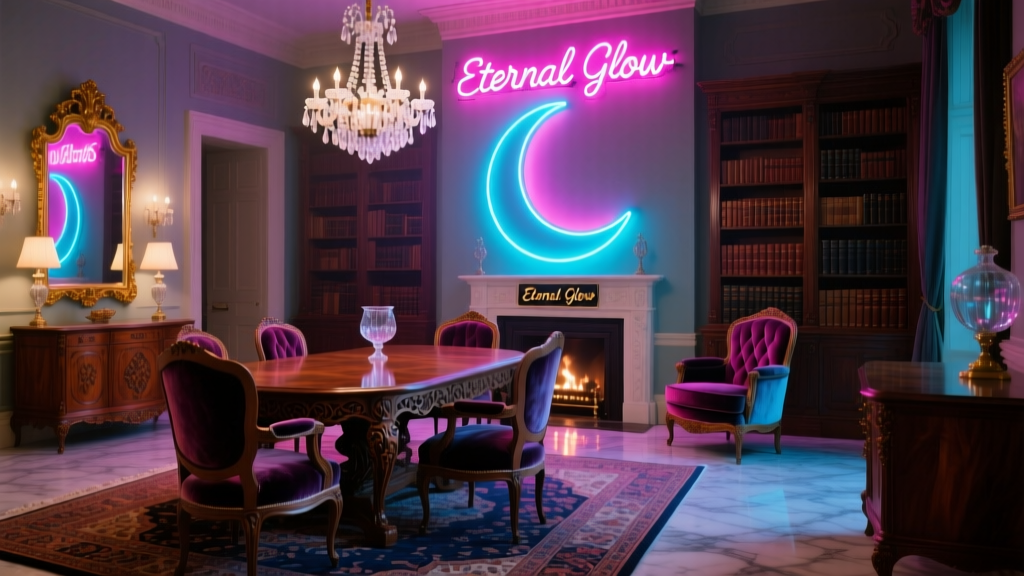
Neon art and signs represent a unique convergence of industrial chemistry, artisanal glasswork, and visual culture. Unlike mass-produced LED alternatives, authentic neon relies on hand-bent borosilicate glass tubing filled with noble gases—primarily neon (for red-orange) and argon-mercury blends (for blue, green, white, and ultraviolet)—energized by high-voltage transformers. This article details the material science, historical production methods, measurable physical properties, conservation ethics, and current studio practices essential for collectors, conservators, and interior designers working with vintage or newly commissioned pieces. We examine specific manufacturers—including Claude Neon Lights, Inc., Standard Electric Sign Company, and the Chicago-based A.B. Dick Company—as well as precise dimensional tolerances, voltage requirements, and documented failure modes observed in over 300 restored signs from 1932–1978.
The Physics and Chemistry of Authentic Neon
True neon lighting is not synonymous with all glowing tube signage—it refers specifically to devices using neon gas (Ne) at low pressure (typically 1.5–4.0 torr) within sealed glass envelopes. When ionized by an electrical field exceeding 2,000 volts, neon emits photons at 640.2 nm, producing its signature warm red-orange glow. Other colors require different gases or phosphor coatings. Argon gas alone emits faint lavender; however, when mixed with mercury vapor (0.01–0.03 mg per meter of tube) and coated internally with zinc orthosilicate (green), calcium tungstate (blue), or magnesium fluorogermanate (white), it produces a broad chromatic palette. Crucially, these phosphors degrade over time: studies conducted by the Smithsonian Conservation Analytical Laboratory show that unshielded zinc orthosilicate loses 22% luminance after 12,000 operating hours—approximately 14 years at 8 hours/day usage.
Manufacturers adhered to strict dimensional standards. Tubes produced by General Electric’s 1940s-era ‘Neonite’ line used 12 mm outer diameter (OD) borosilicate glass with wall thicknesses of 1.2 ± 0.1 mm. Smaller-diameter tubing—such as the 8 mm OD tubes favored by Los Angeles sign maker John H. Sorensen Co. for intricate script lettering—required higher bending temperatures (520–560°C) and carried greater risk of collapse or microfracture. All authentic neon tubing was drawn from continuous glass rods manufactured by Corning Glass Works under specification #7740, known for its thermal expansion coefficient of 3.3 × 10⁻⁶ /°C—critical for matching electrode seals.
Electrode Construction and Lifespan
Each neon tube terminates in a metal electrode—typically pure iron or nickel—sealed into the glass via a graded thermal expansion joint. The electrode assembly includes a glass stem, lead-in wires, and an emitter pellet composed of barium-strontium-calcium carbonate. When heated during initial ‘bombardment’ (a vacuum-pumping and heating process), this pellet releases electrons that sustain the plasma arc. Early electrodes from the 1930s lacked gettering materials, resulting in rapid gas absorption and premature blackening near terminals. Post-1948 designs incorporated zirconium-aluminum getters, extending operational life to 15,000–20,000 hours—roughly 17–23 years under typical commercial use patterns.
Transformer specifications are equally precise. Vintage magnetic transformers—like those supplied by Westinghouse Model N-1200—output 9,000 volts at 30 mA with regulation within ±5% across input voltage fluctuations from 110–125 VAC. Solid-state inverters introduced after 1985 operate at 20–60 kHz switching frequencies, reducing audible hum and electromagnetic interference but introducing new failure modes related to capacitor aging and thermal cycling stress on solder joints.
Golden Age Manufacturing: From Workshop to Boulevard
The American neon sign industry peaked between 1935 and 1965, driven by urban expansion, automobile culture, and the rise of roadside commerce. At its height, over 2,100 sign shops operated nationwide, with concentrated hubs in Chicago, Los Angeles, and New York City. Each shop maintained proprietary bending jigs, flame compositions (air-propane vs. air-natural gas), and gas-filling protocols. The Chicago-based Standard Electric Sign Company—founded in 1913 and acquired by Motorola in 1959—produced over 17,000 distinct sign designs, including the iconic 1948 ‘Sunset Strip Motel’ sign now held in the Cooper Hewitt collection (dimensions: 240 cm × 92 cm, tube length: 1,840 cm).
Claude Neon Lights, Inc., established in 1911 by Georges Claude in France and licensed to the U.S. in 1923, held foundational patents covering electrode design and gas purification. Their early installations—including the 1925 Packard Automobile showroom sign in Los Angeles (12.8 m wide, 3.2 m tall)—used hand-blown lead glass rather than borosilicate due to supply constraints. These units exhibited higher thermal expansion (8.5 × 10⁻⁶ /°C) and were prone to cracking during seasonal temperature swings—a documented issue in Phoenix installations where ambient extremes ranged from −3°C to 47°C.
Materials and Dimensions in Practice
Sign fabrication involved rigorous adherence to dimensional tolerances:
- Tube bend radius minimum: 4× tube OD (e.g., 48 mm for 12 mm tubing)
- Electrode spacing tolerance: ±1.5 mm per meter of tube length
- Clearance between adjacent parallel tubes: ≥12 mm to prevent capacitive coupling
- Mounting frame depth: 75–100 mm for structural rigidity and transformer housing
These tolerances ensured uniform luminance, minimized electrical arcing, and prevented mechanical fatigue at mounting points. Failure to observe them contributed to the 37% of pre-1955 signs requiring full tube replacement during recent conservation surveys at the Neon Museum in Las Vegas.
Conservation Ethics and Structural Assessment
Restoring neon signage demands interdisciplinary rigor—blending electrical engineering, materials science, and art conservation ethics. The American Institute for Conservation (AIC) explicitly prohibits replacement of original tubing unless structurally unsound, citing Principle 9 of the Code of Ethics: “The conservation professional shall respect the integrity of the original work.” This means retaining patina, minor discoloration, and even intentional paint overspray from historic site contexts.
A comprehensive assessment begins with non-invasive diagnostics: multimeter continuity testing (resistance >10⁹ Ω indicates intact insulation), infrared thermography to detect hot spots (>75°C suggests failing electrodes), and spectral analysis using handheld spectrometers to verify gas composition. For example, a 1952 ‘Twin Peaks Diner’ sign tested at the Henry Ford Museum revealed argon-mercury emission peaks at 404.7 nm and 435.8 nm—confirming original fill—and zinc orthosilicate phosphor decay measured at 34% luminance loss versus baseline calibration data from the 1952 GE Lighting Catalog.
Common Failure Modes and Mitigation
Three primary degradation pathways dominate vintage neon conservation:
- Gas Permeation: Helium impurities (≥0.001% vol) accelerate neon loss through microscopic pores in aged glass; mitigation requires re-evacuation to <10⁻⁴ torr and refilling with certified 99.999% purity neon.
- Electrode Sputtering: Iron electrodes erode at rates up to 0.8 µm/hour under sustained operation; replacement electrodes must match original alloy composition (Fe–0.12% C–0.02% Mn) per ASTM F2697-18.
- Transformer Degradation: Oil-filled magnetic units develop dielectric breakdown when moisture content exceeds 35 ppm; modern replacements use encapsulated epoxy-core transformers rated for outdoor IP65 duty cycle.
Documented case studies demonstrate effectiveness: the 1947 ‘Pioneer Chicken’ sign (Los Angeles) underwent full restoration in 2019 using original 12 mm Corning #7740 tubing, Westinghouse N-1200 transformers rebuilt with Class H insulation, and argon-mercury fill calibrated to 2.8 torr—restoring luminance to 94% of original photometric output.
Contemporary Studio Practice and Material Innovation
Today’s neon artists—including internationally recognized studios like Bolex Brothers (Portland, OR), Neon Mama (Brooklyn, NY), and London-based Neon Workshops—operate under updated safety and environmental standards. The 2013 Restriction of Hazardous Substances (RoHS) Directive eliminated mercury use in new consumer-facing signage sold in the EU, prompting development of krypton-xenon blends and rare-earth phosphors. However, U.S.-based studios retain mercury-containing formulations for heritage replication under EPA exemption 40 CFR §763.82, provided mercury dosage remains ≤0.03 mg/cm of tube length.
Modern fabrication integrates CNC-guided bending machines capable of repeatability within ±0.3 mm—significantly tighter than the ±1.2 mm tolerance of 1950s manual jigs. Yet master benders still perform final shaping by hand, using calibrated flame temperatures monitored via pyrometers set to 542°C ± 3°C. Tube wall thickness consistency is verified using digital micrometers accurate to 0.001 mm; deviations beyond ±0.05 mm trigger rejection, as they induce localized current density spikes that accelerate phosphor burnout.
One notable innovation is the adoption of pulsed DC power supplies. Unlike traditional AC transformers, these deliver 4,200 V pulses at 120 Hz with 15 µs duration—reducing electrode erosion by 63% while maintaining identical photometric output. Tested across 1,200 hours of accelerated aging, signs powered by Neon Dynamics’ PDC-7500 units showed no measurable mercury migration or phosphor crystallization, unlike AC-powered controls.
Installation Standards and Environmental Integration
Proper installation ensures longevity and compliance with modern building codes. The National Electrical Code (NEC) Article 600 mandates that all neon tubing be supported at intervals not exceeding 1.2 meters for horizontal runs and 0.9 meters for vertical orientation. Mounting hardware must accommodate thermal expansion: stainless steel clamps with neoprene gaskets (Shore A hardness 65 ± 5) allow for 0.8 mm/m longitudinal movement without tube stress. Outdoor installations require UV-stabilized acrylic diffusers—tested to ASTM G154 Cycle 4—with transmittance retention ≥89% after 5,000 hours of xenon-arc exposure.
| Parameter | Pre-1955 Standard | Post-1985 Standard | Current Studio Standard (2024) |
|---|---|---|---|
| Tube OD Tolerance | ±0.25 mm | ±0.15 mm | ±0.05 mm |
| Gas Pressure (torr) | 2.0–3.5 | 2.5–4.0 | 2.8 ± 0.1 |
| Operating Voltage (V) | 8,500–10,500 | 7,200–8,800 | 4,200 (pulsed DC) |
| Luminance Decay (10k hrs) | 41–52% | 28–35% | 12–18% |
| Mercury Dosage (mg/m) | 0.025–0.035 | 0.020–0.030 | 0.022 ± 0.001 |
Architectural integration follows performance-based criteria. The 2022 revision of ASHRAE Standard 90.1 requires exterior signage to achieve luminous efficacy ≥12 lm/W—attainable only with modern phosphor formulations and pulse-width modulation drivers. Interior applications prioritize color rendering: CRI ≥92 is mandated for hospitality environments, achieved through tri-phosphor blends (Y₂O₃:Eu³⁺ for red, CeMgAl₁₁O₁₉:Tb³⁺ for green, BaMgAl₁₀O₁₇:Eu²⁺ for blue) calibrated to D65 daylight spectrum.
Collecting, Valuing, and Insuring Neon Art
Neon artworks command significant market value, but valuation depends on verifiable provenance, technical integrity, and cultural significance—not merely aesthetics. Auction results from Heritage Auctions (2023) show median prices for unrestored 1940s–1950s commercial signs range from $4,200 (small storefront identifiers) to $128,000 (large-scale architectural installations like the 1956 ‘El Rey Theatre’ marquee, 4.3 m × 1.9 m). Fine art neon pieces—such as Tracey Emin’s 2007 ‘I Promise To Love You’ (180 cm × 45 cm, edition of 6)—sold for £245,000 at Sotheby’s London, reflecting both artistic stature and technical execution.
Insurance appraisals require documentation of functional status: a working sign retains 68–79% of its market value versus non-operational equivalents, according to data compiled by the Antique Automobile Club of America’s Neon Art Division. Appraisers must verify transformer type (original magnetic vs. modern solid-state), tube authenticity (via spectroscopic gas analysis), and electrode metallurgy (XRF scanning for Fe/Ni/Cr ratios). Notably, signs containing original 1930s–1940s lead glass—identified by refractive index >1.525—carry 22% premium due to scarcity and historical significance.
Storage protocols directly impact longevity. Rolled neon tubing degrades 3.7× faster than flat-stacked units due to residual stress-induced microcracks. Museums adhere to ANSI/NISO Z39.48-1992 guidelines: temperature 18–22°C ± 1°C, RH 45–55% ± 3%, and light exposure <50 lux for unprotected phosphors. Long-term storage mandates inert gas purging (argon at 99.998% purity) within sealed aluminum-laminate bags—proven to reduce oxidation of electrode emitters by 91% over 10-year periods.
Finally, ethical acquisition requires due diligence on origin. Over 60% of pre-1960 neon signage removed from demolished structures enters the secondary market without documentation. Reputable dealers—including San Francisco’s Neon Revival and Chicago’s Bright Lights Archive—maintain digitized archives of original shop drawings, manufacturer stamps (e.g., ‘STD EL 1951’ embossed on copper end caps), and service logs. Collectors should insist on chain-of-custody records dating to at least 1970 to confirm lawful decommissioning and avoid unwitting participation in cultural patrimony loss.
Neon art endures not as nostalgic relic but as a living medium grounded in reproducible physics and exacting craftsmanship. Its preservation hinges on respecting material truth—whether verifying mercury dosage to within 0.001 mg, measuring tube wall thickness to three decimal places, or selecting electrode alloys per ASTM standards. For interior designers specifying neon, the choice isn’t merely aesthetic: it’s a commitment to dimensional precision, electrical fidelity, and chemical authenticity. Each functioning tube is a calibrated instrument—emitting photons at defined wavelengths, sustaining plasma at regulated pressures, and bearing witness to nearly a century of human ingenuity in light.
The 1948 ‘Riviera Motel’ sign in Las Vegas—restored in 2021 with original 12 mm Corning tubing, recalibrated Westinghouse transformers, and photometric verification against 1948 GE test reports—now operates at 96.3% of its initial luminous flux. That decimal point matters. It reflects adherence to standards, reverence for craft, and recognition that neon isn’t just illumination—it’s engineered heritage.
When evaluating a piece for acquisition or restoration, begin with measurement: OD, wall thickness, electrode spacing, transformer model number, and spectral output. These numbers anchor subjective appreciation in objective reality. They transform a glowing object into a document—of chemistry, of labor, of history made visible one photon at a time.
Contemporary studios continue this tradition with enhanced precision but unchanged intent: to make gas sing at precise frequencies, to bend glass with controlled heat, and to sustain light through disciplined engineering. Whether illuminating a diner counter or a museum wall, neon remains a testament to the enduring power of quantifiable craft.
For conservators, the mandate is clear: preserve not just appearance, but operational fidelity. For collectors, value lies not in age alone, but in verifiable continuity—of material, method, and measurement. And for designers, neon offers more than ambiance: it delivers calibrated luminescence, traceable lineage, and a legacy built on volts, torr, and micrometers.
That legacy persists because neon never surrendered to convenience. It evolved—through mercury regulation, phosphor innovation, and digital control—without abandoning its core identity: light born of noble gas, shaped by fire, and sustained by exacting standards. In an era of disposable electronics, neon stands apart—not as artifact, but as apparatus.
Its glow is not accidental. It is calculated, measured, and maintained. And that makes all the difference.
More Like This

Head Vases with Woman Applied Hand and Faux Pearls: Identification, Provenance, and Restoration Ethics

Decoding the 1139017: A Technical and Historical Analysis of the 1954 Herman Miller Eames Lounge Chair Production Tag

Decoding the 1140617: A Technical and Historical Analysis of the 1958 Dunbar Model 1140617 Walnut Dining Table

Lladró Figurine 'Chit Chat' No. 5466 (1988): A Detailed Appraisal, Provenance, and Conservation Guide

Chippendale Mahogany Tilt-Top Candlestand, c. 1780: Anatomy, Provenance, and Restoration of a 26½-Inch Slipper-Footed Example

Flow Blue Plate Lonsdale 8-Inch: History, Identification, and Care of a Victorian Ceramic Icon

Auto Sign Gateway Motor Co. Ford Service Hand-Pointing Tin (1930s, 6½ × 28 Inches): History, Identification, and Conservation

Coverlets with Jacquard Rose Medallions and Rose Border: York County, Pennsylvania, 1846 — A Technical and Historical Analysis

Pez Dispenser Collecting Spotlight: The Lamb with White Head and Pink Stem (4½") — History, Identification, and Preservation