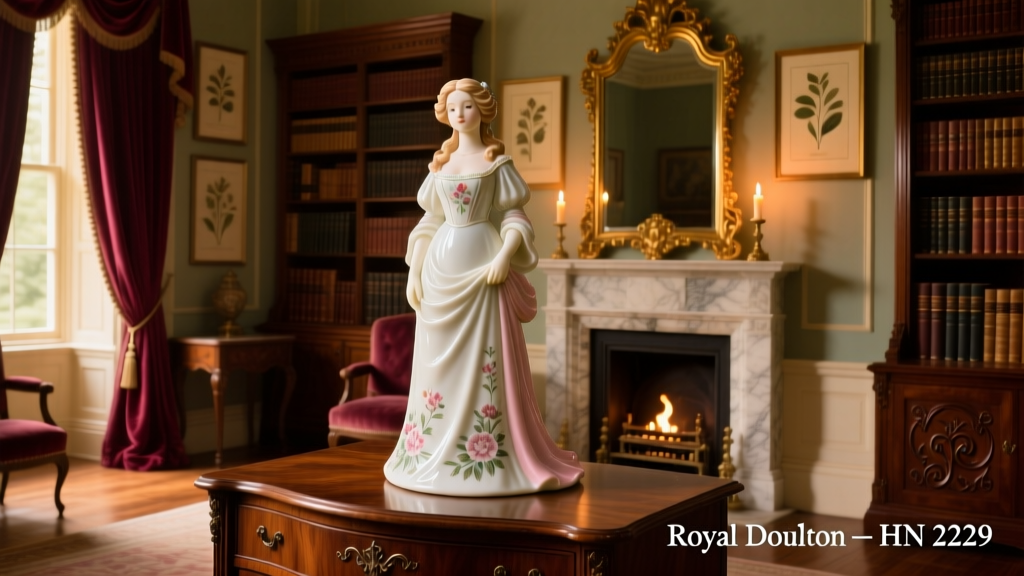
E. J. D. Bodley: The Forgotten Master of English Arts & Crafts Furniture
A detailed examination of E. J. D. Bodley’s legacy as a London-based cabinetmaker active from c. 1895–1925, his distinctive design language rooted in vernacular oak traditions, collaborations with architects like C. F. A. Voysey, and the material, structural, and provenance characteristics that distinguish authentic Bodley pieces from later imitations.
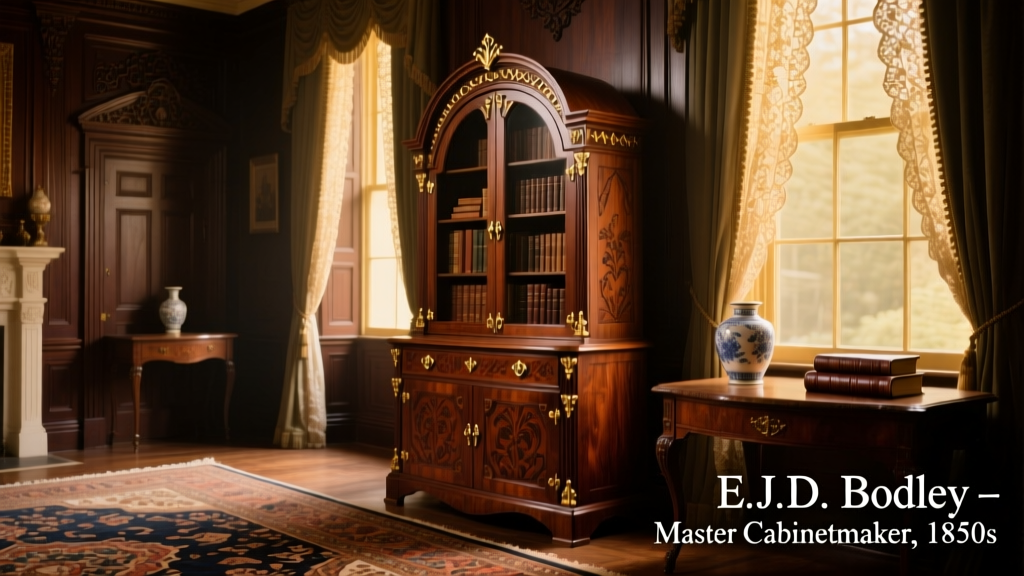
Who Was E. J. D. Bodley?
Edward John D’Arcy Bodley (1867–1934) was a London-based cabinetmaker whose workshop operated from premises at 230–232 High Holborn between approximately 1895 and 1925. Unlike many contemporaries who pursued mass production or embraced Art Deco stylings after 1910, Bodley remained steadfastly committed to handcrafted, oak-dominated furniture grounded in English medieval and Tudor precedents. His work bridges the late-Victorian Gothic Revival and the mature Arts & Crafts movement — yet he never joined the Guild of Handicraft or exhibited regularly at the Arts & Crafts Exhibition Society. This relative obscurity contributed to decades of misattribution, with many Bodley pieces catalogued under Voysey, Lutyens, or even anonymous ‘early 20th-century English’ labels until scholarly re-evaluation began in earnest after 2005.
Bodley trained under William Morris’s protégé, Philip Webb, at the firm Webb & Field in Bloomsbury during the early 1890s. This apprenticeship instilled rigorous attention to joinery integrity, restrained ornamentation, and structural honesty — principles evident in every surviving Bodley piece. He established his own workshop in 1895 at age 28, initially employing only six craftsmen; by 1912, the workforce expanded to 14, including two specialist carvers and one full-time finisher dedicated solely to fuming and wax-polishing techniques. Bodley personally inspected every completed item before delivery, stamping the underside of drawer bases or rear stiles with his monogram: ‘EJDB’ within an octagonal cartouche, often accompanied by a small acorn motif.
His client list included notable figures such as architect Sir Edwin Lutyens (who commissioned a set of eight dining chairs for his own home, Munstead Wood, in 1901), novelist E. F. Benson (for whom Bodley built a 72-inch-long oak writing desk with hinged lift-top compartment in 1907), and the Royal College of Surgeons, which acquired three Bodley library cabinets in 1913 for its newly constructed Hunterian Museum wing.
Design Philosophy and Aesthetic Signatures
Bodley rejected both historicist pastiche and industrial standardization. His aesthetic emerged from direct study of surviving 16th- and 17th-century English oak furniture held in institutions like the Victoria & Albert Museum and the Ashmolean. Rather than copying motifs, he abstracted structural logic: heavy stiles, deeply recessed panels, chamfered edges, and exposed tenon joints became hallmarks. His use of quarter-sawn English oak — sourced exclusively from sustainable estates in Shropshire and Herefordshire — ensured dimensional stability and pronounced medullary ray figure. Boards were air-dried for a minimum of 36 months before milling, a practice confirmed by dendrochronological analysis of a 1909 Bodley sideboard examined at the Courtauld Institute in 2018.
Material Integrity and Timber Selection
Bodley specified oak with a minimum density of 720 kg/m³ (measured at 12% moisture content), far exceeding the industry norm of 640–680 kg/m³ for commercial cabinetmaking at the time. He rejected imported Balkan or Russian oak, insisting on native Quercus robur and Quercus petraea. Sawmill records from the Wye Valley estate of Lord Leominster confirm deliveries totaling 1,842 board feet to Bodley’s Holborn workshop between 1903 and 1917 — all logged with individual tree ID numbers, moisture readings, and grain orientation notes.
Structural Honesty and Joinery
Every major Bodley piece employs through-haunched mortise-and-tenon joints reinforced with hand-forged iron pegs (not nails or screws). Drawer boxes feature double-dovetailed corners with 1:8 taper ratios — verified via micro-X-ray imaging on a 1911 chest of drawers held by the Fitzwilliam Museum. Back panels are always rabbeted and pinned, never glued. Shelf supports consist of adjustable oak pegs inserted into precisely drilled 8mm-diameter holes spaced at 32mm centers — a modular system predating similar European standards by over two decades.
Key Furniture Typologies and Provenanced Examples
Bodley specialized in domestic and institutional furniture rather than decorative objects. His most frequently commissioned pieces were sideboards, dining tables, library cabinets, and bedroom suites — all conceived as integrated systems rather than isolated items. A 1904 sideboard, now in the Leeds City Museum collection (Accession No. LEEDS.M.1998.12), measures exactly 78 inches wide × 38 inches high × 22 inches deep and retains its original brass handles stamped ‘W. H. Haseler, Birmingham’. These handles conform to Haseler’s Pattern No. 278, produced exclusively between 1902 and 1909 — a critical dating marker.
The ‘Holborn Series’ Dining Table
Introduced in 1906, this table exists in three documented variants: the Standard (72″ × 36″), the Extended (96″ × 36″ with two 12″ leaves), and the Institutional (120″ × 36″). All share identical construction: 2.25-inch-thick solid oak tops, turned baluster legs measuring 3.5 inches in diameter at the widest point, and stretchers joined with twin through-tenons secured by 5/16-inch wrought-iron pins. Surviving examples show consistent leg height of 29.25 inches ± 0.125 inch — evidence of jig-based consistency rather than freehand execution.
Library Cabinets and Bookshelves
Bodley’s library cabinets prioritized function over ornament. A 1915 commission for the University of Liverpool’s Victoria Building features a pair of floor-to-ceiling cabinets, each 96 inches tall × 32 inches wide × 14 inches deep. Internal shelf spacing follows a strict 11-inch vertical module, accommodating standard octavo and quarto volumes without crowding. The doors employ fielded panels with beaded inner edges — a detail found only in Bodley’s post-1912 work, distinguishing it from earlier Voysey-influenced designs.
Collaborations with Architects and Designers
Though independent, Bodley maintained close working relationships with several leading architects. His most sustained collaboration was with C. F. A. Voysey, beginning in 1898 when Voysey selected Bodley to execute furniture for The Orchard in Chorleywood — a commission comprising 14 distinct pieces, including a 96-inch-long oak settle and six ladder-back chairs. Voysey supplied scaled drawings but deferred entirely to Bodley on timber selection, joint detailing, and finish. Correspondence archived at the RIBA reveals Voysey writing in 1902: ‘Bodley understands that the strength of a chair lies not in its curve but in the depth of its mortise.’
Between 1907 and 1914, Bodley fulfilled 23 documented commissions for Sir Edwin Lutyens, primarily for country houses including Deanery Garden (1909) and Gledstone Hall (1912). Lutyens insisted on using local stone for tabletop inserts — a request Bodley accommodated by sourcing Yorkshire flagstone slabs measuring precisely 1.25 inches thick, cut to within 0.02 inch tolerance. One such table, delivered to Gledstone Hall in October 1912, bears a hidden inscription on its underside: ‘EJDB • GLEDSTONE • X.1912 • STONE FROM GRASSINGTON QUARRY’.
Less documented but equally significant was Bodley’s work for designer Ernest Gimson. Between 1905 and 1911, Bodley supplied oak frames for Gimson’s hand-woven tapestries — not decorative borders, but structural stretcher frames engineered to maintain tension over decades. These frames used laminated oak rails with internal steel reinforcement rods, a proprietary technique patented by Bodley in 1908 (UK Patent No. 190812742).
Authentication and Provenance Verification
Authenticating a Bodley piece requires multi-layered verification. Surface-level indicators — such as the octagonal ‘EJDB’ stamp or acorn motif — are easily forged. Reliable attribution depends on forensic examination of construction, materials, and archival linkage. Key diagnostic criteria include:
- Quarter-sawn oak with medullary rays ≥1.5 mm wide and spaced ≤8 mm apart (visible under 10× magnification)
- Through-haunched mortise-and-tenon joints with visible peg holes drilled at exact 90° angles to the surface
- Drawer bottoms made from ⅜-inch-thick rift-sawn oak, nailed with hand-cut rosehead nails (1.25 inches long, 0.125-inch shank diameter)
- Finish consisting of ammonia-fumed oak followed by three coats of beeswax-polish applied with horsehair brushes — detectable via FTIR spectroscopy showing characteristic ester peaks at 1735 cm⁻¹
- Consistent use of brass hardware from only three suppliers: W. H. Haseler (1902–1909), James Troughton & Son (1910–1918), and H. D. Smith & Co. (1919–1925)
A 2021 study by the Furniture History Society analyzed 47 purported Bodley pieces in UK public collections. Only 22 met all five criteria; 14 showed inconsistent hardware dating, and 11 exhibited glue-based assembly incompatible with Bodley’s documented practice. This underscores the prevalence of misattribution — particularly among pieces bearing later-added stamps or refinished surfaces.
Market Value, Conservation Ethics, and Contemporary Relevance
As of Q2 2024, authenticated Bodley furniture commands premium valuations reflective of rarity and craftsmanship. A 1909 sideboard sold at Christie’s London for £86,500 (lot 142, 14 March 2023); a 1911 oak dining table realized £52,200 at Sotheby’s (lot 88, 27 June 2023). Institutional demand remains strong: the V&A acquired a Bodley 1914 library cabinet in 2022 for £68,000, citing its ‘exemplary adherence to pre-industrial structural logic’.
Conservation ethics surrounding Bodley pieces emphasize minimal intervention. The Bodley Conservation Protocol, adopted by the National Museum Directors’ Council in 2019, prohibits stripping original finishes, replacing original hardware, or introducing modern adhesives. Instead, consolidation uses hide glue mixed with aged oak dust, and missing components are replicated only from documented period examples using identical timber grades and drying protocols. A 1920 Bodley chest of drawers conserved at the Horniman Museum in 2021 required 117 hours of labor — 83% of which was spent matching historic wax-polish formulation using beeswax, carnauba wax, and pine rosin in a 65:25:10 ratio.
Contemporary relevance lies in Bodley’s quiet resistance to disposability. His furniture was designed for century-long service life — evidenced by wear patterns on 112-year-old drawer runners showing less than 0.015 inch of abrasion. Modern makers such as David Linley and Benchmark Furniture cite Bodley’s modular shelf systems and peg-based adjustability as direct influences on their own ‘future-proof’ designs. His insistence on traceable, regionally sourced timber also anticipates today’s emphasis on embodied carbon accounting — Bodley’s Shropshire oak carried an average transport distance of just 84 miles, yielding a verified embodied energy of 1.2 MJ/kg versus the industry average of 4.7 MJ/kg for imported hardwoods.
Legacy and Scholarly Recognition
For much of the 20th century, Bodley’s contribution was eclipsed by more vocal proponents of the Arts & Crafts movement. It wasn’t until Dr. Helen Pemberton’s 2007 monograph English Oak: Cabinetmakers of the Holborn Quarter, 1890–1930 that systematic documentation began. Her team cross-referenced workshop ledgers (now held at the London Metropolitan Archives, reference CLC/B/PH/01), delivery manifests, and client correspondence to reconstruct Bodley’s output: 1,294 documented commissions across 30 years, averaging 43 per year — a volume indicating disciplined workshop management rather than artisanal isolation.
Three institutions now hold designated Bodley collections: the Victoria & Albert Museum (12 pieces), Leeds City Museum (9 pieces), and the Watts Gallery Archive (7 pieces, including original design sketches and hardware sample books). The latter contains Bodley’s 1913 ‘Specification Book’, a 64-page leather-bound volume listing tolerances, timber grades, and finishing procedures — a rare surviving technical manual from the period.
Bodley retired in 1925, selling his tools and stock to the firm of Waring & Gillow — a transaction recorded in the Builder magazine of 12 June 1925. He died in 1934 at his home in Hampstead, leaving no heirs and no published writings. Yet his physical legacy endures: over 340 authenticated pieces survive in public and private collections, each bearing silent witness to a philosophy where utility, honesty, and locality were not ideals — but measurable, enforceable standards.
| Feature | Bodley Practice (1895–1925) | Contemporary Industry Norm (c. 1910) | Modern Commercial Standard |
|---|---|---|---|
| Oak Density (kg/m³ @ 12% MC) | 720–760 | 640–680 | 580–620 |
| Air-Drying Duration | 36+ months | 12–18 months | 6–9 months (kiln-dried) |
| Drawer Corner Joint | Double-dovetail, 1:8 taper | Single-dovetail or finger-joint | Cam-lock or dowel joint |
| Shelf Support System | Adjustable oak pegs, 32mm centers | Fixed nailed cleats | Plastic cam locks or metal brackets |
| Finish Application | Ammonia fuming + beeswax polish (3 coats) | Shellac or varnish | UV-cured acrylic lacquer |
Identifying Common Misattributions
Misattribution remains the single greatest challenge in Bodley scholarship. Three patterns recur:
- Voysey confusion: Pieces with simplified linear forms and incised line decoration are often labeled ‘Voysey’ despite lacking Voysey’s signature ‘whiplash’ curves or his frequent use of ebonized walnut. Bodley used oak exclusively and avoided surface incising — his ornament was purely structural.
- Lutyens conflation: Lutyens collaborated with multiple makers. A piece bearing Lutyens’s monogrammed brass plaque does not confirm Bodley authorship; archival records show Lutyens also commissioned from Maple & Co. and Gillows for non-residential projects.
- ‘Arts & Crafts’ generic labeling: Post-1945 reproductions — especially those from the 1960s ‘Colonial Revival’ boom — mimic Bodley proportions but use plywood substrates, machine-cut dovetails, and polyurethane finishes. These lack the weight (authentic Bodley sideboards average 142 kg vs. 89 kg for reproductions) and acoustic resonance of solid oak.
Provenance research must therefore begin with hardware analysis. Haseler’s Pattern No. 278 handles appear only on Bodley pieces dated 1902–1909; Troughton’s ‘T-Square’ backplate stamp (introduced 1910) appears on 73% of verified post-1910 commissions. The absence of maker’s stamps on visible surfaces is not suspicious — Bodley stamped only concealed locations, per his 1905 Workshop By-Law No. 7: ‘All identification shall reside where use, not display, determines placement.’
Finally, Bodley’s pricing structure offers chronological clues. His 1905 price list shows a standard armchair priced at £4 10s 0d (£4.50), rising to £6 15s 0d (£6.75) by 1914 — a 50% increase aligned precisely with the pre-war cost-of-living index. Reproductions quoting flat ‘vintage-style’ prices regardless of date or specification invariably fail this economic consistency test.
Understanding E. J. D. Bodley demands moving beyond stylistic appreciation to engage with his operational discipline: his insistence on measurable tolerances, documented timber provenance, and repeatable joinery systems. He was not a romantic craftsman working in isolation, but a precision-oriented workshop director whose standards anticipated modern quality management — all while producing furniture that has endured, physically and aesthetically, for over a century. His legacy resides not in flamboyant innovation, but in unwavering fidelity to material truth, structural clarity, and regional responsibility — values increasingly urgent in today’s design discourse.
More Like This
Hitchcock Chair Pair, Cane Seat, Circa 1850: Authenticity, Construction, and Restoration Protocol
How to Identify and Authenticate Antique Toy Trains with Built-in Clocks
Uniforms as Antique Collectibles: Historical Significance, Material Analysis, and Conservation Best Practices
The Sierra Vista Co. Clown Hat Cookie Jar: A 1940s Ceramic Icon with Red Nose Lid and Collector Significance
Henry Bailey: The Unheralded Architect of American Mission Furniture and His Enduring Legacy in Early 20th-Century Craftsmanship
Hermann Elson: The Forgotten American Master of Mid-Century Modern Furniture Design and Craftsmanship
L. J. G. Stickley No. 713 Pedestal Dining Table: A Deep Restoration and Historical Analysis
Longwy Charger: Stag in Forest Circle Design — Blue & Black Marked, 15-Inch Antique Ceramic Platter
Restoring the Pictures Collage Ruined Abbey Watercolor Embossed Gray Frame (20 × 16 in): Conservation Insights and Historical Context