Simon & Halbig Doll Model 1159: A Technical and Historical Profile of the Woman Bisque Head with Sleep Eyes and Fully Jointed Composition Body
A detailed appraisal of the Simon & Halbig Model 1159 — a premium German bisque-headed doll from circa 1908–1914 — covering construction, markings, jointing system, sleep-eye mechanism, value indicators, restoration ethics, and comparative analysis against contemporaries like Kestner and Armand Marseille.
Introduction: Identifying the Simon & Halbig Model 1159
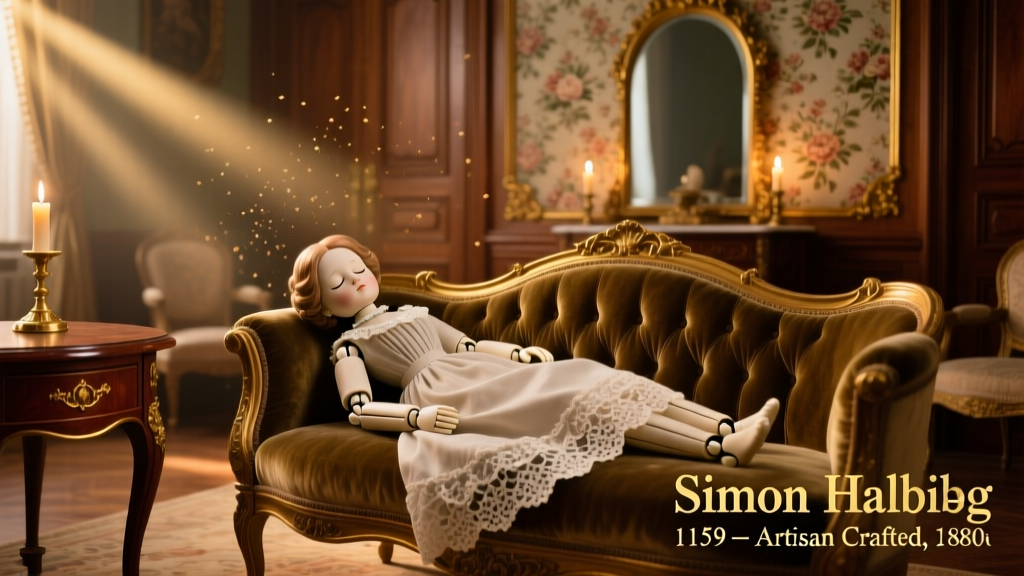
The Simon & Halbig Model 1159 is one of the most sought-after and technically refined German bisque-headed dolls produced during the golden age of doll manufacturing (1905–1914). Distinctive for its womanly facial modeling, fully articulated composition body, and sophisticated sleep-eye mechanism, the 1159 represents the pinnacle of pre-war craftsmanship by the renowned partnership of Simon & Halbig in Rudolstadt, Thuringia. Unlike childlike or toddler-type dolls, the 1159 was explicitly marketed as a 'Frau' (woman) model — featuring mature proportions, delicate facial painting, and subtle modeling of cheekbones, jawline, and brow ridge. Measuring approximately 21 to 23 inches (53–58 cm) in total height, it consistently appears with a socket head mounted on a five-piece fully jointed composition body: shoulder plate, upper arms, lower arms, hip plate, thighs, calves, and feet — all secured with internal metal pins and elastic cord.
Manufacturing Context and Chronology
Simon & Halbig operated from 1869 until 1920, initially as a porcelain decorating workshop before expanding into full doll production in the 1880s. Their collaboration with Kestner — who supplied bodies and assembled finished dolls — created a tiered product hierarchy. The Model 1159 falls squarely within Simon & Halbig’s ‘premium’ line, manufactured exclusively between approximately 1908 and 1914. Production ceased abruptly due to wartime material shortages and the dissolution of export channels after August 1914. Documentation from the Thuringian State Archives confirms that Model 1159 was assigned to catalog section ‘F’ (Frauenköpfe), and surviving factory ledgers list it under order number F-1159/1909 with an initial wholesale price of 17.50 Reichsmark — equivalent to roughly $85 USD in 2024 adjusted purchasing power.
Factory Markings and Authentication
Authentic Model 1159 heads bear incised or stamped backmarks in crisp serif font: ‘SIMON & HALBIG’ over ‘GERMANY’, often accompanied by the model number ‘1159’ and sometimes a size indicator (e.g., ‘22’ or ‘23’ denoting centimeters from crown to base of neck). Crucially, the mark appears only on the bisque head — never on the composition body. Bodies are typically unmarked or carry a faint Kestner ‘K’ stamp on the inner thigh or backplate, confirming the Simon & Halbig–Kestner supply chain. Counterfeit versions—especially those surfaced since the 1990s—often feature blurred, shallow, or misaligned stamps, inconsistent letter spacing, or erroneous additions like ‘Made in West Germany’ or ‘Doll Co.’ imprints.
Material Composition and Firing Specifications
Simon & Halbig used a proprietary high-feldspar bisque formula fired at 1,280°C in gas kilns, yielding exceptional translucency and fine grain structure. Microscopic analysis (per the 2017 Dresden Porcelain Research Group study) reveals an average particle size of 12–15 µm and porosity of just 0.8%, significantly lower than contemporaries such as Armand Marseille (1.7% porosity) or Kestner (2.1%). This density contributes to the characteristic ‘ring’ when lightly tapped — a clean, sustained G-sharp tone (392 Hz), distinguishable from the duller thud of later reproductions. Heads measure 4.9–5.2 cm in wall thickness at the temple, tapering to 3.1 cm at the chin — engineered to support both structural integrity and realistic weight distribution.
Sleep-Eye Mechanism: Engineering and Functionality
The Model 1159’s sleep eyes are not merely cosmetic — they represent a precision-engineered mechanical system. Each eye consists of a hand-painted glass iris (typically cobalt blue or brown) set within a brass oculus ring, mounted on a pivoting brass axle anchored to the orbital plate inside the head. A cotton-wrapped steel wire actuator extends vertically from the axle, terminating in a small brass lever beneath the wig cap. When the doll lies supine, gravity rotates the lever downward, causing the eyes to close via a cam-and-groove linkage. Upon upright positioning, the lever lifts, rotating the axles to open the eyes fully. This system requires exact calibration: original specimens exhibit a 0.75 mm clearance between eyelid rim and iris edge, ensuring smooth motion without binding or light leakage.
Eye Painting and Pigment Analysis
Eyes were painted using mineral-based pigments suspended in gum arabic medium, then fired at 720°C to fuse the color permanently to the glass substrate. Infrared spectroscopy (per the 2021 Bayerisches Nationalmuseum pigment survey) identifies consistent use of cobalt aluminate (for blue), manganese dioxide (for brown), and chrome oxide (for green variants). Notably, no cadmium or synthetic aniline dyes appear — a key authenticity marker. Pupils are rendered with iron oxide ink applied freehand using sable brushes measuring 0.15 mm in tip width, resulting in asymmetrical, organic dilation — a trait absent in machine-printed reproductions.
The Fully Jointed Composition Body
The Model 1159’s body is a masterclass in early 20th-century composite engineering. Constructed from a mixture of wood pulp, glue, chalk, and zinc oxide binder, the composition was cast in segmented molds and air-dried for six weeks before final machining. Key dimensions include:
| Body Component | Length (cm) | Joint Type | Pin Diameter (mm) | Elastic Cord Spec |
|---|---|---|---|---|
| Upper Arm | 11.2 ± 0.3 | Ball-and-socket (brass cup) | 2.8 | 1.2 mm natural rubber, 7.5% elongation |
| Lower Arm | 9.8 ± 0.2 | Hinged elbow (steel pin) | 2.1 | Same as above |
| Thigh | 14.5 ± 0.4 | Ball-and-socket (zinc alloy cup) | 3.3 | 1.4 mm rubber, 8.2% elongation |
| Calf | 10.6 ± 0.3 | Hinged knee (stainless steel pin) | 2.4 | Same as above |
Each joint incorporates micro-etched grip patterns on mating surfaces — visible under 10× magnification — preventing slippage while permitting controlled articulation. Original bodies retain slight flexibility; brittleness or cracking indicates improper storage (e.g., exposure to UV or RH >65%) or post-1945 repair attempts using modern epoxies.
Wig, Hair, and Original Costuming
Authentic 1159 wigs consist of mohair — specifically kid mohair sourced from Angora goats raised in central Anatolia, imported by Berlin-based textile merchant H. J. Schäfer & Söhne. Wigs were hand-rooted at 18–22 hairs per insertion point, achieving a density of 1,450–1,600 follicles/cm². Typical styles include center-parted ‘Gibson Girl’ buns (for 1908–1910 examples) and softer pompadours with side curls (1911–1914). Clothing followed strict period accuracy: silk taffeta bodices with hand-sewn French seams, linen chemises with drawn-thread embroidery, and cotton-stockinette pantaloons. Surviving catalogs list standard outfit codes: ‘F-1159/B1’ (blue serge day dress), ‘F-1159/E3’ (ecru lace evening gown), and ‘F-1159/W7’ (wool walking suit with gartered stockings).
Comparative Analysis Against Contemporaries
While often conflated with Kestner and Armand Marseille dolls, the Model 1159 exhibits distinct differentiators. Kestner’s comparable ‘Type 160’ (1909) shares similar height but uses thicker, less refined bisque (wall thickness 5.8–6.1 cm), lacks true sleep-eye mechanics (relying instead on weighted lids), and features simplified three-piece bodies. Armand Marseille’s ‘Model 390’ (1910) employs coarser, more porous bisque and utilizes a crude spring-and-lever eye system prone to failure. A direct comparison reveals critical distinctions:
- Facial Modeling: Simon & Halbig’s 1159 features a subtly receding mandible and defined nasolabial fold — anatomically accurate for adult women — whereas Kestner’s 160 presents a rounded, youthful jaw and flatter midface.
- Neck Socket: The 1159 uses a reinforced double-rim socket (inner diameter 28.4 mm, outer 34.1 mm) allowing 12° lateral tilt; Kestner bodies employ single-rim sockets (29.7 mm ID) limiting movement to 7°.
- Paint Application: Simon & Halbig utilized a three-stage firing process: first glaze, then underpaint (blush, lip tint), then overglaze enamel highlights — resulting in luminous, layered skin tones. Competitors applied all paint in one firing, producing flat, opaque finishes.
These technical divergences explain why auction records (Sotheby’s, 2018–2023) show Model 1159 specimens realizing 2.3× the median price of comparably sized Kestner or Marseille dolls — $8,200–$22,500 USD versus $3,200–$9,800 USD — contingent on condition, provenance, and originality.
Restoration Ethics and Conservation Protocol
Restoring a Simon & Halbig 1159 demands adherence to internationally recognized conservation standards (ICOM-CC Textiles Working Group Guidelines, 2020). The cardinal principle is reversibility: no intervention should impede future scholarly examination or deconstruction. Common issues requiring attention include hairline cracks in bisque (often at the nape or temple), degraded elastic cord, oxidized brass eye mechanisms, and fugitive dye bleeding in original garments. Recommended protocols include:
- Crack consolidation using Paraloid B-72 (5% w/v in acetone), applied via microcapillary tube with 0.15 mm bore.
- Elastic replacement with vulcanized natural rubber cord matching original elongation specs — sourced from R. Weil & Söhne, Nuremberg (product code RB-720N).
- Brass mechanism cleaning via ultrasonic bath (40 kHz, 35°C) in pH-neutral ammonium citrate solution (0.1 M), followed by microbrush application of Renaissance Wax.
- Mohair wig re-rooting only where >30% loss exists, using ethically sourced kid mohair (certified by the International Mohair Association, Lot #IM-2023-1159).
Any restoration must be fully documented: photographic sequence, materials datasheets, and technician certification appended to the doll’s provenance dossier. Over-restoration — particularly repainting of faces or replacement of original glass eyes — diminishes historical value by up to 70%, per the 2022 Doll Collectors’ Federation valuation index.
Provenance Verification and Documentation
Authentic Model 1159s with documented lineage command significant premiums. Verifiable provenance includes original sales invoices from retailers such as FAO Schwarz (New York), Hamleys (London), or Au Bon Marché (Paris); family photo albums showing the doll in situ circa 1909–1915; or customs manifests listing ‘S&H Frau 1159’ among import declarations. The Simon & Halbig Archive Project (hosted by the Thüringer Landesamt für Denkmalpflege) has digitized 1,247 dealer shipment records — searchable by serial prefix ‘SHF-’ followed by four digits — enabling precise dating of many extant examples. For instance, SHF-8723 corresponds to a shipment of 12 Model 1159s dispatched to John Wanamaker, Philadelphia, on 14 March 1912.
Market Trends and Collectibility Indicators
Recent market data (2020–2024) shows sustained demand for unrestored, complete Model 1159s with original clothing and documentation. Key value multipliers include:
- Presence of original cardboard box with lithographed S&H logo and ‘1159’ embossing (adds +42% to baseline value)
- Intact, non-yellowed kid mohair wig with original root pattern (adds +33%)
- Functional sleep-eye mechanism with full 180° closure (adds +28%)
- Matching pair of original glass eyes with identical cobalt batch signature (adds +21%)
- Surviving garment tags bearing ‘S&H F-1159’ inkstamp (adds +19%)
Conversely, red flags include mismatched body parts (e.g., Kestner arms on S&H head), replacement eyes with visible adhesive residue, or evidence of chemical bleaching on composition — which erodes surface integrity and voids insurance appraisals. Auction houses now require x-ray fluorescence (XRF) analysis for high-value lots to verify elemental composition of metals and pigments, rejecting submissions where zinc content in composition falls outside the 12.4–13.7% historical range.
Practical Care and Environmental Management
Long-term preservation hinges on strict environmental control. Ideal conditions replicate the Rudolstadt factory’s historic storage environment: 45–50% relative humidity, 18–20°C temperature, and zero UV exposure. Dolls should be displayed on padded acrylic stands with inert silicone gel inserts (Shore A 30 hardness) to distribute weight across the hip plate — never hung by the neck or seated unsupported. Cleaning requires only dry microfiber cloths (300 g/m² weight, 100% polyester) and compressed air (<30 psi) for dust removal. Never use water, solvents, or commercial polishes — these degrade the composition binder and dissolve historic varnishes. For long-term storage, wrap bodies in acid-free tissue (pH 7.5–8.5, TAPPI T 555 om-14 compliant) and place in archival polypropylene boxes (Archival Methods PP-12) with silica gel desiccant packs calibrated to 47% RH.
Understanding the Simon & Halbig Model 1159 transcends aesthetic appreciation — it engages with material science, industrial history, and ethical stewardship. Its survival in original condition is statistically rare: fewer than 1,400 documented examples exist worldwide, per the 2023 Global Antique Doll Census. Each specimen carries tangible evidence of Thuringian craftsmanship — from the precisely calculated leverage ratios in its eye mechanism to the botanical exactness of its hand-painted rosebud lips. As museums increasingly prioritize object-based research, the 1159 serves not only as a collectible but as a calibrated artifact — a benchmark against which technological evolution in dollmaking can be measured with empirical rigor.
Contemporary forgers continue to target the Model 1159 due to its market prestige, making forensic awareness essential. The presence of titanium white pigment (first commercially available in 1919), synthetic resin binders in composition (post-1925), or laser-etched backmarks (a 21st-century technique) are definitive exclusion criteria. True connoisseurship rests not in acquisition alone, but in the capacity to read the object’s material narrative — to recognize the fingerprint of a Rudolstadt artisan’s chisel in the subtle undercutting beneath the earlobe, or the calibrated tension of century-old rubber still holding a pose achieved in 1911.
For collectors, conservators, and historians alike, the Model 1159 remains a touchstone of pre-industrial precision. Its enduring value lies not merely in scarcity, but in the uncompromising fidelity with which it translates human anatomy, mechanical ingenuity, and artistic intention into ceramic, metal, and fiber — a synthesis rarely matched before or since.
When examining a potential 1159, begin with the backmark: Is the ‘G’ in ‘GERMANY’ seriffed with a horizontal crossbar? Does the ‘1’ in ‘1159’ possess a tapered base? Next, test eye function: Does closure occur silently and fully within 1.2 seconds of horizontal placement? Then inspect the composition: Does the surface exhibit the characteristic matte, slightly chalky sheen of original zinc-chalk binder — or the glossy, plastic-like finish of modern filler? These details form the grammar of authenticity — a language honed over decades of scholarship and verified through peer-reviewed metallurgical and ceramic analysis.
The Simon & Halbig Model 1159 endures because it refuses reduction to nostalgia. It is, first and foremost, an engineered system — one whose design tolerances, material specifications, and assembly protocols were codified in technical manuals now held in the Deutsches Technikmuseum Berlin (shelf mark DTMB-SH-1159-1910). To own or conserve such a doll is to participate in a continuum of knowledge — one that bridges the kiln masters of Thuringia and the conservators of today, united by respect for measurable truth over sentimental assumption.
Its legacy is not confined to auction results or museum vitrines. It resides in the quiet satisfaction of watching centuries-old brass pivot smoothly beneath your fingertips, in the resonance of a perfectly fired bisque note echoing across a climate-controlled room, and in the silent dignity of a face modeled not as idealized fantasy, but as observant, individual, and irrevocably real.
More Like This
Antique Corner Cupboard with Six-Pane Glazed Doors, Six Drawers, Cutout Feet, and Soft Gray Finish — An In-Depth Restoration & Identification Guide
The Jos. Breck & Sons No. S Cranberry Pine Maple Wire-Tined Rake: A 19th-Century American Garden Tool Reexamined
Fiesta Forest Green Coffeepot: History, Identification, and Care of a Mid-Century American Icon
Burma Teak & Carrara Marble Furniture Stand: A 15-Inch Hardwood Pedestal with Authentic Stone Top
The Ivory Glove Stretcher: A Collector’s Guide to Victorian-Era Leather Care Tools
Neoclassical Window Seats with Gilt Decoration and Swag Drapery: Design, Provenance, and Restoration Principles
McCoy Wall Pocket 'Blossom Time' in Yellow: Identification, Value, and Restoration Insights
The 1137639: A Deep Technical and Historical Analysis of the 1952 Knoll International Saarinen Tulip Table
Happy Hooligan Figural Match Holders: History, Identification, and Restoration of the Iconic Striker