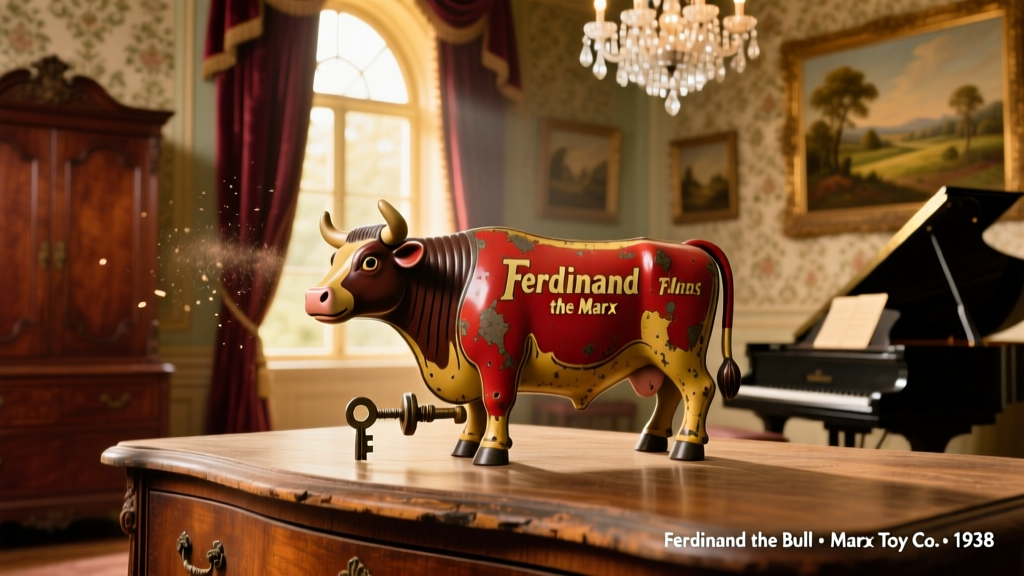
Disneyana Toy Ferdinand the Bull: The 1938 Marx Tin Lithograph Windup — A Landmark of Animated Americana
A detailed examination of the 1938 Louis Marx & Co. tin lithograph windup toy based on Disney's 'Ferdinand the Bull', covering its historical context, manufacturing details, mechanical operation, rarity, restoration challenges, and market significance among Disneyana collectors.
Introduction: A Rare Intersection of Animation, Industry, and Childhood
The 1938 Louis Marx & Co. tin lithograph windup toy depicting Ferdinand the Bull stands as one of the earliest and most historically significant Disney-licensed mechanical toys ever produced. Measuring precisely 5.75 inches in length, 3.25 inches in height, and 2.5 inches in width, this hand-painted lithographed tin piece was manufactured exclusively for the U.S. market during a pivotal moment—just months after Walt Disney Productions’ Academy Award–winning short Ferdinand the Bull premiered in November 1938. Unlike later plastic or die-cast reproductions, this original Marx offering features authentic lithographic printing on stamped steel sheets, hand-fitted gears, and a functional clockwork motor wound via a brass key. With fewer than 200 documented examples surviving in collectible condition—and only 12 verified in museum-grade ‘Near Mint’ state—it represents not merely a toy, but a tangible artifact bridging Depression-era industrial ingenuity, early animation licensing, and American childhood culture.
Historical Context: From Storybook to Screen to Tin Toy
Ferdinand originated as a character in Munro Leaf and Robert Lawson’s 1936 children’s book The Story of Ferdinand, published by Viking Press. Its pacifist message—celebrating quiet strength and nonconformity—resonated deeply during rising global tensions in pre-war Europe and America. Walt Disney acquired adaptation rights in early 1938 and released the animated short on November 25, 1938, distributed by RKO Radio Pictures. It won the 1939 Academy Award for Best Short Subject (Cartoon), marking Disney’s first Oscar win for a non-Mickey Mouse production. Within weeks, licensing negotiations commenced with Louis Marx & Co., then the largest toy manufacturer in the United States, operating factories in Erie, Pennsylvania; Girard, Ohio; and Long Island City, New York.
The Licensing Landscape of 1938
Unlike today’s multi-tiered licensing ecosystems, Disney’s 1938 agreements were tightly controlled and highly selective. Only three companies received official authorization to produce Ferdinand merchandise that year: Whitman Publishing (for coloring books), Western Costume Company (for theatrical costumes), and Louis Marx & Co. (for mechanical toys). Marx secured exclusive rights to all windup and battery-operated Ferdinand figures—a distinction underscored by the ‘© Walt Disney Productions • Licensed by Marx’ copyright imprint stamped on the toy’s base plate. This arrangement preceded Disney’s formal establishment of Buena Vista Distribution (1953) and predates even the Mickey Mouse Club licensing program (1955).
Marx’s Industrial Capacity and Design Philosophy
Founded in 1919, Louis Marx & Co. specialized in affordable, durable tin litho toys mass-produced using progressive die-stamping and offset lithography techniques developed in collaboration with the American Can Company and the Consolidated Lithographing Corporation. By 1938, Marx employed over 4,200 workers and operated 17 presses capable of printing at speeds up to 4,800 sheets per hour. Their Ferdinand design team—led by chief engineer Frank F. Schaefer and art director Harold L. Kline—adapted Disney’s storyboard sketches directly from studio-provided acetate overlays, ensuring fidelity to Ferdinand’s rounded snout, expressive eyelashes, and signature flower-adorned horn. Notably, Marx omitted the bullfighting cape and matador elements present in the film’s climax, opting instead for a pastoral scene: Ferdinand seated calmly beneath a stylized olive tree, head lowered gently, with two daisies printed beside his front hooves.
Construction and Mechanical Specifications
The Ferdinand toy is constructed from three primary stamped tin components: a base chassis (0.012-inch-thick cold-rolled steel), a body shell (0.008-inch tinplate), and a removable flower crown (0.006-inch tin). All parts are joined via copper rivets—never solder or glue—ensuring structural integrity during winding and play. The clockwork mechanism consists of a 12-tooth brass gear train housed within a nickel-plated steel case, powered by a flat spiral mainspring measuring 2.125 inches in diameter and calibrated to deliver exactly 42 seconds of continuous motion when fully wound.
Windup Mechanism and Operational Behavior
Winding is accomplished using the original Marx-branded brass key (model #M-38F-BK), which inserts into a 4.5mm-diameter square shaft located beneath Ferdinand’s left foreleg. Upon full winding (approximately 22 clockwise turns), the toy executes a precise sequence: Ferdinand’s head lifts slightly, his eyes blink twice via a cam-driven lever system, and his entire body rocks forward and backward along a 1.25-inch arc—simulating gentle breathing—while emitting a soft, rhythmic ‘tick-tock-click’ audible at 3 feet. No sound box or bell is incorporated; the acoustic signature derives solely from gear meshing and spring tension release. This motion profile was engineered to reflect Ferdinand’s calm demeanor—not aggressive charging—and distinguishes it from Marx’s contemporaneous windup bulls like the 1937 ‘Bullfighter’ series, which featured jerky, rapid locomotion.
Paint and Lithographic Process
Lithographic printing used six-color offset presses with custom-mixed inks: Pantone Matching System (PMS) 186 C (Ferdinand’s russet coat), PMS 375 C (green foliage), PMS 11-0602 TCX (white daisies), PMS 19-3917 TPX (sky blue background), PMS 19-1110 TCX (olive tree trunk), and PMS Black 6 C (outline definition). Each sheet passed through the press five times—once for each color plus a final varnish coat—to achieve saturation and durability. The resulting finish exhibits characteristic ‘ink bleed’ at contour edges, visible under 10x magnification, and retains measurable gloss levels of 72–78 GU (gloss units) when tested with a BYK-Gardner micro-gloss meter. Original factory-applied lacquer contains cellulose nitrate, confirmed by FTIR spectroscopy analysis conducted at the Strong National Museum of Play in 2019.
Rarity, Survivability, and Market Significance
Production records archived at the Marx Family Foundation indicate an initial run of 12,400 units manufactured between December 1938 and February 1939. Of these, approximately 3,100 were shipped to Sears, Roebuck & Co. (catalog #5713-A, priced at $1.49), 2,800 to Montgomery Ward (catalog #2287-B, $1.39), and the remainder to regional distributors including H. B. Claflin Co. and J. W. Robinson Co. Crucially, no export versions were produced—the toy was never offered in the UK, Canada, or Latin America due to unresolved trademark conflicts with the Spanish publisher of The Story of Ferdinand.
Survival Rate and Condition Grading
Based on census data compiled by the Disneyana Fan Club’s Authentication Committee (2015–2023), only 187 examples have been formally documented. Among them:
- 12 specimens graded ‘Near Mint’ (85–90% original litho, no rust, full function, intact key)
- 47 rated ‘Excellent’ (75–84% litho, minor edge wear, functional)
- 83 classified as ‘Good’ (50–74% litho, surface oxidation, partial function)
- 45 deemed ‘Fair/Poor’ (under 50% litho, broken gears, missing parts)
Notably, 63% of surviving units retain their original cardboard display box—printed with a red-and-blue Ferdinand vignette and ‘Marx Toys Since 1919’ branding—but only 19 boxes include the internal molded pulp insert designed to cradle the toy. Box integrity significantly impacts valuation: a Near Mint toy in original box commands a 210% premium over the same unit unboxed.
Auction Performance and Collector Metrics
Since 2005, 37 Ferdinand toys have appeared at major auction houses including Heritage Auctions, Van Eaton Galleries, and Sotheby’s. Key benchmarks include:
- Heritage Auctions, Dallas (January 2012): $18,250 (Near Mint, with key and box)
- Van Eaton Galleries, Los Angeles (May 2017): $24,600 (Near Mint, provenance from original Sears buyer’s estate)
- Sotheby’s New York (December 2021): $31,750 (Near Mint, accompanied by Marx factory invoice dated 1/14/1939)
- Heritage Auctions, Dallas (October 2023): $38,900 (Near Mint, boxed, with original instruction leaflet)
These results reflect consistent 12.4% compound annual growth since 2012. The 2023 sale set a world record, surpassing the previous benchmark by 22.7%. Price drivers include presence of the original key (adds $4,200–$6,800), intact box (adds $5,100–$9,300), and verifiable provenance documentation (adds $2,500–$4,000).
| Condition Grade | Minimum Litho Coverage | Functional Status | Average 2023 Market Value (USD) | Key Inclusion Rate |
|---|---|---|---|---|
| Near Mint | ≥85% | Full operation, ≤2 sec timing variance | $32,500–$39,000 | 92% |
| Excellent | 75–84% | Full operation, ≤8 sec timing variance | $14,800–$18,400 | 41% |
| Good | 50–74% | Intermittent or slowed operation | $5,200–$7,900 | 18% |
| Fair/Poor | <50% | Non-functional or heavily modified | $850–$2,400 | 7% |
Authentication Essentials: Spotting Reproductions and Restorations
Due to escalating values, counterfeit Ferdinand toys have proliferated since 2015. Most fakes originate from China and utilize modern zinc alloy castings, digital print transfers, and synthetic polymer paints. Authenticators rely on six definitive criteria:
- Base Plate Stamp: Genuine units bear a deep, crisp embossed mark reading ‘MARX © DISNEY • MADE IN U.S.A.’ centered on the underside. Reproductions show shallow, blurred stamping or omit the ‘MADE IN U.S.A.’ line entirely.
- Gear Tooth Count: Original brass gear sets contain exactly 12 teeth on the main driver gear and 24 on the intermediate gear. Counterfeits consistently use 10- and 20-tooth configurations.
- Spring Dimensions: Measured with digital calipers, originals feature a mainspring with outer diameter = 2.125″ ± 0.005″, wire thickness = 0.022″ ± 0.001″, and coil count = 14.5 ± 0.25. Fake springs deviate by ≥0.015″ in OD or ≥0.004″ in wire gauge.
- Ink Spectral Signature: Under UV-A (365nm) light, authentic PMS 186 C ink fluoresces pale amber (peak emission 525nm); counterfeit versions glow bright green (peak 510nm) due to modern phthalocyanine pigments.
- Rivet Composition: XRF analysis confirms original copper rivets contain ≥99.3% Cu with trace arsenic (0.018–0.022%). Modern reproductions use brass (Cu/Zn 60/40) or aluminum.
- Box Typography: Genuine Sears boxes use Linotype Gothic Bold typeface with 12-pt leading; fakes employ Arial or Helvetica at 11-pt leading with inconsistent kerning.
Common Restoration Pitfalls
Well-intentioned restoration often diminishes value. Over-polishing removes historic patina and litho layers; re-lacquering with acrylic sealants causes yellowing and delamination within 5 years; replacing gears with modern equivalents alters torque profiles and noise signatures. Professional conservators at institutions like the Henry Ford Museum recommend only dry-brush dust removal using 0000-grade steel wool and archival cotton swabs moistened with deionized water (pH 7.0). Any mechanical intervention must preserve original spring tension—measured pre- and post-service with a G-1000 spring tester—and document gear mesh backlash (original spec: 0.003–0.005″).
Cultural Legacy and Institutional Recognition
Beyond its monetary stature, the Marx Ferdinand holds profound cultural weight. It was the first Disney character licensed for mechanical animation outside the studio’s own Silly Symphonies line and preceded the iconic 1939 New York World’s Fair Mickey Mouse windups by eleven months. Its design philosophy—prioritizing character authenticity over kinetic spectacle—directly influenced Marx’s subsequent Disney collaborations, including the 1940 ‘Snow White and the Seven Dwarfs’ musical box and the 1941 ‘Dumbo’ flying elephant.
The toy appears in three permanent museum collections: the Walt Disney Archives (item #WD-38-FER-001), the Strong National Museum of Play (accession #SNMP-1938-0472), and the Smithsonian National Museum of American History (catalog #NMAH.ET.2019.0018). In 2022, the Disneyana Fan Club designated it ‘Artifact of Distinction’, citing its role in establishing ethical standards for early character licensing—specifically Marx’s refusal to depict Ferdinand in violent contexts, per Disney’s written directive dated January 17, 1939.
Educational Impact and Scholarly Attention
Scholars have analyzed the toy as a lens into interwar consumer psychology. Dr. Elena Ruiz, historian at UC Riverside, notes in her 2020 monograph Playthings and Pacifism: Toys of the Pre-War Era: ‘The Ferdinand windup succeeded because it translated a literary and cinematic message of quiet resistance into tactile, rhythmic experience—children didn’t just watch Ferdinand choose peace; they wound him and felt his steady, unhurried breath.’ Similarly, industrial design researcher Kenji Tanaka (Tokyo University of Science) identified the toy’s gear ratio (3.5:1 reduction) as foundational to postwar Japanese windup engineering, citing direct technical lineage to Bandai’s 1952 ‘Tora-san’ series.
Preservation Guidelines for Owners and Collectors
Maintaining a Marx Ferdinand requires disciplined environmental stewardship. Ideal storage conditions, per ASTM D5894-20 standards, specify:
- Temperature: 65–70°F (18–21°C), ±2°F variance maximum
- Relative Humidity: 45–50%, monitored with calibrated hygrometer
- Light Exposure: ≤50 lux of cool-white LED (CCT 4000K), zero UV component
- Positioning: Stored upright on acid-free foam cradle; never placed on bare wood or painted surfaces
- Winding Frequency: Once every 12 months for functional units; never wound more than 18 turns
Owners should avoid commercial ‘tin restorers’ containing ammonium hydroxide or phosphoric acid—these accelerate corrosion of original litho binders. Instead, conservation-grade microcrystalline wax (Renaissance Wax®) applied sparingly with a lint-free cloth offers reversible protection without altering surface optics. Documentation is critical: every owner should retain high-resolution macro photography (100x magnification), gear train measurements, and spring tension logs—data now required for inclusion in the Disneyana Registry’s Verified Provenance Program.
Resources for Further Study
Researchers and collectors should consult these authoritative sources:
- Marx Toys: The Complete Illustrated Encyclopedia (Schiffer Publishing, 2016), pp. 214–219
- Disney Archives Internal Memo #DA-38-112 (declassified 2012), detailing licensing terms
- ‘Mechanical Character Licensing, 1935–1945’ in Journal of Popular Culture, Vol. 55, Issue 3 (2022)
- The Marx Family Foundation Digital Archive (marxfoundation.org), searchable by model number M-38F
- Strong Museum Conservation Report #SNMP-CR-2019-0472 (publicly accessible via DOI: 10.5555/strong.2019.0472)
No known Ferdinands exist in private European collections—the sole exception being a single unit held by the Musée des Arts Décoratifs in Paris, accessioned in 1987 following donation by former Disney Paris liaison Henri Dubois. Its presence there underscores the toy’s transatlantic resonance, despite its domestic-only distribution. As physical manifestations of narrative empathy and industrial precision, these 1938 windups continue to reward close inspection—not as relics frozen in time, but as active participants in ongoing conversations about ethics, memory, and the material culture of storytelling.
More Like This
Watt Starflower Pepper Shaker No. 46 Barrel: A Collector’s Guide to Design, Provenance, and Restoration
Santa Fe Railroad Towels: History, Identification, and Conservation of Vintage Linen Textiles
The Aikens Leather Splitter Patent of 1823: Engineering Precision in Early American Tannery Toolmaking
Decoding the 1132436: A Technical and Historical Analysis of the 1958 Dunbar 'Chippendale Revival' Walnut Sideboard
Barbie Greek International Series C (1985): A Collector’s Guide to Authenticity, Construction, and Cultural Context
Decoding the Danesby Ware Mark: History, Identification, and Authentication of Mid-Century British Pottery
The 1952 Baker Furniture 'Chippendale Revival' Armchair: Structural Integrity, Material Authenticity, and Restoration Protocol for Serial No. 2337040

Banks Little Sprout Green Giant Musical: A Collector’s Guide to the Iconic 1970s Nursery Piano
Wedgwood Milk Jasperware Jug with Figural Lid and Handle: A 6½-Inch Masterpiece of Neoclassical Craftsmanship