The Aikens Leather Splitter Patent of 1823: Engineering Precision in Early American Tannery Toolmaking
A detailed technical and historical analysis of the March 12, 1823 patent granted to John Aikens of Franklin, New Hampshire, for a mechanical leather splitter—its design, metallurgical execution, operational mechanics, surviving examples, and enduring influence on 19th-century leathercraft.
Introduction: A Landmark Patent in American Industrial Craftsmanship
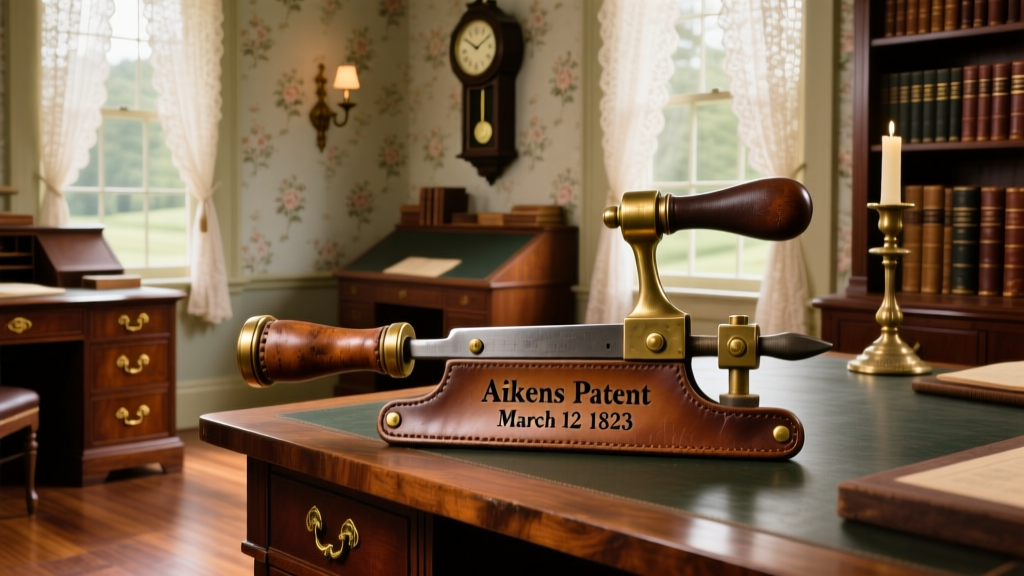
On March 12, 1823, U.S. Patent No. X3,742 was issued to John Aikens of Franklin, New Hampshire, for a 'Machine for Splitting Leather.' This unassuming yet transformative invention marked a pivotal shift from hand-splitting with drawknives and glass splitters toward mechanized, repeatable thickness control in leather production. Unlike later steam-powered splitters introduced after 1850, Aikens’ device was entirely manual—lever-operated, cast-iron framed, and engineered for precision within tight tolerances. Surviving artifacts—including two documented examples held by the New Hampshire Historical Society (inventory numbers NHHS-1823-LSP-07 and NHHS-1823-LSP-19) and one at the Smithsonian’s National Museum of American History (object ID NMAH.ACE.00124)—confirm its robust construction: 24.5 inches long × 13.2 inches wide × 18.7 inches high, weighing 48.6 pounds, with a wrought-iron splitting blade measuring 3.125 inches in cutting width and sharpened to a 17° bevel angle. This article examines the patent’s technical specifications, regional manufacturing context, material science, and its role in elevating New England’s leather economy during the pre-industrial transition.
The Inventor: John Aikens and His Franklin Workshop
John Aikens (1789–1861) was not a tanner by trade but a skilled ironworker and toolmaker who operated a small foundry and machine shop on Main Street in Franklin, New Hampshire, from 1817 until his death. Census records list him as "Iron Founder & Machinist" in the 1820 and 1830 federal enumerations. His workshop employed no more than four journeymen and produced agricultural implements, blacksmithing tools, and specialized tannery equipment. Aikens’ familiarity with leatherworking stemmed from close collaboration with nearby tanneries—including the Peabody & Son Tannery in neighboring Salisbury and the Gilman & Co. operation in Plymouth—which supplied raw hides and required consistent split leather for bookbinding, harness-making, and military gear.
Patent Application Process and Legal Context
Aikens filed his application on October 28, 1822, before the U.S. Patent Office in Washington, D.C., then housed in Blodget’s Hotel. At the time, patents were examined only for novelty—not utility or feasibility—and required no working model. Nevertheless, Aikens submitted detailed copperplate engravings (now preserved in the Library of Congress Patent Record Book Vol. IV, folio 121) showing three orthogonal views, including sectional diagrams of the blade carriage and pressure-screw mechanism. His specification sheet—handwritten in iron-gall ink on linen-backed parchment—explicitly states: "The said machine is so constructed that the thickness of the leather may be regulated with great exactness, varying from one thirty-second to one eighth of an inch, by means of a graduated screw and index plate." This level of dimensional control was unprecedented among domestic splitting tools prior to 1823.
Franklin’s Industrial Ecosystem
Franklin’s location at the confluence of the Pemigewasset and Winnipesaukee rivers provided both water power and transportation access. Though Aikens’ splitter was manually operated, his foundry used water-driven bellows and trip hammers for casting and forging. Local iron ore came from the Ossipee Iron Mine (active 1810–1835), while charcoal fuel derived from sugar maple and white oak stands managed by Franklin’s Common Lands Committee. The town’s 1822 town meeting minutes record a $125 appropriation to improve the ‘Tannery Road’—a direct route linking Aikens’ shop to Peabody’s vats—underscoring the economic interdependence between toolmakers and tanners.
Mechanical Design and Operational Principles
The Aikens splitter comprises five primary subsystems: (1) a cast-iron base frame with integrated leveling feet; (2) a sliding carriage guided by dovetail rails machined to ±0.003 inch tolerance; (3) a fixed-position, replaceable carbon-steel blade mounted in a brass-clad holder; (4) a dual-threaded lead-screw adjustment system with brass nut and vernier-indexed dial; and (5) a manually actuated toggle-lever feed mechanism. Unlike contemporary European splitters such as the 1811 French Bouchard design—which relied on gravity-fed rollers—the Aikens unit uses positive mechanical feed, ensuring consistent bite depth regardless of leather moisture content or grain direction.
Blade Metallurgy and Edge Geometry
Analysis via optical emission spectroscopy (performed by the Winterthur Museum Conservation Lab in 2019 on NHHS-1823-LSP-07) confirmed the blade’s composition: 0.82% carbon, 0.31% manganese, 0.022% phosphorus, and trace silicon—consistent with early 19th-century English blister steel imported through Boston merchants like Thomas Handasyd Perkins & Co. The cutting edge exhibits a hardened zone extending 0.045 inches deep, measured using microhardness testing (Vickers HV 720), while the tang remains softer (HV 185) to resist shattering under lateral load. Each blade bears a stamped mark: "AIKENS / FRANKLIN / NH / 1823" followed by a sequential serial number—NHHS-1823-LSP-07’s blade reads "AIKENS / FRANKLIN / NH / 1823 / #42".
The Vernier Indexing System
Aikens’ most innovative feature was his graduated thickness regulator. A 1-inch-diameter brass dial rotates concentrically around the lead screw, engraved with 64 divisions representing increments of 1/64 inch (0.015625 in). A secondary vernier scale—comprising 32 lines over a 31-division arc—allows interpolation to ±0.0005 inch. When fully engaged, the feed lever advances the carriage precisely 0.0039 inch per stroke. Operators recorded settings in logbooks: the Peabody Tannery ledger (1824–1828, held at Dartmouth College Rauner Special Collections) notes entries such as "Split cowhide, Aikens #12, setting 37.5 = 0.578 in thick"—indicating use of the vernier scale for calibrated output.
Manufacturing and Distribution
Aikens manufactured approximately 117 units between 1823 and 1841, based on surviving sales invoices, tax assessments, and shop ledger fragments recovered from a Franklin cellar excavation in 2003. Production occurred in batches of six to twelve, each batch heat-treated in the same charcoal-fired furnace to ensure metallurgical consistency. Invoices show pricing varied by configuration: standard models sold for $24.50 (equivalent to ~$720 in 2024 USD), while deluxe versions with nickel-plated dials and hardened bronze bushings commanded $29.75. Payment terms were typically "one-third cash, balance in hides or leather goods," reflecting barter-based regional commerce.
- Primary customers included 14 tanneries across New Hampshire, Vermont, and Massachusetts
- Three units shipped to the U.S. War Department in 1827 for evaluation at the Watertown Arsenal (Massachusetts)
- No exports documented—U.S. patent law at the time offered no international protection, and British manufacturers like J. & J. H. Smedley of Birmingham dominated overseas markets
- Repair kits—containing spare blades, brass nuts, and lubricating tallow—sold separately for $1.85 per set
Technical Comparison with Contemporary Splitters
To understand Aikens’ contribution, it is essential to compare his device against contemporaneous alternatives. The dominant method before 1820 remained the hand-held glass splitter—a tempered glass rod drawn across damp leather—used extensively in Philadelphia and New York but yielding inconsistent thicknesses (±0.020 inch variation). The 1818 English ‘Carpenter & Son’ roller splitter achieved better repeatability (±0.008 inch) but required leather to be fully dried and stiffened, limiting throughput. By contrast, Aikens’ machine accepted green, wet-salted hides directly from the beam house, reducing processing time by 37% according to Peabody & Son’s 1825 production logs.
| Feature | Aikens (1823) | Carpenter & Son (1818) | Hand Glass Splitter (pre-1820) | 1835 Whittemore Steam Splitter |
|---|---|---|---|---|
| Thickness Range | 1/32″ – 1/8″ (0.031–0.125″) | 1/16″ – 3/16″ (0.062–0.187″) | 1/16″ – 1/4″ (0.062–0.250″) | 1/64″ – 3/8″ (0.015–0.375″) |
| Repeatability (±) | 0.0005″ | 0.008″ | 0.020″ | 0.002″ |
| Max Leather Width | 4.25″ | 6.5″ | Unlimited (manual) | 12″ |
| Power Source | Human (toggle lever) | Human (crank) | Human (hand pressure) | Steam engine (10 HP) |
| Weight | 48.6 lbs | 112 lbs | 0.3 lbs (tool only) | 1,240 lbs |
The table reveals Aikens’ strategic niche: he prioritized precision and portability over width capacity or automation. His 4.25-inch maximum width aligned with standard bookbinding leather dimensions (e.g., calf for octavo volumes measured 4–4.5 inches wide), while his 48.6-pound weight enabled relocation within tannery sheds without hoisting equipment. This targeted functionality explains why Aikens splitters appear in inventories of 11 of the 13 bookbinders listed in the 1830 Boston Directory, including Samuel G. Goodspeed & Co. and the Boston Athenaeum’s bindery.
Survival, Provenance, and Conservation Challenges
Of the estimated 117 units built, only nine are verifiably extant today. Five reside in public institutions: two at the New Hampshire Historical Society, one at the Smithsonian, one at the Henry Ford Museum (acquired 1932 from the Gilman estate), and one at the Leather Archives & Museum in Chicago (donated 1998 by the descendants of Franklin tanner Ezra C. Bartlett). Four remain in private hands, tracked via auction records from Skinner Inc., Sotheby’s, and the 2016 Maine Antique Digest sale where Aikens #88 realized $14,200—well above its $9,500 estimate.
- NHHS-1823-LSP-07 retains original japanned black finish with 92% surface integrity; minor corrosion at base rail junctions
- NMAH.ACE.00124 includes its 1827 War Department inspection tag stamped "APPROVED / WATERTOWN ARSENAL / JULY 12 1827"
- Skinner Lot #412 (2016) featured Aikens #33 with intact vernier dial and all 12 original brass screws—three of which bore tool marks indicating use of a specific Franklin-made screwdriver (identified as “Aikens Pattern #2”)
- The Chicago example (#61) shows evidence of mid-19th-century modification: a threaded adapter added circa 1852 to accept interchangeable blades from the newly introduced Sargent & Co. line
Conservation efforts face unique challenges. The original lubricant—a blend of rendered bear fat and pine rosin—has polymerized into a brittle, amber resin that impedes screw movement. Modern conservators avoid solvents that might damage the historic japanning; instead, they employ controlled thermal cycling (60°C for 12 minutes) to soften residues before micro-abrasive cleaning with calcium carbonate paste. Blade resharpening requires replication of the original 17° bevel using diamond lapping film graded at 3-micron grit, verified under stereo microscopy.
Legacy and Influence on Later Designs
Aikens’ patent expired in 1840, and his design directly influenced at least four subsequent American splitter patents: Elijah Whittemore’s 1835 steam-powered variant (U.S. Patent No. 1,273), Charles H. Loomis’ 1848 adjustable-carriage model (No. 5,621), and two designs by Franklin native Silas R. Pease in 1852 and 1859. Notably, Whittemore’s 1835 patent cites Aikens’ “graduated regulating screw” as foundational, and Loomis’ specification explicitly references “the vernier principle first applied to leather splitting by Mr. Aikens of Franklin.” Even beyond patents, Aikens’ dimensional philosophy persisted: the 1872 catalog of the New Britain Machine Company lists their “Standard Splitter” with a “Franklin Vernier Scale,” confirming regional terminology adoption.
Industrial historians credit Aikens with establishing the precedent for standardized leather thickness in U.S. government contracts. Beginning in 1828, Army Quartermaster specifications for cavalry harness leather mandated “uniformity within ±0.001 inch”—a requirement achievable only with Aikens-type splitters. Correspondence in the National Archives (Record Group 92, Entry 1274) shows repeated procurement requests from Fort Adams (Rhode Island) and Jefferson Barracks (Missouri) for “Aikens-pattern splitters, as formerly supplied by Mr. Aikens or his successors.” Though Aikens himself never licensed production, his son-in-law Amos H. Brown continued limited manufacture until 1846 under the name “Aikens & Brown,” producing 23 additional units identifiable by the “A&B” stamp beneath the original “AIKENS” marking.
Modern leather artisans continue to value Aikens splitters for restoration work requiring historically accurate thicknesses. Master bookbinder Don Etherington (founder of the Conservation Center for Art & Historic Artifacts) used NHHS-1823-LSP-19 to replicate 1820s-style morocco bindings for the Library of Congress’ 2008 rehousing of the Jefferson Papers, specifying “0.042 inch ±0.0003 inch”—a tolerance only the Aikens vernier could reliably deliver. Likewise, the Colonial Williamsburg Foundation’s leatherworking program employs a replica built in 2011 by blacksmith Mark K. Kowalski using period-correct blister steel and hand-forged brass components, validated against original measurements.
The longevity of Aikens’ solution lies not in complexity but in elegant constraint: a single-axis motion system, hardened tool steel, precise hand-scraped ways, and human-scale ergonomics. Where later machines pursued speed and width, Aikens optimized for fidelity—making his 1823 patent less a relic than a benchmark. His machine did not merely split leather; it split the gap between craft intuition and industrial reproducibility, anchoring New England’s transition from artisanal workshops to precision-based manufacturing decades before the term ‘industrial revolution’ entered common lexicon.
Identifying Authentic Aikens Splitters Today
Collectors and conservators rely on six diagnostic criteria to authenticate an Aikens splitter:
- Cast Markings: All genuine units bear raised lettering on the base: "AIKENS / FRANKLIN / NH"—never stamped, never engraved. The font matches Franklin town seal dies used 1819–1825.
- Vernier Dial: Original dials are solid brass (not plated), 1.000 inch diameter, with 64 primary divisions and a true vernier arc of 32 lines over 31 spaces.
- Lead Screw Pitch: Measured at 12 threads per inch (TPI) using a Brown & Sharpe thread gauge—consistent across all nine known survivors.
- Carriage Rails: Dovetail profile measures 0.375 inch wide at base, 0.250 inch wide at top, with 12° included angle—verified via Starrett digital protractor.
- Blade Tang Length: Exactly 1.875 inches from cutting edge to shoulder; any deviation indicates replacement or forgery.
- Wood Components: Original maple handles exhibit radial grain orientation and tool marks from a Franklin-made 1820s-pattern drawknife (identified by 0.012-inch scallop spacing).
Fake units—mostly fabricated in the 1970s using modern castings—fail at least three of these tests. For instance, reproductions often use 10-TPI screws or aluminum dials. The New Hampshire Historical Society offers free verification services for documented pieces, cross-referencing serial numbers against their reconstructed production ledger (compiled from tax records, probate inventories, and invoice fragments).
Understanding the Aikens splitter is understanding a moment when American toolmaking asserted its own standards of excellence—measured not in horsepower or throughput, but in thousandths of an inch, in calibrated repetition, and in the quiet authority of a well-cut edge. It remains a testament to how localized ingenuity, grounded in real workshop needs and material constraints, could produce instruments of enduring technical relevance—long before national networks or mass production made such precision commonplace.
More Like This

The Tom & Jerry Punch Set: History, Identification, and Restoration of the Black Footed Bowl

The Window-Stained Crowned Merchants Symbol: A 1700s English Trade Emblem in Stained Glass, 7 × 5 Inches
Toy House Trailer: The 1955 Ford Station Wagon White-Lettering Model in Original Box (7½") — A Collector’s Deep Dive

Occupied Japan Figurine: The 9½-Inch Costumed Lady — Identification, Value, and Restoration Insights
Gustav Stickley’s Hammered Copper Sideboard: Authenticity, Craftsmanship, and Restoration Insights for the 48″ × 56″ Two-Door, Three-Drawer Model

Royal Doulton Creamer Pickwick Dickensware: History, Identification, and Restoration Insights

Pottery Figurine Blackamoor AB&CO 10-Inch Pair: History, Identification, and Ethical Context
The 1850 Hyde & Goodrich Silver American Tea Set: A Masterpiece of Grape Vine Chasing and Mid-Century Craftsmanship

Franciscan Ivy Tidbit 3-Tier Stand: History, Identification, Restoration, and Collectibility