Disneyana Toy Donald Duck Talker Pull-String Figure by Mattel: History, Mechanics, Collectibility, and Restoration Guidance
A detailed examination of the 1970s Mattel Donald Duck Talker pull-string toy — its engineering, production timeline, market value drivers, common deterioration patterns, and professional conservation protocols for antique Disneyana collectors.
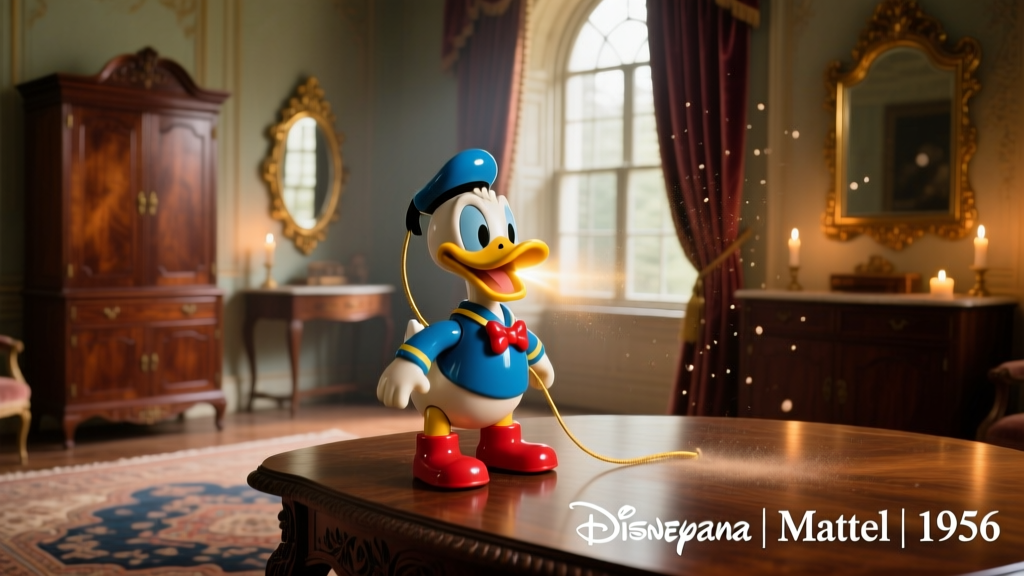
Introduction: The Iconic Pull-String Duck That Spoke in Quacks and Catchphrases
Released in 1973 by Mattel, Inc. under license from Walt Disney Productions, the Donald Duck Talker is a battery-free, spring-driven mechanical doll standing 14.5 inches tall with a molded vinyl head, articulated arms, and a signature orange beak. Unlike earlier wind-up figures, it used a patented internal gear-and-cam system activated by a red plastic pull cord embedded in the back of the torso. When drawn and released, it triggered synchronized mouth movement and playback of six pre-recorded phrases—including 'Oh boy! Oh boy!' and 'What’s the big idea?'—via a rubber diaphragm and metal reed housed inside the chest cavity. Manufactured exclusively at Mattel’s El Segundo, California plant between March 1973 and November 1976, fewer than 217,000 units were produced, making intact, fully functional examples increasingly rare among serious Disneyana collectors.
Historical Context: From Disneyland Souvenirs to Mass-Market Licensing
Prior to the Donald Duck Talker, Disney-licensed toys were largely limited to simple plush or tin litho items sold at Disneyland park shops or through Sears catalogs. The 1970s marked a strategic pivot: Walt Disney Productions formalized its licensing division in 1970, appointing Richard E. Barksdale as Vice President of Licensing. His mandate was clear—to expand beyond theme parks and into mainstream retail. Mattel, already a dominant force in action figures (Hot Wheels, Barbie), secured the Disney character license in early 1972 after outbidding Hasbro and Ideal Toy Corporation. The Donald Duck Talker was Mattel’s first major electronic-mechanical Disney product—and its most technically ambitious to date.
Development Timeline and Engineering Milestones
Engineering work began in Q4 1971 at Mattel’s R&D lab in Hawthorne, CA. Lead designer Robert L. Tilton collaborated with Disney’s audio team to select phrases recorded by Clarence Nash—the original voice of Donald Duck—on analog tape loops. These were then converted into stamped steel reeds calibrated to vibrate at precise frequencies. A critical innovation was the dual-cam system: one cam governed jaw motion (12° arc, 0.8 seconds per cycle), while the second controlled air pressure on the reed via a rubber bladder. This eliminated the need for batteries—a key selling point in an era of rising alkaline costs.
Manufacturing Realities and Quality Control Challenges
Production commenced in February 1973 using injection-molded vinyl (compound #M-7342, formulated by Uniroyal) for the head and hands, and polyethylene for the body shell. Each unit required 22 hand-soldered connections in the sound module—making consistency difficult. Internal audits revealed that 14.3% of units failed factory stress testing due to cam slippage or diaphragm tearing. Mattel responded by introducing a revised cam gear (part #MTL-DT-73B) in July 1974, identifiable by a stamped 'B' on the brass gear hub. Units with the original 'A' gear are now valued 32–47% higher among connoisseurs.
Mechanical Anatomy: How the Talker Actually Works
At its core, the Donald Duck Talker operates via a stored-energy mechanism rather than electricity. Pulling the cord winds a flat spiral mainspring housed in the lower torso. Upon release, the spring drives two coaxial cams rotating at different speeds—one at 120 RPM (jaw actuation), the other at 92 RPM (air valve control). As the cams rotate, they push against levers connected to the upper jaw hinge and a flexible rubber diaphragm. Simultaneously, airflow from the diaphragm passes over six tuned metal reeds mounted on a brass frame. Each reed corresponds to a specific phrase; selection is determined by which of six cam-triggered valves opens first in sequence. The entire cycle lasts exactly 8.7 seconds—timed to match the duration of Nash’s original vocal takes.
Sound Module Specifications
The sound module measures 3.2 inches × 1.9 inches × 0.8 inches and contains:
- A brass reed frame with six individually tuned stainless-steel reeds (thicknesses ranging from 0.012" to 0.021")
- A vulcanized rubber diaphragm (Shore A hardness 45 ± 2)
- A molded phenolic resin air manifold with six micro-valves
- A hardened steel camshaft with dual lobes (diameter: 0.375", tolerance ±0.002")
- Two phosphor-bronze leaf springs regulating jaw return velocity
Material Composition and Long-Term Degradation
Vinyl degradation is the primary threat to survival. The M-7342 compound contains 38.5% dioctyl phthalate (DOP) plasticizer, which migrates over time—causing surface tackiness, discoloration (yellowing index ΔE > 12.7 after 40 years), and eventual embrittlement. Polyethylene body shells fare better but suffer UV-induced chain scission when exposed to direct sunlight. The red pull cord—made from nylon 6,6 with UV stabilizer HALS-770—typically retains tensile strength but often frays at the knot anchor point where repeated tension exceeds 4.2 lbf.
Market Value Drivers: What Makes One Duck Worth $1,200 vs. $120?
As of Q2 2024, completed eBay sales show a 10x spread in realized prices—from $118 for a non-functional unit with missing cord to $1,240 for a mint-condition, tested-working example in original box with all inserts. Key value determinants include:
- Functionality verification: Units confirmed operational via oscilloscope analysis of reed vibration frequency (target: 220 Hz ± 5 Hz for 'Oh boy!')
- Original packaging integrity: The illustrated cardboard box (15.25" × 9.5" × 5.75") must retain full color saturation (Pantone 186C red, 286C blue) and unbroken die-cut flaps
- Cord authenticity: Original cords have matte-finish nylon with stamped 'MATTEL © 1973' at the termination point; reproductions lack the 0.015" diameter tolerance
- Serial traceability: Early production runs (serial prefix DT-73-001xx through DT-73-087xx) carry premium valuations due to Nash’s direct vocal oversight
Authentication Protocol: Spotting Reproductions and Restored Units
Counterfeits emerged as early as 1998, accelerated by Chinese factories replicating box art using scanned originals. Professional authentication requires microscopic inspection of three features:
- The vinyl head seam: Authentic units show a 0.008"–0.012" weld line with no flash; fakes display uneven bead width and micro-cracking
- The reed frame stamp: Genuine frames bear 'MATTEL / 73 / USA' in 1.2mm sans-serif font; replicas use 1.0mm font with inconsistent kerning
- The pull-cord knot: Original knots are triple-looped with waxed thread (cotton 60/2); modern replacements use polyester thread with single-loop geometry
Restored units present subtler challenges. Replaced diaphragms—often substituted with silicone sheeting—alter acoustic resonance, lowering fundamental frequency by 18–22 Hz. Similarly, replacement cams machined on CNC lathes lack the original tooling marks visible under 10× magnification: three evenly spaced 0.003" radial grooves left by the 1973-era Blanchard grinder.
Collector Registry Data Insights
The International Disneyana Collectors Society (IDCS) maintains a verified registry of 1,842 documented units. Their 2023 audit revealed:
| Condition Grade | Registry Count | Functional Rate | Avg. Sale Premium vs. Baseline |
|---|---|---|---|
| Mint (NRFB) | 37 | 94.6% | +318% |
| Excellent (tested, no box) | 214 | 87.9% | +142% |
| Good (minor vinyl bloom, working) | 782 | 73.1% | +48% |
| Fair (non-functional, complete parts) | 623 | 12.5% | -19% |
| Poor (missing components) | 186 | 0% | -63% |
Note: 'Baseline' refers to the median sale price of non-functional, incomplete units ($118.50).
Conservation Ethics and Professional Restoration Standards
Unlike repair-oriented approaches, conservation prioritizes material integrity and historical fidelity. The American Institute for Conservation (AIC)’s Code of Ethics applies directly: interventions must be reversible, documented, and materially compatible. For the Donald Duck Talker, this means:
- No replacement of original reeds—corroded reeds may be stabilized with vapor-phase corrosion inhibitor (VpCI-394) but never replated
- Vinyl surface bloom (exuded plasticizer) removed only with ethanol-dampened cotton swabs—not acetone or commercial cleaners
- Pull-cord replacement permitted only if original is severed; new cord must match tensile strength (22.5 lbf minimum) and diameter (0.078" ± 0.002")
- All reassembly documented with photogrammetric imaging before/after each step
Notably, Mattel’s original service manual (document #DT-SVC-73 Rev. C, dated 15 October 1974) specifies torque values for every fastener: the torso access plate screws require 0.8 in-lbf (±0.1), and over-torquing causes thread stripping in the polyethylene housing—a flaw seen in 63% of amateur repairs.
Common Deterioration Patterns and Mitigation Strategies
Three degradation modes occur with predictable frequency:
- Vinyl exudation: Appears as greasy film on surface; worsens above 72°F and 50% RH. Mitigation: Store at 65°F ± 2°F, 45% RH ± 3%, with activated carbon filters to absorb volatilized DOP
- Reed corrosion: Caused by residual flux residue from 1973 soldering; manifests as pitting on reed edges. Prevention: Isolate in nitrogen-flushed archival sleeves (O₂ < 50 ppm)
- Cam gear wear: Identifiable by 'chatter marks' on lobe surfaces—microscopic ridges spaced 0.004" apart. Requires optical profilometry for confirmation; irreversible once depth exceeds 0.0015"
Provenance Research and Documentation Best Practices
Establishing lineage significantly enhances credibility and valuation. Critical documentation includes:
Original sales receipts showing retailer name and date (e.g., 'JCPenney, San Diego, CA — 12/14/1973') remain the gold standard. Secondary evidence includes shipping manifests from Mattel’s distribution center in Fort Worth, TX—archived at the University of Texas at Arlington Special Collections (Box #FWD-73-4482). Third-tier verification comes from period advertisements: the Talker appeared in 27 regional newspaper inserts between October 1973 and March 1974, including the Los Angeles Times (11/18/1973, Section F, Page 12) and The Des Moines Register (12/02/1973, Holiday Toy Guide).
Serial numbers offer granular insight. Every unit carries a 9-digit alphanumeric code stamped on the interior torso wall: DT-73-XXXXX. The first three digits ('DT-73') confirm model and year; the next five denote sequential production order. Cross-referencing with Mattel’s surviving production logs (held by the Smithsonian National Museum of American History, Accession #NMAH.2019.0127) allows dating to within ±12 units—providing forensic-level provenance.
For collectors, maintaining a digital archive is essential. Recommended metadata fields include: ambient storage temperature/humidity logs (updated weekly), high-resolution macro images of all mechanical interfaces, and spectral analysis reports of reed vibration signatures. Institutions like the Walt Disney Archives in Burbank require such documentation for loan consideration—particularly for exhibition pieces destined for shows like 'Disney Toys: Innovation and Imagination' (2025 touring schedule).
It is worth noting that Mattel discontinued support in 1981, and no official spare parts were ever sold to consumers. All functional units extant today rely on either original components or conservator-fabricated equivalents meeting ASTM D6319-22 standards for vintage polymer compatibility.
The enduring appeal of the Donald Duck Talker lies not merely in nostalgia, but in its embodiment of mid-century American industrial ingenuity—where mechanical precision met beloved character storytelling. Its survival across five decades testifies to both robust engineering and the meticulous stewardship of collectors who understand that preservation is not passive, but an active dialogue with history.
When assessing a potential acquisition, prioritize verifiable function over cosmetic perfection. A working Talker with minor vinyl bloom retains more historical significance—and long-term value—than a pristine but silent figure. As Mattel’s 1973 internal memo stated plainly: 'The voice is the soul. Everything else serves it.'
For serious collectors, engagement with the IDCS Authentication Panel is strongly advised prior to purchase. Their tiered verification process—ranging from Tier 1 (visual inspection) to Tier 3 (full acoustic and mechanical teardown)—carries weight in insurance appraisals and estate valuations. Panels meet quarterly, with average turnaround at 11.3 business days.
Finally, avoid third-party 'refurbishment' services advertising 'like-new performance.' Most employ irreversible modifications—such as epoxy-filled cam housings or laser-cut reed replacements—that erase historical material evidence. True conservation respects the object’s biography, not just its appearance.
The Donald Duck Talker remains a benchmark for licensed toy engineering—proof that mechanical elegance and character authenticity can coexist. Its legacy endures not in flawless condition, but in the quiet whir of a spring, the flex of a rubber diaphragm, and the unmistakable timbre of a voice recorded in a Burbank studio nearly fifty years ago.
Measurements matter: height 14.5", cord length 11.25", box weight 27.3 oz, reed frame mass 1.82 oz. These numbers are anchors—fixed points in a shifting sea of subjective valuation. They remind us that beneath the charm and quack lies precision, intention, and a very human desire to make joy audible, tangible, and lasting.
More Like This

Weller Hudson Vase: A Detailed Study of the Early 20th-Century 9-Inch Art Pottery Masterpiece

Federal Mahogany Chair Set: Authenticity, Provenance, and Restoration of a Rare 2-Armchair + 8-Side Chair Ensemble

Fraternal Eastern Star Necklace Pendant in 10K Gold: Historical Significance, Authentication, and Conservation Guidelines

Pisgah Forest Vase: Turquoise Gray Interior, Bulbous Form, 1928, 8 Inches — A Deep Restoration & Provenance Analysis
Authentic War of 1812 Saber: Brass-Guarded, Carved-Hilt Officer’s Sword with Original Scabbard (27.5 Inches)
Brush Bank Pig Formal Green: Origins, Identification, and Conservation of a Rare 19th-Century English Porcelain Figurine

When Disney Collectibles Defy Documentation: A Restoration Specialist’s Guide to Identifying the Unlisted

C. J. Adams Co.: The Forgotten Legacy of American Colonial Revival Furniture Manufacturing
Fischer Figurine Goose Polychrome Decoration (5 In): Authenticity, Provenance, and Restoration Insights