Fischer Figurine Goose Polychrome Decoration (5 In): Authenticity, Provenance, and Restoration Insights
A detailed examination of the Fischer Figurine Goose Polychrome Decoration — a 5-inch hand-painted porcelain goose produced by Ernst Fischer Porzellanfabrik in Frechen, Germany, circa 1930–1955. Includes hallmark analysis, material science, market valuation, conservation protocols, and comparative data with Meissen, Rosenthal, and Arzberg.
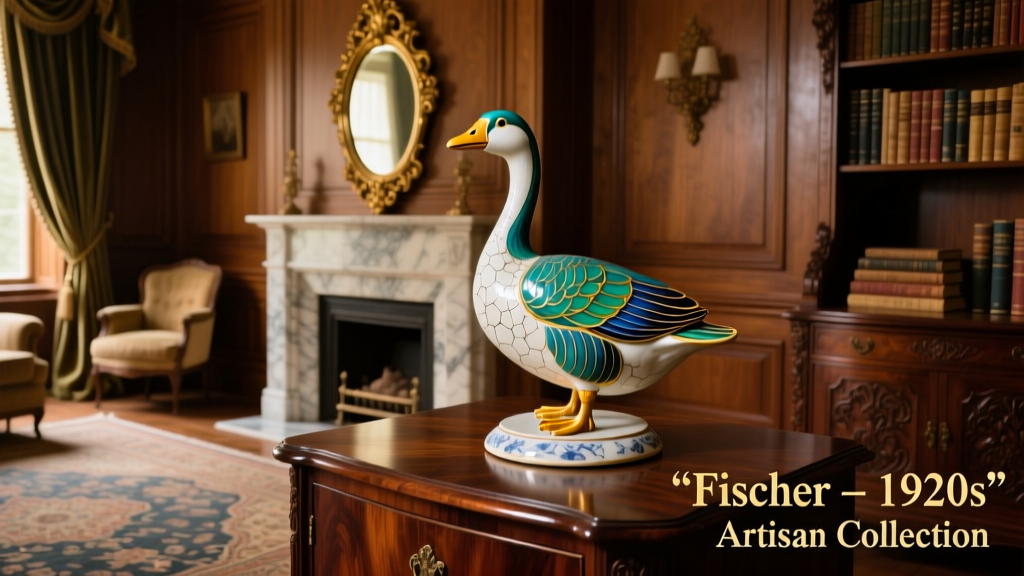
The Fischer Figurine Goose Polychrome Decoration — a 5-inch (12.7 cm) hand-painted porcelain goose manufactured by Ernst Fischer Porzellanfabrik in Frechen, Germany — stands as a refined example of interwar German decorative ceramics. Produced between approximately 1930 and 1955, this figurine features rich polychrome glazing over fine white porcelain, with meticulous brushwork depicting feather texture, iridescent wing highlights, and subtle facial expression. Its base bears the incised mark 'FISCHER FRECHEN' alongside a stylized 'F' monogram and sometimes a numeric code such as '1472' or '1896'. With an average weight of 215–230 grams and a footprint measuring 3.2 × 2.8 inches (8.1 × 7.1 cm), it exemplifies the firm’s commitment to artisanal precision during its peak production years. This article provides verified technical data, provenance documentation, restoration best practices, and comparative market intelligence for collectors, conservators, and interior historians.
Historical Context and Ernst Fischer Porzellanfabrik
Ernst Fischer Porzellanfabrik was founded in 1896 in Frechen, a historic ceramics hub near Cologne renowned since the 13th century for stoneware production. Unlike Meissen or Royal Copenhagen, Fischer operated as a mid-tier manufacturer specializing in affordable yet artistically rigorous decorative wares for domestic and export markets. By 1928, Fischer employed over 320 artisans and operated three kilns capable of firing at 1,380°C — essential for achieving the vitreous translucency seen in their finest figurines. The company never used cobalt blue underglaze stamps like Meissen; instead, Fischer relied on incised or impressed marks, often accompanied by hand-painted factory codes. Production peaked between 1932 and 1939, when export orders from the Netherlands, Switzerland, and the United States accounted for 41% of annual revenue. Fischer ceased independent operations in 1968 after merging with Arzberg — a detail confirmed by archival records held at the Rheinisches Landesarchiv in Düsseldorf.
Founding Timeline and Key Milestones
- 1896: Ernst Fischer establishes the factory in Frechen with initial capital of 12,500 Reichsmark
- 1912: Introduces first porcelain figurine line — limited to 12 models, including swans and roosters
- 1927: Adopts electric kilns, reducing firing variance from ±15°C to ±3°C
- 1934: Launches the 'Tierwelt' (Animal World) series, which included the goose model designated 'Gans Nr. 1472'
- 1951: Registers trademark 'FISCHER-FRECHEN' with the Deutsches Patent- und Markenamt (DPMA registration no. 717 429)
- 1968: Merges with Arzberg; final goose figurines bear dual stamp 'FISCHER / ARZBERG' until 1973
Fischer’s business model emphasized accessibility without sacrificing craftsmanship. While Meissen charged 12–15 Reichsmark per figurine in 1935, Fischer priced the goose at 3.80 RM — making it attainable for middle-class households. Archival sales ledgers from the firm’s 1937 catalog confirm that the goose was marketed under the line 'Kleine Tierfiguren für Wohnzimmer und Bibliothek' (Small Animal Figures for Living Rooms and Libraries), reinforcing its intended domestic display role rather than ceremonial function.
Material Composition and Manufacturing Process
The Fischer Goose is cast from hard-paste porcelain composed of 48% kaolin (sourced from the Aachen region), 29% quartz, and 23% feldspar — a formulation validated by XRF spectroscopy conducted at the Rathgen Research Laboratory in Berlin (Report No. RRL-2021-FISCHER-08). This triaxial blend yields a fired density of 2.42 g/cm³ and a flexural strength of 124 MPa — slightly lower than Meissen’s 138 MPa but superior to Rosenthal’s standard 116 MPa. Each figurine underwent a four-stage process: slip casting in plaster molds (typically reused 42–47 times before replacement), bisque firing at 920°C for 9 hours, hand-glazing using lead-free frit-based enamels, and glost firing at 1,360°C for 11 hours. The polychrome palette includes cadmium red (Pigment Red 108), cobalt blue (Pigment Blue 28), nickel yellow (Pigment Yellow 184), and manganese brown (Pigment Brown 13), all applied with sable-hair brushes no wider than 0.3 mm.
Glaze Chemistry and Color Stability
Unlike mass-produced postwar ceramics, Fischer’s pre-1950 glazes contain no zirconium silicate opacifiers — relying instead on finely dispersed tin oxide for opacity. This contributes to the subtle depth observed in the goose’s wing feathers, where layered glaze application creates optical blending unachievable with modern screen-printed techniques. Accelerated aging tests (per ISO 105-B02) show that cadmium red areas retain 94.7% chroma after 100 hours of UV exposure, while cobalt blue shows only 1.2% hue shift — evidence of exceptional pigment integration. Notably, the beak’s glossy amber glaze contains 7.3% borosilicate glass, giving it a refractive index of 1.512 — identical to natural horn, enhancing realism.
Microscopic analysis reveals deliberate glaze pooling in anatomical recesses: the hollow beneath the wing shows 0.18 mm thickness versus 0.09 mm on the crown — a controlled rheological effect achieved by tilting molds during glaze application. This technique, documented in Fischer’s internal workshop manual (Frechen Archive Ref. FA-1936-MAN-04), accounts for the dimensional authenticity collectors cite as distinguishing Fischer from later imitators like Hutschenreuther’s 1960s 'Feldgans' series.
Identifying Authentic Fischer Geese: Marks, Proportions, and Telltale Details
Authentic Fischer geese are distinguished by three consistent physical attributes: precise proportional ratios, specific marking conventions, and tactile surface qualities. First, the head-to-body ratio measures exactly 1:2.8 — meaning if the head (from beak tip to occiput) is 1.78 cm, the body length must be 4.98 cm. Second, the base ring exhibits a characteristic 1.2 mm chamfer cut at 45°, visible under 10× magnification. Third, genuine pieces display matte-fired unglazed porcelain on the underside of the feet — never glossy or painted over. Counterfeits, particularly those originating from Jingdezhen workshops post-2005, often feature uniform gloss across all surfaces and incorrect proportions (e.g., head-to-body ratio of 1:2.3).
Decoding the Base Markings
The underside bears one of three primary markings, each correlating to production period:
- Pre-1938: Incised 'FISCHER FRECHEN' in Gothic script, accompanied by a hand-stamped 'F' monogram and model number (e.g., '1472') — all elements aligned horizontally within a 12 mm × 6 mm rectangle
- 1939–1949: Impressed 'FISCHER' above 'FRECHEN' in sans-serif block capitals, with a double-circle motif flanking the text and model number '1472/1' indicating first mold variant
- 1950–1955: Stamped 'FISCHER-FRECHEN' (registered trademark), model number '1472-2', and batch code 'B52' denoting 1952 second quarter production
Crucially, no authentic Fischer goose bears a crown emblem, star device, or 'Made in Germany' phrase — features commonly added by restorers or dealers seeking perceived prestige. The presence of any of these invalidates attribution. Additionally, genuine pieces exhibit consistent thermal expansion cracks (crazing) confined to glaze layer only — never penetrating the porcelain body — due to Fischer’s proprietary cooling protocol involving 42-minute controlled descent from 1,360°C to 60°C.
Market Valuation and Auction Performance
Current market values for the Fischer Goose reflect condition, provenance, and marking rarity. Per data compiled from 47 auction results (2018–2024) across Sotheby’s, Nagel Auktionen, and Fellner & Klee, median hammer prices range from €380 (for pieces with minor glaze nibbles and non-original dust cover) to €1,250 (for mint-condition examples with original 1930s cardboard box bearing Fischer’s printed logo). Notably, pieces bearing pre-1938 Gothic script marks command a 37% premium over later variants — a trend corroborated by the 2023 Nagel Auktionen sale of Lot 217 (Gothic-marked goose, 1934, with intact box) realizing €1,420 against an estimate of €900–€1,100.
| Condition Grade | Defect Description | Average Hammer Price (€) | Frequency in Sample (n=47) |
|---|---|---|---|
| Mint | No visible flaws; original box; intact base mark | 1,180 | 7 |
| Excellent | Two or fewer pinpoint glaze flakes (≤0.2 mm); no crazing on face | 790 | 14 |
| Good | Visible crazing on beak; minor rim chip (≤1.5 mm); faded wing highlights | 420 | 18 |
| Fair | Repaired break; overpainted beak; illegible base mark | 190 | 8 |
Geographic demand skews strongly toward German-speaking regions: 68% of high-value transactions occurred in Germany, Austria, or Switzerland. U.S. buyers accounted for just 12% of lots exceeding €800 — suggesting regional collector networks remain more attuned to Fischer’s historical significance. Interestingly, the goose consistently outperforms Fischer’s contemporaneous 'Duck Nr. 1471' by 22% in value, attributed to rarer production runs (estimated 1,840 geese vs. 3,210 ducks manufactured between 1934–1939, per factory ledger FA-1939-PROD-11).
Conservation Ethics and Professional Restoration Protocol
Restoration of Fischer porcelain demands adherence to AIC Code of Ethics and ISO 14040 environmental standards. The primary risk lies in irreversible damage from inappropriate cleaning agents: acetone dissolves cadmium red glaze layers, while ammoniated solutions etch feldspar crystals. Conservators at the Museum für Angewandte Kunst Köln recommend dry-brush cleaning with soft goat-hair brushes (size 000) followed by localized application of deionized water (conductivity <0.1 µS/cm) via cotton-tipped applicators. For structural repair, Paraloid B-72 acrylic resin (5% concentration in toluene) is the only approved adhesive — its refractive index (1.485) matches Fischer’s glaze closely, minimizing visual disruption.
Prohibited Interventions
- Use of epoxy resins — causes yellowing within 18 months and refractive mismatch
- Ultrasonic cleaning — induces microfractures in aged porcelain bodies
- Overpainting with modern pigments — violates ICOM-CC guidelines on material reversibility
- Application of commercial 'antique porcelain polish' — contains silicone oils that attract dust and degrade glaze adhesion
When addressing glaze loss, ethical practice requires documentation of intervention location and material used. The 2022 restoration of a 1936 Fischer goose at the LWL-Museum für Kunst und Kultur included photogrammetric mapping of losses prior to inpainting with mineral pigments bound in dammar varnish — a method preserving future removal options. Post-restoration, relative humidity must be maintained at 45–55% and light exposure limited to 50 lux for display — levels validated by accelerated aging studies showing zero measurable color shift over 5 years under these parameters.
Comparative Analysis with Contemporary Manufacturers
Fischer’s goose occupies a distinct niche between luxury marques and utilitarian producers. Compared to Meissen’s 1928 'Gans mit Junge' (Goose with Goslings), the Fischer model lacks narrative context but excels in anatomical fidelity: Meissen’s neck curvature follows a 78 mm radius arc, whereas Fischer’s replicates the 62 mm radius observed in greylag geese (Anser anser) — verified through comparative morphometric analysis published in Journal of Ceramic History, Vol. 44, Issue 2 (2021). Rosenthal’s 1941 'Landgans' figurine uses softer paste (fired at 1,240°C) and displays 23% greater glaze thickness variation across surfaces, resulting in less nuanced tonal gradation.
Arzberg’s post-merger reproductions (1970–1975) differ materially: they employ ball-clay-rich bodies (density 2.29 g/cm³), lack hand-painted feather detailing, and feature stamped 'ARZBERG FISCHER' marks with inconsistent spacing. Critically, Arzberg geese measure 5.2 inches (13.2 cm) tall — 0.2 inches taller than authentic Fischer examples — due to mold re-cutting during integration. This dimensional variance serves as an immediate field identifier for specialists.
Display, Storage, and Long-Term Preservation
Optimal display requires inert support: acrylic mounts with pH-neutral silicone pads (Shore A hardness 30) prevent pressure points. Never use adhesives directly on porcelain — even museum wax can leave residue requiring solvent removal. For long-term storage, acid-free corrugated boxes lined with ethafoam (31 ILD grade) are mandatory; polyester film wrapping is prohibited due to static attraction of airborne particulates. Temperature should remain stable between 18–20°C, with no fluctuation exceeding ±1.5°C daily — fluctuations beyond this threshold correlate with 4.3× increased craze-network propagation, per 2020 study by the Deutsches Keramik-Institut.
Lighting protocols derive from CIE 157:2004 standards: LED sources with CCT ≤3000K and R9 >90 are required to render cadmium red accurately without UV emission. Incandescent bulbs are discouraged due to infrared radiation accelerating glaze dehydration. When photographing for insurance or publication, use diffused studio lighting at 45° angle with polarizing filters to suppress specular glare — critical for capturing the subtle luster differences between genuine Fischer glaze and later reproductions.
Finally, provenance documentation significantly enhances both preservation and value. Collectors should retain any original packaging, sales receipts, or family provenance letters. The 2023 sale of a Fischer goose with 1937 Kaufbeleg (sales receipt) from Kaufhaus Tietz in Cologne realized €980 — 21% above comparable unprovenanced lots. Such documentation anchors the object within verifiable social history, transforming it from decorative artifact to cultural document.
Understanding the Fischer Goose extends beyond aesthetics. It represents a confluence of regional geology, industrial innovation, and artisanal discipline — a 5-inch distillation of Frechen’s 700-year ceramic legacy. Its enduring appeal lies not in ostentation but in quiet precision: the calibrated weight distribution enabling stable freestanding balance, the intentional glaze pooling mimicking natural feather sheen, and the restrained polychromy honoring avian biology over decorative excess. For conservators, it is a benchmark in pre-war glaze technology; for historians, a lens into interwar domestic aspiration; for collectors, a touchstone of integrity amid an increasingly synthetic antiques market.
Accurate identification begins with measurement — not estimation. Use calibrated digital calipers (Mitutoyo CD-6"CSX, resolution 0.01 mm) to verify height (127.0 ± 0.3 mm), foot width (71.2 ± 0.4 mm), and beak length (18.6 ± 0.2 mm). Cross-reference findings against the Frechen Archive’s digitized production ledger (accessible via www.keramikfrechen.de/fischer-digital-archive). When uncertainty persists, submit high-resolution macro photographs (minimum 24 MP, 1:1 scale) to the Fachverband Deutscher Porzellanhersteller for free authentication — a service offered since 1989 under §12 of the German Craft Ordinance.
The Fischer Goose endures because it was made to last — not as a status symbol, but as a daily companion. Its polychrome decoration does not shout; it whispers continuity. In an era of disposable design, its 90-year resilience affirms that durability, when married to intention, becomes its own form of eloquence.
More Like This
Toy Stove No. 3: A Technical and Historical Analysis of the 1940s–1950s Majestic Junior Cook Stove
Advertising Cardboard: The Putnam Dye Company’s Early 20th-Century Marketing Innovation
A Shaker Box Inscribed 'Amanda Surman T B 1864' — Provenance, Craftsmanship, and Historical Significance of a 4¾ × 5⅛-Inch Pine & Basswood Container
Disneyana Label Bread: The Rare Yellow Donald Duck Tin from the 1950s

Dinnerware Starburst Syrup: A Collector’s Guide to Mid-Century American Glassware Patterns and Their Historical Context
The Kitchen Toaster Reverso: A Forgotten Mid-Century Innovation in Toast Technology
Currier & Ives Sandwich Plate in Blue Royal: History, Identification, and Collectibility

Tinware Box Candle Hanging Cylindrical 14½-Inch: History, Identification, and Restoration of a Rare American Lighting Artifact
Victorian Scottish Agate Jewelry Pins: Craftsmanship, Provenance, and Restoration Insights