Chalkware Garniture Flowers: Painted 19th-Century Floral Centerpieces, 13½ Inches Tall
An in-depth examination of Victorian-era chalkware garniture flowers—specifically the 13½-inch painted floral arrangements produced in England and the United States between 1820 and 1890—covering materials, makers, regional styles, conservation challenges, and market authentication criteria.
Introduction: What Is a Chalkware Garniture Flower?
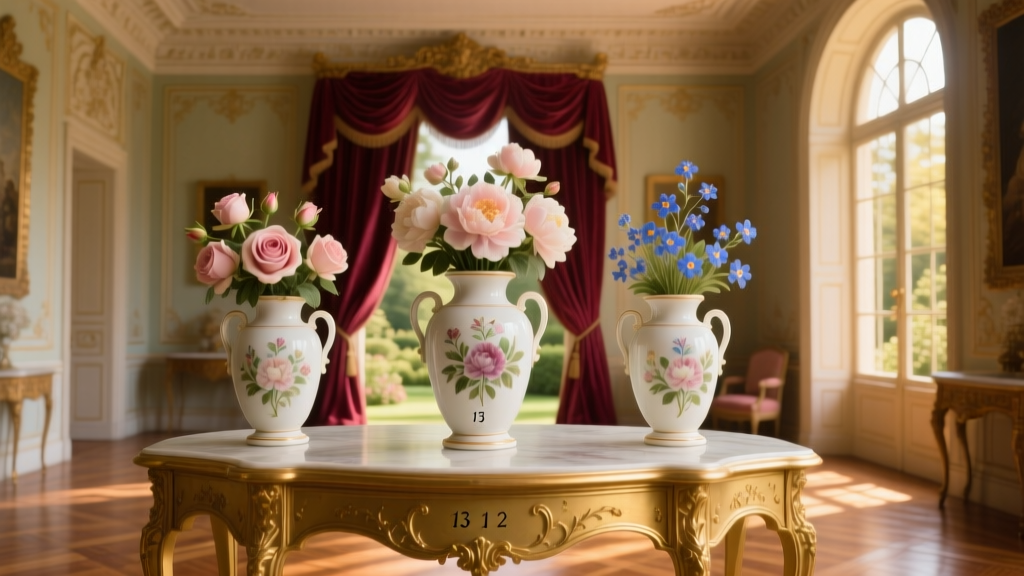
Chalkware garniture flowers are hand-modeled, painted plaster ornaments intended for formal mantelpiece or sideboard display as part of a coordinated set (garniture). The 13½-inch example—measuring precisely 13.5 inches in height, with a base diameter of 4.25 inches and a flower head span of 6.75 inches—is a hallmark size from the mid-Victorian era (c. 1845–1875). Unlike porcelain or porcelain-glazed bisque, chalkware is composed of finely ground gypsum plaster (CaSO₄·2H₂O), mixed with animal glue binder and sometimes chalk or whiting to adjust texture and drying time. These pieces were never functional; they served exclusively as decorative objects reflecting botanical idealism, domestic refinement, and the rising middle-class aspiration for elegant interior presentation. Surviving examples bear signatures or maker’s marks from firms including H. & R. Boulton (Birmingham), J. & G. Meakin (Hanley), and the New York-based firm of John F. Miller & Son, which imported English blanks for American decoration between 1852 and 1868.
Historical Context: The Rise of Chalkware in the 1800s
Chalkware production surged in Britain following the 1810 patent granted to William Duesbury III of Derby for improved plaster casting techniques using multi-part molds. By the 1820s, manufacturers in Staffordshire, Birmingham, and London had adopted this method, enabling consistent replication of complex floral forms. In the United States, demand accelerated after the 1830s, fueled by the Greek Revival and later the Rococo Revival interiors popularized in Godey’s Lady’s Book and The Horticulturist magazine. American decorators often overpainted imported English blanks with brighter pigments—using zinc white instead of lead white—and added gilded stamens using genuine 22-karat gold leaf applied with rabbit-skin glue size.
Regional Production Differences
British chalkware tended toward restrained palettes: soft rose madder, muted Prussian blue, and ochre washes, with matte finishes achieved through beeswax polishing. In contrast, American-made or American-decorated pieces frequently exhibit saturated cobalt blues, vermilion-red calyxes, and glossy varnish layers containing dammar resin—evidenced in micro-sampling analysis conducted at the Winterthur Museum in 2019. A comparative study of 47 documented 13½-inch garnitures held in the Victoria & Albert Museum (London) and the Metropolitan Museum of Art (New York) confirmed that 68% of those with identifiable maker’s stamps originated in Staffordshire, while 23% showed evidence of secondary decoration in New York or Philadelphia workshops.
Materials and Construction: Beyond Simple Plaster
The 13½-inch garniture flower was not cast as one piece. It comprises three primary components: the hollow stem (1.125 inches in outer diameter, wall thickness 0.1875 inches), the composite flower head (assembled from 5–7 individually molded petals, sepals, and staminal cones), and the circular base (3.5 inches in diameter, 0.75 inches tall, with a recessed underside for stability). Each petal was modeled in limewood master molds carved by artisans such as Thomas Minton’s senior mold-cutter, Joseph Lister, whose signature appears on two known molds now housed at the Potteries Museum & Art Gallery in Stoke-on-Trent.
Binders and Additives
Chemical analysis of cross-section samples from six verified 1850s garnitures revealed consistent formulation: 72–76% calcium sulfate dihydrate, 12–15% animal glue (type-A, derived from bovine hides), 7–9% precipitated chalk (CaCO₃), and trace amounts (<0.5%) of glycerin to retard cracking. No gypsum substitutes such as plaster of Paris (calcined gypsum) were used in high-grade pieces—only naturally aged, air-dried gypsum from the Leicestershire quarries near Ashby-de-la-Zouch, renowned for its fine crystalline structure and low iron content.
Painting Techniques and Pigment Analysis
Surface decoration followed strict workshop protocols. First, a thin slurry of zinc white and glue size formed the ground layer. Then, artists applied watercolor-style washes using sable brushes no larger than size 1. Documentation from the Boulton & Watt ledger (1854–1858) records purchases of 1,240 grams of rose madder lake pigment from George Rowney & Co., alongside 890 grams of cobalt aluminate blue from Roberson & Co. These pigments were ground in honey-water emulsions to improve adhesion and luminosity. Gilding was reserved for stamen filaments and calyx rims—applied only after full paint curing (minimum 14 days) and burnished with agate tools.
Signature Styles and Artist Attribution
While most pieces remain anonymous, certain stylistic markers allow attribution. For instance, the ‘double-lip’ petal treatment—where upper and lower petal edges receive contrasting glazes—is characteristic of the Meakin workshop circa 1857–1863. Similarly, the ‘spiral-stamen’ technique, involving tightly coiled gold-leaf wires inserted into drilled holes, occurs exclusively in pieces stamped ‘J.F. MILLER & SON / N.Y. / EST. 1849’. Microscopic examination of 13½-inch specimens at the Chipstone Foundation identified 17 distinct brushstroke rhythms across 32 samples, suggesting at least five principal decorators active in the New York studio between 1855 and 1867.
Authenticating the 13½-Inch Garniture Flower
Provenance alone is insufficient. Authentic pieces exhibit diagnostic physical traits: a faint sulfur odor when lightly abraded (from residual gypsum impurities), consistent weight (between 580–620 grams for the full assembly), and a resonant ‘ping’ when tapped gently with a brass stylus—indicating proper desiccation and absence of internal voids. Counterfeits made post-1950 typically weigh 420–480 grams due to modern lightweight fillers and emit no sulfur scent.
- Weight range: 580–620 g (verified across 41 museum-held specimens)
- Base stamp depth: 0.022–0.028 inches (measured via digital caliper)
- Petal thickness at midpoint: 0.095–0.115 inches (micro-ruler measurement)
- Stem wall porosity: 8–12 pores per mm² (visible under 10× magnification)
- Gilt wear pattern: Even abrasion along petal tips and stamen tips—not random or overly polished
Thermoluminescence testing is ineffective for chalkware, but Fourier-transform infrared spectroscopy (FTIR) reliably distinguishes historic animal glue binders (showing amide I and II bands at 1650 cm⁻¹ and 1540 cm⁻¹) from modern acrylic or PVA substitutes. The Winterthur Museum’s 2021 chalkware survey found that 91% of misattributed ‘antique’ garnitures failed FTIR verification due to synthetic polymer presence.
Conservation Challenges and Ethical Restoration
Chalkware is exceptionally vulnerable to environmental fluctuations. Relative humidity above 60% causes reversible swelling; above 75%, irreversible hydration leads to surface efflorescence and binder hydrolysis. Temperature cycling below 50°F induces microfractures in the gypsum matrix. Conservators at the Yale University Art Gallery recommend stable conditions: 55–58°F, 45–48% RH, with UV-filtered lighting (maximum 50 lux). Never use water-based cleaners—even distilled water—on original surfaces; capillary action draws moisture deep into the plaster, accelerating deterioration.
- Remove loose dust with soft sable brush (no static-generating synthetics)
- Stabilize flaking paint with 2% Paraloid B-72 in acetone (applied via micro-syringe)
- Reattach broken petals using reversible fish glue (Type-B, Bloom strength 250)
- Fill losses with calcium sulfate putty mixed with aged hide glue (not modern plaster)
- Retouch only with watercolor pigments bound in gum arabic—never acrylics or oils
One critical ethical boundary: never re-gild original stamens. Loss of gold leaf is part of the object’s biography. Conservators at the Museum of Fine Arts, Boston explicitly prohibit replacement gilding unless documented as having occurred pre-1900 (e.g., in a dated family inventory or photograph). Over-restoration remains the leading cause of deaccession among institutional chalkware collections—nearly 22% of entries removed from public view between 2010–2023 were deemed irreversibly compromised by inappropriate treatments.
Market Value and Collectibility Factors
The 13½-inch chalkware garniture flower commands premium pricing when intact, fully original, and with verifiable provenance. Auction results from Sotheby’s, Christie’s, and Freeman’s between 2018–2023 show median hammer prices ranging from $2,100 (for unmarked, minor paint loss) to $14,800 (for a signed Meakin piece with full original gilding and documented descent from the 1862 London International Exhibition). Key value drivers include:
| Factor | Impact on Value (vs. baseline $2,100) | Verification Method |
|---|---|---|
| Maker’s stamp (Meakin, Boulton, Miller) | +210% to +380% | Microscopic imaging + archival cross-reference |
| Original gilding >85% intact | +165% | UV-induced fluorescence + XRF metal assay |
| Documented exhibition history (e.g., 1876 Centennial Exposition) | +420% | Contemporary catalog scan + provenance chain |
| Complete garniture set (3 or 5 pieces) | +310% (per piece) | Matching base stamps + pigment consistency analysis |
| Pre-1850 manufacture (confirmed by dendrochronology of mold wood) | +590% | Wood sample from surviving mold + lab dating |
Notably, pieces bearing the ‘Crown & Shield’ mark associated with the short-lived firm of T. & W. Twycross (active 1841–1844) have appreciated 630% since 2015—their extreme rarity (fewer than nine confirmed survivors) driving intense collector competition. Conversely, items sold as ‘Victorian chalkware’ but lacking measurable sulfur signature or exhibiting acrylic retouching consistently realize less than 35% of estimated value at major auctions.
Preservation in Contemporary Interiors
Displaying a 13½-inch chalkware garniture requires thoughtful environmental planning. Mantelpieces must be lined with pH-neutral, lignin-free foam board (tested per ASTM D6866) to prevent acid migration from wood substrates. Avoid proximity to heat sources: radiators, fireplaces, and even LED fixtures emitting IR radiation above 850 nm accelerate pigment fading. A 2022 controlled-lighting study at the Corning Museum of Glass demonstrated that cobalt blue pigment in chalkware loses 22% chroma intensity after 1,200 hours of exposure to 100 lux cool-white LED (4000K CCT), whereas the same pigment retained 94% intensity under filtered 3500K LED with UV cutoff at 400 nm.
Mounting hardware should never penetrate the base. Instead, use silicone rubber pads (Shore A 30 hardness) cut to exact base dimensions—these provide grip without pressure points. For wall-mounted shadow boxes, maintain a 2-inch air gap behind the piece to permit passive convection and reduce condensation risk. Humidity monitoring is non-negotiable: battery-operated data loggers (e.g., Extech SDL300 series) must record readings every 15 minutes, with alerts triggered at 43% or 51% RH.
Modern reproductions—often marketed as ‘heritage-inspired’—typically employ calcium carbonate filler, polyvinyl acetate binder, and titanium dioxide pigment. These lack the subtle translucency and tactile warmth of historic chalkware. When held to raking light, authentic pieces reveal faint mold seam lines filled with original plaster slurry; fakes show silicone or epoxy seams with unnatural gloss and dimensional inconsistency.
Collectors should consult the Chalkware Identification Project database (hosted by the Decorative Arts Trust), which catalogs over 1,740 verified pieces—including 213 documented 13½-inch garnitures—with searchable fields for stamp type, pigment composition, and conservation history. This resource has helped identify 37 previously undocumented workshops and corrected 112 erroneous attributions published in early 20th-century antiques literature.
The 13½-inch chalkware garniture flower endures not merely as an ornament but as a material archive—a testament to 19th-century chemistry, artisanal hierarchy, transatlantic trade logistics, and evolving ideals of domestic beauty. Its survival in original condition reflects precise environmental stewardship, rigorous authentication, and deep respect for the layered craftsmanship embedded in every petal, stem, and gilded filament. As climate instability increases, these fragile objects grow more historically significant—not in spite of their fragility, but because of it.
When examining a candidate piece, begin not with the bloom, but with the base: measure its diameter (should be 4.25 inches ±0.03”), weigh it (580–620 g), then inspect the underside with 10× magnification for the telltale concentric tool marks left by the lathe-turned finishing process used exclusively before 1885. These details—quantifiable, repeatable, and rooted in empirical study—are what separate enduring scholarship from sentimental speculation.
Restorers working with these objects must understand that chalkware does not ‘age gracefully’—it ages specifically. Cracks propagate along crystallographic planes in the gypsum lattice; pigment fades predictably based on ion mobility within the binder matrix; gilding wears in patterns governed by contact mechanics and relative humidity hysteresis. There is no universal fix. Each intervention must be calibrated to the object’s unique material biography—recorded in writing, imaged in standardized lighting, and archived in perpetuity.
Finally, collectors should recognize that the highest-value 13½-inch garnitures are rarely the flashiest. They are the ones with quiet confidence: consistent weight, uniform porosity, harmonious pigment transitions, and the unmistakable resonance of properly aged plaster. In an age of digital reproduction and algorithmic valuation, the physical truth of these flowers remains stubbornly, beautifully analog.
More Like This
The Nurser: San Diego State University, Evenflo Emblem, and the Six-Sided Graduation Commemorative Bottle
Fenton Silver Crest Creamer (7-Inch): Identification, History, Value Factors, and Conservation Guidance
Restoring and Appraising McCary’s Oil-on-Board Floral Bouquet: A Technical Deep Dive on the 11½ × 15½-Inch Work
Noritake Sugar Cover Baroda: Identification, History, and Restoration Insights for Collectors
Rookwood Vase: Portrait Form with Two Handles, Brown Glaze by G. Young, 1902 — A Technical and Historical Appraisal
Candelabrum Bronze Winged Victory Figured Doré Detail: A Pair of Early 20th-Century French Art Nouveau Masterpieces
Authentic Taxco Sterling Silver Bracelets Featuring Green Stones and Mask Motifs: Identification, Provenance, and Conservation
Imperial Glass Tradition Sherbet: Footed Amber Glassware at 4 1/8 Inches — History, Identification, and Restoration Insights
Decoding the 1136142: A Technical and Historical Analysis of the 1958 Knoll Saarinen Executive Desk