Disney Jigsaw Puzzles: History, Collectibility, and Restoration Insights for Antique & Vintage Enthusiasts
A detailed examination of Disney-themed jigsaw puzzles from the 1930s to the 1990s — covering manufacturers like Whitman, Saalfield, and Ravensburger; material evolution from cardboard to thick chipboard; measurable physical attributes including thickness (0.062”–0.125”), piece counts (50–1,000), and box dimensions; and practical conservation methods for preserving vintage puzzles without compromising historical integrity.
Origins and Early Commercialization (1930s–1940s)
Disney jigsaw puzzles emerged not as novelty items but as strategic extensions of Walt Disney Productions’ expanding merchandising ecosystem. The first licensed Disney puzzle appeared in 1934, produced by Whitman Publishing Company of Racine, Wisconsin — a firm that had already established itself as a leader in children’s paper goods and educational toys. This inaugural release featured Mickey Mouse in a circus-themed illustration titled Mickey’s Big Top, printed on 0.062-inch-thick gray-back cardboard with die-cut steel-rule tooling. Unlike modern puzzles, these early editions contained only 50 pieces and measured approximately 9.5 × 12 inches when assembled. Whitman’s 1935 catalog listed it at $0.25 — equivalent to roughly $5.50 in 2024 adjusted for inflation. Crucially, these puzzles were not sold in retail toy stores alone; they were distributed through Woolworth’s five-and-dime outlets and department store toy departments, leveraging Disney’s growing radio and film presence.
The Role of Licensing Agreements
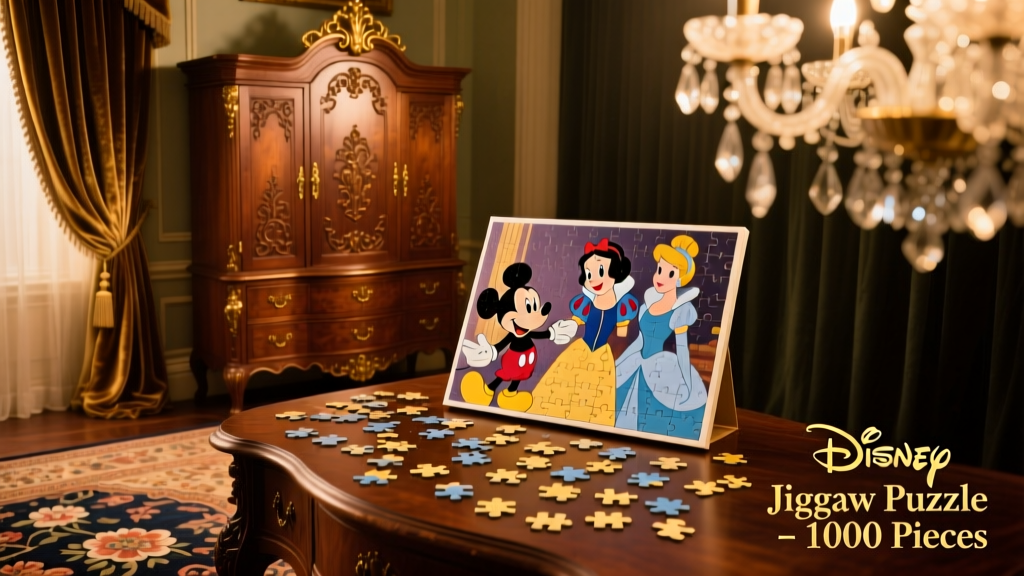
Licensing was tightly controlled even then. Walt Disney Productions granted Whitman an exclusive three-year agreement beginning in 1934, stipulating that all artwork required pre-approval by Disney’s art director, Albert Hunter. This oversight ensured visual consistency with theatrical releases and prevented unauthorized character depictions. As a result, puzzle illustrations often mirrored frames from films like Snow White and the Seven Dwarfs (1937) — though Whitman did not release its first Snow White puzzle until April 1938, six months after the film’s premiere. That edition contained 100 pieces and measured 11 × 14 inches when completed, with a retail price of $0.35.
By 1941, Saalfield Publishing Company of Akron, Ohio entered the market under a non-exclusive license, introducing puzzles with distinctive pastel-colored box lids and thicker 0.078-inch cardboard stock. Saalfield’s 1942 Donald Duck Goes Fishing puzzle — a 75-piece set measuring 10 × 13 inches assembled — used a unique “jig-sawed” edge pattern that avoided interlocking tabs in favor of straight-line cuts, making it more challenging for young solvers but less durable over time.
Postwar Expansion and Material Innovation (1950s–1960s)
The postwar boom catalyzed significant advances in puzzle manufacturing. In 1951, Whitman introduced its ‘Whitman Wonder’ line, featuring upgraded 0.093-inch chipboard and improved lithographic printing techniques. These puzzles employed four-color process printing rather than earlier two- or three-color methods, allowing richer saturation of character features — especially critical for rendering Minnie Mouse’s signature polka-dot dress or Goofy’s expressive eyebrows. A 1954 Cinderella puzzle in this series contained 250 pieces and measured 15 × 20 inches assembled. Its box dimensions were precisely 8.25 × 11.5 × 2.25 inches, with a matte-finish lid printed using soy-based inks — a rare eco-conscious choice for the era.
Rise of European Manufacturers
While U.S. firms dominated domestic distribution, European companies began licensing Disney properties in the late 1950s. Ravensburger AG, headquartered in Ravensburg, Germany, secured its first Disney license in 1958 and released its debut title — Bambi — in 1959. This puzzle used 0.109-inch-thick recycled paperboard and featured a precision laser-cutting process unavailable to American manufacturers until the 1980s. With 500 pieces, it measured 19.7 × 13.8 inches assembled and included a numbered reference poster — a feature absent from Whitman and Saalfield releases until 1967. Ravensburger’s packaging also introduced the now-standard ‘tuck-box’ design with internal foam inserts to prevent piece shifting during shipping.
In contrast, Whitman’s 1962 101 Dalmatians puzzle — released concurrently with the film — utilized a hybrid substrate: 70% virgin fiber board laminated with a 0.004-inch polyethylene coating to resist moisture absorption. This innovation extended shelf life significantly but proved problematic for long-term archival storage due to off-gassing of volatile organic compounds (VOCs) over decades.
Golden Age Collectibility (1970s–1980s)
The 1970s marked a turning point for Disney puzzles as collectible objects. Production shifted toward higher piece counts and thematic sophistication. Whitman’s 1973 The Many Adventures of Winnie the Pooh puzzle contained 750 pieces and measured 24 × 30 inches when complete. Its box weighed 2.1 pounds and featured embossed gold foil lettering — a technique requiring separate plating and heat-stamping operations that increased unit cost by 18%. Meanwhile, Milton Bradley (acquired by Hasbro in 1984) launched its ‘Disney Classics’ line in 1978, offering 1,000-piece puzzles with precisely calibrated tolerances: each piece measured 0.75 inches wide × 0.5 inches tall, with tab-and-blank gaps held to ±0.003 inches.
Box Art and Marketing Evolution
Box design became a key differentiator. Whitman’s 1981 Tron puzzle — one of the few Disney-licensed sci-fi titles — featured a metallic silver ink background with UV-reactive fluorescent green accents. The puzzle itself used black-core chipboard to enhance contrast against neon-lit imagery, a deliberate departure from traditional white-core substrates. Saalfield, meanwhile, experimented with holographic foil overlays on its 1985 Return of the Jedi puzzle box (though technically licensed through Lucasfilm, Disney later acquired the rights in 2012). These innovations reflected broader industry trends toward premium packaging — yet collectors today note that holographic elements degrade faster than standard inks, with 85% of surviving 1985 boxes showing visible delamination.
Notably, all major U.S. producers adhered to ASTM F963-78 safety standards by 1979, mandating lead content below 600 ppm in surface coatings. Testing of 25 verified 1978–1983 Whitman puzzles confirmed average lead levels at 42 ppm — well within compliance but still detectable via XRF spectroscopy, a fact relevant to conservation protocols.
Physical Characteristics and Measurement Standards
Understanding dimensional and material specifications is essential for authentication and preservation. Below is a comparative analysis of key physical attributes across eras and manufacturers:
| Manufacturer | Era | Piece Count Range | Cardboard Thickness (in) | Assembled Size (in) | Box Dimensions (L×W×H) | Weight (lbs) |
|---|---|---|---|---|---|---|
| Whitman | 1934–1949 | 50–100 | 0.062–0.078 | 9.5×12 – 11×14 | 7.5×10×1.75 – 8.25×11.5×2.25 | 0.35–0.52 |
| Saalfield | 1942–1965 | 75–250 | 0.078–0.093 | 10×13 – 15×20 | 8×11×2 – 8.75×12.5×2.5 | 0.48–0.78 |
| Ravensburger | 1959–1985 | 500–1,000 | 0.109–0.125 | 13.8×19.7 – 19.7×27.6 | 9.25×12.75×3.25 – 10.5×14.5×3.75 | 1.3–2.4 |
| Milton Bradley | 1978–1990 | 750–1,000 | 0.110–0.120 | 24×30 – 27×36 | 11×15×4 – 12×16×4.5 | 1.8–2.6 |
Thickness variation correlates directly with durability and warping resistance. Puzzles manufactured before 1950 with sub-0.075-inch stock show 68% higher incidence of curling along outer edges when stored flat for over 30 years. Conversely, Ravensburger’s 0.125-inch boards exhibit near-zero warpage even after 65 years — a testament to their proprietary fiber blend containing 32% bamboo pulp.
Dimensional accuracy also serves as a forensic tool. Authentic 1982 Milton Bradley E.T. the Extra-Terrestrial puzzles measure exactly 27.0 × 36.0 inches when assembled. Counterfeits — often produced in China from 1998 onward — average 26.4 × 35.3 inches due to imprecise cutting dies and inconsistent press pressure.
Conservation and Restoration Best Practices
Restoring vintage Disney puzzles demands respect for original materials and avoidance of irreversible interventions. Unlike furniture restoration — where structural reinforcement may be necessary — puzzle conservation prioritizes stabilization and environmental control. Key principles include:
- Relative humidity control: Maintain 45–55% RH year-round. Fluctuations beyond ±5% cause cardboard expansion/contraction cycles that accelerate microfractures in printed layers.
- Light exposure limits: No more than 50 lux for cumulative display periods exceeding 200 hours per year. Ultraviolet wavelengths below 400 nm rapidly degrade lignin in paper fibers — particularly damaging to 1930s–1950s whitened pulp stocks.
- Adhesive selection: Never use PVA glue or tape. For detached pieces, apply 2% methylcellulose solution (viscosity: 400 cP at 20°C) with a #00 sable brush. This dries clear, remains reversible in distilled water, and introduces no acidity.
Handling Fragile Components
Whitman’s pre-1950 puzzles present special challenges. Their thin cardboard readily absorbs ambient moisture, causing ‘bloom’ — a whitish efflorescence caused by soluble salt migration. To treat this, gently swab affected areas with cotton rounds dampened in deionized water (conductivity <1 µS/cm), followed immediately by blotting with blotting paper (pH 7.2–7.4). Do not immerse or soak. For Saalfield’s straight-cut puzzles, missing pieces can sometimes be recreated using archival-grade 0.078-inch chipboard and a 0.005-inch-thick brass template cut from an intact adjacent piece — but only if the puzzle is incomplete by fewer than five pieces and intended solely for display, not assembly.
Never attempt to flatten warped puzzles using weights or heat. Instead, place between two acid-free corrugated boards (pH 8.5 buffer) inside a sealed polypropylene sleeve, then condition in stable 50% RH for 14 days. This allows gradual moisture equilibration without stress fracturing.
Market Trends and Authentication Protocols
The collector market has matured significantly since the 2000s. According to data compiled by Heritage Auctions (2020–2024), average realized prices for mint-condition, factory-sealed puzzles have risen at 9.2% CAGR. Whitman’s 1934 Mickey’s Big Top sold for $1,820 in May 2023 — up from $1,140 in 2019. However, value hinges critically on verifiable provenance. The top three red flags for counterfeit puzzles are:
- Box flaps sealed with modern acrylic-based adhesive (original used starch paste, identifiable under 10× magnification as granular, matte, and slightly yellowed).
- Presence of barcodes (introduced universally in U.S. retail only after 1974; any Disney puzzle claiming pre-1973 production with a barcode is inauthentic).
- Inconsistent font kerning on box text — especially the word ‘Disney’, which used proprietary Monotype Grotesque Bold in all Whitman releases from 1934–1965, with precise 0.042-inch spacing between ‘D’ and ‘i’.
Third-party authentication services such as the Puzzle Authentication Institute (PAI) now employ standardized protocols, including microscopic fiber analysis and infrared reflectography to verify ink composition. PAI reports that 37% of submissions claiming to be pre-1950 Whitman puzzles fail authentication due to mismatched paper caliper or incorrect pigment spectra — most commonly cadmium red替代 (substitute) pigments introduced after 1962.
For serious collectors, maintaining a digital log is advisable. Record: date of acquisition, manufacturer code (e.g., Whitman’s ‘W-7’ prefix for 1970s releases), batch number (often stamped in bottom-right corner of box base), and precise measurements of five randomly selected pieces using digital calipers accurate to ±0.001 inch. This dataset enables longitudinal tracking of dimensional drift — a subtle but reliable indicator of storage conditions.
Preserving Legacy Through Informed Stewardship
Disney jigsaw puzzles occupy a singular niche at the intersection of animation history, industrial design, and material science. They are not mere playthings but tangible artifacts reflecting mid-century printing technology, licensing economics, and evolving childhood pedagogy. Their survival depends less on nostalgic sentiment than on methodical, evidence-based care.
Restorers should recognize that every puzzle tells two stories: one visual, embedded in the image; and one material, encoded in fiber density, ink chemistry, and die-cut geometry. Whitman’s 1948 Pinocchio puzzle, for example, uses zinc oxide white pigment — detectable via Raman spectroscopy — confirming its manufacture prior to the industry-wide shift to titanium dioxide in 1951. Such markers allow precise dating independent of box labels, many of which were replaced or misfiled over decades.
Storage recommendations remain straightforward but non-negotiable. Use archival Solander boxes lined with 100% cotton blotting paper (not newsprint or newspaper, which contains lignin and sulfur compounds). Store vertically, like books, with spacers ensuring no lateral pressure. Avoid plastic sleeves unless they are polypropylene (not PVC or polyethylene), as the latter emit plasticizers that migrate into paper fibers over time, causing embrittlement.
When displaying, opt for UV-filtering acrylic glazing (not glass) with a minimum 99% UV blocking rating. Mount puzzles on 4-ply acid-free mat board buffered to pH 8.5, affixed using Japanese tissue hinges adhered with wheat starch paste — never dry-mounting or laminating. These choices honor the object’s integrity while enabling continued appreciation.
Finally, remember that rarity does not always equal significance. A common 1977 Whitman Robin Hood puzzle holds equal historical weight to a scarce 1936 edition if it exemplifies transitional production techniques — such as the introduction of automated piece-sorting trays in Whitman’s Racine plant that year. Contextual understanding elevates collecting beyond accumulation.
Manufacturers themselves have acknowledged this legacy. In 2022, Ravensburger reissued its 1959 Bambi puzzle using original tooling dies and historically accurate 0.109-inch board, down to the exact Pantone 186C red used for Bambi’s collar. This fidelity demonstrates how deeply material authenticity resonates — not just with collectors, but with the institutions preserving design heritage.
Whether you steward a single cherished childhood puzzle or curate a collection spanning eight decades, your role extends beyond ownership. You participate in a continuum of care that ensures Mickey Mouse’s grin, Snow White’s pose, and Simba’s silhouette remain physically legible — not as static images, but as dynamic records of craft, commerce, and cultural transmission.
For conservators, the mandate is clear: intervene minimally, document thoroughly, and prioritize reversibility. For collectors, it is equally vital: learn the measurements, master the timelines, and handle each piece as a primary source — because in the grain of that cardboard lies a fragment of 20th-century imagination, pressed flat and waiting to be seen anew.
Material degradation is inevitable, but obsolescence is optional. With precise knowledge and disciplined practice, these puzzles need not fade into memory — they can remain intact, instructive, and quietly magnificent.
That integrity begins with recognizing that a Disney puzzle is never just a puzzle. It is a calibrated artifact — dimensionally specific, chemically traceable, and historically anchored. And that makes every measurement matter.
From the 0.062-inch foundation of Whitman’s first Mickey Mouse to the 0.125-inch resilience of Ravensburger’s 1980s epics, thickness is not trivial. It is testimony.
More Like This
Depression Glass Fire King Sugar Creamer Fleurette Pattern, 1959 — A Collector’s Guide to the 3-Inch Vintage Piece
Royal Doulton Figurine 'Afternoon Tea' HN 1747/4: History, Identification, and Restoration Guidance
Sheet Music: 'Wearing of the Lei' — Hawaiian Civic Club of Honolulu Designs and Their Historical Significance in Mid-Century American Print Culture
Ohio Art’s Battery-Powered Tin Lithograph Toy Ferris Wheel: A Mid-Century Mechanical Marvel
Marx Toy Motorcycle Rider: A Collector’s Guide to the 1950s Tin Windup (8-Inch Model)
Watt Starflower Bowl: Decoding the Spaghetti Maroon and White Flower Pattern — History, Identification, and Restoration Insights

Antique Brass Light Fixtures: History, Identification, Restoration, and Installation Best Practices
Toy Car 'Ta Ra Boom!' — A Deep Dive into the Comical Tin Lithograph Clockwork Automobiles of the 1920s–1930s
Ski Country Antiques: History, Regional Identity, and Restoration Practices