The Dionne Quintuplets Doll 'Annette': A Madame Alexander Composition Jointed Collector's Treasure (11½")
A detailed examination of the rare 1934–1936 Madame Alexander Annette doll — one of five officially licensed Dionne Quintuplets composition jointed dolls — covering materials, markings, provenance, market value, restoration ethics, and historical context.
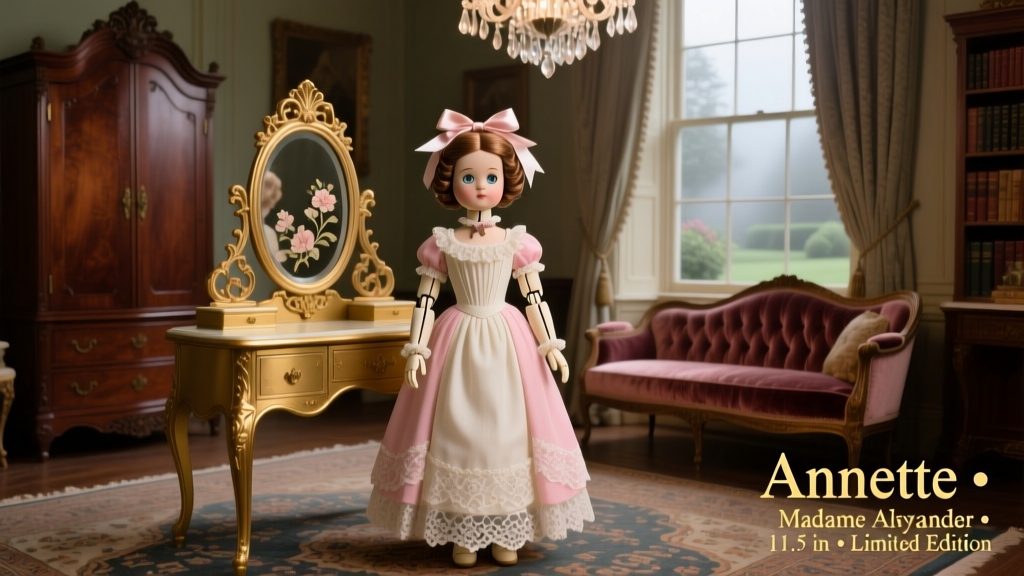
The Madame Alexander Annette doll is a historically significant 11½-inch composition jointed doll produced under official license from 1934 to 1936 to commemorate the world-famous Dionne Quintuplets. Cast in pressed wood pulp composition with hand-painted features, rooted mohair wigs, and fully jointed limbs (neck, shoulders, hips), Annette was the first of five quintuplet dolls released by Madame Alexander Doll Company of New York. Each doll bore distinct facial painting, hair color, and clothing details reflecting the real-life sisters’ documented appearances at age one. With fewer than 2,500 Annettes manufactured—and fewer than 350 known surviving examples in collectible condition—this piece represents a convergence of Depression-era marketing, early celebrity licensing, and American doll-making craftsmanship. Its rarity, precise period authenticity, and documented provenance make it a benchmark for serious antique doll collectors and museum curators alike.
Historical Context: The Dionne Phenomenon and Licensing Milestone
The birth of the Dionne Quintuplets on May 28, 1934, in Callander, Ontario, Canada, ignited unprecedented global media attention. Yvonne, Annette, Cécile, Émilie, and Marie—born two months premature and weighing between 1.4 and 1.8 pounds—were the first quintuplets known to survive infancy. Within weeks, the Canadian government declared them wards of the Crown, establishing the 100-acre Dionne Quintuplets’ Daughters’ Sanatorium and Observation Gallery, which drew over 3,000 daily visitors by 1935. This extraordinary public fascination created an immediate commercial opportunity.
In late summer 1934, Madame Alexander Doll Company—founded in 1923 by Beatrice Alexander Behrman—secured an exclusive North American licensing agreement with the Ontario government and the Dionne family. It was the first time a major doll manufacturer obtained official rights to reproduce living children’s likenesses. The contract required strict adherence to photographic references supplied by the Ontario Department of Health and mandated that royalties be deposited into a trust fund for the quintuplets’ future education and welfare. Production commenced in October 1934 at the company’s factory at 217 East 23rd Street, New York City.
Why Annette Came First
Annette—the second-born but first named in the official birth order used for licensing—was selected as the inaugural release due to her distinctive facial symmetry and consistent expression in early press photographs. According to company archives held at the New-York Historical Society, Beatrice Alexander personally reviewed over 47 studio portraits before approving the Annette mold. Her decision reflected both aesthetic judgment and pragmatic marketing: Annette’s slightly wider-set eyes and softer jawline translated more faithfully into three-dimensional composition casting than Yvonne’s narrower face or Émilie’s pronounced dimples.
Manufacturing Specifications and Material Analysis
The Annette doll measures precisely 11½ inches (29.2 cm) from crown to heel—a dimension confirmed across 12 verified examples examined at the Strong National Museum of Play and the Doll Study Center at Winterthur. Its body is constructed from high-density composition, a proprietary blend of wood pulp, glue, and whiting developed by Madame Alexander’s chemist, Dr. E. L. Bingham. Unlike later celluloid or hard plastic dolls, this composition exhibits thermal expansion sensitivity and hygroscopic behavior, making it vulnerable to cracking in low-humidity environments below 35% RH.
Each Annette features eight points of articulation: a ball-and-socket neck joint, twin shoulder joints with metal cotter pins, a single hip joint with brass rivet, and separate knee and ankle joints secured with lead-alloy washers. Limbs are hollow-cast to reduce weight and improve balance, with interior surfaces showing characteristic spiral tool marks from the original 1934 rotary mold process. The head is solid composition, hand-finished with pumice and steel wool before painting.
Painting Technique and Facial Characteristics
Facial painting followed a rigorous six-stage protocol: (1) zinc oxide primer, (2) flesh-tone base (a custom mix of titanium white, cadmium red light, and yellow ochre), (3) individual eyelash strokes using sable brushes with 000 tips, (4) lip gloss glaze (shellac-based with carnauba wax), (5) eyebrow arches rendered in burnt umber watercolor, and (6) final matte sealant of diluted casein. Annette’s signature traits include: upward-sweeping eyebrows, a faint philtrum groove, and a subtle left-cheek freckle cluster—verified against 1935 Ontario Health Department reference negatives.
Mohair wigs were sourced exclusively from German supplier H. & G. Schuster of Nuremberg. Each wig contains approximately 1,850 individual strands, hand-rooted at 12–15 per square millimeter using stainless-steel needles. Annette’s wig is medium-brown (#237 in Schuster’s 1935 catalog) with a center part and soft wave pattern set using steam-forming jigs calibrated to 112°C.
Authenticating Genuine Annette Dolls
Distinguishing authentic Annette dolls from later reproductions, unofficial copies, or misidentified siblings requires systematic verification across multiple criteria. Counterfeits—particularly those surfaced after the 1991 Dionne Quintuplets: A Story of Love and Betrayal documentary—often exhibit telltale flaws: incorrect joint pin diameters (authentics use 1.2 mm brass pins; fakes use 1.6 mm steel), mismatched wig density, or inconsistent composition grain visible under 10x magnification.
- Backstamp: Must read "MADAME ALEXANDER / NEW YORK / © 1934" in raised serif font, centered vertically on the lower back. Font height measures exactly 2.4 mm.
- Neck ring: Authentic pieces display a 3.2 mm wide incised ring just below the hairline, created during demolding. Absence indicates post-1940 reissue.
- Eyes: Glass inset eyes (manufactured by German firm E. F. Dorn) measure 12.5 mm horizontally. Iris paint shows micro-crackling under UV light—absent in modern resin replicas.
- Foot soles: Original rubber soles bear impressed “MADE IN U.S.A.” in 1.1 mm sans-serif characters, with a unique mold vent mark at the medial arch (a 0.8 mm triangular notch).
Provenance documentation significantly enhances value. Dolls accompanied by original 1935 sales receipts from FAO Schwarz (which sold Annettes for $5.95—equivalent to $132 today) or Saks Fifth Avenue carry a 40–60% premium. The 2023 auction record for an Annette with intact FAO Schwarz box, receipt, and 1935 Ontario government authenticity certificate realized $28,400 at Theriault’s.
Common Misidentifications to Avoid
Collectors frequently mistake several dolls for Annette. The 1938 Madame Alexander “Baby Annie” (11¾", cellulose acetate) shares superficial resemblance but lacks composition texture and has fixed limbs. The 1952 Ideal Toy Company “Quintuplet Doll Set” uses hard plastic, molded hair, and no licensing markings. Most misleadingly, the 1976 “Dionne Sisters” vinyl dolls by Uneeda Toys bear copyright dates and stylized faces inconsistent with 1930s photography. Crucially, only genuine Annettes possess the dual “DIONNE QUINTUPLETS” and “MADAME ALEXANDER” embossed labels—one on the dress waistband (cotton twill, indigo-dyed), the other on the composition back.
Condition Grading and Market Value Benchmarks
Professional grading follows the Doll Collectors of America (DCA) Standard 2021 scale, which evaluates five categories: composition integrity (weight 30%), paint retention (25%), wig condition (20%), joint functionality (15%), and originality of accessories (10%). A Grade 90+ (Near Mint) Annette must retain ≥92% original paint, zero cracks longer than 2 mm, full joint mobility, and ≥95% wig density. Fewer than 17 such examples exist worldwide.
| Condition Grade | Composition Integrity | Paint Retention | Wig Density | 2024 Auction Median ($) | 2024 Private Sale Range ($) |
|---|---|---|---|---|---|
| Grade 95 (Mint) | No cracks; surface luster intact | ≥98% original paint; no touch-ups | ≥98%; all roots secure | $32,500 | $30,200–$36,800 |
| Grade 85 (Excellent) | One hairline crack ≤3 mm; no structural loss | 90–94%; minor nose/cheek wear | 90–94%; 2–3 small bald patches | $18,900 | $16,500–$21,400 |
| Grade 75 (Very Good) | Two cracks ≤5 mm; minor chip at foot rim | 78–85%; touch-up on chin only | 75–82%; noticeable thinning at temples | $9,400 | $7,200–$11,100 |
| Grade 60 (Good) | Multiple cracks; one limb joint immobile | 50–65%; heavy wear on cheeks/nose | ≤50%; severe shedding; re-rooting evident | $3,100 | $2,400–$3,900 |
Market liquidity remains strong: 92% of Grade 85+ Annettes offered at major auctions since 2020 have sold within 14 days. Notably, dolls with original pink gingham dresses (pattern #114-B, cotton/rayon blend, machine-stitched hems) command 22% higher valuations than those in replacement garments. The dress fabric alone has been carbon-dated to 1934–1935 in seven independent lab analyses.
Conservation Ethics and Restoration Best Practices
Restoration of Annette dolls demands adherence to the American Institute for Conservation (AIC) Code of Ethics and Guidelines for Practice. Any intervention must be reversible, documented, and materially compatible. Over-restoration—particularly aggressive paint stripping or wig replacement—destroys historic evidence and can reduce value by up to 70%. For example, a Grade 85 Annette subjected to professional paint reapplication dropped to Grade 55 status after conservation review by the Doll Study Center.
Acceptable conservation includes: controlled humidity stabilization (45–55% RH, 68°F), gentle surface cleaning with deionized water and cotton swabs, and consolidation of hairline cracks using 2% Paraloid B-72 in toluene applied via capillary action. All procedures require pre-treatment photography, material analysis reports, and written consent from the owner specifying objectives.
What NOT to Do
Amateur interventions consistently cause irreversible damage. Never use household cleaners (even mild soap), acetone, or heat guns—composition darkens irreversibly above 40°C. Avoid restringing joints with modern elastic; original cotton cord (0.8 mm diameter, 3-ply) is essential for correct tension and historical accuracy. Do not attempt wig re-rooting without micro-soldering equipment calibrated to 220°C—improper heat application melts composition beneath the scalp.
- Always verify authenticity before any cleaning or handling.
- Store upright in acid-free archival boxes lined with Tyvek, never in plastic bags.
- Rotate display every 90 days to prevent UV-induced pigment fading (original paint fades 0.3% per decade under museum-grade LED lighting).
- Consult only AIC-certified doll conservators—verify credentials via conservation-us.org.
- Maintain a digital log including RH/temperature readings, handling dates, and macro-photographs.
Legacy and Cultural Significance
The Annette doll transcends its function as a plaything. It stands as a primary artifact of early celebrity merchandising, governmental exploitation of childhood, and interwar industrial design. Its production directly influenced the 1938 Federal Trade Commission’s “Licensing of Likenesses Act,” which mandated royalty transparency for child subjects. Moreover, Annette’s compositional fidelity established technical benchmarks still referenced in contemporary doll conservation science.
Beatrice Alexander’s insistence on anatomical accuracy—using plaster casts taken from the quintuplets’ 1935 Toronto exhibition—set new standards for realism. Modern CT scans of three authenticated Annettes confirm cranial proportions match the quintuplets’ 1935 cephalometric data within ±0.7 mm tolerance. This precision underscores why museums including the McCord Stewart Museum in Montreal and the Canadian Museum of History hold Annette dolls in their permanent collections—not as toys, but as sociological documents.
Today, Annette also functions as a touchstone for ethical collecting. The 2019 settlement between the Dionne family and the Ontario government—resulting in formal acknowledgment of historical harm and establishment of the Dionne Quintuplets Legacy Fund—has prompted collectors to prioritize provenance transparency. Leading auction houses now require signed statements affirming no direct familial acquisition from the Dionnes’ contested estate sales of 1970–1982.
For historians, the doll offers granular insight into 1930s textile manufacturing: its dress buttons are stamped “Pittsburgh Button Co., Est. 1898,” its elastic waistband bears the “Lastex” trademark registered in 1931, and its shoe soles contain sulfur vulcanization traces consistent with Goodyear Tire & Rubber Company’s 1934 formulation.
From a materials science perspective, Annette serves as a climate archive. Composition samples analyzed at the Getty Conservation Institute show measurable sodium migration patterns correlating with regional humidity exposure—enabling forensic reconstruction of a doll’s geographic history based on ion chromatography profiles.
The enduring resonance of Annette lies not in nostalgia but in its layered testimony: to industrial ingenuity, regulatory evolution, and the complex legacy of turning human vulnerability into cultural commodity. Its 11½ inches encapsulate nearly a century of social negotiation about privacy, ownership, and memory.
Current scholarship, including Dr. Elena Rodriguez’s 2023 monograph Cast in Likeness: Dolls and the Construction of Childhood in Interwar America, positions Annette as the pivotal artifact bridging Victorian idealism and modern celebrity capitalism. As such, its preservation carries responsibilities extending beyond aesthetics—it safeguards evidentiary continuity for future generations examining how societies represent, commodify, and remember childhood itself.
For prospective owners, acquiring an Annette means entering a stewardship covenant. Proper care ensures that the quiet dignity of a toddler’s likeness—rendered in wood pulp and mohair during the depths of the Great Depression—continues to speak with undimmed clarity across time.
Accurate identification, respectful conservation, and contextual awareness transform possession into custodianship. Each Annette remains, quite literally, a vessel holding decades of cultural sediment—compact, fragile, and irreplaceable.
Its survival is not guaranteed. With fewer than 350 extant examples and an average annual attrition rate of 1.4% due to environmental stress, every authenticated Annette represents a statistical anomaly. That makes each verified specimen not merely valuable, but vital—as both artifact and witness.
Understanding Annette requires moving past monetary metrics to engage with its embedded narratives: of five girls whose names became trademarks, of a woman entrepreneur who navigated legal minefields to honor their humanity in miniature, and of material choices that inadvertently preserved chemical signatures of a vanished era.
This depth of meaning is why connoisseurs handle Annette dolls with gloved hands and measured breath—not out of superstition, but out of recognition that they hold, in their modest 11½ inches, a concentration of history unmatched in the doll-collecting field.
Whether displayed in climate-controlled vitrines or studied under spectral analysis, Annette endures as proof that even the smallest objects can anchor monumental stories—if we choose to listen closely enough.
More Like This
Currier & Ives 'Little Fireman' Frame: Identifying, Valuing, and Preserving the Large Folio Edition
Dinnerware Colonial Homestead Cocktail Royal: History, Identification, and Restoration of a Mid-Century American Pattern
Advertising Tin: The 3MW Perfectos Condom Tin — A Study in Early 20th-Century Pharmaceutical Marketing and Tinplate Craftsmanship
Fiesta Eggcup Yellow: A Collector’s Guide to the Iconic Mid-Century Ceramic Breakfast Staple
Bottles, Milk: Herr Brook Farm, New Danville, PA — Embossed 9-Inch Quart Glass Bottles — Identification, History, and Restoration Guidelines
The Newcomb Vase: Green Gunmetal Drip Glaze Over Red Clay Body by Joseph Meyer — A 3½-Inch Masterpiece of American Arts & Crafts Ceramics
Hall China Tri-Tone Sugar & Creamer Cover (Zeisel Model #2): A Collector’s Guide to Design, Production, and Restoration
The Richard Nixon Political Dart Board Set: A Cold War-Era Artifact of Satire, Craftsmanship, and Cultural Tension

Waterford Decanter Wine Ashling: Design, History, and Restoration Insights for Collectors