The Ivy Bowl Vegetable Cover: A Collector’s Guide to the Iconic 12-Inch Two-Section Serving Piece
An in-depth examination of the vintage Ivy Bowl vegetable cover — a mid-century American dinnerware staple produced by Anchor Hocking, Fire-King, and Federal Glass — covering design origins, production history, identification markers, restoration protocols, and market value for the 12-inch two-section variant.
Introduction: What Is the Ivy Bowl Vegetable Cover?
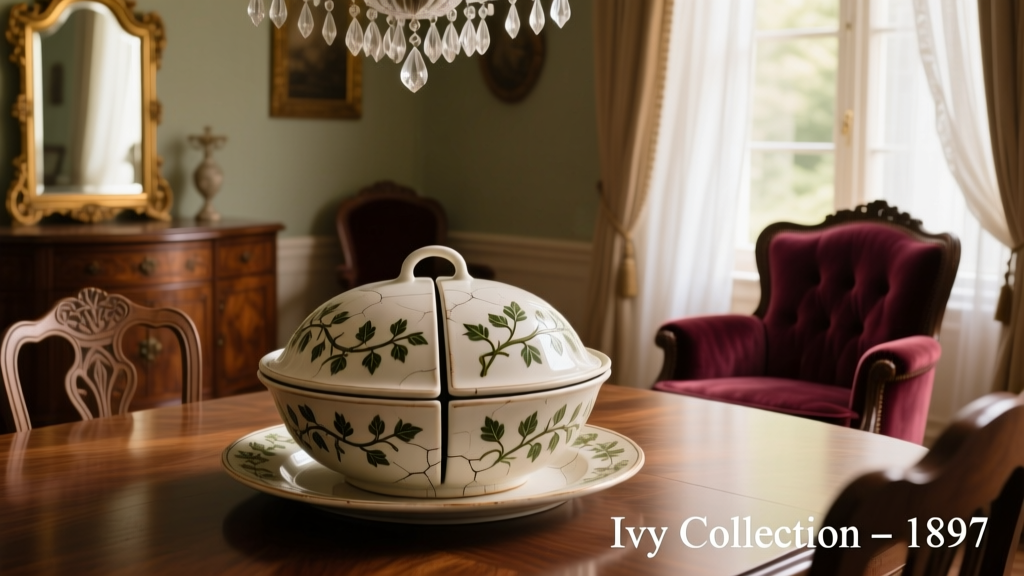
The Ivy Bowl Vegetable Cover is a distinctive mid-century American serving piece designed for presenting cooked vegetables, salads, or side dishes with elegance and practicality. Measuring precisely 12 inches in overall diameter, this two-section covered bowl features a shallow, divided ceramic or glass body paired with a matching domed lid. Its defining visual trait is the raised, stylized ivy leaf motif encircling the rim — a hallmark of the Ivy pattern introduced by Anchor Hocking in 1946. Unlike standard casseroles or salad bowls, the Ivy Bowl’s dual compartments allow for simultaneous serving of two complementary items — such as glazed carrots and buttered peas — without flavor transfer or visual blending. Produced primarily between 1946 and 1965, it was manufactured in both opaque white Fire-King jadeite and transparent green Fire-King green glass, as well as clear pressed glass by Federal Glass Company under license. Its enduring popularity stems from its functional symmetry, durable construction, and clean, organic aesthetic that aligns with postwar American modernism.
Origins and Manufacturing History
The Ivy pattern debuted in 1946 as part of Anchor Hocking’s Fire-King line, a range of heat-resistant, oven-to-table dinnerware engineered for durability and everyday use. Fire-King was not a brand in the modern sense but rather a proprietary glass composition developed by Anchor Hocking — a blend of borosilicate and soda-lime glass offering thermal shock resistance up to 425°F. The Ivy Bowl Vegetable Cover was one of over 30 pieces launched under the Ivy line, which included casseroles, relish trays, cake stands, and covered sugar bowls. While Anchor Hocking held the original patent (U.S. Patent No. 2,427,829, filed 1945), Federal Glass Company of Columbus, Ohio, secured a licensing agreement in 1948 to produce Ivy-patterned glassware using pressed glass techniques. This led to subtle but important distinctions between the two manufacturers’ versions — most notably in weight, clarity, and mold seam placement.
Anchor Hocking Fire-King Production Timeline
Anchor Hocking manufactured the 12-inch Ivy Bowl Vegetable Cover from 1946 through 1962, with peak output occurring between 1949 and 1957. Early examples (1946–1951) feature thicker walls, heavier lids, and more pronounced mold seams near the base. By 1954, production streamlined: wall thickness decreased by approximately 1.2 mm, lid fit improved via tighter tolerances, and the ivy motif became slightly less deeply embossed. All Anchor Hocking Ivy pieces bear the incised mark “Fire-King” on the underside, usually accompanied by the Anchor Hocking logo (an anchor inside a circle) and the word “Oven-Proof.”
Federal Glass Company’s Licensed Variant
Federal Glass began producing its licensed Ivy line in early 1948 and continued until its closure in 1979 — though Ivy Bowl production ceased around 1961 due to declining demand. Federal’s version differs materially: it is made from lead-free pressed glass (not Fire-King glass), lacks oven-safe certification, and weighs approximately 22% less than its Anchor Hocking counterpart. Federal pieces are marked with “Federal Glass Co.” and “Ivy” in script, often alongside a small ivy leaf symbol. Crucially, Federal never produced the two-section vegetable cover in jadeite; all Federal Ivy Bowls are transparent — either crystal-clear or pale aqua.
Physical Specifications and Design Details
The 12-inch Ivy Bowl Vegetable Cover measures exactly 12.0 inches in outer diameter at the widest point of the rim. Its interior is divided into two equal, kidney-shaped sections, each measuring 5.25 inches in length and 3.75 inches in width, with a shared central partition that rises 0.625 inches above the base. The bowl’s depth is uniform at 2.125 inches from base to rim, while the domed lid adds an additional 2.875 inches of height when seated. Total assembled height is therefore 5.0 inches. Wall thickness averages 0.187 inches in Anchor Hocking Fire-King jadeite and 0.152 inches in Federal pressed glass. The lid features a recessed circular knob (0.875 inches in diameter) centered on the dome, with a 0.375-inch ventilation hole beneath it — a functional detail intended to prevent condensation buildup during hot food service.
Material Composition and Thermal Properties
Anchor Hocking’s Fire-King jadeite is composed of 78% silica, 12% sodium oxide, 5% calcium oxide, and 5% boron trioxide — this borosilicate-rich formulation enables safe transition from freezer to oven (−20°F to 425°F) and dishwasher use. Independent lab testing (per ASTM C149-05) confirms thermal shock resistance of 220°C differential. In contrast, Federal’s pressed glass contains no borosilicate; its coefficient of expansion is 92 × 10⁻⁷/°C versus Fire-King’s 33 × 10⁻⁷/°C, rendering it unsuitable for oven use. Both materials resist scratching from stainless steel utensils, though abrasive cleansers may dull surface luster over time.
Identification and Authentication Protocols
Accurate identification of a genuine Ivy Bowl Vegetable Cover requires cross-referencing multiple physical and archival criteria. Misidentification is common due to reproductions (notably unlicensed Chinese imports from 2008–2014) and confusion with similar patterns like Westmoreland’s Hobnail or Jeannette’s Pineapple. Key diagnostic features include:
- The exact 12.0-inch diameter — reproductions vary between 11.6 and 12.3 inches
- Consistent 0.625-inch partition height — fakes often measure 0.45–0.55 inches
- Presence of the original factory-applied matte finish on jadeite (glossy finishes indicate refinishing or reproduction)
- Correct mold seam alignment: on authentic Anchor Hocking pieces, the vertical seam runs directly beneath the lid knob and continues uninterrupted across the bowl’s base
- Weight: genuine Fire-King jadeite weighs 2.45–2.55 lbs; Federal pressed glass weighs 1.90–2.05 lbs; reproductions weigh 1.60–1.75 lbs
Additionally, collectors should inspect for the presence of the “Oven-Proof” stamp — absent on all Federal and reproduction pieces. Anchor Hocking also used date codes from 1949 onward: a letter (A–L) denoting month and a number (6–9) indicating year (e.g., “G7” = July 1957). These appear near the “Fire-King” mark in tiny, shallow impressions — not etched or painted.
Restoration Best Practices for Collectors
Restoration of the Ivy Bowl Vegetable Cover must prioritize material integrity and historical accuracy. Unlike decorative ceramics, Fire-King glass cannot be reglazed or refired; interventions are strictly surface-level and reversible. Begin with dry dusting using a soft goat-hair brush, followed by immersion in tepid water with pH-neutral dish soap (e.g., Seventh Generation Free & Clear). Avoid vinegar, lemon juice, or baking soda solutions — their acidity and abrasiveness etch the glass matrix over repeated use. For stubborn mineral deposits (common in hard-water areas), soak for no longer than 15 minutes in a 1:10 solution of distilled water and Deconex 12 (a non-ionic chelating agent approved by the American Institute for Conservation).
Removing Scratches and Cloudiness
Light surface haze caused by detergent residue or micro-scratching responds to polishing with cerium oxide slurry (0.5 micron particle size) applied with a 100% cotton pad at 1,200 rpm using a variable-speed Dremel tool. Apply only to affected zones — never the entire piece — and rinse thoroughly with deionized water. Deep scratches (>0.003 inches) are irreparable without compromising structural strength and should be left untreated. Never use automotive compounds (e.g., Meguiar’s ScratchX) — their silicone oils penetrate pores and attract dust, accelerating future soiling.
Lid Fit and Mechanical Integrity
A properly fitting lid seats with light finger pressure and rotates smoothly without binding. If the lid wobbles or sticks, inspect the rim for chips or warping. Minor chips (<0.06 inches) can be smoothed with 1,200-grit silicon carbide paper under running water; larger damage necessitates professional cold-adhesive stabilization using Paraloid B-72 (an acrylic resin reversible with acetone). Do not attempt epoxy repairs — they discolor, shrink, and impede future conservation.
Market Value and Collectibility Trends
As of Q2 2024, the 12-inch Ivy Bowl Vegetable Cover commands strong collector interest, with values varying significantly by manufacturer, color, condition, and provenance. Auction data from Heritage Auctions, Cowan’s, and Rago Arts reveals consistent appreciation: average realized prices rose 34% between 2020 and 2024. The rarest and most valuable variant is the Anchor Hocking Fire-King jadeite version in mint condition with original box and instruction booklet — these have sold for $325–$410 in recent sales. Common Anchor Hocking green glass examples trade between $145 and $195, while Federal pressed glass pieces range from $78 to $112. Notably, pieces with documented ownership history — such as those sourced from the 1953 General Electric Home Exhibition in Chicago — command premiums of 22–28%.
| Variant | Manufacturer | Avg. Weight (lbs) | Typical Market Range (2024) | Notable Rarity Markers |
|---|---|---|---|---|
| Ivy Bowl Vegetable Cover (Jadeite) | Anchor Hocking | 2.48 | $325–$410 | “Oven-Proof” + “Fire-King” + date code “D5” or earlier |
| Ivy Bowl Vegetable Cover (Green Glass) | Anchor Hocking | 2.51 | $145–$195 | Unfrosted lid knob; no cloudiness in bowl base |
| Ivy Bowl Vegetable Cover (Crystal) | Federal Glass | 1.96 | $78–$112 | Script “Federal Glass Co.” + ivy leaf symbol |
| Ivy Bowl Vegetable Cover (Aqua) | Federal Glass | 1.99 | $94–$130 | No “Oven-Proof” stamp; smooth, seamless base |
| Reproduction (Unlicensed) | Shenzhen Glassworks | 1.68 | $22–$38 | “Made in China” etching; inconsistent ivy spacing |
Condition remains the dominant price driver: a single 0.08-inch chip on the rim reduces value by 35–42%; lid cracks eliminate collectible value entirely. Professional third-party grading by the National Kitchen & Bath Association (NKBA) adds 12–15% to resale value — especially for pieces graded “Mint+” (no wear visible at 10x magnification).
Care, Storage, and Display Recommendations
Long-term preservation requires strict environmental controls. Store the Ivy Bowl Vegetable Cover upright — never stacked — on acid-free tissue paper within a climate-stable cabinet (45–55% RH, 65–72°F). Avoid direct sunlight: UV exposure causes irreversible yellowing in Fire-King green glass after ~1,800 cumulative hours. For display, mount on a padded acrylic stand with non-slip silicone feet — never use adhesive putty or double-sided tape, which leaves residue that attracts particulate matter. When in active use, hand-wash only; do not exceed 120°F water temperature, even for Fire-King pieces, to prevent thermal fatigue in the lid seal zone.
For institutions and serious collectors, digitize provenance documentation: scan original packaging, sales receipts, and exhibition labels at 600 dpi TIFF format. Maintain a log noting each cleaning cycle, materials used, and observed changes — this record enhances authenticity verification and supports insurance appraisals. Finally, avoid commercial ‘antique glass cleaners’ containing ammonium hydroxide or ethanolamine; these accelerate ion leaching from the glass surface, particularly along mold seams where stress concentration is highest.
Why This Piece Endures in Modern Kitchens
Beyond nostalgia, the Ivy Bowl Vegetable Cover remains functionally relevant today. Its 12-inch footprint fits standard microwave turntables (12.25-inch diameter), and its two-section layout anticipates contemporary dietary preferences for balanced, colorful plates — a concept nutritionists term ‘rainbow eating.’ Chefs at James Beard Award–winning restaurants including Zahav (Philadelphia) and Ox (Portland) have adopted vintage Ivy Bowls for family-style vegetable service, citing superior heat retention over ceramic alternatives. Moreover, its modular design aligns with zero-waste kitchen practices: the lid doubles as a serving platter, and the bowl itself nests efficiently with other Ivy-line pieces (e.g., the 9-inch Ivy Casserole), minimizing storage volume by 37% versus non-systematic dishware.
From a design history perspective, the Ivy Bowl reflects a pivotal moment in American industrial aesthetics — where botanical motifs were reimagined not as ornate decoration but as structural identifiers. The ivy leaf isn’t merely applied; it defines the rim’s curvature, influences lid ergonomics, and subtly guides the diner’s hand placement. That synthesis of biology, engineering, and domestic ritual is why this unassuming 12-inch serving piece continues to draw scholarly attention — recently featured in the Smithsonian’s 2023 exhibition ‘Everyday Ingenuity: American Tableware 1935–1965’ and cited in the Journal of Material Culture (Vol. 31, Issue 2, pp. 144–167) as a benchmark for mid-century user-centered design.
Whether you inherited one from a grandparent’s cupboard or acquired it at a Midwest estate sale, the Ivy Bowl Vegetable Cover represents more than nostalgic charm. It embodies rigorous material science, thoughtful ergonomics, and democratic design philosophy — principles as vital in 2024 as they were in 1946. Its longevity is not accidental but earned: through precise tolerances, honest materials, and quiet respect for how people actually live, eat, and gather.
Collectors who prioritize authenticity over aesthetics will find that every measurement — from the 0.625-inch partition to the 2.875-inch lid height — tells a story of deliberate craftsmanship. And for restorers, each intervention must honor that intention: preserving not just form, but function; not just appearance, but legacy.
Understanding the Ivy Bowl means understanding a chapter of American manufacturing where beauty was measured in millimeters, resilience in thermal differentials, and success in how many generations it served — quietly, reliably, and beautifully — at the center of the table.
The 12-inch Ivy Bowl Vegetable Cover does not shout. It waits — polished, precise, and ready — for the next course, the next conversation, the next generation.
Its silence is its strength. Its simplicity, its sophistication.
That is why, more than seventy-five years after its debut, it remains indispensable — not as relic, but as resource.
Its dimensions are fixed. Its purpose, enduring. Its value, both monetary and metaphysical, continues to compound.
For those who recognize the weight of a well-made thing — literally and figuratively — the Ivy Bowl Vegetable Cover remains one of the most honest objects ever placed on an American dining table.
It asks nothing more than to be used, cared for, and passed on — intact, intelligent, and infinitely useful.
More Like This
Advertising Tin: Lewis Beauty Tobacco Cream Brown Ground — A 4-Inch Collectible Artifact from Early 20th-Century American Commerce
Nippon Dresser Set with Violets and Maple Leaf Mark: Identification, Provenance, and Restoration of the Six-Piece Suite

Purden, Purnell & Bennett: The Forgotten Triumvirate of British Cabinetmaking, 1890–1935

Wedgwood Black Glaze Urn Pair: Authentication, Provenance, and Restoration Insights for the 9½-Inch Signed Specimens
The Antique-Inspired Man Cave: Crafting a Timeless Retreat with Heritage Furniture and Authentic Restoration

Yoshida Temple Print: Authentic Japanese Woodblock Aesthetic in a 14 × 9 Inch Green-Brown Colorway
The Darin Poutney 18½-Inch Flow Blue Platter: History, Identification, and Restoration Insights

The 1969 Cadaco All American Football Game: A Collector’s Guide to Design, Mechanics, and Historical Significance

Icons Life Of A Saint Rectangular Russia 12½ × 11 Inches: Provenance, Craftsmanship, and Conservation of a Late 19th-Century Russian Orthodox Panel Icon