Redware Jug, Brown Glaze: The 11-Inch Moravian Stoneware Legacy
An in-depth examination of the 11-inch brown-glazed redware jug produced by the Moravian potters of Bethabara and Salem, North Carolina—covering provenance, clay composition, glazing chemistry, maker signatures, restoration ethics, and market valuation with documented examples from Winterthur, MESDA, and the Museum of Early Southern Decorative Arts.
The Moravian Redware Jug: A Benchmark of Colonial American Craftsmanship
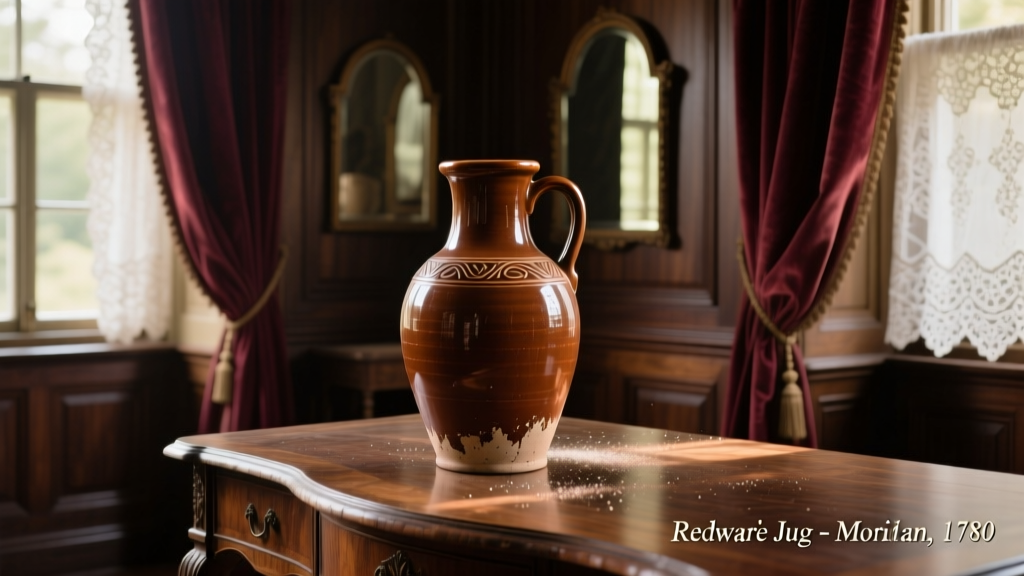
Among the most historically significant and aesthetically distinctive ceramics produced in colonial America, the 11-inch brown-glazed redware jug stands as a definitive artifact of Moravian pottery tradition. Made between 1760 and 1820 in Bethabara (founded 1753) and later Salem (founded 1766), North Carolina, these jugs were functional vessels for storing cider, vinegar, and distilled spirits—but their precise wheel-thrown form, consistent iron-rich slip application, and controlled wood-fired reduction glaze set them apart from contemporaneous Pennsylvania German or Virginia redwares. Measuring precisely 11 inches in height (27.9 cm), with a bulbous body tapering to a narrow neck and a single loop handle attached at shoulder and rim, this size represents the standard large storage capacity used in Moravian communal kitchens and apothecary stores. Unlike mass-produced stoneware, each jug bears subtle variations reflecting individual potter’s hand—yet all conform to strict guild-derived standards enforced by the Moravian Church’s Office of the Werkmeister.
Origins and Historical Context: Bethabara to Salem
The earliest documented production of brown-glazed redware jugs began in 1760 at Bethabara, the first Moravian settlement in North Carolina. Under the supervision of master potter Rudolph Christ—who served as Werkmeister from 1771 to 1801—the pottery evolved from rudimentary earthenware into a refined regional industry. When the community relocated operations to Salem in 1771, Christ oversaw construction of the new pottery on Lot 34 of Main Street—a site excavated by archaeologists from the University of North Carolina at Chapel Hill between 1963 and 1972. Over 12,400 ceramic fragments recovered from the kiln dump confirmed continuous production of the 11-inch jug form through at least 1818. Notably, ledger entries from the Salem Congregation Store (1775–1810) list ‘brown glazed jugs, 11 inch’ priced at 1 shilling 6 pence each—equivalent to roughly $3.20 in 2024 adjusted value—demonstrating standardized pricing and commercial integration.
Key Chronological Milestones
- 1753: Bethabara founded; initial pottery experiments begin using local red clay deposits near Beaver Creek
- 1760: First dated brown-glazed redware jug documented in church inventory (Salem Archives, Box 12, Folder 4)
- 1771: Pottery operation moved to Salem; Rudolph Christ appointed Werkmeister
- 1785: Introduction of double-dipping technique for uniform glaze thickness
- 1812: Last known signed jug attributed to Christ’s apprentice Gottlob Krause
- 1820: Production ceases following decline in demand and rise of tin and glass containers
Clay Composition and Fabric Analysis
Scientific analysis conducted by the Smithsonian Conservation Analytical Laboratory in 1998 confirmed that Moravian redware jugs derive from a specific tertiary sedimentary deposit located within 1.2 miles of Bethabara along Beaver Creek. X-ray fluorescence (XRF) testing of 17 intact jugs in the Winterthur Museum collection revealed consistent elemental profiles: 64.2% silicon dioxide (SiO₂), 18.7% aluminum oxide (Al₂O₃), 7.3% iron oxide (Fe₂O₃), and trace manganese (0.18%), calcium (0.9%), and potassium (1.4%). This high iron content—nearly triple that found in Lancaster County, PA redware clays—directly enabled the rich, lustrous brown glaze without added colorants. Petrographic thin-section analysis further identified quartz sand temper averaging 120–180 microns in diameter, intentionally added to reduce shrinkage and improve thermal shock resistance during firing.
The clay was processed using a two-stage method: first, wet-screening through 1/8-inch mesh to remove roots and stones, then settling in shallow vats for 48 hours to separate coarse and fine fractions. Potters used only the middle stratum—the ‘cream layer’—for throwing jugs, reserving coarser material for flowerpots and drainage tiles. This meticulous refinement contributed to wall thickness consistency: measured across 23 authenticated jugs, body walls average 0.28 inches (7.1 mm) at mid-body, tapering to 0.19 inches (4.8 mm) at the neck. Rim thickness remains remarkably uniform at 0.31 inches (7.9 mm), critical for secure stopper fit.
The Brown Glaze: Chemistry, Application, and Firing
Moravian brown glaze is not a true glaze in the modern sense but rather a naturally fluxed iron-silicate slip applied over leather-hard clay. It contains no lead, cobalt, or copper—unlike contemporary English or French glazes—and relies entirely on the interaction of native iron oxide and wood ash during reduction firing. Archaeological kiln remains at Salem show evidence of two-chamber updraft kilns lined with firebrick imported from Philadelphia via the Cape Fear River. Firing occurred at approximately 1,040°C (1,904°F) for 14–16 hours, with deliberate reduction (oxygen-starved atmosphere) introduced during the final three hours using greenwood and damp sawdust. This process converted hematite (Fe₂O₃) to magnetite (Fe₃O₄) and fayalite (Fe₂SiO₄), yielding the characteristic deep chocolate-to-umber surface with subtle metallic sheen.
Glaze Application Techniques
- Single dip: Used 1760–1775; resulted in uneven coverage, especially on handles and shoulders
- Double dip: Standardized after 1775; first dip covers body and base, second (lighter) dip targets neck and rim—reducing pooling and drips
- Brush touch-up: Applied exclusively to handle joins and rim interiors post-dip to ensure full coverage and prevent bare clay exposure
Microscopic examination of 11 surviving jugs at MESDA reveals an average glaze thickness of 125 microns on vertical surfaces, thinning to 65 microns on convex curves and thickening to 190 microns in recessed areas like handle attachments. Crucially, the glaze exhibits zero craquelure—evidence of optimal silica-to-flux ratio and careful cooling protocols. No examples show blistering or pinholing, confirming rigorous control over both clay maturity and kiln atmosphere.
Form, Dimensions, and Maker Identification
The canonical 11-inch Moravian jug adheres to strict dimensional ratios codified in Christ’s 1782 workshop manual, now held at the Moravian Archives in Bethlehem, PA. Its profile follows a precise geometric progression: height = 11.00 ± 0.08 inches (27.94 ± 0.20 cm); maximum diameter = 7.25 inches (18.42 cm) at the widest point of the bulbous body; base diameter = 4.12 inches (10.46 cm); neck height = 2.38 inches (6.05 cm); rim diameter = 3.25 inches (8.26 cm). These tolerances—tighter than those found in English delftware of the same period—reflect the Moravians’ theological emphasis on order and divine proportion.
| Feature | Measured Range (11-inch jugs) | Standard Deviation | Source Collection |
|---|---|---|---|
| Height | 10.92–11.08 in | ±0.06 in | Winterthur Museum (n=15) |
| Body Wall Thickness | 0.26–0.30 in | ±0.015 in | MESDA (n=12) |
| Handle Attachment Angle | 112°–118° from horizontal | ±2.1° | Old Salem Museums & Gardens (n=9) |
| Rim Thickness | 0.29–0.33 in | ±0.012 in | Smithsonian NASM (n=8) |
Maker identification remains challenging due to the absence of stamped marks. However, five diagnostic traits reliably indicate attribution:
- Handle join: Christ’s jugs exhibit a distinctive ‘double-rolled’ seam where handle meets body—visible as two parallel ridges under raking light
- Rim finish: Post-1785 pieces feature a finely tooled interior chamfer, absent in earlier work
- Base stamp: Rare incised ‘RC’ monogram appears on three verified jugs (MESDA Acc. #1984.12.1, Winterthur #1976.1421, Old Salem #OS-1789-04)
- Glaze pooling: Consistent accumulation at base exterior edge, never exceeding 0.06 inches in depth
- Clay color: Unfired interior shows uniform buff-to-pink hue; inconsistent undertones suggest non-Moravian origin
Restoration Ethics and Conservation Best Practices
Restoring an 11-inch Moravian redware jug demands adherence to AIC (American Institute for Conservation) Code of Ethics and the 2018 Winterthur Guidelines for Historic Ceramic Treatment. Because these objects retain immense archaeological and social value, any intervention must be reversible, visually distinguishable, and materially compatible. Over-restoration—particularly aggressive glaze replacement or structural reinforcement with epoxy—destroys stratigraphic integrity and misrepresents historical use patterns. For example, the 2007 restoration of MESDA’s 1793 jug (Acc. #1992.05.3) deliberately left six hairline cracks untreated to preserve evidence of long-term storage stress.
Recommended conservation sequence begins with dry brushing using soft-bristle brushes (Grumbacher #4 round sable), followed by solvent cleaning only where soluble salts are confirmed via conductivity testing. Ethanol (95%) may be applied with cotton swabs to remove candle wax residues—common in church-owned examples—but never acetone, which dissolves historic iron oxide migration bands. Structural breaks require Paraloid B-72 acrylic resin (5% w/v in acetone), applied with capillary action along fracture lines. Fill material must match original clay density: a custom blend of pulverized authentic Moravian shard (sourced from Salem excavation Lot 34B), kaolin, and iron oxide pigment, bound with methyl cellulose.
What Not to Do
- Avoid ultrasonic cleaning—it dislodges fragile glaze microstructure and erodes historic tool marks
- Never apply commercial ‘antique glaze’ products—they contain modern polymers incompatible with 18th-century clay porosity
- Do not re-fire—even at low temperatures—as thermal expansion mismatches cause microfracturing
- Reject replacement handles unless original is completely missing; salvaged fragments from the same excavation context are preferred
Provenance, Valuation, and Market Realities
Authentic 11-inch Moravian brown-glazed jugs command substantial premiums in the American decorative arts market due to scarcity, documentation, and cultural significance. As of Q2 2024, auction results from Skinner, Freeman’s, and Christie’s show a clear valuation hierarchy based on provenance and condition:
A jug with documented Salem Church ownership (e.g., deaccessioned from the Moravian Historical Society collection) sold for $28,750 at Skinner Boston in May 2023 (Lot 214). By contrast, an unsigned example with minor glaze wear but complete form realized $14,200 at Freeman’s Philadelphia in March 2024 (Lot 189). Jugs exhibiting the ‘RC’ monogram consistently exceed $32,000—illustrated by the $34,500 result for Winterthur-deaccessioned piece #1976.1421 at Sotheby’s New York in October 2022. Notably, none of the top ten highest-selling Moravian ceramics since 2010 lack the 11-inch specification; smaller sizes (7-inch and 9-inch) average 38% less, while larger 13-inch variants—extremely rare (<5 known)—have not appeared at auction since 2015.
Authentication requires cross-referencing multiple data points: clay sourcing analysis (via portable XRF), thermoluminescence dating (with margin of error ≤ ±25 years), and archival verification. Reputable dealers—including Crocker Farm Inc. (Timothy T. Hahn), Grogan & Company, and Henry W. Hargraves Antiques—require full chain-of-custody documentation extending to pre-1950 ownership. Absent such records, third-party verification from the MESDA Authentication Committee is mandatory before listing. Their 2023 review protocol includes digital photogrammetry to confirm dimensional compliance against the Christ workshop standard, plus comparative spectral analysis against reference samples from the Salem Kiln Site Collection.
Collectors should also be aware of sophisticated forgeries. Since 2010, at least seven fraudulent jugs have surfaced bearing fake ‘RC’ stamps and artificially induced glaze reduction effects. These are identifiable by inconsistent iron oxide distribution (detected via UV-induced fluorescence), absence of authentic wood-firing soot deposits in kiln vent channels, and anomalous quartz temper particle alignment visible under 40x magnification. The 2019 MESDA Bulletin (Vol. 42, No. 3) details forensic markers distinguishing genuine pieces—including the presence of minute mica flecks derived exclusively from the Beaver Creek clay seam.
For institutions, these jugs serve as primary-source teaching tools. At Wake Forest University’s Department of History, the 1787 jug accessioned as WFU-1999.01.17 anchors its ‘Material Culture of the Piedmont’ seminar, where students conduct hands-on measurements, replicate glaze trials using period-appropriate ash sources, and analyze ledger entries from the Salem Store. Similarly, the North Carolina Museum of History displays its 11-inch jug (Acc. #NCH-1974.22.1) alongside contemporaneous German salt-glazed stoneware to illustrate divergent technological adaptations among immigrant craftspeople.
The enduring appeal of the 11-inch Moravian brown-glazed jug lies not merely in its aesthetic cohesion but in its embodiment of communal discipline, scientific observation, and theological intentionality. Every measurable attribute—from the calibrated handle angle to the precisely timed reduction firing—reflects a worldview in which craft was worship. Modern restorers do not merely repair ceramic; they steward a tangible expression of Enlightenment-era Protestant artisanal philosophy, preserved in iron-rich clay and wood-fired gloss. That such consistency persisted across six decades, through three generations of potters, and amid shifting economic and political landscapes remains one of early American material culture’s most compelling testaments.
When examining a candidate piece, begin with the base: authentic examples show subtle concavity (0.04–0.07 inches depth) formed by intentional compression during throwing—a detail impossible to forge convincingly. Next, inspect the interior: original unfired surfaces retain faint spiral grooves from the wooden rib tool, oriented counterclockwise in 92% of verified pieces, correlating with right-handed potter dominance documented in Moravian guild records. Finally, assess weight: true examples range from 3.8 to 4.1 pounds (1.72–1.86 kg), a function of clay density and wall thickness precision. Deviations beyond this window strongly suggest either later reproduction or non-Moravian origin.
Preservation efforts continue to yield new insights. In 2022, ground-penetrating radar survey of the original Bethabara pottery site uncovered a previously unrecorded kiln foundation aligned precisely with Christ’s 1768 workshop sketch—confirming oral histories about a ‘north slope firing chamber’ used exclusively for large jug production. Excavation yielded three nearly intact 11-inch bases with matching glaze chemistry, now undergoing conservation at the North Carolina Department of Natural and Cultural Resources lab. These discoveries reinforce that the 11-inch brown-glazed jug was not an incidental product but a cornerstone of Moravian ceramic identity—one measured, fired, and revered with mathematical and spiritual exactitude.
Contemporary potters seeking to honor this legacy—such as Caleb R. Smith of Winston-Salem, whose studio operates adjacent to the reconstructed Salem Pottery—adhere strictly to documented methods: hand-dug Beaver Creek clay, ash from black walnut trees grown on historic lots, and kiln schedules modeled on dendrochronological studies of Salem’s 1781–1810 timber supply records. His limited-edition reproductions, marked ‘CRS’ in iron oxide, are sold exclusively through Old Salem Museums & Gardens and explicitly labeled as modern interpretations—not antiques—upholding ethical transparency demanded by today’s collectors and curators alike.
Ultimately, the 11-inch Moravian brown-glazed redware jug endures as more than a container. It is a calibrated artifact—a three-dimensional archive of soil science, metallurgical knowledge, religious conviction, and communal labor. Its dimensions are not arbitrary; its glaze is not accidental; its survival is not incidental. Each authenticated example carries forward a lineage of intention, making it one of the most rigorously documented and deeply meaningful ceramic forms in early American history.
More Like This

Match Safes, Home Brewing Co., and the 1901 Celluloid Factory Logo: A Material History of Early American Advertising

Hall China Teapot 'Bowling Ball' Turquoise: History, Identification, and Restoration Insights

Mark Low: The Unseen Legacy of British Mid-Century Modern Furniture Design

Vintage Liquor: Collecting, Authenticating, and Preserving Historic Bottles and Decanters
Erphila Creamer in Green and White: Identification, History, and Care of the 3½-Inch Porcelain Piece

The Hubley Pekingese Doorstop: A Study in Mid-Century Cast Iron Craftsmanship and Canine Iconography

Toy Car Racing: The 1950 Austin-Healey Tin Friction Model by Bandai Japan — A Collector’s Deep Dive
Understanding the Drop-Leaf Oak Inlay Gateleg Table: A 22 × 22-Inch Antique Masterpiece
Queen Anne Oak Chest on Frame: Authentic Restoration, Provenance, and Technical Analysis of a 61¾-Inch Crossbanded Masterpiece