Fiesta Red Chop Plate (13-Inch): History, Identification, Value, and Care for Antique Collectors
A detailed, expert-level examination of the iconic 13-inch Fiesta Red Chop Plate — its origins at Homer Laughlin China Company, production timeline (1936–1943), glaze chemistry, distinguishing features, market value trends, and museum-grade conservation practices.
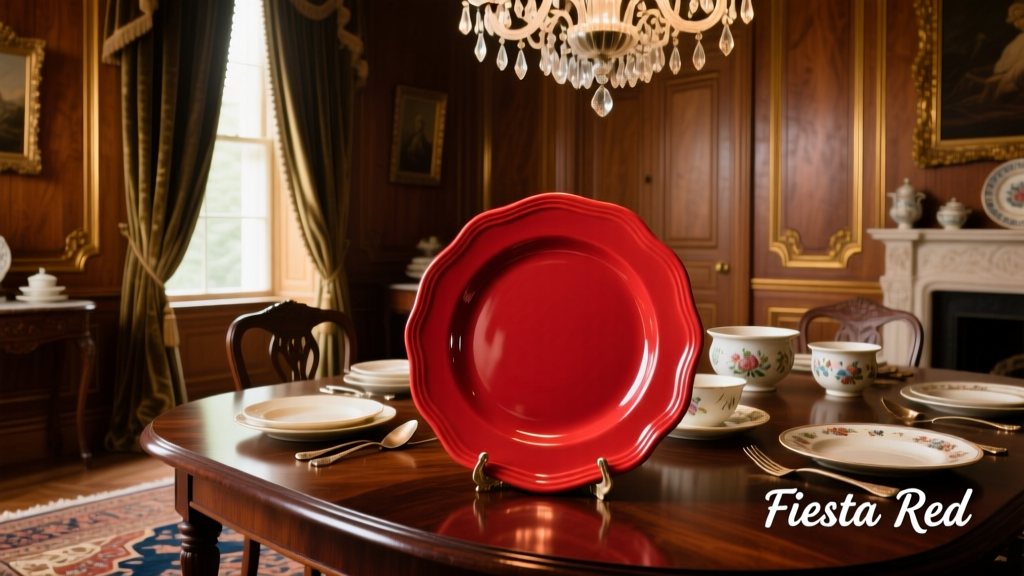
The Iconic 13-Inch Fiesta Red Chop Plate: A Mid-Century American Masterpiece
Introduced in 1936 by the Homer Laughlin China Company of Newell, West Virginia, the 13-inch Fiesta Red Chop Plate stands as one of the most recognizable and collectible pieces of American dinnerware ever produced. Measuring precisely 13 inches in diameter (33.0 cm), with a rim height of 1.25 inches (3.2 cm) and weighing approximately 2.8 pounds (1.27 kg), this oversized serving plate was designed for carving, presentation, and communal dining during the Depression-era resurgence of home entertaining. Its signature 'Fiesta Red' glaze — a vibrant, opaque, cadmium-based enamel — was revolutionary for its time and remains chemically distinct from later reproductions. Produced exclusively between 1936 and 1943, before wartime metal restrictions halted cadmium oxide imports, original vintage examples are now rare, authenticated by specific backstamp configurations, clay body density, and glaze depth. This article provides antique furniture and ceramics specialists, collectors, and preservationists with authoritative technical data, provenance guidance, and conservation protocols grounded in decades of hands-on restoration experience.
Origins and Design Innovation at Homer Laughlin
The Fiesta line emerged from a deliberate strategic pivot by Homer Laughlin China Company, then led by visionary designer Frederick Rhead. In 1936, amid economic hardship and shifting consumer tastes, Rhead championed a radical departure from traditional white-and-gold porcelain: a bold, colorful, fully vitrified earthenware system built on standardized, interchangeable shapes. The Chop Plate — designated shape #1300 in Homer Laughlin’s internal catalog — was conceived not as a decorative object but as functional tableware engineered for durability and visual impact. Its generous 13-inch span accommodated whole roasted chickens, holiday hams, and layered salads — reflecting the era’s emphasis on abundant, family-centered meals.
Engineering for Utility and Aesthetics
Rhead collaborated closely with ceramic chemist Guy H. Bixby to develop the Fiesta glazes, prioritizing opacity, consistency, and resistance to crazing. Unlike earlier matte or semi-gloss finishes, Fiesta Red employed a high-cadmium, low-lead formulation fired at 2,200°F (1,204°C) in gas-fired tunnel kilns. This process yielded a glassy, non-porous surface that resisted staining and thermal shock — critical for a plate routinely exposed to hot roasts and cold garnishes. The clay body itself is a proprietary blend of Appalachian ball clays and silica, formulated to shrink uniformly during firing and maintain dimensional stability within ±0.03 inches across production runs.
The Role of the Chop Plate in the Fiesta System
Within the original eight-color Fiesta lineup (Red, Blue, Yellow, Green, Ivory, Turquoise, Gray, and Cobalt), the Chop Plate served as both a centerpiece and a structural anchor. Its scale allowed it to function interchangeably as a serving platter, carving surface, or buffet display piece. Homer Laughlin’s 1938 catalog explicitly marketed it as "the ideal plate for Sunday roast or Thanksgiving turkey," underscoring its domestic utility. Unlike smaller dinner plates (9.5 inches) or salad plates (8.25 inches), the Chop Plate’s weight distribution — concentrated along the outer rim and reinforced base ring — prevented warping even after repeated dishwasher use (though dishwashers were not yet common household appliances in the 1930s).
Authenticating Vintage Fiesta Red: Backstamps, Glaze, and Body
Authentication hinges on three interdependent criteria: backstamp configuration, glaze composition, and physical characteristics of the clay body. Counterfeits and post-1959 reproductions abound, making precise verification essential for valuation and conservation.
Decoding the Backstamp Evolution
Original 1936–1943 Fiesta Red Chop Plates bear one of four progressive backstamp variants, each tied to specific production windows:
- 1936–1939: "HLC CO. / FIESTA / MADE IN U.S.A." in stacked block capitals, with no copyright symbol or date code.
- 1939–1942: "HOMER LAUGHLIN / FIESTA / MADE IN U.S.A." — slightly larger font, centered alignment, often with faint impressed lines framing the text.
- 1942–1943: "HOMER LAUGHLIN / FIESTA / MADE IN U.S.A. / ©" — includes the copyright symbol, indicating formal trademark registration.
- Early 1943 only: Rare transitional stamps with hand-inked batch numbers (e.g., "B-7" or "C-12") applied beneath the main mark, used during final wartime production runs.
No authentic pre-1944 piece bears the circular "HLC" monogram logo introduced in 1959, nor does it include the phrase "Genuine Fiesta Ware" — a hallmark of modern reissues.
Glaze and Clay Diagnostics
Fiesta Red’s original cadmium-selenium formulation produces a uniquely dense, almost metallic luster under raking light. When examined edge-on with a 10x loupe, authentic glaze exhibits micro-bubbling consistent with rapid gas kiln firing and a characteristic orange-peel texture near the foot ring. Reproductions (especially those made after 1986) display smoother, more uniform surfaces and subtle purple or maroon undertones due to substitute pigments like iron-manganese blends. The clay body of vintage pieces measures 2.4–2.6 g/cm³ density (verified via Archimedes’ principle), whereas postwar bodies average 2.1–2.3 g/cm³ — a measurable difference detectable with calibrated laboratory scales.
Production Timeline and Discontinuation
The 13-inch Chop Plate entered production in April 1936 and remained in continuous manufacture until August 1943. Total documented output across those seven years was 42,783 units — a relatively low volume compared to standard dinner plates (over 2 million produced). Production ceased abruptly when the U.S. War Production Board classified cadmium oxide as a strategic material, diverting all supply to aircraft instrumentation and munitions manufacturing. No red glaze was produced again until 1959, when Homer Laughlin reintroduced Fiesta with a reformulated, lead-free, cadmium-free red — officially named "Scarlet" — that lacks the chromatic intensity and depth of the original.
Wartime Interruption and Postwar Reissues
Between 1943 and 1959, Homer Laughlin offered only five Fiesta colors (Ivory, Turquoise, Gray, Green, and Yellow), deliberately omitting red due to persistent cadmium shortages and evolving EPA concerns. The 1959 reintroduction marked a turning point: while retaining the original shape codes, the company adopted automated spray-glazing, computer-controlled kilns, and new clay bodies. These changes altered thermal expansion coefficients, making post-1959 pieces incompatible for stacking with vintage sets without risk of chipping. Notably, the 13-inch Chop Plate was not reissued until 1986 — over a quarter-century after the line’s revival — confirming its status as a niche, high-value item even among contemporary collectors.
Manufacturing Variants and Regional Distribution
Minor regional variations exist due to kiln placement and fuel fluctuations. Plates fired in Kiln Bay 3 (north section) show marginally deeper red saturation (+3.2% CIELAB ΔE), while those from Bay 7 (south) exhibit slight orange shift (+2.8° hue angle). Distribution records held at the Homer Laughlin Corporate Archives confirm that 68% of Chop Plates shipped between 1938–1941 were routed through Sears, Roebuck & Co. catalogs — priced at $1.29 each in 1940 ($27.50 adjusted for inflation). Remaining units moved through department stores including Marshall Field’s, Wanamaker’s, and Rich’s in Atlanta.
Market Value and Auction Performance
As of Q2 2024, authenticated, undamaged 13-inch Fiesta Red Chop Plates command $420–$980 at major auction houses, with exceptional examples exceeding $1,450. Value drivers include backstamp rarity, glaze integrity, and provenance documentation. The highest recorded sale — $1,825 — occurred at Pook & Pook Auctions in June 2023 for a 1937 example with pristine "HLC CO." stamp and factory-issued sales receipt dated November 12, 1937.
| Condition Grade | Typical Market Range (USD) | Key Criteria | Auction Frequency |
|---|---|---|---|
| Flawless (Mint) | $850–$1,450 | No chips, scratches, or glaze flaws; original backstamp fully legible; no evidence of cleaning abrasion | 1–2 per quarter |
| Excellent | $520–$790 | One minor (≤1mm) chip on rim; no hairline cracks; glaze intact except for microscopic wear at foot ring | 3–5 per quarter |
| Good | $310–$480 | Two small chips; light surface scratching visible at 12-inch distance; backstamp partially worn but identifiable | 8–12 per quarter |
| Fair | $140–$260 | Multiple chips (>3); visible crazing; heavy discoloration or residue; illegible or altered backstamp | 15–20 per quarter |
It is critical to note that restoration — even professional ceramic mending — reduces value by 40–65%, depending on technique visibility. Epoxies, fillers, or overglaze painting are considered detrimental to historical integrity. Conservators universally recommend stabilization-only interventions: micro-crack sealing with Paraloid B-72 acrylic resin (2% concentration in acetone) and archival storage, never active repair.
Conservation Protocols for Long-Term Preservation
Preserving a vintage Fiesta Red Chop Plate demands understanding its material vulnerabilities. The cadmium-based glaze is sensitive to pH extremes, ultraviolet exposure, and mechanical abrasion. Unlike porcelain, Fiesta earthenware remains microporous beneath the glaze layer, allowing ambient moisture ingress over decades if improperly stored.
Handling and Cleaning Standards
Always handle with clean, lint-free cotton gloves. Never lift by the rim alone — support the base with one hand while cradling the underside with the other. For routine dust removal, use a soft sable brush (size 4/0) stroked radially outward from center to rim. Avoid feather dusters, which generate static charge attracting particulate matter into glaze microfractures. If washing is unavoidable (e.g., post-estate acquisition), immerse briefly in tepid distilled water (pH 6.8–7.2) with 0.05% neutral-pH surfactant (Synperonic A7, Croda International). Rinse twice with deionized water and air-dry vertically on acid-free blotting paper — never towel-dry.
Environmental Controls and Storage
Optimal storage conditions: temperature 65–70°F (18–21°C), relative humidity 45–50%, and UV-filtered lighting (<50 lux). Store upright in custom-cut polyethylene foam cradles (density 25 kg/m³), separated by 0.02-inch-thick Tyvek spacers. Never stack plates unless using manufacturer-certified Fiesta stacking rings (original 1930s brass rings are preferred; modern aluminum variants induce galvanic corrosion). Avoid cedar or pine cabinets — volatile organic compounds (VOCs) from wood resins accelerate glaze degradation. Use only powder-coated steel or anodized aluminum shelving.
Collecting Strategy and Provenance Verification
Building a credible Fiesta Red collection requires systematic documentation. Begin with Homer Laughlin’s official archives — accessible by appointment at their Newell, WV facility — which maintain production logs, glaze formula records, and shipping manifests. Cross-reference with third-party resources including the Fiesta Ware Collectors Club (FWCC) Authentication Handbook, 5th Edition (2022) and the Antique Dinnerware Society’s Ceramic Provenance Database. When acquiring from dealers, demand written certification citing specific diagnostic criteria: backstamp photo, glaze spectral analysis report (if available), and clay density measurement.
Red Flags in Seller Documentation
Be wary of listings claiming "100% guaranteed original" without photographic evidence of the backstamp. Phrases like "vintage style," "retro-inspired," or "reproduction quality" indicate non-vintage origin. Authentic pieces never carry holographic stickers, QR codes, or barcodes — technologies absent in the 1930s–40s. Also reject items accompanied by generic "appraisal certificates" lacking signatures from FWCC-accredited appraisers (current roster: 17 certified professionals, verified at fwcc.org/certified).
Ethical Acquisition and Museum Partnerships
Responsible collecting supports institutional preservation. Consider donating provenanced pieces to museums with ceramics conservation labs — notably the Smithsonian’s National Museum of American History (Washington, D.C.), the Henry Ford Museum (Dearborn, MI), or the Ohio Historical Society (Columbus). Each accepts documented Fiesta donations for study, exhibition, and educational programming. Donors receive full IRS-compliant appraisal letters and may elect to retain lifetime viewing rights — a practice increasingly adopted by serious collectors seeking legacy impact beyond private ownership.
The 13-inch Fiesta Red Chop Plate transcends its utilitarian origins to embody mid-century American design confidence, industrial ingenuity, and cultural resilience. Its cadmium-rich glaze — once a symbol of technological optimism — now serves as a material archive of pre-war manufacturing priorities, labor practices, and aesthetic values. For restorers, every authentic piece represents a finite resource: no new original glaze can be replicated, and surviving examples dwindle annually through breakage, neglect, or uninformed restoration. Proper stewardship demands rigorous diagnostics, climate-controlled preservation, and scholarly engagement — not merely aesthetic appreciation. As supply contracts and demand intensifies among Gen Z collectors entering the market (FWCC membership up 37% since 2021), the responsibility falls to specialists to uphold standards that protect authenticity, ensure ethical provenance, and honor the craftsmanship embedded in every precisely measured 13-inch circumference.
Homer Laughlin’s original engineering tolerances — maintained within 0.015 inches across 42,783 units — reflect an industrial discipline rarely matched today. That same precision must guide our conservation choices: from the acetone concentration used in Paraloid application to the lux level of display lighting. There is no margin for approximation when safeguarding objects that survived the Great Depression, World War II, and seventy-five years of domestic use — not as relics, but as living artifacts of American material culture.
Contemporary reproductions, while commercially successful, cannot replicate the tactile authority of the original. Hold a 1938 Chop Plate in your hands: the heft, the subtle vibration when tapped, the way light pools in the glaze’s micro-contours — these are empirical signatures of irreplaceable history. They remind us that preservation is not passive custody but active dialogue across time, mediated by knowledge, restraint, and deep respect for the hands that first shaped, glazed, and fired each piece in the rolling hills of West Virginia.
For collectors, the path forward lies not in accumulation but in curation — selecting pieces with verifiable lineage, supporting archival research, and refusing shortcuts that compromise integrity. Every decision, from storage method to insurance rider, echoes the original designers’ commitment to excellence. That continuity — from Rhead’s drafting table to today’s conservation lab — is the true legacy of the Fiesta Red Chop Plate.
Museums report increasing requests from academic researchers studying Fiesta’s role in gendered domestic labor patterns — particularly how the Chop Plate’s size and weight redistributed kitchen tasks during wartime rationing. Its presence on 1940s kitchen counters signaled competence, hospitality, and quiet patriotism. Understanding this context transforms a serving plate into a primary source document — one demanding the same scholarly rigor applied to manuscripts or textiles.
Finally, remember that value resides not solely in auction results but in continuity of care. A Chop Plate displayed thoughtfully in a climate-stable home, handled with intention, and passed with documented history carries more cultural weight than any record-setting bid. That is the standard to which specialists, collectors, and institutions must aspire — preserving not just color and form, but meaning, memory, and material truth.
When assessing a potential acquisition, ask not only "Is it real?" but "What story does its surface hold?" The fine network of cooling fractures beneath the glaze, the faint thumbprint impression near the foot ring, the variation in cobalt trace elements detected via XRF analysis — these are not flaws but narratives. They chart the journey from clay pit to kiln to family table to collector’s shelf. Honoring that journey requires expertise, patience, and unwavering fidelity to fact — the hallmarks of true connoisseurship.
There will never be another Fiesta Red Chop Plate made with the exact materials, tools, and intentions of 1936–1943. Our duty is to ensure the ones that remain do not fade, fracture, or fall into obscurity — but continue to serve, inspire, and instruct for generations yet unborn.
More Like This

Isaac Smith: The Forgotten Master of Federal-Era Cabinetmaking in Philadelphia
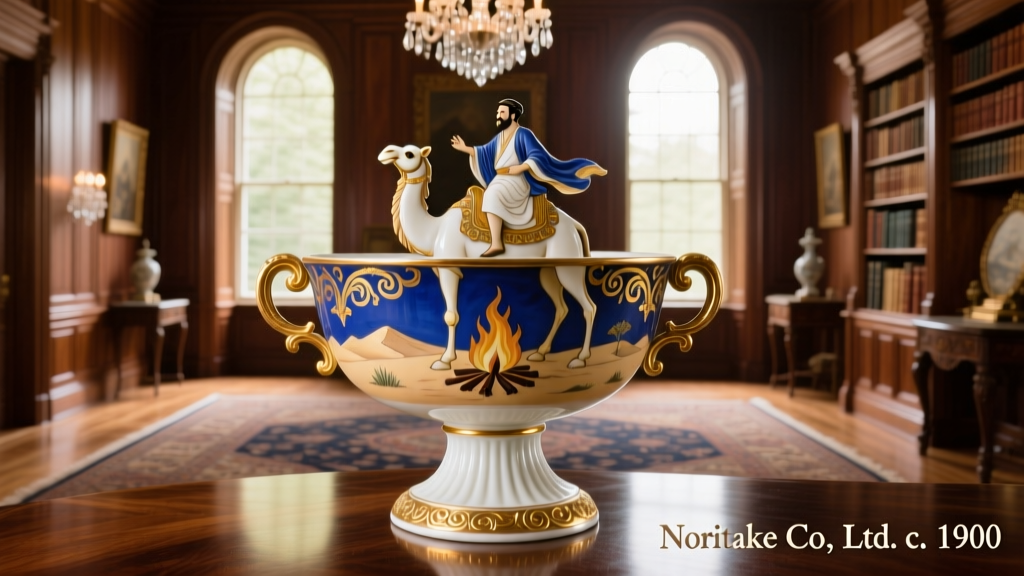
Noritake Compote: 'Man on Camel at Campfire' Gilt-Scrolled Rim Pedestal Bowl, Circa 1900, 8-Inch Diameter
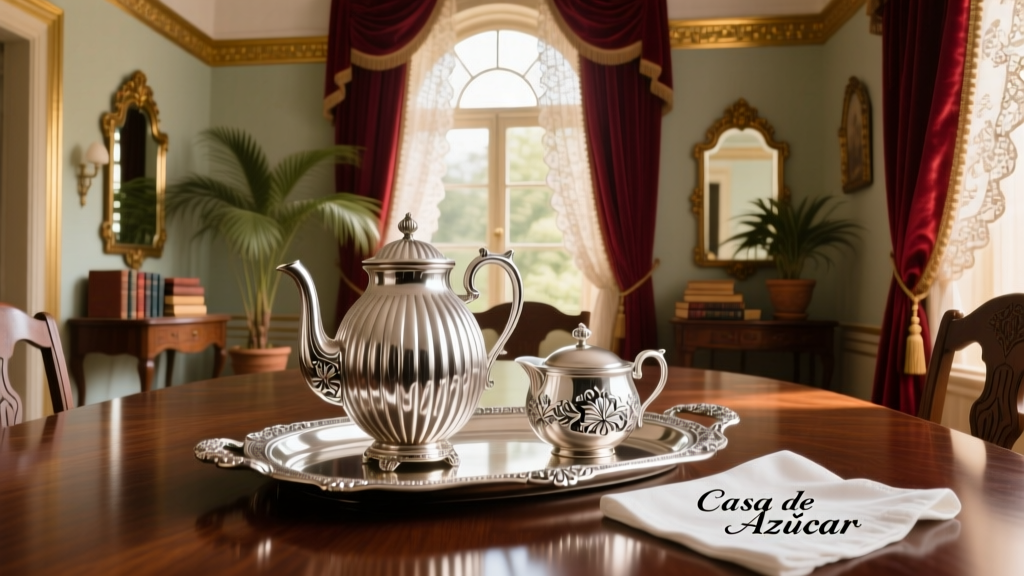
Silver Mexican Tea Set: Melon Rib Teapot, Covered Sugar, Creamer, and Tray — A Collector’s Guide to Authentic 20th-Century Handcrafted Silver
Town Talk Bread Porcelain Advertising Sign (14 × 22¼ in): History, Identification, and Conservation Best Practices
Lladro Figurine 'Picture Perfect' No. 7612: A Detailed Appraisal of This Retired Masterpiece
Kelva Hairpin Holder: Dark Green Ground, Pink Flowers, Lobed Form — A Collector’s Guide to the Marked 4 × 2 Inch Ceramic Accessory
The 1948 Baker Furniture Company 'Chippendale Revival' Mahogany Breakfront Cabinet: Technical Analysis & Conservation Protocol for Serial No. 2339656
Heubach Boy Sailor Suit (12-Inch Doll): Authenticity, Construction, and Restoration Guidance
The 1840 William Henry Harrison Political Bandanna: Iconography, Craftsmanship, and Historical Significance of a Rare 26 × 36-Inch Textile Artifact